Anyone else finding game preparation really hard work?

By UniversalHead, in WFRP Gamemasters

I'm curious how other GMs feel about the subject of prepping for your games. Recently, I've been finding the prep of our infrequent games pretty exhausting, on a par with preparing for a big exam. I do tend to be a perfectionist of course, and probably spend far too much time on it, but there seems to be something particularly difficult about the whole process. I enjoy the game itself, but am starting to begrudge the time it takes up between games.

Perhaps there's less detail in the published adventures, perhaps the game is just much more complicated than previous versions (too much choice?) Hell, perhaps I'm just getting old and my imagination is drying up.

If I happen to whinge to my players a little, they say 'wing it more', but I'm 90% sure it's the extensive prep I do that makes the games so enjoyable for them.

So what do you lot do? Wing it, prepare until you're exhausted, or somewhere in between? Discuss. :)

Ah GM burnout - it threatens.

I was on the edge coming into Warhammer and played mostly published or converted from earlier edition until recently.

If find Warhammer much much less work to prep for, and run, than D&D 4th edition (what I was playing/running before).

I think you need to enjoy prep, figuring out who/what/why/where of things, for itself. That said, there is always a danger of over-prepping things - there have been useful threads about this on various message boards about "efficient design".

Read books, see movies, play other games to get idea and work your mind in different ways as well as relax. Avoid video games and other "stimulant" type activities that draw energy but don't require imagination. I kid you not that some basic yoga posture to releive stress that my wife taught me has helped me get stuff out of my system to work on games or do other things.

There is some not bad advice in one of the GM books about looking through location and item cards etc to just pick out a few that spark you, fit with the germ of an idea you have or give you one. Add in some critters, either bringing back a recurring villain or something new this time (e.g., I decided to find a way to fit forest spirits into adventure I pretty much finished writing today simply because they would be something new after goblins, beastmen, undead, cultists).

It's 4700 words (a "situtation ready to explode with a few "proto scenes" to then be played as it develops) and took about 4 days while I was on vacation and doing other stuff. That's about what my home brews that are one or two "episodes" (sets of 3 acts) - 4000-5000 words. Who Doesn't Like Pie, the Return of Krokarg that you can see play reports on in the boards.

The one I was to start running tonight is 12,000 (murder mystery, lots more notes) took almost a month as there's more weaving together etc. (game night cancelled due to colds and such).

Well, that amount of prep fills me with pure horror! You're doing a lot of work there. I'm just playing the published adventures and I find myself with hours and hours of work to do; I shudder to think of the effort involved in coming up with stuff from scratch.

There seems to be so much to keep track of in this new edition, but it's interesting that you find D&D 4thEd even more work. Last time I played D&D was way back in the Advanced D&D days, and it was pretty easy.

demonio.gif

I have generated sheer horror! Excellent, despite my game night being cancelled my work is done!

That is part of what I meant by "you have to like it". I don't find it that hard because I enjoy it. If I'm not "in a place" to enjoy it, I don't do it. I read most of a book of Cthulhu stories at the same time, and have some Dying Earth to read next (Dying Earth meets Cthulhu is sort of my view of Warhammer)

I generally putter at my laptop while TV plays. My sweety is a teacher and spends much of evenings putting on school work beside me.

"Play Unsafe" by Graham Whalmsley is a good source of ideas for improvising and being creative - using reincorporation, establishing norms to tilt, don't be afraid of being predictable at times, listening to players and "saying yes" to them - people often play wanting the old house to be haunted, it fulfills expectations. I keep everything I've done so the progress track not used in that adventure is reskinned and used in another (the Gathering Storm cutting a swath through zombies in Morr's garden shall become Cutting a Path Through the Angry Forest in the adventure with forest spirits).

The mechanical part of all this is pretty easy - the Guard Captain, well he's a Soldier with some upped stats and improved block etc. I spend more time trying to ensure player hooks and past elements are worked in.

D&D 4e encounter are like amusement park rides to lay out. I find warhammer more like cooking by instinct. I don't find using the all stuff and working it in etc. difficult.

On a related point, I have been thinking that people who do their own 3rd edition adventures need to start putting them up online and sharing them the way so many earlier homebrews were.

That's actually quite inspiring, thanks valvorik! And amusing - your partner preparing schoolwork while you prepare WFRP is hilarious; don't get 'em mixed up now! :)

I'll read that book you mention and try some different approaches. I think, after some 30 years of occasional GMing, I may be putting too much emphasis on my lovely perfectly-designed reference notes and cards and too little on exploring the flair and fun of RPGing that got me into it in the first place all those years ago. More instinct and fun, less hard work I think.

Huge fan of the Dying Earth books here too.

Thanks mate!

I finally got to run a session and didn't use any of the released adventures, just my own short introductory adventure. Even though I was worried, I found the game easy to run as a GM. Since it was my first time, I had to flip through a book a couple of times (index was nice) and look over my cheat sheets. I can imagine that later I won't have to do that as much, perhaps hardly at all. I did have various cheat sheets to help, some made by others, some by myself. I also had the official GM Screen (didn't use it so much) and the creature vault.

I've dumped the purchased campaigns and like Valvorik I think 3e is easier to prepare for then D&D. For my next adventure, I only have a sheet of paper of hand-written notes to remind me of what will happen next. I will have the Creature Vault cards set out for any planned combat encounters. I do have my own creature card sheet to lay them upon that was helpful last adventure. With abstract movement, I'm using over-sized location cards to place the official stands upon to show distances from each other. Abstract movement is where I'm really saving time - no need for me to spend hours drawing out maps on 1" square paper.

I may be a little early in deciding, but 3e may have less prep time of any RPG I've GM'd yet. I must admit there was a massive amount of pre-campaign prep time learning rules, collecting official products, making my own cheat sheets, and choosing cheat sheets others have made. But, with that done, all I really need to do now before each session is use my imagination to form the next adventure then pull out the appropriate cards for NPCs and Locations.

UniversalHead said:

That's actually quite inspiring, thanks valvorik! And amusing - your partner preparing schoolwork while you prepare WFRP is hilarious; don't get 'em mixed up now! :)

Well she's never used my gaming stuff in her classroom, but the two stuffed dogs she used as part of creative writing (Grade 2 French immersion) - Coco and Roshnee - did inspire 2 warhounds in a session I was running. The players were quite amused when the villain cried out, "Attack Coco!", though less amused when Coco actually appeared and tore into them, and when they killed Coco and Roshnee the villain wailed and cursed them promising doom (and of course then got two other hounds also naming them the same). You can kill all the nameless minions you want but when you kill Coco and Roshnee, now it's personal.

Somehow the villain having pets with those names also made him more "real".

Rob

I just wing it.

I've Tome of Adventures and GM's toolkit handy but the players do not know if I look at them for stats or not. I now it's a bit dull but I didn't even get myself to read through the posts above...

I find preparing for WFRP 3 VERY easy when using the official scenarios.

  1. I read the scenario (or all the scenarios involved in my campaign, which is all released 3rd ed. material for my new one)
  2. I make a document where I write down my first impression ideas and make a over arching plot for the entire campaign. This took me about three to four hours for the whole campaign.
  3. For each individual play session I do the following:
  4. Read the scenario again.
  5. Find all NPCs in my stack of NPC card and put them into my binder with all their actions. I bought the vaults so I have extra player actions for the NPCs. I have a binder that holds 9 cards on each sheet and that is really enough for all NPCs. They can still use basic actions of course.
  6. Find relevand NPC standups for the session.
  7. I prepare any custom handouts I feel add to the session.
  8. Generally my preparation for a 10 hour session is about one hour.

It's wonderfully easy now that I have found a good system for preparing. If I feel a certain NPC needs to be tougher than the general Soldier for instance, I just give him more ACE, giving him training in weapon skill and select some great actions for him. WHen selecting actions I try to keep it simple and just select two or three extra actions that give the NPC a certain style. I don't overthink it. I don't spend more than 5 minutes selecting actions and giving ACE/skill for each NPC. I have a general goal that says it can only take an hour for the preparation (plus reading the scenario again). But even with 10 hour sessions a scenario from the expansions take about 1½ session, so some of the preparation carries over.

I've been GMing non-stop since 1981 (I started Gming when I was 9).

I rank prep time as follows:

1st Place: (Easiest): Pathfinder/D&D Convention Scenarios :

  • scenarios are straight forwards (Railroads that the GM can add-depth to)
  • scenarios have nonsense crunch removed and are edited down to "only what you need to survive to run the scenario". Authors aren't paid by the word.
  • The scenarios are extensively playtested.
  • scenarios have read-aloud text and GMs text clearly organized
  • skill checks and other things are clearly BOLDED
  • Handout timing is labled "Give players Handout 1"
  • the beginning of the scenario has a clear, concise, "how the adventure is expected to play out" adventure synopsis . The adventure synopsis is sometimes numbered, leaving an instant Table of Contents for sections.
  • Sections/encounters are numbered, which promotes ease of reference.
  • maps are plain and simple and included in the scenario (not as a seperate download or worse..on a card imo)
  • paper has margins where I can write stuff
  • The backgrounds are concise. Rather than reading a fricking novel to find out the history and motivations of the BBEG/boss man, it's there plain and simple.
  • They are designed to be played in a single game session (3.5 hours)
  • no new rules are introduced, handouts are clearly marked in the text and placed in a neatly-organized appendix,
  • the monsters are referenced or clearly stat-blocked in a single location and a specific reference page is given for monsters or rules needed. E.g. (3) Bugbears, see Monster Manual p.146
  • Weaknesses: some GMs have trouble coming up with side plots for railroad scenarios when not running them at conventions. The writing isn't always all that inspiring.

2nd Easiest - General Pathfinder/D&D (ed. 1-3)-

  • Very similar to the above, except not designed to be run in 4 hours.
  • Scenarios are mind-numbingly simple: Throw a bunch of monsters at the PCs and let them go room to room.
  • Monsters are referenced on a single page or stat block reference WITH A PAGE NUMBER to the monster manuals.
  • Prep = Read the synopsis, look at the map, circle the AC, HP's, attack bonus and anything else that makes sense and go.
  • These are easy mostly because D&D scenarios typically lack any roleplaying beyond "we kill them and take their stuff."
  • The "adventure path's" make the GM's campaign prep much easier both in the short term and obviously because they are campaigns from Levels 1-20. In WFRP terms that would be like from Rank 1-6.
  • These scenarios were perfected through years of DUNGEON magazine feedback and regular work-ups. I cannot deny that they (Dungeon Magazine scenarios in the past 10 years) have become the best layout and design, even for investigative scenarios.

3rd Easiest - Savage Worlds One-Sheet Scenarios:

  • If not for the fact that you're making a lot of stuff up, the reference is very easy. It is the epitome of the Adventure Synopsis that makes my #1 above so easy to run. Lack of concrete details makes the GMs job harder.

4th Place: WFRP (3e) - Time-Consuming:

  • Scenarios involve complex plots with multiple NPC motivations.
  • Scenarios tend to be investigative rather than dungeon crawl, requiring GM to have easy reference to the clues and motivations (these are not always made clear in WFRP scenarios and this would help).
  • Monsters that are not well-referenced on a single page and INITIALLY finding monster cards is a prep burden.
  • The disconnect between cards and text references makes for another burden.
  • There tends to be a lot of unnecessary text. There tends to be a lack of clearly organized author-proposed flow (meaning they tend to be "supplemental-information-style" rather than "#1 at the top, which tends towards railroad."
  • The maps are oftentimes piled into another pile of cards, sheets and other crap instead of just being in an appendix in the scenario.
  • There seems to be this mentality for WFRP that you must just get a pile of disorganized information and as the GM, you're required to figure it out and put it together. This makes prepping WFRP scenarios more work than should be necessary and is a direct cause of GM burnout. A sure fire way to destroy a game product is to cause GM burnout with your organization.
  • The lack of grand campaigns: Another Enemy Within, Thousand Thrones, etc scenario bundle would really help the GM..and for a longer time.
  • SOLUTIONS: You've simply got to do the extra legwork for these scenarios: Youve got to create your own advnture synopsis, you've got to write in your books, you've got to use post-its, and you've got to spend a lot of extra time (plan for it) doing planning and prep.

5th Place: Call of Cthulhu - Most Time-Consuming:

  • Scenarios involve complex plots and the scenarios are long, requiring rote memorization of obscene amounts of text.
  • Layout tends AWAY from convenience, and more towards newspaper-research-"presentation"
  • There are not good references back to the books.
  • HATE prepping CoC scenarios unless they are CoC Convention scenarios (in which, they are actually fun to prep).

jh

I should clarify that my times above and thoughts about it being "easier than D&D" are for homebrew or extensively adapted scenarios.

re Jay's thoughts on Warhammer, I agree a dungeon crawl is easier to prepare for using D&D's information formats than any of the more significant pre-written warhammer adventures. To the extent FFG adventures include monster stats and actions printed they make it easy, to the extent they rely on GM's using existing cards it's a bit more challenging.

For Warhammer 3 existing adventures, what I tend to is much what I do for Cthulhu scenarios (though I use Cthulhu Dark not Call of Cthulhu):

- make sure I have a timeline of past and future "default" events if heroes don't intervene (for adventures like Horro of Hugeldal, Gathering Storm or Witch's Song this is important when peope start investigating, looking for witnesses etc.)

- make sure I have a flowchart and know "which scenes/acts are optional vs which are (a) plot critical or (b) just so much fun they should happen if at all possible. For the plot critical, figure out "what makes them so" (e.g., is it that a particular item or piece of informatin shows up) so I can wing it if a player choices and actions somehow duck around the scene.

- if it's not clear from the information above (often it is implicit by this time), relationship/objective off key NPC's (usually not a relationship map literally but amounts to same thing), again so I know how they will react and can manage them if the adventure moves away from pre-potted scenes.

I do the same with earlier edition warhammer (1000 Thrones for example, I really need those things for that monster).

Most of the rest of my prep is adaptation to fit into the personal story lines of my PCs and creating visuals and hand outs. My Cthulhu prep gets more elaborate there than Warhammer as I'm doing up front pages from the Arkham Advertiser, making Strange Eons standups of the NPC's. Though Cthulhu Dark is a very light system, I find Cthulhu prep more challenging because I'm working to be "lovecraftian but not recycled" whereas with Warhammer I'm more "embrace the tropes and have fun with them, just putting twist on them from time to time".

For 3rd I find myself re-writing the published material into my own notes to the point where in conjunction with the npc reference cards I don't refer to the ffg published book at all during the session. I do this for a few reasons, firstly I avoid reading out "read aloud" text directly but instead change it into bullet pointed notes so that when I am winging it my players a bit more my style of descriptions and language remain the same whether they are on track or down a blind alley

I also find with 3rd ed publIshed materials that ffg put info in high light boxes and the like which can make info difficult to find in the heat of the moment and can involve flickIng around trying to find for instance what the official penalty for darkness is...So I add those penalties into each section of my notes where they might be applicable

So this is a fair amount of prep, but I enjoy doing it which is key as others have said.i also agree that the non linear and relatively complex adventures ffg produce make more prep necessary but that isn't a critiscm

As Pumpkin says: I spend a lot of time writing bullets on post-it notes that I margin into the books. Sometimes I just call it quits and write in my books, but I hate to have to do that. I prefer more GM-friendly formats.

Other things that I usually work up:

* Peasant names and 'one memorable thing' about each person. It's one thing to have a name. It's another to give them a memorable trait.

* I combine in recurring NPCs and rumors from before. Rather than just recap, I oftentimes have NPCs in whatever bar they're in recite things like, "Oh, so you guys were the ones who uncovered that the high priest of ulric was really a camp following lycanthrope!"

jh

UniversalHead said:

I'm curious how other GMs feel about the subject of prepping for your games. Recently, I've been finding the prep of our infrequent games pretty exhausting, on a par with preparing for a big exam. I do tend to be a perfectionist of course, and probably spend far too much time on it, but there seems to be something particularly difficult about the whole process. I enjoy the game itself, but am starting to begrudge the time it takes up between games.

Perhaps there's less detail in the published adventures, perhaps the game is just much more complicated than previous versions (too much choice?) Hell, perhaps I'm just getting old and my imagination is drying up.

If I happen to whinge to my players a little, they say 'wing it more', but I'm 90% sure it's the extensive prep I do that makes the games so enjoyable for them.

So what do you lot do? Wing it, prepare until you're exhausted, or somewhere in between? Discuss. :)

UniversalHead said:

I'm curious how other GMs feel about the subject of prepping for your games. Recently, I've been finding the prep of our infrequent games pretty exhausting, on a par with preparing for a big exam. I do tend to be a perfectionist of course, and probably spend far too much time on it, but there seems to be something particularly difficult about the whole process. I enjoy the game itself, but am starting to begrudge the time it takes up between games.

Perhaps there's less detail in the published adventures, perhaps the game is just much more complicated than previous versions (too much choice?) Hell, perhaps I'm just getting old and my imagination is drying up.

If I happen to whinge to my players a little, they say 'wing it more', but I'm 90% sure it's the extensive prep I do that makes the games so enjoyable for them.

So what do you lot do? Wing it, prepare until you're exhausted, or somewhere in between? Discuss. :)

Forgive me if I am wrong. Because of the nature of WFRPv3 and the nature of your creativety, Univdersal Head, this games brings out the game designer AND the graphic designer in you. It inspires you to recreate and extend and customise, but the the intention of the tools is to short cut you having to do all that ( your group ain't paying you ;) ).

I would advise being a little lazy and use what comes in the box as is. Use the defaults. Don't tweek encounters and stay well away from your graphics work station. It will free your energy up to 'play unsafe' and tweek on the fly in response to the players.

God bless Graham Whalmsley.

Wow - you guys make me feel like a complete slouch!

I've run entire campaigns without bothering to even think up the stats of a single NPC... The simpler the system you're using, the easier this is, as it's easy to judge whether the opponent is at/above/below average and roll 2/3/1 dice respectively. Although I get players to roll plenty of dice, I rarely do so myself, and am quite comfortable allowing single rolls to paint quite broad brush pictures; this is something the WFRP 3 system lends itself to quite well. (i.e., I'm quite happy telling each player to make a single attack roll, and on the basis of their results, I narrate the entire battle - allowing them to contradict me if they want to react to events differently to how I'd expect).

So that considerably cuts down on prep time! That said, I do spend quite a lot of time thinking about the story, timelines, NPC motivations etc, and making notes and charts so that I know what's going on, and then wing how this gets altered according to the players' actions.

Something else that helps me with this, is that I run quite a relaxed and slow game, with plenty of in-character chatting and plenty of description of places, people, smells, etc. (Although I try to be careful to allow players to interrupt me at almost any time to minimise the danger of me boring them.) What this means is that if the players do something that throws a spanner in the works, the session will normally end before too much in-game time has passed and it has become too apparent, and I've then got time to work out how NPCs will change their plans, and work out what type of scenes/events may need to take place in the next session (and which I hadn't originally considered being necessary). i.e. a typical game session will cover a day or two of plot, rather than several weeks. Not many PC actions - even those with dramatic knock-on effects - will change everything in 24 hours.

Here's one actual tip: quick and dirty NPCs... following on from Emrikol and peasant characteristics. One way of creating a personality is to take the personality of someone you know (even if not well), and use their most obvious traits to characterise the NPC.

eg. PCs are arrested by a guard and introduced to the captain. What sort of guy is he?

Quick think about someone I know - let's say my secondary school teacher: neither clever nor dull, moderately friendly but kind of annoying, supposedly having an affair with another one of my teachers, seems like someone who drifted into her job without giving it much thought.

S o; the captain in his raspy voice addresses the PCs in a disinterested manner. He seems to be asking some reasonable questions, but will not necessarily notice small holes in their cover story, and if they think quickly and blather well, then they can run rings around him. He'd like to wrap things up as quickly as possible, as he wants to get out of the watch post in time to see his mistress before he heads back home. There we have it - a 'fully developed' NPC personality in a few seconds.

The important point here is not to accurately try to capture a real person, but to use them as inspiration you need to give them a personality, and you, the GM, the confidence in playing the character consistently. The process of turning a real into into a watch leader often creates a new NPC, who can then become a recurring character if needed.

There's some really useful info here and I'm glad I've started some discussion. We played again after a bit of a break last night. Had a great time, but it struck me again how much time we all, players and GM, have to spend looking over little cards sorting out which dice pool modifiers to use. And this is even with some pretty comprehensively-designed combat reference and fatigue/stress reference cards I've made. I think my players, on the whole, preferred WFRP2 to WFRP3, despite there being some really nice cinematic elements to WFRP3.

I definitely spend too much time making my reference materials looking like professional ones (curse of the obsessive graphic designer), though they're all designed to save me time and interruptions during the game (see for example the combat dice pool already calculated). I do feel, however, that there are many elements to the system that could do with some serious cleaning up. The adventures, as someone pointed out, are written in a confusing manner. Take The Edge of Night : there must be at least four points in the book where the three main noble characters are described; each adding different bits of information. The layout of that adventure in particular is probably the worst so far. Some minor things are descibed in detail, while some major elements (the way the influence system works at the Masquerade, for example), are given only a cursory description.

I also have always maintained that the Creature Guide system is a bloody mess. If only they'd kept with the simple layout established in Tome of Adventure. Even with my combat reference sheets (see below), you have to juggle that, plus the relevant action cards, plus the basic actions, putting recharge actions on them as well.

I'm beginning to contemplate ways to simplify things, which is a bit of a shame. The Party Sheet will be the first to go - after 14 or so sessions we still never remember to use the **** thing, except perhaps for an occasional Talent socketed to it.

I love the basics of the system, I just think there are too many cards and modifers and fiddly rules. It's a shame it didn't go through a serious streamlining pass, IMHO.

I do admire you guys who manage to wing it though. Must be far more relaxing!

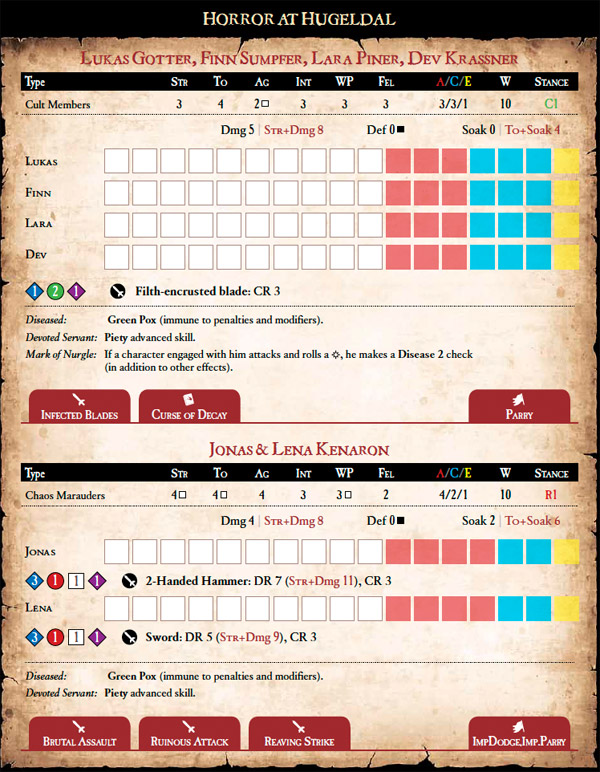
iPad reference sheet (boxes are form elements that can be ticked off)

WFRP_ref1.jpg

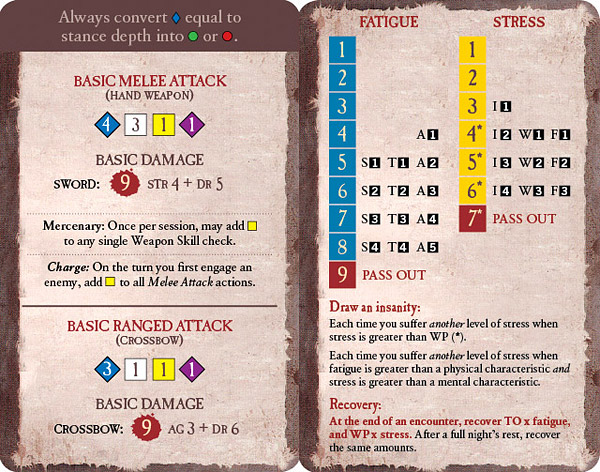
Two of my player reference cards designed to speed up things for them:

WFRP_ref2.jpg

Wow; they're beautiful!

But my eyes still glazed over as I glanced over them... No wonder it's taking you so long to prepare! In my opinion, you shouldn't need to consult charts for modifiers to work out what dice to add. Make it up on the spot. If a player thinks its odd that he's not getting a penalty for the dark, or a bonus for his high ground (that you forgot all about); he'll mention it, and can add the die to the pool himself. If the player forgets too, then who really cares or notices?

I do think your summary of player attack information is useful, but I'd still only use something like that if someone else made it for me, or there was a simple version to print off and fill in the gaps.

Have you considered just using the Creature Vault cards as they are? It may be worth your time to move off the iPad and into the cards.

... though, as one designer to another, your sheets look wonderfully functional.

EDIT: (Of course, it's hard for me to talk when I'm currently spending a so time on map-making. I feel ya.)

Those sheets look really nice!

That said I track wounds and A/C/E on paper like this

Orc1 Hits A/C/E

16 4/1/2

13 2/0/1

etc.

I just ready a piece of paper for each combat where I scribble the starting values and make enough room for writing. I put critical wounds on to the side for reference.

It's super fast and takes one minute tops to set up :)

Your work does look beautiful, but I don't have the skills to do that. If I had I could be in the same bind as you :D

Think effectively. Everything that can easily be done with pencil and paper... keep it to pencil and paper. I write notes down during sessions on paper and use them to update the campaign notes later. I do track everything very precisely though, so it's not like I'm a slacker - but most of my time goes into:

1. Read the scenario and think about running it. (1-2 hours - depending on lenght of course - second reading)

2. Making notes for alterations depending on the campaign progression (15-25 minutes)

3. Setting up NPCs (creature/action cards and standups) (20-40 minutes)

4. Preparing stuff for tracking (2-5 minutes, but always do it before the session anyway).

About the reading of the scenario. I always read the entire campaign and all the scenarios in it before I start. Then I create my campaign notes. Reading the entire campaign takes as long as it does, no cutting corners there. Making my campaign notes (that are altered, modified and added to durring the campaign) takes anywhere from 2 hours to 5 hours. The bulk of the work is done in one sitting over a weekend usually (although it did take me a bit longer to read TTT and since I had to convert everything it took longer).

I can't find those sheets on your site :(

Sorry, I can't make them available due to FFG/GW copyright crap.

It's funny hearing from you guys who just scribble notes on a sheet of paper - you probably are doing things a lot faster and having more fun preparing! I just can't help myself in some crazy quest for total visual efficiency (I'm a graphic designer through and through). I find it kind of weird to not think about modifiers and make it up on the spot though - I do add my own modifiers if necessary, but what's the point of the actions, talents, specialties etc if you're not using them? You might as well not use the game system at all. The problem is of course that the game system spreads them all out over myriad cards. With these cards I'm trying to gather them all together in one place for each player. As for fatigue and stress modifers, how many of your players are remembering to keep track of that? Mine weren't, and now I've done this card players are suddenly very aware of the dangers of fatigue and stress buildup.

Most of the work was in the initial design. Now I'm making standard sheets like this for things like bandits, watchmen, beastmen etc, that I can easily reuse.

I found the iPad worked pretty well last night and I didn't use pencil and pad once. The finger-touch boxes work well (touch a box and you get a big X through it). I have two PDF programs, one with this creature reference open, the other with my rules reference open, and I can easily swipe between the two.

Mentioning critical wounds brings up another (slightly off-topic) point. You have to keep track of those **** things as well! Up until recently, when a monster got a crit, I was just drawing a critical card and reading its severity as the wounds inflicted, then on a rules re-read I realised that monsters take crits just characters. Yet another level of complexity - you've got all the modifiers from a few crit cards as well to deal with. And doesn't it mean that creatures are always going unconscious rather than dying outright? It seems weird to just 'fall unconscious' after a couple of reckless cleaves with a double handed axe ...

Enjoying this thread - I no longer feel alone in my pain! :)

I just put the critical wounds next to the creature on my paper for tracking. All my standup bases have numbers on them, making it easy to keep track of stuff.

And another little thing - two creatures that use the same creature action = confusion over which tracking tokens belong to which creature.

I try to sit somewhere in the middle. I make a few player and GM aids to speed up play, but otherwise use the components as is, and I don't stress much if I find myself not paying attention or using a certain set of provided tools.

E.g. I made a bunch of these mini-cards and grab them as the PCs enter combat with a group. Then I can just tick off wounds and ACE useage as necessary. It's a bit more informative than a pure scribble on paper, but it's got the speed of just ticking stuff off. If you have a couple dozen of each printed, you're good for many sessions worth of encounters.

wound-ACE%252520tracker.png

I have plenty of table space, so having the party sheet tucked into the corner and used only once a session isn't a detractment, esp. since when we do make a point to use it, it's often a critical or epic scene with the players invested in Fortune or Party Stress. My focus is on working with the players in developing the story and helping to arbitrate + narrate dice results.

In prepping combat encounters, I think about what the PCs are likely to encounter, +1 or 2 quick backup encounters. I pick out a couple of location cards or quickly make my own using a barebones template. Then I peruse my creature/NPC deck and pull out a few cards. I grab a couple of action cards I think make sense and will make for an exciting scene. Lastly, I grab a few of the stands that correspond and put each encounter into its own mini-box. When the PCs hit the encounter, I grab the box, place the figures and away we go.

For social encounters I'm anticipating (esp. those crucial to the advancement of a plot), I create a simple social mat with the tracker right on it. It also includes NPC stats, and likely responses, and other quick hints. Nothing major, but a decent reference point.

Lastly, I update a master list of handy names+descriptions of NPCs. I wing the rest, and always use the NPC creature reference cards with a couple of modifiers at best to represent specialties.

I think the Game Mastering book by Brian Jamison does a great job of showing how you can prep for a fairly deep, rewarding session on 1-2 hours. Of course, most of that won't carry your exquisite graphical richness (which I personally so love!) - but you my be emboldened by his suggestions.

Maybe try going bare bones on the majority of content, and save your deeper graphic-design work for the big bad or the last major encounter?

In reference to hedge wizard's suggestion and one of your gripes, I only track crits for major bad guys, stocknpcs just get the severity applied just like henchmen. I am also pretty fuzzy at checking recharge of npc actions normally letting them be used again when it feels right - note by official rules only one npc can use an action at a time and you just remove one token at the end of each round anyway - I don't particularly like that which led me to my fuzzy tracking method.

Your sheets do look fantastic and I prep similar info such as dice pools and expected actions(i also preroll a stock initiative value) but as I am only typing it out it takes far less time I assume than designing one of your great sheets - the curse of the designer eh?