Spending Gold & Timing

By avaticus, in 2. AGoT Rules Discussion

This is probably a noob question but I wasn't able to find an answer for this anywhere:

When can you spend gold during Marshalling?

Here is the scenario that brought up this question:

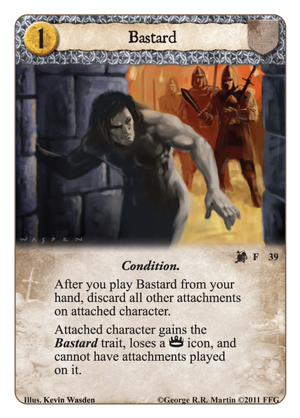
We are playing a four player game. For this round, by turn order, I am Player 3. Player 1 Marshals, Player 2 Marshals. When it comes time for me to Marshal I first play Distraction to kneel one of Player 2's characters. I then pay to attach the Poisoned Coin to that same character of Player 2. In response, Player 2 pays to attach a Bastard to that same character, allowing her to get rid of the Poisoned coin. I initially protested, saying you could only spend gold during your turn of the Marshalling Phase. In addition, I compared it to paying gold to bring a Character in play; you wouldn't be able to bring a Character into play after your opportunity has passed so paying gold for other things such as Attachments and Locations, ideally, would abide by the same rule. However, I allowed it, accepting her logic that attachments did not abide by those rules and coupled with the inability to find anything saying that particular action could not be done despite a decent search.

Can anyone clarify this for me?

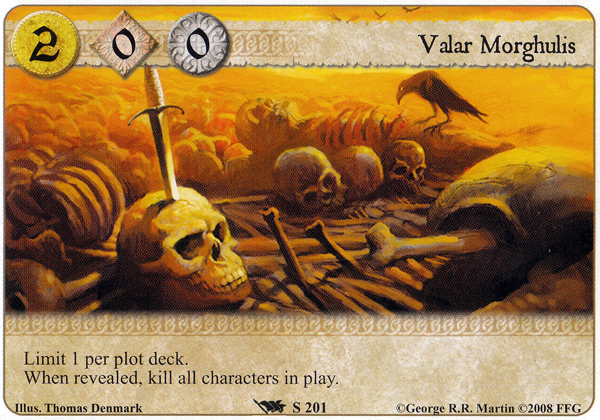
And one more thing, while I'm at it. I have Valar Morghulis in my plot deck to even the playing field every once in awhile. We have played under the assumption that Characters can be saved from this. For example, a Character with Nymeria attached or kneeling Ghost to save a Night's Watch character (I'm a Stark player if you haven't caught on to that yet). I guess to clarify, is that death instant or can Characters who are about to die kneel to save others (for example, Ghost to save a Night's Watchmen or the version of Tyrion Lannister that allows you to kneel a Clansmen to save him from being killed?).

Thanks in advance for your help.

Core Set rules, p. 12:

"Only 1 player can marshal cards (i.e., play cards from his hand to the play area by paying the printed gold cost on the card) at a time, but other players can still take 'Marshalling:' or 'Any Phase:' actions as usual."

-and-

"You may not want to spend all of your gold in the marshalling phase, as it can be used throughout the round to pay for effects, or to influence the actions of the other players in the game. However, any card that you want to play from your hand by paying its gold cost must be played during your turn of the marshalling phase."

All of this is phrased in terms of "cards," not "characters," so I'm not entirely sure where the idea that these rules only applied to characters came from? You may only marshal non-event cards from your hand when you are the Active Player in marshaling.

Core Set rules, p. 23:

"Save responses are special effects that interrupt and prevent the killing or discarding of a card in play. However, any costs of the killing/discarding action must still be paid."

Since saves interrupt the initiation and the resolution of the kill, no characters have actually died from that effect before you get a chance to use things that have the word "save" in them.

You can only pay gold to play cards when it is your turn during the marshalling phase - thus is it often useful to go last and allow other players to commit first

There are player actions in turn all the time - so after you marshalled Poison Coin, another player could have i.e. reduced someone's stregth (event card), and then i.e. do a response, such as kneeling Mereneese Brothel to discard an attachment

For something like V-M you can do saves and the saves occur before the kills - an good example of this relates to Clansmen - you have Tyrion who can be saved by kneeling a clansman and you have a card with "knelt clansmen cannot be killed"

So you kneel a clansman to save Tyrion and then that knelt clansman also cannot be killed

You may need to study the flowchart / timing mechanism ... Save / Cancel is step 2

I don't know where the idea of "character only" came from either, but I went ahead and accepted it because I knew I could kill that character anyway using a character ability and we were in the middle of a game. Thanks for the clarification though. It would have helped if I brought the rule book along, apparently. Thanks again, ktom!

Just to clear up another possible avenue of confusion: even if the character/location/attachment is 0 cost, you still can't "play" it when you're not the active player. You'd still be paying the gold cost, even if that cost is 0.

Edited by -Istaril

You can only pay gold to play cards when it is your turn during the marshalling phase - thus is it often useful to go last and allow other players to commit first

There are player actions in turn all the time - so after you marshalled Poison Coin, another player could have i.e. reduced someone's stregth (event card), and then i.e. do a response, such as kneeling Mereneese Brothel to discard an attachment

For something like V-M you can do saves and the saves occur before the kills - an good example of this relates to Clansmen - you have Tyrion who can be saved by kneeling a clansman and you have a card with "knelt clansmen cannot be killed"

So you kneel a clansman to save Tyrion and then that knelt clansman also cannot be killed

You may need to study the flowchart / timing mechanism ... Save / Cancel is step 2

I am so confused by your use of i.e. (i. e. it's wrong, e. g. this sentence is proper usage)

I am such a jerk. D:

-50 DKP for both of us!!!!!

Your so cruel MDC :)

I don't know .... i.e. / e.g. - maybe one is latin and one is greek ... maybe it is my written equivalent to an verbal err ...

Typically I mean "this is one scenario but the situation is not limited to this scenario only and others may apply, but this is the best one that I can think of right now ....

Seems quicker to type i.e. / e.g.

If you care:

Both are Latin. They mean different things. "i.e." means "that is"; "e.g." means "for example". They are not interchangeable.

Your description of what you "typically mean" boils down to "for example" (which did come across in context, of course). So "e.g." is what you meant, even though you typed "i.e.". That was what mcd was getting at in his post.

(And I guess I lose the most points under mcd's system for explaining it.)

That's okay. Just give me all your loot from now on.

It's really confusing and more confusing to explain.

i. e. - In other words

e. g. - This is an example of what I just said

Edited by mdc273

To explain fully:

i.e. = "Id Est" = "That is (or, as others have said, in other words - I could have used i.e. in place of the or just then)"

e.g. = "Exempli Gratis (sp?)" = "For example"

This quickly turned into a Latin lesson, which is cool because I didn't know any of this. Lol thanks everyone for so much new knowledge at once!

Thanks for the grammar lesson - I did Google the terms after my posting and found they were both Latin (****!)

Problem is I tend to think of i.e. as "in example" and I very rarely use eg

I've never been pulled up on this ay work, despite tons of emails, documents etc. that I write using i.e. wrongly

I used to pretend i.e. stood for "instance, example" and that e.g. stood for "example given". Now I know for sure that i.e. is not what that means at all.

I'm glad I could learn something productive today.

There are player actions in turn all the time - so after you marshalled Poison Coin, another player could have i.e. reduced someone's stregth (event card), and then i.e. do a response, such as kneeling Mereneese Brothel to discard an attachment

I am so confused by your use of i.e. (i. e. it's wrong, e. g. this sentence is proper usage)

I am such a jerk. D:

-50 DKP for both of us!!!!!

either is acceptable... i.e. translated means "that is" (usually to clarify a sentence, that is to make it easier to understand) and e.g. translated means "example given"

Just depends on your actual wording

However, in HastAttack's sentence, neither is needed...

Edited by stormwolf27

I have been productive!

ARE WE IN THE TWILIGHT ZONE?!?!?!?!

ARE WE IN THE TWILIGHT ZONE?!?!?!?!

~ Detailing minutiae, insisting it makes a difference in the cosmic scheme of things? Just another day on the AGoT boards.

ARE WE IN THE TWILIGHT ZONE?!?!?!?!

~ Detailing minutiae, insisting it makes a difference in the cosmic scheme of things? Just another day on the AGoT boards.

preach it brother