Here's what this system needs badly.

By That Blasted Samophlange, in Star Wars: Edge of the Empire RPG

In my opinion Edge of the Empire, Age of Rebellion and Force and Destiny need one thing. To be a Game master free game, or more likely, to have a round robin style of game.

If any of you are familiar with a roleplaying game by the name of Cosmic Patrol, it does this. There are a bunch of one page missions, detailing the overarching plot broken down into different acts. Every player has a character but also controls the adversaries actions. When that scene/act is done, the next person takes over.

Our Star Wars game here could benefit from this idea greatly. Now many will probably say: "why samophlange, YOU can already do this yourself!" And yes, I could. But the beauty of Cosmic Patrol is that it has two books beyond the main book (Into the Cosmos and The Moon Must Be Ours! Respectably) that are mostly just missions ready to run.

The overarching plot these missions provide is good for people who can't or don't like improvising the story on the fly but are also vague enough to allow interpretation of who is running that section.

This setup would benefit this game. I'm not just saying this as the EverGM.. well a little.

I wouldn't say it needs this badly...it doesn't "need" it at all. If it needs anything it might be better starship combat, but what it has works well enough.

The big prob I see is.... Well.. D&D4e. That game had such a solid tight ruleset it didn't really need a serious sigle dedicated GM if the module/delve/adventure were written by someone with some proficiency.

Of course we all know that 4e didn't go over so well with all groups, and seeing that Wizards not only is making D&D Next more like pre4e editions but they also rereleased legacy editions of D&D while 4e was still in full production, says a lot about the customer base. You don't rerelease the iPhone 3 if the 5 is making the sales your company needs, you rerelease the 3 because the customers think the 5 is pants.

Its a neat idea and something you could do, but to get the ruleset to a place where you could get proper consistent play means taking the game in a direction the player base probably doesn't want to go.

As something for use in a well designed module, I'll say I'm intrigued, but as something the game as a whole "needs badly" no, just no.

I think GM'ing takes a certain drive and talent. Not everyone at wants to play has those qualities. I know I don't!

Someone on some thread (see how helpful I am!!) on this forum mentioned something that was a virtual GM. Maybe that could work in eote? I have no clue what it is (still helpful!!) exactly but it seems like it might be what Samophlange (omg) is looking for.

I'm also way too happy with my current GM (except when he lectures me for forgetting my homework) so I'm not sure how much eote needs to be GM free. I also wouldn't trust most of the goons in my group to GM.

Who'd play the NPCs?

My groups and I couldn't possibly disagree with the OP more on this subject.

Love, The GM

Who'd play the NPCs?

Harvey Keitel. All of them.

The big prob I see is.... Well.. D&D4e. That game had such a solid tight ruleset it didn't really need a serious sigle dedicated GM if the module/delve/adventure were written by someone with some proficiency.

4E was a total train wreck of a rule system. Solid and tight are not words to describe a game that failed to get the basic math right. PHB2 fixed AC, MM3 fixed monster math, skill DCs got replaced (but not before they released the new DM screen with the bad values), Essentials removed some of tier problems. The magic item books gradually removed some of the problems with the ridiculous healing surge mechanic by making it pretty redundant. No, not at all a solid system.

Even with all the fixes it was still unplayable at high levels as characters could use monsters as punching bags and there was no way to challenge PCs short of the DM adding all sorts of immunities, extra actions and other bandages to the monsters.

Rant mode off. Anyway, your suggestion is still to have a module, written by a professional, playtested and edited. In effect an expert system for a GM much like WotC's Castle Ravenloft game. In comparison Cosmic Patrol doesn't really have the module. The sample adventure in the book is 3 pages for instance (compared to EotE's 20ish). The Players are doing a lot of the heavy lifting a writer would normally do and the GM conveys. A lot of the sense of mystery and exploration disappear.

Likewise their free games day module including quick start rules can be gotten for free here http://rpg.drivethrustuff.com/product/116271/Cosmic-Patrol-The-Eiger-Agenda-%28Free-RPG-Day-2013%29 The adventure part of it is 8 or 9 pages, but could easily have fit on 3. Compare 3 pages to the 23ish that Shadows of a Black Sun are... It's the difference between a Hollywood Movie and your friends putting on a puppet show.

Agree completely about 4E, and Essentials was like putting a plaster on a gunshot wound. There's a reason it didn't last very long, and everyone could see that coming.

But I'll have to disagree with TBS as GM, too. Though if that works for your group, that's fine too.

I think you need someone to have a) a good grasp of the system, and/or b) a really good idea of what the campaign is and where it's going. Storytelling is my speciality, and while I'm looking forward to playing my Space Weasel at some point, I prefer the creative control being GM gives me.

As Haley says, not everyone wants to be GM, or is suited for it.

Our GM is an imaginative guy that takes pleasure in our successes and our near-death experiences. From the start of a story-arc to the end, we have no idea what is going to happen, just that we are going to have to fight for our lives and live through a great story.

Thanks to him, I can't listen to Willie Nelson's "On the Road Again" without hearing the lyric As "On the Rodian..."

Have I mentioned that he's just the right kind of not right in the head?

I wouldnt give that up for a sheet of paper.

I suppose I could see a desire for a "GMless" means of playing the game, particularly if there's nobody in your group that has the time or inclination to step into the GM role.

But I think the game itself is vastly diminished without there being a GM, particularly when it comes to PC to NPC interactions. As noted, 4e could be run without a GM per se, but that game was really more of a simulationist/wargame style of RPG, where FFG's Star Wars system isn't. The rules aren't 100% cast in stone, and have a degree of flexibility in how they're applied, something that could cause problems if there's no GM to say "Okay, this is the ad hoc ruling that I'm making, and we're moving on." Or if the players go way off track from a planned module, the GM can either make something up whole-cloth, or find various ways to bring them back on track, doing so with it being entirely obvious that they're doing.

To say nothing of GMs that add a great deal of "flair" to the NPCs they run. Seeing GM Chris role-play a sleazy Hutt was a sight I'll not soon forget, nor was Jay Little breaking down as his EotE/AoR pick-up game broke down around drink vouchers. Or the surly bartender in Cyril's Skype game that asked my teenage Force-sensitive street rat if his parents knew where the kid was, to which Valin cheekily replied "Not at all." Like Bren Mastigar, I wouldn't trade those for a lifeless sheet of paper in a hundred years.

Edited by Donovan Morningfire

I guess I don't see a substantive difference between a GM-free RPG and some kind of low-tech MMORPG--which I don't bother with precisely because of the limitations a software-based format places on player choices. Round robin is another thing entirely, but I think that can be handled by the gaming group with little need for system provisions. Some GM advice for round-robin games might be nice, but that's as far as I feel the need to take it.

While I can understand the desire to shift GM duties around (both for the sake of the EverGM and for greater flexibility), I also see some major issues that the average group of Roleplayers will face.

Not everyone has the talent, skill, or drive to GM.
A GM's job is not just to manage numbers or tell players what happens next, otherwise round-robin GM-ing would be great! Their most difficult tasks are to manage player happiness and focus, and to present a story that is worth getting lost in. Most of the people in my gaming group have tried their hand at running a game; only 2 of us have been able to run a full story-arc without serious problems. I've even seen one of my players work from a very comprehensive campaign guide, with the players dutifully following the rails (I secretly read ahead to help keep the others on track), and he still somehow let the game crash and burn.

Even those GMs who can keep the players happy, follow the script, and keep the story moving, aren't necessarily able to breathe any life into the campaign.

Adventures are more than just dice rolls.
Combat and luck-based resolution are a prominent part of most RPG systems, but most of my actual play experience has taken place between the dice rolls. It is easy to pick from a list of attacks and do some basic math to determine how much damage the hero receives. It is much harder to present NPCs as actual people, instead of a collection of numbers and pre-written quotes. It is much, much harder to adapt the story and NPC's reactions to whatever new and unexpected thing the players just did.

Following a script, especially a script that is getting passed around the table, takes away surprise, mystery, and flexibility.

EDIT: Annnd Donovan pretty much said it all.

Edited by RedfordBlade

People have brought up some good points, and those of you who have (or are) good gms are lucky. I am, I feel mediocre as a gm, but I'm the only one willing to run a game. It is frustrating as I don't have time to plan/prepare as most of my time is spent being the primary caregiver to my 9 Month old son.

When I say GM less, I mean no singular gm for a game - as I said a round robin style shared duties. Give the gm at the time some crunch and a minimal fluff and be off.

I honestly figured this to be a good match to the system as the players have so much more freedom in altering the gm's plans than in most other games. A single triumph or despair can have astounding repercussions to a game and a creative player can do so much to enhance the story. Perhaps most players just stick to what the example uses are.

If the gm's want the power do they reserve the right to veto a players triumph roll? I say they do not. A "yes, but.." is the route.

I just felt that a game that encourages such player freedom and has such a good system for telling a story by interpreting a dice roll would be great for this play style. We, as players are already trying to tell a communal story.

I am surprised at the reticence to this idea. I understand a degree of aprehension at being a full time gm that some may have. But this game every potential dice roll gives you some of that power.

The round robin idea is interesting, if you have the folks to do it. In my case I don't think you're seeing resistance as much as disinterest. I've tried the gm-less route with a few games. It is what it is. It has some merit, and it was generally a good time. I did, however, find myself basically in campfire story mode. Without someone to drive the npcs, reel us back in when things got out of control, or provide a sense of mystery or unknown elements things got boring pretty fast. If you had a table full of very imaginative, improv-minded players I think your experience could be pretty good. That said, the really imaginative and improv-minded players drive things in a way that seems sort of familiar. Almost...like a GM :) :)

End of the day, there's no such thing as WrongBadFun. But I think GM-less gaming is basically a very small niche experience that's only successful with a very particular table make-up. Your mileage may vary.

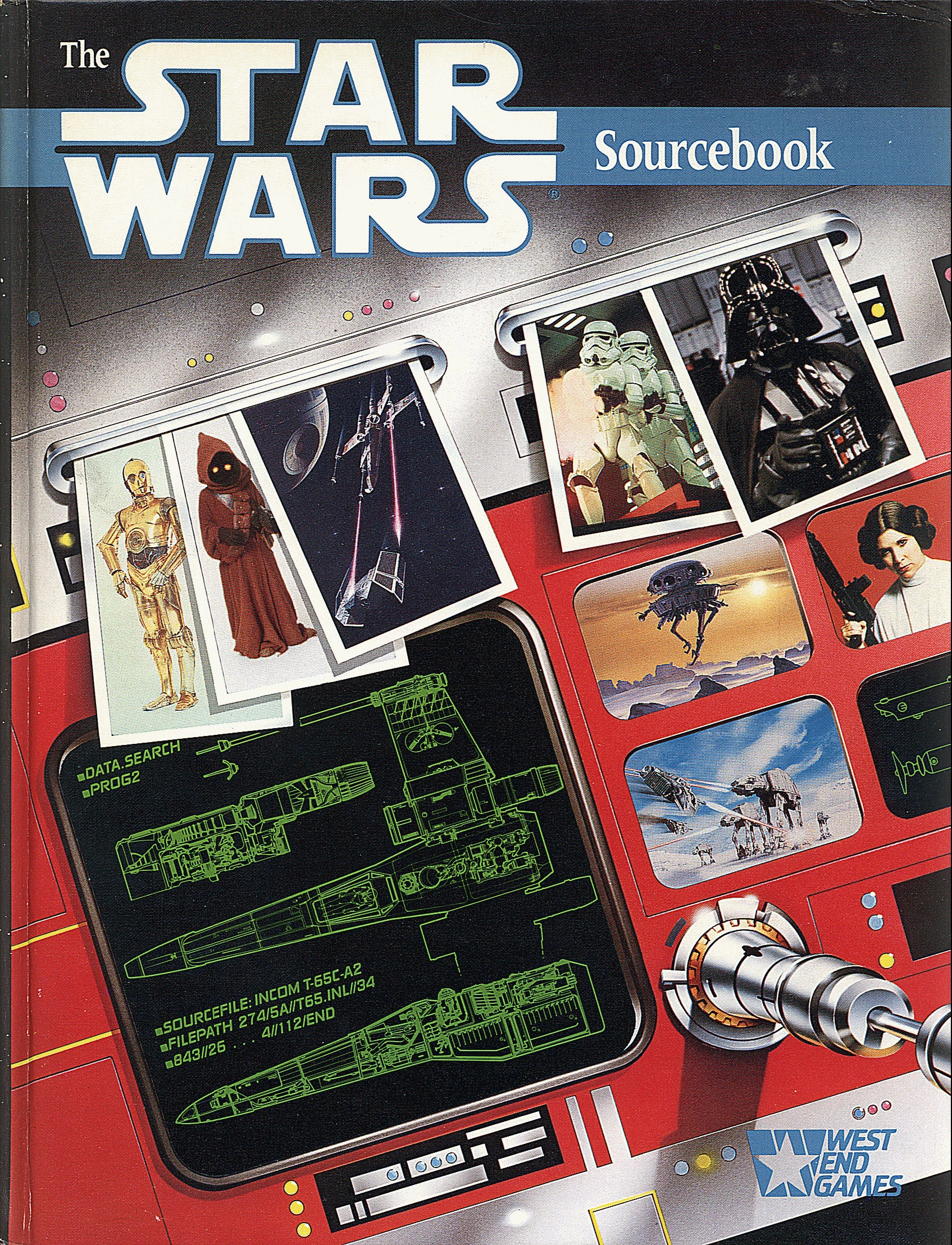
My take on what this game needs badly? This:

Starwarssourcebook1st.jpg

I would gladly buy a book of just stuff. Ships, gear, aliens, planets, NPCs. Later on in the games life, a book like this, assorted random items, not so necessary. But early on, when we only have a small handful of things to draw on - a centralized source of stats would be awesome.

I don't think you'll get that. Instead you'll get lots of little tastes spread through many sourcebooks.

I don't think you'll get that. Instead you'll get lots of little tastes spread through many sourcebooks.

Yes, I think this was discussed a while ago, the publishing model that works best for SW is to spread races, ships, equipment, etc across many different sourcebooks. By "best", I mean helps ensure a smooth revenue flow. Otherwise you get a "feast or famine" result. It's too hard to predict the feasts, and too many famines in a row means the end of the game.

I don't think you'll get that. Instead you'll get lots of little tastes spread through many sourcebooks.

Yes, I think this was discussed a while ago, the publishing model that works best for SW is to spread races, ships, equipment, etc across many different sourcebooks. By "best", I mean helps ensure a smooth revenue flow. Otherwise you get a "feast or famine" result. It's too hard to predict the feasts, and too many famines in a row means the end of the game.

It's pretty painful trying to look up a ship's stats and having to manually search every book. I'm really on the fence about buying Edge of the Unknown for that reason. PDFs would mitigate this somewhat, but of course we aren't getting those.

It's pretty painful trying to look up a ship's stats and having to manually search every book. I'm really on the fence about buying Edge of the Unknown for that reason. PDFs would mitigate this somewhat, but of course we aren't getting those.

I think it is safe to assume that some crafty player or GM will come up with an index covering all FFG Star Wars products.

It's pretty painful trying to look up a ship's stats and having to manually search every book. I'm really on the fence about buying Edge of the Unknown for that reason. PDFs would mitigate this somewhat, but of course we aren't getting those.

I think it is safe to assume that some crafty player or GM will come up with an index covering all FFG Star Wars products.

FFG has done it themselves in the past. Hopefully they'll do it again once some additional product gets released.

http://www.fantasyflightgames.com/ffg_content/wfrp/support/warhammer-fantasy-roleplay-living-index.pdf

I don't think you'll get that. Instead you'll get lots of little tastes spread through many sourcebooks.

Yes, I think this was discussed a while ago, the publishing model that works best for SW is to spread races, ships, equipment, etc across many different sourcebooks. By "best", I mean helps ensure a smooth revenue flow. Otherwise you get a "feast or famine" result. It's too hard to predict the feasts, and too many famines in a row means the end of the game.

It's pretty painful trying to look up a ship's stats and having to manually search every book. I'm really on the fence about buying Edge of the Unknown for that reason. PDFs would mitigate this somewhat, but of course we aren't getting those.

They could provide a "Living Index" pdf that covers all of the products. It would make searching for a particular ship/species/world/gear relatively easy.

EDIT - Beaten to it.

Edited by HappyDaze

Any game can do this and benefit from it if the players want to try their hats as GM.

Interesting thoughts... But no. I have 4 attention deficit players who'd love to volunteer and... Squirrel! Where we're we?

I'm a fan of all RPGs. 4e was combat tactical, but I think it's biggest failing was WOTCs adventures. They are linear and prescriptive. A lot of Pathfinder adventures are the same, with a few notable exceptions. The best 4e I ran was a conversion of Death In Freeport from 3e... 4e action with 3d terrain in an urban setting was amazing, and the story unfolded in natural almost sandbox fashion.

EOTE is almost purely narrative which allows the GM to focus on how he wants the story to unfold. This allows for better stories. Beyond the Rim is like a linear sand box... As far as I'm concerned all adventures should follow that example. (My players just wiped out the Yiyars.... enter the Imperials you'd almost think the adventure designers knew it could happen.)

To the OP... You don't need rules to do what you want. If you want to take turns go for it. Maybe you guys should vote on exceptions to the rules. Instead of breaking it down by encounter you should break it down by session. See where that takes your story.

Interesting thoughts... But no. I have 4 attention deficit players who'd love to volunteer and... Squirrel! Where we're we?

I'm a fan of all RPGs. 4e was combat tactical, but I think it's biggest failing was WOTCs adventures. They are linear and prescriptive. A lot of Pathfinder adventures are the same, with a few notable exceptions. The best 4e I ran was a conversion of Death In Freeport from 3e... 4e action with 3d terrain in an urban setting was amazing, and the story unfolded in natural almost sandbox fashion.

EOTE is almost purely narrative which allows the GM to focus on how he wants the story to unfold. This allows for better stories. Beyond the Rim is like a linear sand box... As far as I'm concerned all adventures should follow that example. (My players just wiped out the Yiyars.... enter the Imperials you'd almost think the adventure designers knew it could happen.)

To the OP... You don't need rules to do what you want. If you want to take turns go for it. Maybe you guys should vote on exceptions to the rules. Instead of breaking it down by encounter you should break it down by session. See where that takes your story.

I don't think rules are needed, more guidelines really. A round robin style game is a different style of game than the traditional 'adversarial' style. It would require a different GM section, and adventures would have to be different, with more scenes written in.

I think a lot of people think I'm trying to say that this method should replace the current. That isn't so. I feel it should be an option. Being a GM is a lot of hard work. Something that many players don't understand, and I think far too many take for granted. The nature of the mechanics of this game give so much power to the players to alter the story as they want, beyond what the GM intended. Yes every game CAN do this, but most aren't as upfront about it as this system. Look at the Triumph and Despair results. They tell you as a player that you can come up with something that alters a battle, such as a blast door closing, or a shield generator being destroyed. These are things that can mess up a GM's day, but are integral to this system.

A method of co-GMing as I suggest, could be great, and I feel is something this game should have, an optional rulebook or supplement could be great. Does it have to be a regular retail release? No. A print on demand, something Fantasly Flight has already used with the talent cards for this game, would be the best way to release this.

As to those who have the attention deficit players, perhaps they need to be more invested in the game in a different way. Fully running a game might be too much for them, but running a scene may be a nice way to get them to focus. Maybe not. But, I know if I can't get my players to focus, something is wrong and I might be wasting what limited free time I have on writing an adventure that the players don't care about.

Once again, I don't want to replace the GM's role entirely, just offer a different style of play that I see will do nothing but help players and GM's craft a story. For instance I have a house rule, that any player that comes up with a despair result AGAINST them, gets one experience point. This is basically a reward for the player making their own characters life harder, and enhancing the story.