Ion token vs the Advanced Sensors

By newmagrathea, in X-Wing Rules Questions

I had this situation come up the other night and wanted to see what everyone thought of our interpretation.

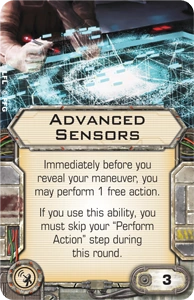
I was playing with a B-wing equipped with Advanced Sensors so I could spend my action before my move. My friend/opponent was using the Lambda with an Ion cannon and Anti pursuit lasers and a TIE Bomber. He had a good strategy which was to shoot my B-wing with the ion cannon to make it drift one movement but since his Lambda had lower pilot skill he would move it into the path of my B-wing causing me to lose my actions next turn. But I had Advanced sensors that allows me to "Immediately before you reveal your maneuver, you may perform one free action...." So I though I'll barrel roll to the side and go around the Lambda. After reading the "before you reveal your maneuver" part we though that it might render the Advanced sensors useless since you don't reveal your maneuver when under the influence of an ion token, it's predetermined. We did settle on Advanced Sensors not working in this situation, which ultimately resulted in the destruction of my B-wing.

What does everyone think? Loop hole or not?

BTW: I did win the game. I forced the Lambda to flee the battlefield by shooting it with the ion cannon on my HWK. And then I took the last hull point from the TIE bomber that my B-wing failed to remove.
You skip the reveal maneuver step, but you do still have the opportunity to perform actions before or after that step would have occurred. Otherwise, you wouldn't be able to continue the game at all.

Now, if Advanced Sensors said "When you reveal your maneuver" rather than "Before you reveal your maneuver", then Ionizing would prevent their use. But you are perfectly capable of doing something before your "reveal maneuver" step, then when you get to that step you skip it.

Edited by KineticOperator

You were correct. Advanced Sensors requires you to reveal a maneuver dial, in effect, by saying it takes place immediately before you reveal your maneuver . The wording of the Ion effect is that you do not select a maneuver on your next turn, so there's nothing to reveal. You just grab the 1-speed straight and drift your ship forward. Because it specifically says you do not pick a maneuver, I believe it is correct that you cannot reveal a maneuver, and thus Ion would prevent the use of Advanced Sensors.

You skip the reveal maneuver step, but you do still have the opportunity to perform actions before or after that step would have occurred. Otherwise, you wouldn't be able to continue the game at all.

Now, if Advanced Sensors said "When you reveal your maneuver" rather than "Before you reveal your maneuver", then Ionizing would prevent their use. But you are perfectly capable of doing something before your "reveal maneuver" step, then when you get to that step you skip it.

See, I disagree. I would say you still get to take your action, as normal, but would NOT get to used Advanced Sensors to do it, because you're not able to complete the 'reveal a maneuver' bit.

Although Buhalin disagrees with me on this one, from another thread, so I'm not sure:

It may perform actions as normal.

Direct from the Ion Token card itself. Fluff expectations aside, the rules are what they are, and very intentionally so I think.

Although it does get a bit odd with the new Advanced Sensors - you could be ionized, and barrel roll or boost before your drift move. A bit odd, but again, not the least bit wrong as far as the rules go.

Edited by CrookedWookie

I see what you are saying, but because this would occur before something else occurs there can be no real requirement for that other thing to happen. This is really just because otherwise you get weird time-loop causal problems by doing it any other way. If you had a similar action that said you had to perform it immediately before attacking you would not necessarily need to attack for it to occur. Doing it the way you suggests is literally putting the cause after the effect, which might work in physics but is a dismal failure in realtime.

For example: Say Darth Vader said "Immediately Before performing your attack". If you used Darth Vader and killed your only legal target, then you wouldn't get to attack. If you cannot attack, then Darth Vader couldn't have gone off, so the attack would have worked, so Vader could have gone off, so you couldn't attack... etc., etc.

When writing rules involving timing, this sort of looped logic is a big no-no. I cannot imagine that any editor (who knew his business) would allow that sort of mechanic to enter a game. If you want to create something of that sort, you need to put qualifiers like "If a ship would reveal a maneuver, then immediately before your reveal your maneuver" in order to have the rule function. Alternately, you can require that something be done immediately afterwards (which is what we have), but cannot predicate the first action on the second.

Edited by KineticOperator

But by the same token, when Vader says "immediately AFTER performing an attack you DO have to attack first." That hardly seems fair.

CrookedWookie if I didn't do my action before movement I wouldn't have gotten an action because the B-wing would have collided with the Lambda, forcing me to lose my action.

Correct, because your effect (Vader goes off) is predicated on a cause (attacking) that occurs at an earlier point in time.

Theoretically, cause and effect do not have to go in any particular order. Practically, cause needs to precede effect for the system to function.

Edited by KineticOperator

CrookedWookie if I didn't do my action before movement I wouldn't have gotten an action because the B-wing would have collided with the Lambda, forcing me to lose my action.

Well running into a Lambda seems like the exact opposite of what you want to do.

Advanced-sensors.png

pic1457576.png

This one is a bit tricky, but I think its clear enough.

The ioned ship is not assigned a maneuver dial in the planning phase.

In the activation phase the ioned ship moves AS IF it were assigned a white 1 speed straight

Advanced sensors specifies "immediately before you reveal your maneuver..." but when ioned there is no maneuver to be revealed. When ioned you are still executing a maneuver, however, for the ioned ship, there is no planning phase and no revealing of maneuvers . Therefore, Advanced Sensors cannot be triggered when ioned (CrookedWookie et al 2013).

(of course, if you don't overlap another ship or obstacle and are stress free, the ioned ship still gets it's action after moving)

Edited by Daveydavedave

CrookedWookie if I didn't do my action before movement I wouldn't have gotten an action because the B-wing would have collided with the Lambda, forcing me to lose my action.

Well running into a Lambda seems like the exact opposite of what you want to do.

Ha, yeah. Anti pursuit lasers are no fun on the receiving end.

I get both sides of the argument. Which is why we spent so much time debating it during the game.

Edited by newmagrathea

"Before" timings are a bit odd, but they must still depend on the actual event occurring. So long as the effect is careful about what it does, there isn't really time looping paradox. "I'm about to reveal my maneuver, so this interjects just before I do" is perfectly manageable. Even if the ability does change something, it interjects and changes how things proceed from that point on.

I'm curious what you think the other alternative is, KO - if you don't actually need to reveal a dial to trigger Advanced Sensors, what triggers the ability? The potential of revealing a dial?

I think considering alternate wordings here would be informative as well. The card could easily have said "You may take one free action during the Reveal Dial Step. If you do..." The ability pretty directly ties itself to the actual dial being revealed, rather than just something that happens around that time.

I agree with the general consensus: If you don't reveal a dial, you can't trigger Advanced Sensors.

Wow, really? I could have sworn I saw you argue the exact opposite somewhere else, so this surprises me. :blink:

I was fully expecting (hoping?) you'd come in here and make your Spocklogical case in favor of why it should work, bringing around my way of thinking on it. I wonder if that was some random dude who happened to have the same avatar.

So... you're saying we are all on the same page? CrookedWookie, Buhallin and I? Cool!!!

Hehe. Nope, this one has a solidly-accepted precedent with things like the Seismic Charge. If you don't reveal a maneuver, the trigger condition isn't there, and the ability doesn't go off. I don't see that "before" changes that.

You and I disagree on these things usually because while you see triggers I see timing. Before you reveal your maneuver tells you when to perform the action, as opposed to after you reveal your maneuver. The problem with reversing cause and effect timing is that whenever you perform an action you open the potential for a change in game state.

The only way you can accomplish this is to have a check in game state occur at the moment you take the action, and if that works then you can require an action to be taken afterwards. For example, you could say "If your ship has an assigned maneuver, then immediately before revealing that maneuver you may perform one free action."

If you do it otherwise, you are saying that you can only perform Advanced Sensors if you potentially will reveal a maneuver. In this particular case we do not have a direct way to alter the game state, but as a rules mechanism this is completely verboten. The potential mess created by this sort of reversed cause and effect mechanism is what I attempted to illustrate with my Darth Vader example.

It just seems MUCH more likely to me that the writers used imprecise grammar than that the designers intentionally used a well known rules writing no-no. This is especially true because while I see a general consistency in the rules as applied, I have seen great inconsistencies with how they have been translated into actual written rules.

Seismic Charge is done when you reveal a maneuver, not before, which is why it is different. Very, very, VERY different.

If a card said "before you attack you may" and you performed the action would you then be required to attack? Not unless it specifically said you must attack.

An example from the rules:

"The player may measure to see if his ship can perform a barrel roll before committing to this action"

This is only meaningful if we apply cause-effect. Following your reasoning, we would need to commit to the action before measuring. Which would mean that if you measure and discover you cannot barrel roll, then you cannot be committed to the action. Which means you couldn't have measured, because you aren't committed to the action. Etc., etc. This is a perfect example of the "effect" changing the game state before the "cause" can take effect, creating a causal-loop.

Alternately, from target declaration:

"A player may measure to verify that these conditions are met before declaring a target."

You are specifically NOT required to declare a target in order to measure range and arc. Even if you were, you have the potential of declaring a target in order to allow you to verify, then finding out that it is invalid. Which would mean you could not declare it as a target in the first place. But you would then be breaking the rules because you would have verified the conditions despite not having declared a target. It would literally be impossible to resolve this situation in a manner that would satisfy all RaW if we apply your method of resolution, and rules that CANNOT be followed should be edited out of a game.

This would be an example of unworkable rule writing, which is why we don't read it that way. Some aspects of game design and writing really are universal. I cannot believe that the designers are amateur enough to have done this intentionally. Either the designers overlooked a major rule of game design (possible), or the writers overlooked some ambiguity in their writing (likely). Of the two possibilities, the second seems much more probable, especially considering how many poorly worded precedents we have.

Edited by KineticOperator

Again, I'm not sure the designers are all computer programmers or something. It's entirely likely they see something like Advanced Sensors as giving you your action on credit, BEFORE paying for it, rather than after.
And he's right - if you get Ioned, you can't drop a seismic charge. Why? Because it says "after you reveal a maneuver dial." The fact they ruled negatory on that is a pretty strong precedent for Ion excluding ANYTHING that happens "after you reveal a maneuver dial."

I'm also not sure I understand this sudden obsession with "checking the game state." You're always 'checking the game state' for various conditions. Are you ignoring everything happening on the table unless the game specifically instructs you otherwise?

Edited by CrookedWookie

I don't see it as quite so disastrous. IMHO, a "before" timing is resolved like this:

1. Trigger condition is met

2. Resovlve "before" effect

3. Start resolving the process of the trigger condition

So it's not that you'd be required to attack - you already started the attack. A "before" just interrupts to resolve before the triggering condition resolves. There might be cleaner ways to do it, but I don't think it's going to cause a collapse in the timestream.

I think writing it YOUR way is more paradoxical than this way, to be honest.

If it says "before you do X" and you then turn around and never do X, that to me upsets the timing of things and creates a weird break, more than being allowed to do something when you know full well you won't be able to meet the condition FOR doing it when it comes up.

I worded that so badly that confused ME. Hopefully I untangled it.

Anyway, I don't know, it just seems to me that if it says "Before you reveal a maneuver" and you know full well you can't/won't reveal a maneuver that turn, you're kind of skipping out on the bill. I think there's an implied 'promise' there along the lines of "ok, we'll give you your action before you make your move, but only if you promise to take your - wait, where are you going??"

I don't know, maybe I don't need to anthropomorphise it, but it just reads to me like it expects you to know when you're going to reveal a maneuver dial - it's not a secret, it's not a mystery, there's a spot in the rules for it which you, the player, should be aware of - and it gives you permission to quick slip your action in there first.

I mean it's not a program where it only knows what you tell it - the player knows when he's about to reveal a maneuver dial, just as he knows if he's NOT going to be able to reveal a dial because he was zapped with an Ion token. So I don't think there's got to be any big paradoxical confusion as to the timing. You know when you're going to reveal a dial. I know when you're going to reveal a dial. I don't find it weird they'd write a rule that ALSO assumes you know when you're going to reveal your dial.

Edited by CrookedWookie

You are completely correct that the current wording makes a mess, CrookedWookie (and Buhallin). I just think that the bad wording is more likely to be a result of a small mistake in writing, than a massive error in game design. There are SO many ways to have worded this that would have made it function the way you describe, but EXACTLY as written it creates potential for massive problems. Not the least of which, is what to do if there is no maneuver to reveal.

How about "If a ship would reveal a maneuver, immediately before revealing that maneuver ..." Makes it work very well. Or "Immediately before the reveal maneuver step, you may..." works very well the other way.

What if we do it exactly your way, and you use Advanced Sensors to barrel roll on to proximity mines and are destroyed (which we would all agree happens right then and there). If the ship is destroyed, it cannot reveal a maneuver, which would make the entire thing illegal! Would I then be able to argue that we should put my ship back on the board, because I wasn't allowed to use Advanced Sensors in the first place?

That whole sequence is idiotic, which is why I very much doubt that it is what the designers had in mind.

Edited by KineticOperator

Well that would be kind of silly, because you can premeasure to make sure that you can legally complete a boost or barrel roll, can't you?

What if we do it exactly your way, and you use Advanced Sensors to barrel roll on to proximity mines and are destroyed (which we would all agree happens right then and there). If the ship is destroyed, it cannot reveal a maneuver, which would make the entire thing illegal! Would I then be able to argue that we should put my ship back on the board, because I wasn't allowed to use Advanced Sensors in the first place?

No... You're considering "before" as part of the trigger, rather than a timing element which describes when and how to resolve the effect relative to that trigger. Revealing a maneuver happens. Nothing changes whether or not that has occurred, only the order in which you resolve the various effects.

Exactly my point, it would be silly. Also, I edited the post to include a specific example, using Advanced Sensors, in which a player could "intend" to reveal a dial but not be able to do so because of what happens when he activates his Advanced Sensors.

What if we do it exactly your way, and you use Advanced Sensors to barrel roll on to proximity mines and are destroyed (which we would all agree happens right then and there). If the ship is destroyed, it cannot reveal a maneuver, which would make the entire thing illegal! Would I then be able to argue that we should put my ship back on the board, because I wasn't allowed to use Advanced Sensors in the first place?
No... You're considering "before" as part of the trigger, rather than a timing element which describes when and how to resolve the effect relative to that trigger. Revealing a maneuver happens. Nothing changes whether or not that has occurred, only the order in which you resolve the various effects.

Sorry for the double post, but I got ninja'd. :ph34r:

I don't understand what you are saying. I am wanting to use "before" strictly as timing, not a "trigger" as you put it, in order to avoid conflicts. Revealing a maneuver in this case would NOT happen, because the ship would be destroyed, which is the point I was trying to make. If revealing a maneuver is a requirement in order to follow RaW, we would be putting ourselves in a position where it would be impossible to actually follow them.

It is entirely possible to write unworkable rules, and there are guidelines provided to professional designers to avoid doing so. An example of an unworkable rule would be.

"Player A goes first. Player B goes before player A."

There may be perfectly good ways to word that in order to have a logical sequence happen, and I am guessing a game designer would not have intended for that sort of idiocy. If we ever saw that in a game, my assumption would be that something got lost on its way from game designer through writers, editors, and publisher, not that the designer meant for an unworkable rule to make its way into the game.

Edited by KineticOperator

You are completely correct that the current wording makes a mess, CrookedWookie (and Buhallin). I just think that the bad wording is more likely to be a result of a small mistake in writing, than a massive error in game design. There are SO many ways to have worded this that would have made it function the way you describe, but EXACTLY as written it creates potential for massive problems. Not the least of which, is what to do if there is no maneuver to reveal.

How about "If a ship would reveal a maneuver, immediately before revealing that maneuver ..." Makes it work very well. Or "Immediately before the reveal maneuver step, you may..." works very well the other way.

What if we do it exactly your way, and you use Advanced Sensors to barrel roll on to proximity mines and are destroyed (which we would all agree happens right then and there). If the ship is destroyed, it cannot reveal a maneuver, which would make the entire thing illegal! Would I then be able to argue that we should put my ship back on the board, because I wasn't allowed to use Advanced Sensors in the first place?

That whole sequence is idiotic, which is why I very much doubt that it is what the designers had in mind.

But at least you had placed maneuver dial with the intention and ability at the time of placement to revel it. Something very specifically interrupted it.

Otherwise you never placed a dial and had neither the intention or ability to pay to cost of the action.