Except for its cost this one does not seem that interesting. What do you think, clever trick or wasted cardboard?
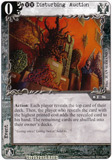
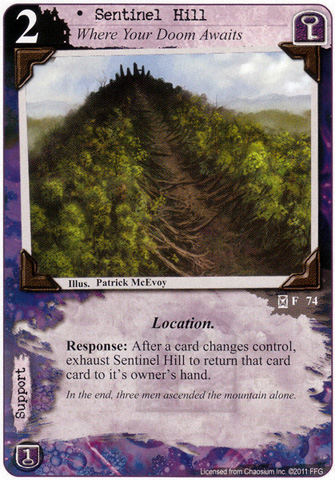
Attachments are the weakest card since it can be taken out either with support or character removal. It's a waste of cardboard imo.
Let me expound on why:
1) As an attachment, you have to play it in your operations phase, which means that whatever character you play it on must commit as a defender that turn, which means that in some cases you can't get the undefended success.
2) If that character is vulnerable to insanity, then it will likely go insane and that attachment will fall off. The opponent still has the choice about where to send it.
3) If the character is immune to insanity (i.e. has terror or willpower), then you might get to wound him, which is best case probably.
4) However, any damage you could do to that single character by forcing it to commit is mitigated if your opponent has other problematic characters that can protect it.
Therefore, this is a "win more" card that is most useful when you already have board advantage, and it is most useful to take out "support" characters that tend to sit on the back row and never commit, but are mostly used for their effect (cards that come to mind are Obsessive Insomniac or Clover Club Torch Singer).
I agree, this card is mainly useful for flushing support characters out into the open. I can't seem to find it now, but I do recall having a deck that used this card mainly as a cheap attachment because of some other card that just required an attachment to work. However, I don't remember what the other card was until I can re-locate the deck…
The Dunwich Horror
Bigger 'n a barn…
Type: Character Faction: Yog-Sothoth
Cost: 4
Icon: (T)(T)©© Skill: 4
Monster.
Villainous.
Action: Choose an opponent. That opponent gains control of The Dunwich Horror, if able. If control changes, choose and destroy another character or a support card that player controls. This ability cannot be canceled or disrupted.
How about this one? May be useful against Hastur steal effects, but otherwise is the Dunwich Horror combo any good?
It's targeted uninterrupable destruction but at what cost? You end up facing a potent character. Maybe the Monster or Villaineous traits could be exploited somehow? All in all mostly an amusing but costly ability.
I played a game with new player using Dunwitch horror - it was fun and good excersise on learning when to use his ability. If you have many characters and no single card is key taking opponents big AOs or main combo pieces might be worth it. But its really expensive as they can trade back. Also if you like smaller table it might be worth it.
With sentinel hill + Hastur take controll it might be ok in a more competitive deck… but im not convinced, sounds too unreliable.
For fun decks hes great IMO. Figuring out when to use him makes game more interesting.
i'd have to say that ive built nearly every deck and found uses for nearly every card imaginable (damned Premature Detonation), though ranging from just fun to seriously competative. so many cards get overlooked because at face value they just dont seem very good. examples are Naval Tactics (a card that is doing wonders for my 'Criminal Genius' deck), and Come to the Altar featured in 'Dark Secrets of the Order'. its basically what i do. im no meta monkey and find it fan more challenging and proof of intelligence to get these 'so-so' cards working. i pick a card that looks crap, and make it perform somehow (another example would be Binding Worm and Arkham Inmate).
Wolf Hunger - when combined with Ghoul Taint, can create some serious committing woes when applied correctly. both are 1 cost opponent attachments (so not so vulnerable to Character destruction or bouncing), and getting to decide who commits in what phase can sometimes be a very powerful force. they're also 1 cost, so destroying them outright is very cost inefficient in most cases or draws out the opponents good cards. i also tend to prefer attaching it in my phase to exhausted opponents, forcing them to commit and perhaps defend the character in their own story phase.
Sentinel Hill - has been used quite successfully to defend against the Hastur controlling, but will see its full potential with the new Yog expansion i believe, especially Nathaniel Peaslee which would be RIDICULOUS and i'm fearing this combo a little bit (while also calling dibs on it - haha).
COCLCG said:
i pick a card that looks crap, and make it perform somehow (another example would be Binding Worm and Arkham Inmate).
Why don't you post Binding Worm up here and we can have a discussion on it?
COCLCG said:
Wolf Hunger - when combined with Ghoul Taint, can create some serious committing woes when applied correctly. both are 1 cost opponent attachments (so not so vulnerable to Character destruction or bouncing), and getting to decide who commits in what phase can sometimes be a very powerful force. they're also 1 cost, so destroying them outright is very cost inefficient in most cases or draws out the opponents good cards. i also tend to prefer attaching it in my phase to exhausted opponents, forcing them to commit and perhaps defend the character in their own story phase.
Sure, Wolf Hunger is a cheap attachment and it becomes inefficient to use a Burrowing Beneath on it, but it is still a card that takes up a card slot with seemingly little impact. What are some situations you've encountered when forcing a particular character to commit was crucial?
COCLCG said:
Sentinel Hill - has been used quite successfully to defend against the Hastur controlling, but will see its full potential with the new Yog expansion i believe, especially Nathaniel Peaslee which would be RIDICULOUS and i'm fearing this combo a little bit (while also calling dibs on it - haha).
This definitely seems like it could be worth a couple of card slots to protect against Hastur, which probably will be very prevalent still, and to use in combo with Peaslee. He is so cheap!
Danigral said:
Wolf Hunger - when combined with Ghoul Taint, can create some serious committing woes when applied correctly. both are 1 cost opponent attachments (so not so vulnerable to Character destruction or bouncing), and getting to decide who commits in what phase can sometimes be a very powerful force. they're also 1 cost, so destroying them outright is very cost inefficient in most cases or draws out the opponents good cards. i also tend to prefer attaching it in my phase to exhausted opponents, forcing them to commit and perhaps defend the character in their own story phase.
Sure, Wolf Hunger is a cheap attachment and it becomes inefficient to use a Burrowing Beneath on it, but it is still a card that takes up a card slot with seemingly little impact. What are some situations you've encountered when forcing a particular character to commit was crucial?
the card itself is pretty wasted, i agree, and i didnt say it was a 'great' combo, but most cards that look stoopid simply need to be explored in combination with other cards.
some advice for new players for example is that this is definately not a game like magic (which i've never played so wouldn't really know), and i was victim from the start too. WOW. destruction !! WOW. single card whammy's !! im unstoppable !!! instead its a game that has deep synergies within the cards that can outwit and flow around direct card by card strategies, and it simply takes time and a final 'click' to see a dumb card as an ok one (which Wolf Hunger is).
imagine the situation you might be in where some of your characters (opponents choice) HAVE to commit in their story phase while others (again opponents choice) CANNOT commit until the defending story phase (Ghoul Taint). believe me it can suck. having to use your defenders as attackers and your attackers as defenders blows hard. Ghoul Taint on Y'Golonac = gold. Wolf Hunger on Teodor Corvin (first that came to mind) = gold etc etc. the problem with the deck (and why its never been seriously developed) is that you need a majority of the 6 cards to come out fairly quickly. BUT. when it works its not very nice so all in all, id say a nice card for a neat trick and not totally wasted.
Wolf Hunger is very situational, so like most situational cards it's usually cut from a deck for cards that are useful all of the time. If you could actually force your opponent to commit the attached character no matter what to a story of your choice, it would become significantly more useful.
As it is, if your opponent has a way to exhaust the attached character, he doesn't have to commit him. This makes it useless against any characters that have good actions that are paid by exhausting. And in any case since you have to play it in your operations phase it can never surprise your opponent, so he can plan his story phase accordingly.
Dunwich Horror is a card that confuses me. Do I really want my opponent to get control over it just to destroy a card? Particularly since he can return the favor in his turn? I think there are easier ways to achive similar and better results without any weird drawbacks attached.
Lol, nice one, Jan. I'd be interested to see how coclcg made this one work in some fancy combo.
Probably something like Aziz to put an Ancient one into play and then Disturbing Auction to draw it again after it returns to the top of the deck.
har. har. har. (hee hee). now, even if i said i had a use for 99% of the cards, that would still leave 10-20 that are complete duds, so i'll cover myself a bit there. BUT. i have used this card. once. 2 copies. in a deck with 'prism of many views'. with the top card of both decks revealed, when i saw an opportunity to discard a valuable opponents card while gaining perhaps an important one of mine, 'disturbing auction' was quite handy (and i could discard with prism at any time to get another chance at getting a card on my deck that i REALLY wanted).
now. there is a very strange rule for those that don't know (and is covered by the blanket 'lowest skill' section of the FAQ as confirmed by Damon), that if 2 card are of EQUAL cost, the acting player can determine which is the 'highest', as technically they BOTH are. i know. whacky. and don't forget that X = 0, and some of these are quite powerful cards.
im not about to give all my secrets for card combos away though (and i admit this wasn't a fantastic one but quite possibly won me a game or 2) haha. i've only been playing for a year now, but that year has been TOTALLY dedicated to deck building. i wake up and deckbuild. at night i playtest against the euros / americans. 6 days a week. on the 7th i go to work and get paid to sit behind a counter and deckbuild - haha. there must be over 200 in my stable by now. BUT. i'm STILL finding funny (and sometimes freakishly strange but powerful) combinations of not only 2 or 3 cards, but entire decks !! the joy is when the penny drops and suddenly a new combo idea takes form and next thing you know you're madly scratching a deck out on lackey or the like. enjoy the experience !!
my fervour and the possibilities are somewhat spent by now though, so you may be thankful to know that i've taken a step back and only deckbuild 2 or 3 days a week (haha).
COCLCG said:
now. there is a very strange rule for those that don't know (and is covered by the blanket 'lowest skill' section of the FAQ as confirmed by Damon), that if 2 card are of EQUAL cost, the acting player can determine which is the 'highest', as technically they BOTH are. i know. whacky. and don't forget that X = 0, and some of these are quite powerful cards.
I thought of the Prism after I replied. As well as other cards that allow you to arrange the top of your opponents deck. But still, that's using one (or more!) card(s) to gain one card, and it's very situational. I'd say that 99.99% of the time I'd want a different card in my deck.
Oh and I recently (last week) asked Damon about that as well because there are two cards that reference "highest" (Artist's Colony and Disturbing Auction). He said that choosing between ties does indeed go to the active player, but it only applies to targeted effects (i.e. when it says "choose".) I didn't think it was worth posting though because I didn't think anyone would actually play these cards. hehe.
Here's his direct quote:
"IT is the card effect's controller who chooses which card is targeted on ties. Also it only works when it says choose. If it is not a targeted effect then the effect simply does not resolve when multiple cards meet its checked value. So Artists Colony and Disturbing Auction would have no effect"
jhaelen said:
Dunwich Horror is a card that confuses me. Do I really want my opponent to get control over it just to destroy a card? Particularly since he can return the favor in his turn? I think there are easier ways to achive similar and better results without any weird drawbacks attached.
I just realized that I posted the pic of Sentinel Hill and the text of Dunwich Horror. Sorry. I meant to have a discussion of Sentinel Hill, and that it kind of flowed over into Dunwich Horror, which naturally combos with it. You're right though, if using Sentinel Hill, you wouldn't have to give control, but I wouldn't want to pay 4 every turn to destroy a card. However, it is ANY card and it cannot be cancelled or disrupted!
I do like coclcg's idea of the new Peaslee with Sentinel Hill. Much cheaper, and gaining control of a key card vs. destroying is much better imo. I see a Hastur/Yog control deck in my future.lol.
Danigral said:
Oh and I recently (last week) asked Damon about that as well because there are two cards that reference "highest" (Artist's Colony and Disturbing Auction). He said that choosing between ties does indeed go to the active player, but it only applies to targeted effects (i.e. when it says "choose".) I didn't think it was worth posting though because I didn't think anyone would actually play these cards. hehe.
Here's his direct quote:
"IT is the card effect's controller who chooses which card is targeted on ties. Also it only works when it says choose. If it is not a targeted effect then the effect simply does not resolve when multiple cards meet its checked value. So Artists Colony and Disturbing Auction would have no effect"
thats funny. here's my response from Damon:
Rule Question:
sorry to bother AGAIN. a certain someone in high standing tried to convince me that when using artists colony, and the drawn cards are of equal value, that the active player gets to choose which is 'highest' and thus keeps the card, as in the case of choosing 'lowest' skill. im not fully convinced though. in english 'highest' means higher than the others, but in cthulhu-ese i can understand if 'highest' could mean just ONE OF the highest cards.
Answer:
Generally, the emphasis determines what is being checked for in English,
Danigral said:
I do like coclcg's idea of the new Peaslee with Sentinel Hill. Much cheaper, and gaining control of a key card vs. destroying is much better imo.
This is fun. How about this one?
Basilisk
Type: Character Faction: Neutral
Cost: 4 Skill: 7 Icons: (T)©©©©
Game Text:
Creature. Monster.
Fast. Toughness +3.
Forced Response: At the end of your turn, deal 2 wounds to all other characters you control or sacrifice Basilisk.
jhaelen said:
Danigral said:
I do like coclcg's idea of the new Peaslee with Sentinel Hill. Much cheaper, and gaining control of a key card vs. destroying is much better imo.
Yes, the new Peaslee is definitely a better bargain, even without Sentinel Hill. I actually had to look up Sentinel Hill to see what it's effect was. I had totally overlooked it so far. I suppose I've dismissed it as being too situationally useful, but if you can engineer situations that cause your opponent to take control of characters, it's really nice.
DIBS DIBS DIBS !!!! hahahahaha.
i guess this is where my (insane) dedication to the game comes in handy. i know every card, what it costs, what it does, what it combines with (what its icons and skill are). which also means any new card that comes out i know exactly what cards will combo with it almost immediately. i was using the Logan / Altar / Necro combo the day after the AP was released for example.
What happens if you control an invulnerable character?
Basilisk seems strong but the drawback, I don't know …maybe if you field characters which trigger off being wounded.
i see all kind of messages which include some saying about the new peaslee. Am i missing something? Don't know about a new peaslee and sofar i can see nothing has been spoiled about one?
It was presented on the Elder Things Podcast:http://elderthingspodcast.blogspot.no
THE COCLCG COMBO OF THE WEEK
Next card please?
The Silver Key
Unlocking the way…
Type: Support Faction: Yog-Sothoth
Cost: 1
Game Text:
Artifact. Attachment
Attach to a story card.
Readied characters cannot commit to attached story. Exhausted characters can commit to attached story.
Forced Response: After a character commits to attached story, ready that character.
Set: SftSK
Number: 72
This card has baffled me for the longest time, so much that I simply forgo playing it. Is it best to play defensively, so you rush for stories and then have them all to defend on the next turn with this one? Do you put it on a critical story to make your opponent less likely to go for it? Do you play with characters that exhaust using their abilities so that you can attack, and if so, will it be enough to succeed?