Does Wild Bear attack twice, i.e. when he engages and then when in combat? Or does "immediate attack" mean it replaces his normal attack during this turn? Just curious.
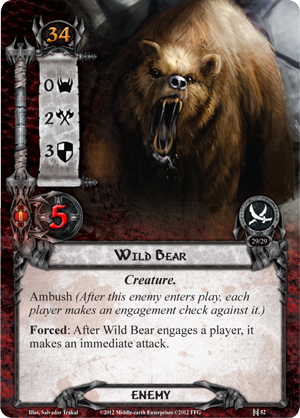
Does Wild Bear attack twice, i.e. when he engages and then when in combat? Or does "immediate attack" mean it replaces his normal attack during this turn? Just curious.
Nothing in the Bear's text prevents it from attacking normally during the combat phase, so it will attack twice on any turn in which it engages a player. It will not, however, be dealt a shadow card for the attack triggered by its forced effect (since shadow cards are only dealt at the start of the combat phase).
OK, thanks. What a nasty bear.
Does anyone know why the announcement said Quick Strike is useless against the bear?
As far as I know there's still an action window in the attack sequence which would allow to kill the bear before it causes any damage if i have enough firepower with a single attacker. (ie: The bear attacks: I declare Snobourne Scout as a defender, after the declare defender step is an action window and I kill the bear with Quick Strike and Beorn)
Doom1502 said:
Does anyone know why the announcement said Quick Strike is useless against the bear?
As far as I know there's still an action window in the attack sequence which would allow to kill the bear before it causes any damage if i have enough firepower with a single attacker. (ie: The bear attacks: I declare Snobourne Scout as a defender, after the declare defender step is an action window and I kill the bear with Quick Strike and Beorn)
im not sure, but i think the word immediate may push me to believing that you dont have time.....im never great on action windows though
richsabre said:
im not sure, but i think the word immediate may push me to believing that you dont have time.....im never great on action windows though
That's what I believe is the case when Ambush occurs. Forced takes place and resolves before anything else(unless there are two at the same time, then first player chooses) as soon as the condition is met. You are not engaged with the Wild Bear before Ambush so he is not an eligible target for Quick Strike until after the Ambush effect takes place(and the immediate attack).
Doom1502 said:
Does anyone know why the announcement said Quick Strike is useless against the bear?
As far as I know there's still an action window in the attack sequence which would allow to kill the bear before it causes any damage if i have enough firepower with a single attacker. (ie: The bear attacks: I declare Snobourne Scout as a defender, after the declare defender step is an action window and I kill the bear with Quick Strike and Beorn)
I think you could indeed use Quick Strike after declaring a defender BUT I feel their point was that you cannot use Quick Strike to kill it before it attacks (since it's a Forced effect, it cannot be interrupted by actions), thus forcing you to commit a defender and exhaust him.
If you use the Quick Strike in the way you described, it will only avoid you some damage. The Defender committed will still be exhausted.
At least, that's what I think, unless someone corrects me.
I think since the bear engages AND gets an immediate attack during the encounter phase, it cannot be defended against. It's an ambush. A surprise, free attack for the bear. It gets dealt no shadow card, since those are only dealt during the combat phase, but also the player cannot declare a defender, for the same reason. This also means that Quick Strike doesn't work, since a defender cannot be declared. I would take it to mean that the bear inflicts it's 2 damage (undefended) on any character the player chooses. Then begin the combat phase as usual.
Faradey said:
I think since the bear engages AND gets an immediate attack during the encounter phase, it cannot be defended against. It's an ambush. A surprise, free attack for the bear. It gets dealt no shadow card, since those are only dealt during the combat phase, but also the player cannot declare a defender, for the same reason. This also means that Quick Strike doesn't work, since a defender cannot be declared. I would take it to mean that the bear inflicts it's 2 damage (undefended) on any character the player chooses. Then begin the combat phase as usual.
I do not think your assessment is correct. According to the preview itself (end of the paragraph, right before ''Wicked Tricks and Snares'' :
''You must simply defend against it or face the consequences.''
Thus implying that you can defend against the Ambush. As I said earlier, I believe they wrote that you cannot use Quick Strike to remove the threat before it attacks. You can, however, use an Action Window to play Quick Strike before it actually damages you, after assigning a defender. However, since this bear only has an attack value of 2, it would be kind of a waste, especially since playing a Quick Strike would force you to exhaust yet another character for the attack.
The usual use of Quick Strike is to avoid an attack altogether and especially, the exhausting of a defender. In that sense, it is true that Quick Strike is of no help.
My earnest hope is that the pack insert that describes the Ambush keyword will have some more detailed information about how these attacks resolve.
The_Fallen_Arises said:
Faradey said:
I think since the bear engages AND gets an immediate attack during the encounter phase, it cannot be defended against. It's an ambush. A surprise, free attack for the bear. It gets dealt no shadow card, since those are only dealt during the combat phase, but also the player cannot declare a defender, for the same reason. This also means that Quick Strike doesn't work, since a defender cannot be declared. I would take it to mean that the bear inflicts it's 2 damage (undefended) on any character the player chooses. Then begin the combat phase as usual.
I do not think your assessment is correct. According to the preview itself (end of the paragraph, right before ''Wicked Tricks and Snares'' :
''You must simply defend against it or face the consequences.''
Thus implying that you can defend against the Ambush. As I said earlier, I believe they wrote that you cannot use Quick Strike to remove the threat before it attacks. You can, however, use an Action Window to play Quick Strike before it actually damages you, after assigning a defender. However, since this bear only has an attack value of 2, it would be kind of a waste, especially since playing a Quick Strike would force you to exhaust yet another character for the attack.
The usual use of Quick Strike is to avoid an attack altogether and especially, the exhausting of a defender. In that sense, it is true that Quick Strike is of no help.
I didn't read any preview, so I know nothing of it. My interpretation was solely based on looking at the card.
Also keep in mind that players have no choice in which who engages the Wild Bear. Only the forced engagement check is made by comparing Threat levels to the Wild Bears threat cost. First player compares threat and then second player. There no player optional one. The weakest player may have to face the Wild Bear if he has a high threat.
radiskull said:
My earnest hope is that the pack insert that describes the Ambush keyword will have some more detailed information about how these attacks resolve.
I agree. When I read the preview article I was confused about the statement about simply choosing a defender. It seemed to me that there was no window for choosing a defender. It definitely needs clarification.
"A Wild Bear attack during the quest phase may lead into the shadow effect of a Sleeping Sentry (Road to Rivendell, 46), triggering the discard of all exhausted characters, including the one who just exhausted to defend the Wild Bear."
This would suggest that the Bear would get a shadow card even if he attacked during the Quest phase.
Resolving an attack is defined in the core rulebook as a sequence of steps that includes declaring a defender(s) and flipping over the shadow card if there is one and then comparing attacking and defending STR.
There is no shadow card dealt to the Wild Bear because that occurs at the beginning of the Combat phase. Otherwise, you could argue that you should also be allowed to return an attack on the Wild Bear once his Forced effect resolves.
Sprenger said:
"A Wild Bear attack during the quest phase may lead into the shadow effect of a Sleeping Sentry (Road to Rivendell, 46), triggering the discard of all exhausted characters, including the one who just exhausted to defend the Wild Bear."
This would suggest that the Bear would get a shadow card even if he attacked during the Quest phase.
Very interesting. After re-reading the article, that is most certainly implied. I presume that the Wild Bears' Forced effect will have more details coming up, because Ambushed does nothing but an engagement check, it's his Forced effect doing the attacking.
EDIT:
My other theory is that there will be other Forced effects on other Ambushed cards that may explain their own Shadow effects. Perhaps "Forced: Deal a shadow card to this enemy. Reveal and resolve it.". There is no implication that it is specific to Ambush or the Wild Bear attacking.
Bomb said:
Sprenger said:
"A Wild Bear attack during the quest phase may lead into the shadow effect of a Sleeping Sentry (Road to Rivendell, 46), triggering the discard of all exhausted characters, including the one who just exhausted to defend the Wild Bear."
This would suggest that the Bear would get a shadow card even if he attacked during the Quest phase.
Very interesting. After re-reading the article, that is most certainly implied. I presume that the Wild Bears' Forced effect will have more details coming up, because Ambushed does nothing but an engagement check, it's his Forced effect doing the attacking.
EDIT:
My other theory is that there will be other Forced effects on other Ambushed cards that may explain their own Shadow effects. Perhaps "Forced: Deal a shadow card to this enemy. Reveal and resolve it.". There is no implication that it is specific to Ambush or the Wild Bear attacking.
What if the quest card made it where when anytime an enemy makes an attacks it gets +1 shadow card. That would make more sense and still keep all the rules intacted.
Here's the official ruling, as detailed in a thread over at BGG:
Official Answer
From Nate:
Shadow cards should be dealt during attacks made outside of the combat phase. The [rules, pg 18] reads, "when resolving enemy attacks, follow these four steps." The main issue I see with that interpretation is that it is conflating the resolution of an attack with the act itself, and making the jump to the conclusion that anything that does not happen during the resolution of an attack (such as the dealing of a Shadow card) is not a part of the attack.
The main reason that Shadow cards are dealt at the beginning of the combat phase is that they serve as a convenient means of portraying which enemies have yet to act when combat is being resolved. (If an enemy has a face down shadow card, it still needs to resolve its attack.) Of course, this breaks down when the encounter deck empties mid shadow phase, but in most cases it serves its purpose, particularly early in most players' games, when they are still learning the basic mechanics -- it amounts to one less "memory issue" and stumbling point in those early experiences.
That said, it is worth specifying that Shadow cards should be dealt for enemies that attack outside the combat phase, so thanks for bringing it up -- I'll put it on the FAQ list. And yes, if the game is "foolish" enough to launch an attack during staging and open up action windows, the players can take full advantage of those action windows as they see fit.
(http://boardgamegeek.com/thread/777895/what-constitutes-an-attack)
---
Basically, an attacking enemy will ALWAYS be dealt a shadow card (if possible), even if the attack occurs outside of the combat phase. So, ignore my earlier comment, as Nate's ruling explicitly contradicts my assessment.
Again, the Bear WILL attack twice on any turn in which it engages a player, and it WILL be dealt a shadow card for each attack.
I think it's a curious decision on his part. Not necessarily a bad one from a gameplay standpoint (makes Wild Bear quite a bit more threatening), but a strange choice nonetheless. The rule book (p.18) seemed to be pretty clear regarding the precise method and timing of dealing shadow cards, and this ruling makes portions of the shadow text on cards like Wolf Rider and Chieftain of the Pit somewhat superfluous. Still, it means that enemy attacks outside the combat phase are treated exactly like those during the combat phase (including opportunities for player actions between each step of the attack). Even though I'm not sold on the rationale here, it does a good job of creating a simple, general rule for a particular game mechanic. That should clear up much of the confusion surrounding ambush, which is definitely a good thing in my book.
Also, it means Quick Strike or other Actions could be used in action windows between each step of the attack. However, as I have pointed out, it wouldn't prevent the necessity of declaring and exhausting a defender (since there was no window to prevent it, thanks to the Forced effect), so it would be kind of pointless unless you have no defender, no one resilient enough to defend or if you really want to avoid resolving the Shadow card's effect.
However...I'm interested in the part of the official answer that says that the action windows could be used as the players see fit...meaning that non-combat Actions could be used saaaay to prevent more cards from being drawn (Gildor's Counsel), or to scry, heal or anything else. Maybe said bear could be a blessing in disguise since normally the Staging step and the drawing of encounter cards cannot be interrupted by actions.
The_Fallen_Arises said:
Also, it means Quick Strike or other Actions could be used in action windows between each step of the attack. However, as I have pointed out, it wouldn't prevent the necessity of declaring and exhausting a defender (since there was no window to prevent it, thanks to the Forced effect), so it would be kind of pointless unless you have no defender, no one resilient enough to defend or if you really want to avoid resolving the Shadow card's effect.
However...I'm interested in the part of the official answer that says that the action windows could be used as the players see fit...meaning that non-combat Actions could be used saaaay to prevent more cards from being drawn (Gildor's Counsel), or to scry, heal or anything else. Maybe said bear could be a blessing in disguise since normally the Staging step and the drawing of encounter cards cannot be interrupted by actions.
Isnt there an action window between choosing the attacker (the forced effect in this case) and exhausting a defender?
Anodos said:
The_Fallen_Arises said:
Also, it means Quick Strike or other Actions could be used in action windows between each step of the attack. However, as I have pointed out, it wouldn't prevent the necessity of declaring and exhausting a defender (since there was no window to prevent it, thanks to the Forced effect), so it would be kind of pointless unless you have no defender, no one resilient enough to defend or if you really want to avoid resolving the Shadow card's effect.
However...I'm interested in the part of the official answer that says that the action windows could be used as the players see fit...meaning that non-combat Actions could be used saaaay to prevent more cards from being drawn (Gildor's Counsel), or to scry, heal or anything else. Maybe said bear could be a blessing in disguise since normally the Staging step and the drawing of encounter cards cannot be interrupted by actions.
Isnt there an action window between choosing the attacker (the forced effect in this case) and exhausting a defender?
Yes, which is why I think we really need to see the official rules on Ambush before jumping to conclusions. The article suggests we cannot use Quick Strike to attack the Wild Bear during an Ambush, so it's possible that it's a special combat window that is created where there are no Player Actions allowed. Otherwise, I can't see any reason why you cannot use Quick Strike before a defender is declared. Thematically, being allowed to Quick Strike against an Ambushed attack doesn't make much sense because you are caught by surprise, so my guess is you simply can't do any Player Actions before defenders are declared.
Yeah I am not seeing anything in the rules or current ruling which would prevent any cards normally played during combat. So either the preview is misleading or there will be some special rule about "ambush" forthcoming.
Curious as to what will happen if it enters play during the middle of the combat phase.
Here's my interpretation...(IMO)
I was under the impression the Forced effect specified that after engaging, the bear makes an immediate attack (with emphasis on ''immediate''), thus you do not have the option to choose an enemy to defend against since he attacks you right there and then (in effect skipping the first step of the attack). Because you never had the option of choosing a specific attacker (it has to be a bear), the attack begins at step 2 : choosing a defender. After that, the action window opens as normal.
I guess this is linked to the fact that he is revealed out of the combat phase, in phases where you never have a specific step to choose an attacker (because there usually isn't any). You have to deal with it immediately. Otherwise, this would generate a weird situation...for instance, if you're already engaged with say, Orcs of Dol Guldur. During the staging step, you draw Wild bear...would you really have the option to engage another enemy ? In essence, preserving the first step of the attack (choosing attackers) could mean we are ambushed by a bear, but attacked by orcs instead. Granted, as Anodos said, we could say that the Forced effect simply replaces Step1 of the attack, and that the action window normally between Stap 1 and 2 could be preserved, but as Bomb added, it would go against the spirit of the Ambush keyword to be able to play Quick Strike before defenders are chosen.
As the official ruling said about Shadow Cards, the way things were laid out in the rulebook seem to be geared more towards learning the game and less towards defining timing, which is kind of a bummer since now we have a bunch of timing issues. I love the game but I feel every new addition will bring more and more errata, and will make the game harder to learn in the long run for people less familiar with CCGs and all the lexical complexities they bring. The term ''immediate'', for instance, sometimes brings confusion.
Of course, this is only my two cents. At that point, speculating might seems pointless unless we have an official clarifications on the subject. However, I believe that by posting interpretations and questions, we might help FF in defining a ruling on this particular issue (or any rules issue, actually).
"Immediate attack" seems to most reasonably mean (particularly inflight of this latest ruling) "an attack right now" (in which you deal out a shadow card and follow the 4 steps) and not "do step 1 right now". IOW, "immediate" in the sense it is used every where else - to designate a forced interrupt in the normal flow of play, not a skipping of some step. Also, "attack" seems (esp. in light of the ruling) distinct from "choose an enemy".
And even if it does mean the latter, I still don't see this negating an action at the end of step 1 regardless of whether step 1 was immediatley forced or not. Nothing in the rules specifies that there is an action window at the of step 1 only if it wasn't forced. That step 1 may be forced doesn't negate the rule that says to do each step and that you can take actions after each step. Not unless "immediately" also means "skip". Given what the rules do say and what the card doesn't say, barring some ruling to the contrary or some rule yet to be revealed, I can't see any reasonable way to rule out an action before the defender is declared.