
If you wanna be a star of the stage and screen
Look out it’s rough and mean
It’s a long way to the top
If you want to rock ‘n’ roll
-AC/DC, It’s a long way to the top if you want to rock ‘n’ roll
In the last Rockband Manager preview, we looked at the Rockstar Recruitment phase and some of the interesting personalities that populate this entertaining card game. This week, we look at the Career phases, where bands compete to put on the biggest show, produce the best records, and get the most decibels to win the game.
Career management
In the Career stages of the game, each manager sends out his newly recruited stars to gain fame and fortune. Managers can send their musicians to play shows, which are represented by Concert cards. Attaining these cards immediately adds to the band’s decibel level. Also, players can collect Album cards that lead to decibel bonuses at the end of each phase, but only if your band has the highest total Album card score. Last, band members can claim Opportunity cards that provide bonuses, or they can also cause grief to rival bands. There are many routes to victory in Rockband Manager, so managers must decide which of these options places their band in position to win the game. With this in mind, here is a closer look at how the Career phases work.
There are two Career phases in Rockband Manager, a Career Debut phase and a Career Apex phase. At the start of each phase, one player draws ten cards, one at a time, from the Career card deck, forming two rows of five face up Career cards. The column nearest to the Career card deck is the first column, while the one farthest from the deck is the fifth column. Columns become important in the next step of the phase, when players start claiming cards. To claim cards, managers take turns placing one of their rock stars on the Career cards.

A rock star can acquire a card from either row, but can only acquire cards from a column that is equal to or less than the value of the characteristic that corresponds to the type of Career card in that column. Charisma (the red number) corresponds to Concert cards, Talent (blue) corresponds to Album cards, and 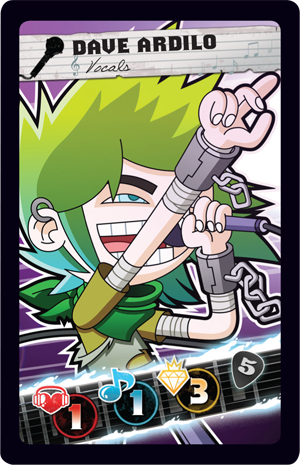 Opportunism (yellow) corresponds to Opportunity cards. For example, Dave Ardilo can only claim Concert and Talent cards in the first column, but he can claim Opportunity cards in columns one through three. When recruiting stars, make sure to take into account members’ individual characteristics, or you might get burned.
Battle of the bands
Inevitably, conflicts occur over valuable cards, and bands are bound to clash. When this happens, managers must flex their fiscal muscles to help their band members win a duel with their adversaries. If two or more stars are on the same card at the end of a round, a duel takes place. In a duel, all players involved secretly choose one of their remaining cash envelopes and reveal it simultaneously; the player who made the largest bid wins the duel and gets the card. The loser (or losers) can then select another card to claim, if there are any cards still available.
Winning duels depletes managers of valuable cash, but many times the risk will be worth it, especially when a duel is for an Opportunity card. For example, winning a duel for the Golden Opportunity or Sabotage card gives the winning band an enormous advantage over competing bands. Also, if there are no cards remaining that your star could claim, it may be worth starting a duel over a card, since not claiming a card in this phase badly hurts your band’s aspirations for greatness.


The Award Stage
At the end of both of the Career phases, the bands earn awards based on their total Album scores. The band with the highest Album score gains a Gold Record, while the band with the second highest Album score earns a Silver Record, and the band with the third most Album points earns a Bronze Record. These awards are worth different amount of decibels depending on the Career phase, which are added to the band’s decibel score at the end of the game. As the manager, you need to decide if you want your talent to produce albums that have a delayed payoff, or if you would rather have your stars performing live shows and immediately collecting decibels.
Rockband Manager arrives first quarter of 2012. So do your sound test and prep your instruments, because it’s almost time to rock! If you still need more information on this rocking card game, check out our previous Rockband Manager preview.