
The jade amulet now reposed in a niche in our museum, and sometimes we burned a strangely scented candle before it. We read much in Alhazred's Necronomicon about its properties, and about the relation of ghosts' souls to the objects it symbolized; and were disturbed by what we read.
Then terror came.
–H.P. Lovecraft, The Hound
Welcome back, Initiate! A few weeks back, we looked at what power the Order of the Silver Twilight stands to gain from the Curse of the Jade Emperor. Controlling the flow of your turn might seem like a neat trick, but the Silver Twilight doesn’t stop there. Our goal is to control the ebb and flow of an entire game. To achieve that very goal, we have Initiate of Huang Hun (Curse of the Jade Emperor, 40) on our side.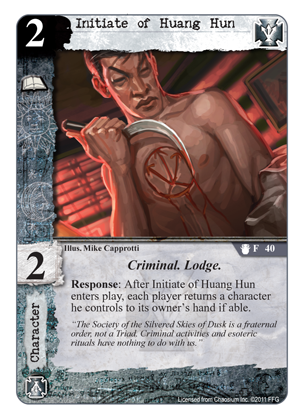
At first glance, he may seem like a stranger, more symmetrical version of Lord Jeffrey Farrington (Order of the Silver Twilight, 16) that allows your opponent to choose what he returns. The cold harsh truth of the situation is that when the game offers symmetry, balance seldom follows. After all, you choose to play symmetrical cards the moment symmetry works in your favor.
From initiate to master
So, how does it work? When Initiate of Huang Hun comes into play, you can choose to trigger his Response. If you do, each player returns a character of his choice to his hand. You can choose to have the Initiate return himself, and you can repeat the trick. Accounting for how you set up your domains, it’s possible to do this multiple times per turn. The Initiate is fairly cheap at two cost, so unless your opponents can replay all their bounced characters in one turn, you’ll be gaining quite an advantage.
Even when your opponents can replay all the characters they have to return, doing so stunts the development of their board position and ties up all their domains. Until you choose to do something else. Better yet, you’re doing this at ‘Response’ speed, making it difficult to disrupt the trick with the usual means. Most events and support cards operate at ‘Action’ speed, so they’ll be too late to take care of the Initiate.
Establishing equilibrium on your terms
This strategy is not completely fail safe, though. It helps maintain the status quo, but that doesn’t help you if you’re already behind. Clifton Rosenberg (Order of the Silver Twilight, 16) 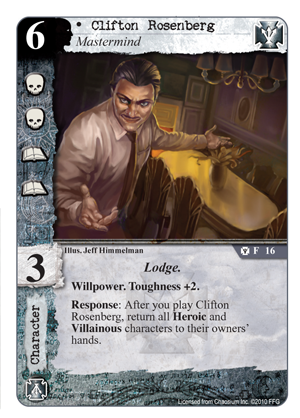 may help you catch up or take the lead, but only if your opponent has a lot of Heroic or Villainous characters. Meanwhile, your opponent might very well have characters with ‘when it comes into play’ responses of their own. And if they keep replaying their characters, there is little that holds them back or prevents them from playing aggressively. You are not locking them out completely. You are just slowing them down.
Other ways they can get back at you include hand manipulation effects, like Clover Club Deck (Twilight Horror, 6). The true champion of disruption in this case may very well be Miskatonic University though. Not only are they able to make the best of the early window of opportunity with aggressive commitment to stories and their Investigation icons, but since you keep replaying the same character, the University can use Notebook Sketches (Mountains of Madness, 4) or Dreamlore Documents (In Memory of Day, 25) to lock the Initiate out of the game. Professor Lake (Mountains of Madness, 3) can limit him to being played only once per turn.
But it’s hard work. Not everyone is initially equipped to deal with the Initiate of Huang Hun at this moment, so all the Order needs to do is set up an early advantage and use the Initiate of Huang Hun to help maintain it. Once it does, the Order will finally get the respect it deserves as a power to be reckoned with among the factions of Call of Cthulhu: The Card Game.
Curse of the Jade Emperor is on sale now! For more information, read the announcement.