
In the gritty, alternate-reality World War II of Dust Tactics, each hero, walker, and elite squad of soldiers can make a difference in the course of a battle or the war. But when a general understands his troops and how they might best work together, his army can become stronger than the sum of its parts.
Today, we’re debriefing with a review of the army lists for the top two players from the first ever Dust Tactics World Championship, which was held last month at Gen Con Indy 2011. See what worked in the heat of battle, and learn how to seize the advantage in your next game!
Champion: Christopher Smith
Axis–Army Cost: 248
Heroes:
Markus (20)
Sigrid (20)
Walkers:
Ludwig x2 (80)
Luther (35)
Squads:
Axis Gorillas (24)
Recon Grenadiers x2 (32)
Laser Grenadiers (27)
Sniper Grenadier (10)
Strategy:
Players were told to bring 250-point armies, which they had to then cut down to 160 points for each scenario.
Christopher decided Sigrid, his Laser Grenadiers, Axis Gorillas, and Recon Grenadiers would serve as the core of any army he played. From his army, Christopher was able to build two different forces that were each 155 points or more. He would either run the two Ludwigs, the Recon Grenadiers, and the Laser Grenadiers with Sigrid; or the Luther, two Recon Grenadiers, Sigrid, the Laser Grenadiers, and then Markus and the Axis Gorillas. Both forces offered Christopher good flexibility. He played his Luther / Axis Gorillas force for the final four matches of the tournament. Second Place: Louis Gentile
Axis–Army Cost: 248
Heroes:
Manfred (16)
Walkers:
Lothar x2 (72)
Squads:
Beobachter x4 (20)
Kommandotrupp (40)
Recon Grenadiers (48)
Sniper Grenadier (40)
Tank Killers (22)
Strategy:
Louis sought to use artillery to its full effect. With two Lothars and four Beobachters, he could repeatedly direct artillery strikes anywhere on the board. Louis knew his army had a small disadvantage, however, as his walkers ended up serving as fixed turrets, leaving the infantry little support for breaking into enemy positions.
He used his Recon Grenadiers to provide some muscle to an otherwise highly-specialized force. They provided enough anti-tank power to finish off anything the artillery didn’t, and they held their own against all but the heaviest infantry.
Observations
Axis forces made a strong showing throughout the first Dust Tactics World Championship tournament, and both finalists took advantage of Axis ranged firepower. While Christopher played with a squad and a hero limited to close-combat, he also fielded two copies of the mighty Ludwig, the biggest Axis walker available during the tournament, capable of pounding anything in line of sight with its long-range 8.8 cm FpK.
Early in the game, Louis took the early edge, hiding his Lothars out of reach and calling in artillery strikes with his Beobachter squads. Christopher’s forces were taking their lumps, but he launched a decisive counter, bringing the Axis Gorillas into the fray at just the right moment. His angry apes tore through squad after squad, forcing Louis to bring his Lothars out of hiding and making them vulnerable.
Unit analysis
Both players made good use of the Recon Grenadiers. This versatile and inexpensive unit may not excel at any one task as well as others, but it allows players to adapt to the changing situations of a game. And for a mere 16 army points, it offers a lot of bang for the buck.
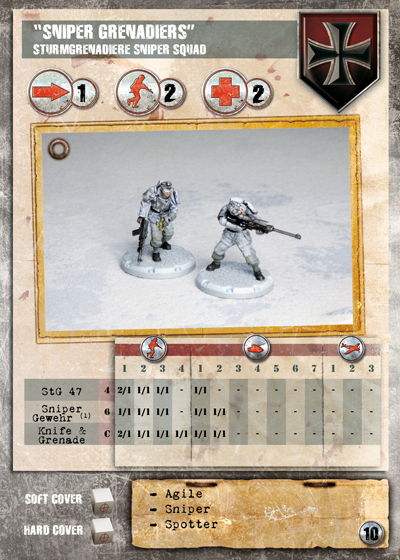
Both players also chose to run Sniper Grenadiers. While they didn’t take center stage in the final game, it was clear to see that both players wanted the ability to control their shots. Their Sniper skill allows the Sniper Grenadiers to target a single miniature within a squad, meaning they can pick out the individual member of the Allied BBQ Squad wielding the flamethrower.

The combination of Beobachter and Lothar Louis employed was highly successful for most of the tournament, but Christopher was able to exploit its key disadvantage at the end, when his bigger, tougher units rushed at the separate Beobachter squads. Because Louis kept his Lothars back where they were safe, they were unable to provide much support for his squads. Meanwhile, Christopher’s Axis Gorillas, particularly, proved devastating. With Markus commanding at them, they were a furious frenzy of fists and steel, storming across the tiles, turning the tide of battle in his favor.
Specialization or flexibility?
Both Christopher and Louis had excellent showings throughout the tournament, and their different army designs illustrate the viability of drastically different schools of thought.
As the Dust Tactics campaign continues to heat up, players will find clever uses for exciting new units such as the Allied Grim Reapers and Tank Busters, the Axis Zombies, and the new heavy walkers for both sides. How will these units boost your armies and shake up your local metagame? Will your army push toward stronger and faster specialization or greater flexibility? Who knows what next year’s Dust Tactics World Championship may hold? We’re excited to find out!