Is there anything in the cannon that suggests that there's a duelling tradition / trial by combat in the Warhammer 40K RPG universe? You've got royalty/titles/feudalism/inquisition/martial tradition so it seems reasonable. I'd assume commoners are exempt (the don't have ANY rights, correct)?
Duelling Tradition
furashgf said:
Is there anything in the cannon that suggests that there's a duelling tradition / trial by combat in the Warhammer 40K RPG universe? You've got royalty/titles/feudalism/inquisition/martial tradition so it seems reasonable. I'd assume commoners are exempt (the don't have ANY rights, correct)?
A duelling tradition, singular? There are hundreds of thousands of them at least, and that's only counting the Imperium. Any culture with even the slightest inclination towards formal combat will have developed traditions around it.
Is there something specific in the cannon that describes the Imperial tradition here? e.g., if one noble insults another they can opt for a duel, if you get tagged by the preists (it starts with "E") as a heretic you can try trial by combat, etc. I didn't see it in the Eisenhorn or Ravenor books, which are the only ones I've read. However, that makes sense, since once you get tagged by the Inquisition, you don't really get many "outs."
Do you mean Excommunicated? A lot of the time I get the feeling that if a priest says you're a heretic he is probably going to whip the local populace up into a frenzy and get them to come knocking on your door with pitchforks and flaming torches, therefore giving you very little opportunity to tell anyone you would prefer a trail by arms.
As to canon with regard to duelling I don't think there really is any in the 40k literature and so you may have to make it up yourself. You also have to remember that most people in the 40k universe never leave there homeworld, even nobles, so the each world can be culturally quite isolated and so many different traditions relating to duelling could spring up, rather than there being a set of 'Imperium Duelling Rules'. You could use any number of forms of duelling that have existed or do exist on Earth nowadays as inspiration, the combatants don't even have to be armed, boxing and wrestling are essentially forms of duelling. The codes of honour that dictate when a duel should or can be fought would probably be as wide ranging as there are forms of combat themselves so whatever you feel as GM fits the culture of the world your on would be fine. It could be ranging from nobles engaging in combat of some imagined insult or champions fighting for masters to resolve a territorial dispute.
I know this isn't really the answer you wanted but the advantage of roleplay is that as a GM you can make stuff up to fill the gaps in canon.
As No-1 was trying to point out, the Imperium is vast, and overall, loosely organized when it comes to such a specific question of culture. Nobility on one planet may mean something totally different on another. Beyond the Adeptus, local tradition will probably remain within planet, or general region. In other words, its entirely valid within canon for most any system to exist, and is up to the GM. Given the culture of the Imperium, its almost guaranteed to exist, but sadly, I do not know of any specific example within the fluff.
Realize that in the Imperium, planets are generally ruled locally by their Planetary Govenors, and as long as the tithes keep coming in, the Imperium at large pretty much does not care about the goings on or culture on a planet (as long as its not outright heresy/dealing with the enemy, that sorta thing). What you don't have, is some sort of unifying culture of the Imperium (beyond the general veneration/worship of the Emperor, but even thats subject to local custom (but shaped by the Ecclisharchy)).
furashgf said:
Is there something specific in the cannon that describes the Imperial tradition here? e.g., if one noble insults another they can opt for a duel, if you get tagged by the preists (it starts with "E") as a heretic you can try trial by combat, etc. I didn't see it in the Eisenhorn or Ravenor books, which are the only ones I've read. However, that makes sense, since once you get tagged by the Inquisition, you don't really get many "outs."
Hi,
the fluff mentions Scintilla as having a duelling tradition. Mainly on the hives of Sibillus and Gunmetal City. See the world entry in the core rules on p.290 and the following pages.
If you want some inspiration for a possible kind of dueling tradition on civilized planets there is still a living dueling tradition in the german academic circles around the universities. Last year there was a crime thriller on TV (imagine the series "Tatort" very roughly as a CSI:Germany) which gave a correct view into these circles (most displays in TV are just based on hearsay and riddled with glaring mistakes - this one clearly had an inside advisor).
I found a YouTube video with the core scenes from that Movie. Sadly i didnt find any english subtitled version, but by just watching it you still should get the gist of what happens around a Duel of Honor.
Ah, the so-called "Heidelberg fencing". Silly boys who deck themselves with protective gear and use dulled blades so no serious (deadly) injury can occur, and then try their hardest to get sexy facial scars as befits true men of the master race. Quite laughable, but very representative of a duelling tradition where death must not occur. And lets not even get into the idiotic over-macho of the participants - But I suppose many young men are idiots, certainly not innocent myself.
I still have a hard time not laughing when meeting Bundeswehr officers with haughty noses and chips in their ears and slashes on their cheeks. They are just so ... Sterotypical.
WH40K seems to have no end of nobles, however, since they seemingly can throw hundreds of sons away on deadly duels. I never did come to grips with that part, but it seems on par with all the other crazyness of WH40K.
I believe that the module "Rejoice for you are true" has a description of the noble duel pits of Scintilla. That is certainly another style, and those duels can be both to the death or injury.
Could be fun if people listed up various dueling traditions they know of? For inspiration.
In Norway we had something called holmgang, which was a duelled called when a dispute couldn't be settled with words.
It was, as the name suggests, performed on a holme where possible, which is a small reef barely above the water. Mostly wet and slippery. You were allowed a sword, shield and at times a helmet. The goal was to draw blood from your opponent. Depending on the dispute the fighters would go for mortal strikes, or "banesår" as there were no rules preventing it and a blood feud (basically where two families start bloody revenge killings on eachother) cannot be started when someone dies in a Holmgang.
Elderly men would usually select a son to fight in his stead.
****, no edit button. Mister Zipangu, alot of nobles in old europe would die in duels either amongst themselves or against other gentlemen. Though being a minor noble wasn't very luxurious, especially by todays standards, but since the common folk had it so much worse then it was a good'ish life. Also, no one had heard of prevention and alot of children was common as they'd help and support their grandparents when they got too old to work themselves.
Mister Zipangu said:
who deck themselves with protective gear and use dulled blades so no serious (deadly) injury can occur,
Dont want to get into a discussion on how the tradition is to be evaluated. Just want to get the facts right.
- The Blades are sharp as scalpells. The same technique for sharpening as for medical scalpells is used. Having a sharp blade without noticeable kinks in the surface from previous blocking actions is required to be allowed to use this blade in the fencing. Dull blades are used when training.
- True, no death since 1921. Duels are to the first serious bloodening. But serious injury can happen if you get really, really unlucky and a not properly placed swing just barely misses your skull, but not far enough to also miss your skin and sheares off a piece of your headskin. (Never seen personally, but happens). Oh and even just watching the duel is not completly safe as i have been watching one where on participant´s blade broke and flew on chest hight right between two guys into the wooden wall behind them and stuck there. Never heared of such an incident before or after, so it was probable a freak occurence. But then and there it was a Wow!-moment. Normally they just get bend instead of breaking, and are then replaced in a break.
@Topic.
The imperium is so big that resonably any kind of dueling tradition you can dig up from history is probably in use somewhere. Most had a distinction between fights to the "first blood", "first serious blood", "unable to fight back" and "to the death". Depending on the gravity of the insult or matter at hand.
And shooting duels often had the same excalation way with how many reloads you had and how distant you were when shooting.
The Mongols had a kind of Duel where they rode around in a big circle and took turns shooting at each other with their bows. Killed horses were replaced, first rider to get hit lost.
I do recall reading somewhere that the Imperial Navy has a particularly strong tradition of honour duels, though I can't recall the source for that.
EDIT: yes I can - it was one of the Shira Calpurnia novels, where Calpurnia is attacked by some naval thugs and a duel is fought over her legal standing. She is represented by the ship's commissar.
The novel Cadian Blood also has an example of formal duelling - in that case, between a Cadian officer and the regiment's new Comissar (who, being non-Cadian, isn't particularly well-regarded by the men or the officers... the duel is part of the Commissar's attempt to obtain the respect he requires, because a Commissar nobody respects can't do his job). The duel is with Chainswords, making it quite different to many other styles of sword-fighting, due to the weight of the weapons. The swords themselves were inactive, their blades idle (because they can cause horrific wounds, and this is a civilised duel)
N0-1_H3r3 said:
The novel Cadian Blood also has an example of formal duelling - in that case, between a Cadian officer and the regiment's new Comissar (who, being non-Cadian, isn't particularly well-regarded by the men or the officers... the duel is part of the Commissar's attempt to obtain the respect he requires, because a Commissar nobody respects can't do his job). The duel is with Chainswords, making it quite different to many other styles of sword-fighting, due to the weight of the weapons. The swords themselves were inactive, their blades idle (because they can cause horrific wounds, and this is a civilised duel)
****, I was going to bring that up.
One thing to add is that the duel ended whenever first blood was drawn, with whomever dealt the wound as the victor.
The huge number of variations in honour dueling in the Imperium are in all probability too mumerous to even attempt to document to a Savant's satisfaction. The Imperial Navy generally has ancient dueling traditions, often sporting minor but important differences of detail on a sector or segmentum level. The Imperial Guard will of course be literally all over the map on this topic, with some units placing great prestige and honour on a particular brand of dueling while the unit they are paired with on a random battlefield might have rigid prohibitions against dueling.
As far as canon sources we have Hydraphur naval traditions detailed in the Enforcer series, the "casual" duel (very Cadian) described in Cadian Blood, and Dan Abnett has described several different dueling traditions (mostly in the Sabbat Worlds Crusade region). Scintilla has a dueling tradition detailed in RFYaT, Malfi has a dueling tradition detailed in "Red Wake." Gunmetal City has informal but very strict dueling traditions involving pistols. Landunder has an informal system of duels that rigidly require the use of blades. Dark Angels and Space Wolves Astartes nominate symbolic champions to fight a formal duel whenever they are forced to share a battle zone (always melee weapons of the individual marine's choice). Moritat death cult members naturally settle disputes as well as simple advancement within the organization with blades. It is fairly common practice amongst Astartes to fight "casual and friendly" duels as a test of skill and comeradery, with "casual" often meaning blows that would kill mortal fighters dozens of times over but leave only a fat lip and a wicked set of bruises and abraisions. Also note the variety of single shot dueling pistols described in Rogue Trader and Inquisitor's Handbook. Many of the Eldar Craftworlds have incredibly elaborate and ritualized dueling traditions that are completely baffling to such unsophisticated speicies as the filthy Mon-kiegh. Also of important note, when the Adepta Sororitas go to war they are sometimes accompanied by "Penitent Engines" arco-flagellants and/or Sisters Repentia, so guilt and innocence are not the only things that can be proven in combat within the Imperium!
Most of Europe has a rich assortment of diverse dueling traditions, all of which are obvious source material for 40K. Likewise modern and ancient martial arts from Asia are rich source material (especially modern dojo etiquette and the too-awesome-to-not-use iaido duels of the warring shogunate era). "Queens rules" boxing, savate and even pancretian wrestling are interesting options. Given the overal organizational structure of the Imperium is effectively a star-faring variant of the classic European mideval model it is a statistical certainty that many worlds will have some variation on "trial by combat" where the God-Emperor will grant the innocent party (or their skilled proxy!) victory over their accusers, thus demonstrating their virtue in the matter at hand to a panel of nobles, judges or peers of the realm (such as knights). Ancient China had a very bureaucratic and formal dueling tradition that required the challenger to provide formal written challenge in advance of any actual fighting, the terms of which were often decided on by both parties and a formal witness/judge; Japanese fighters often adopted similar customs based on the Chinese system. Mongols fought combat-trials on horseback. Some martial arts duels consist of so-called "psychic-dueling" or "kido" where the opponents will face off and attempt to stare the other participant into backing down (and of course the Eldar and Primaris-level psykers can make such duels much more literal!)
If you can read about it, watch a documentary about it, or just plain dream it up then it is probably suitable for some corner of the Warhammer 40K universe. Sophisticated, formal and elegant definately have their place, as does the casual brutality of mob-justice.
Part of the fun of the Imperium, something can be an utterly dominant social practice across 100 systems and totally unknown half a sector away (other than by scholars etc etc)
All you need for something to be a duel is for it to be between equal numbers with equal, agreed upon or otherwise standardised weapons.
Some fun real world practices that could be used
Cotswold Shin Kicking
Zulu Stick Fighting http://www.youtube.com/watch?v=8k1N2xMZ0KQ&feature=related
Medieval male vs female duelling http://img.kb.dk/ha/manus/th290/kamp0166.jpg (explained here )
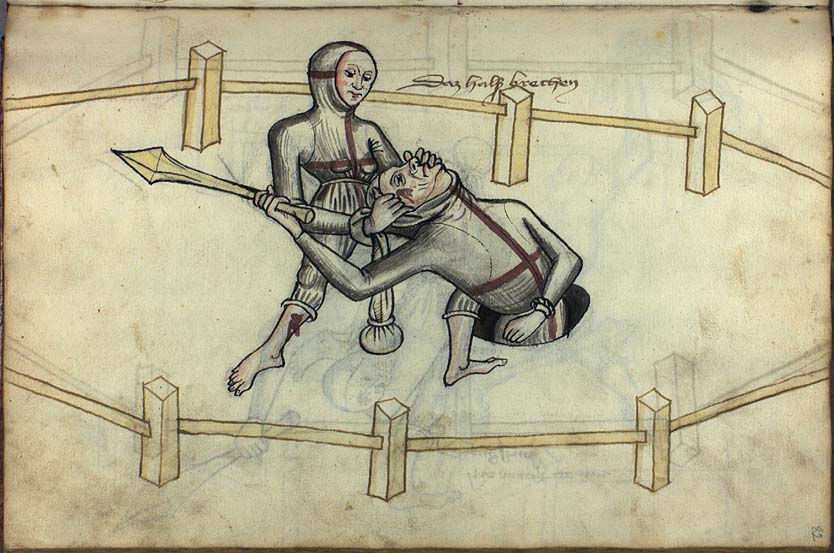
More medieval duelling with huge shields and clubs http://www.kampaibudokai.org/DragonPreservationSociety/Talhoffer_files/talhoffer15.jpg

Some a little more modern
If you need a "cultural tradition" to make your story run in 40K, make it up.
The empire has more then/nearly a billion worlds, many of which are completely unique from one another. If it weren't for the huge distances between theses sectors some of these worlds should "logically" war with each other. As rigid as the empire seems to be it cannot completely enforce its will upon every single one of it's planets.
If your playing in the Calixis sector this isn't very helpful, but even then one world to the next could be incredibly different.
For dueling, just make up the tradition and rules. In one scene in my dark heresy campaign the party scum started flirting with a noble lady, her father overheard and challenged the scum to a duel. They both called upon their champion to fight on their behalf. The duel was with sabres, first man to bleed or drop his sword loses.