.png)
They are beyond good and evil as we know it. They are that which in the beginning fell away from cleanliness. Through the deed they became bodies of death, receptacles of all foulness. But they are not evil in our sense because in the spheres through which they move there is no thought, no moral, no right or wrong as we understand it. There is merely the pure and the foul. The foul expresses itself through angles; the pure through curves. Man, the pure part of him, is descended from a curve. Do not laugh. I mean that literally.”
–Frank Belknap Long, The Hounds of Tindalos
Rules are meant to be broken. The whole concept of building decks is to put cards in it that break rules. That doesn't mean the rules are unimportant. It means that you'll have to know the rules in order to break them willfully and purposely. Which means the rules I'm going to talk about are actually guidelines. Or suggestions at best. Tools. You might have read some ideas on how to exploit resources in Francesco Zappons' articles. If you haven't, check out Exploiting Resources and Exploiting Resources, Continued. Today, we're going to explore this from a different angle – Let's take a look at curves, and bend them to our will!
First of all, the term “curve” denotes two widely different, but closely related concepts. There is “the curve” which is a measure of how powerful a card is and how much it impacts the game in relation to its resource cost. Generally speaking, the higher the cost of a card, the more impact it should have on the game. Not all cards have the same bang/buck ratio though. That's not a problem, but more of a feature – and that's why you can have three of a certain card and why factions have different strengths and weaknesses. It all adds a little bit of chaos to the game, keeps it fresh and makes deck construction a test of skill.
The Four Elements
If we're looking at cost, there are generally 4 categories:
0 cost – These are the cards that are free to play, and even circumvent the three-action-soft-cap, since they don't require you to drain a domain. While they promise to help you to be lightning fast, there is often a hefty drawback involved. Often, they come with steadfast to help tie them to a certain faction.
 1 cost – They’re still kind of free, in the sense that they don't require you to develop a domain by adding resources. Still, you need to have a domain with the correct resource open to play them.
2 cost – This category contains all the cards that put you to work in planning your resources and forcing you to make the difficult choices outlined in Francesco's articles. These cards have an important role in your deck; Generally they represent the most powerful play you can do turn one, so these better count.

Depending on how many you put in your deck, 2 cost cards are also part of the next category; If their number is low they bridge the gap toward the 3+ cost cards. In higher quantity they favor an equal resource spread among your domains –“horizontal resourcing”- putting them at odds with the 3+ category.
3 cost and higher – This final category contains all the strongest cards. Since they require you to focus on one domain, they strongly favor a “vertical resourcing” strategy. From the 3rd turn on, you have to decide whether you go for one big domain, or spread out resources equally.
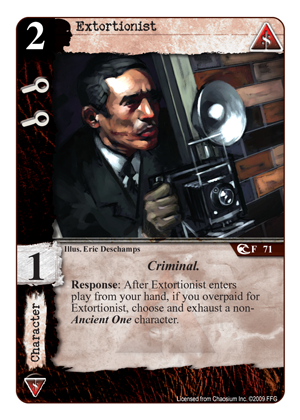
Note that in this final category X costs are also represented, as usually you want to have the largest X possible. Also, while a card like Extortionist (Core Set, F71) has a cost of 2, you generally want to overpay him for the effect, so effectively he’ll fit in with the other 3+ cards.
Some cards are just above the curve. Alaskan Sledge Dog (The Mountains of Madness, F18,) even post errata, offers the kind of power usually reserved for 2 cost cards. Being typical sledge dogs, they really pull their weight. For them to stand out, there need to be other cards that are just more situational, more average or just plain unfitting your strategy. But even if you just use the best cards for their cost, “higher resource cost” means “better card,” right? So, why not put in every card above cost 6 and call it a deck? This is where the other kind of curve comes in.
The Art of Deck Building
 So, why is this important? Well, to help understand your deck, you might want to throw a little math at it. We’re going to play a strategy game with it and so we can bring in Sun Tzu:
“The general who wins a battle makes many calculations in his temple ere the battle is fought. The general who loses a battle makes but few calculations beforehand. Thus do many calculations lead to victory, and few calculations to defeat: how much more no calculation at all! It is by attention to this point that I can foresee who is likely to win or lose.”
If you are reading a strategy article, chances are you prefer winning over losing. So, we’re going to borrow some tools from Sun Tzu when we’re deck-building.
"I perceive everything simultaneously. I perceive everything from all sides; I am a part of all the teeming billions about me. I exist in all men and all men exist in me. I perceive the whole of human history in a single instant, the past and the present.”
–Frank Belknap Long, The Hounds of Tindalos
In the part where you are putting together a deck, all possible scenarios are true at the same time. Every play you make is in there, planned in advance. To help having the most possible positive outcomes in this time vortex, it might help to fine-tune the details using the power of statistics. Aside from the actual content of the deck on a card-to-card basis, there is also something you can take into account called the “resource curve.” You can see this by sorting cards based on their resource cost.
The least complex option to do this is just sorting the cards on resource cost (or expected cost, in case of overpay or X costs) and see how they relate to each other. Some deck-building software you find online also has features to accommodate this. Once this is done, we can draw some conclusions on the effectiveness of the deck, the ease of making resource decisions and the general expected flow. Next time, we will look further into these ‘resource curves,’ and try to incorporate a more holistic approach to making a deck. Then, we’ll try to draw conclusions from it... and then find out when to forget all these calculations and willfully and purposely break the rules of deck-building.