Unoffical FAQ (and suggested answers) thread....

By pumpkin, in The Lord of the Rings: The Card Game

Kiwina just described exactly what I'm talking about, hence my confusion; I just didn't have access to the rulebook when I asked the question, so I couldn't put page numbers and quotes.

Glaurung, you really think I didn't look in the rulebook before asking? lengua.gif

Hmmmm this question was on this Forum cuople of months before. Anyway i already explain how i see it. And im sure green is mean you can play actions and events in your wish order. Otherwise is no logic. Same situation in planing phase.

Looks like the latest article answered my question once and for all.

" If you commit Prince Imrahil to a quest, along with a Gandalf (Core Set, 73) played via Sneak Attack..."

I would also take this to imagine that the colored chart in the back of the rulebook would override the "at the end of each step," ruling earlier in the book. Interesting.

I believe you can play things at the end of red steps, and throughout green steps. I do think there is an action window at the beginning of each phase, though - the intent of the designers for there to be such a window is becoming clear.

Pleeeeeease can we have a detailed aGoT-style timing chart?

radiskull said:

I believe you can play things at the end of red steps, and throughout green steps. I do think there is an action window at the beginning of each phase, though - the intent of the designers for there to be such a window is becoming clear.

Pleeeeeease can we have a detailed aGoT-style timing chart?

i agree...i believe the "play at end of step" refers to the red steps, whereas the green steps you can play at any time.

reno1051 said:

radiskull said:

I believe you can play things at the end of red steps, and throughout green steps. I do think there is an action window at the beginning of each phase, though - the intent of the designers for there to be such a window is becoming clear.

Pleeeeeease can we have a detailed aGoT-style timing chart?

i agree...i believe the "play at end of step" refers to the red steps, whereas the green steps you can play at any time.

I'll add to FAQ now that FFG have cleverly clarified it - coincidence or intnetional, I wonder!? gui%C3%B1o.gif

Just to clarify:

If I play Will of the West on myself, I shuffle the cards from my discard pile back into my deck before Will of the West enters my discard pile?

Yes, that's correct. You play an event, execute the event, THEN put it in your discard pile.

The latest preview of Rhosgobel http://www.fantasyflightgames.com/edge_news.asp?eidn=2610, previews treachery cards that damage wounded characters and characters without attachments.

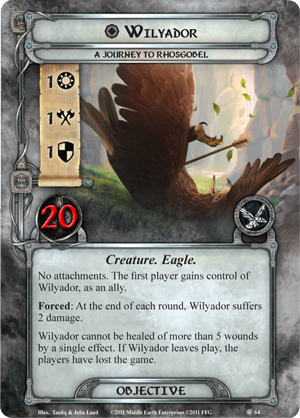
Both pictures shows eagles wounded or in peril, which makes me think of Wilyador http://www.fantasyflightgames.com/ffg_content/lotr-lcg/journey-to-rhosgobel/wilyador.png. But it's an objective card.

So my question is this: Does objective cards with the creature tag count as characters?

I'd say any creature you have control of is considered a character (like future Gollum card). In this example Wilyador is even specifically mentioned being a character in the treachery card text (shadow text).

DarthJalapeno said:

So my question is this: Does objective cards with the creature tag count as characters?

Character Cards
Sometimes, game or rules text will refer to “character”
cards. Both heroes and allies are considered to be
“characters.” Card text that says “choose a character”
allows a player to choose either a hero or an ally card
as the target of the effect.

Since objective cards are not mentioned, they are not considered characters,

unless the card text itself says that the card is to be considered a character (golden rule).

DarthJalapeno said:

The latest preview of Rhosgobel http://www.fantasyflightgames.com/edge_news.asp?eidn=2610, previews treachery cards that damage wounded characters and characters without attachments.

Both pictures shows eagles wounded or in peril, which makes me think of Wilyador http://www.fantasyflightgames.com/ffg_content/lotr-lcg/journey-to-rhosgobel/wilyador.png. But it's an objective card.

So my question is this: Does objective cards with the creature tag count as characters?

The key word here I think is "as an Ally".

All Objective Cards I've seen so far that Joins the players... this Eagle Creature included, have a text that says "join as an Ally."

I interpret this to mean, that ONCE HE JOINS the players he becomes an Ally (and therefore, by definition a Character) BUT NOT BEFORE he joins.

/wolf

jhaelen said:

Since objective cards are not mentioned, they are not considered characters,

unless the card text itself says that the card is to be considered a character (golden rule).

All I've seen so far have a card text that says "join the first player as an ally." or "first player gains controll of him as an ally." or something similar.

Therefore I would apply the Golden Rule and treat them as Allies for all intents and purpouses.

/wolf

GhostWolf69 said:

jhaelen said:

Since objective cards are not mentioned, they are not considered characters,

unless the card text itself says that the card is to be considered a character (golden rule).

All I've seen so far have a card text that says "join the first player as an ally." or "first player gains controll of him as an ally." or something similar.

Therefore I would apply the Golden Rule and treat them as Allies for all intents and purpouses.

/wolf

Thanks! I overlooked that.

P.S. Var köper du dina spel? [Where do you but your games] D.S.

GhostWolf69 said:

Therefore I would apply the Golden Rule and treat them as Allies for all intents and purpouses.

/wolf

But only after they join a player, not before.

reno1051 said:

radiskull said:

I believe you can play things at the end of red steps, and throughout green steps. I do think there is an action window at the beginning of each phase, though - the intent of the designers for there to be such a window is becoming clear.

Pleeeeeease can we have a detailed aGoT-style timing chart?

i agree...i believe the "play at end of step" refers to the red steps, whereas the green steps you can play at any time.

The reason it says "play at the end of step" is because after every red step, there is a green step. The only exception being in the Refresh Phase, where 3 red things happen back-to-back.

So, when you play, just follow the chart in the back of the Rulebook. Play actions at anytime during green steps. Play only responses during red steps.

The only phases that start with a green block are Planning and Quest.

sWhiteboy said:

reno1051 said:

radiskull said:

I believe you can play things at the end of red steps, and throughout green steps. I do think there is an action window at the beginning of each phase, though - the intent of the designers for there to be such a window is becoming clear.

Pleeeeeease can we have a detailed aGoT-style timing chart?

i agree...i believe the "play at end of step" refers to the red steps, whereas the green steps you can play at any time.

The reason it says "play at the end of step" is because after every red step, there is a green step. The only exception being in the Refresh Phase, where 3 red things happen back-to-back.

So, when you play, just follow the chart in the back of the Rulebook. Play anything at anytime during green steps. Play only responses during red steps.

The only phases that start with a green block are Planning and Quest.

Well, not anything at anytime. You can play actions during the green steps. Units and Attachments can only be played during the Planning phase though.

You know what I meant.... I fixed it.

Of course I did not consider the added complicaiton of card text allowing the same player to again declare an attack against the same Enemy, but... in essence the FAQ is quite spot on.

Players are Limited - Characters are not.

/wolf

Just to expand on this. According to the FAQ, a character can still only make 1 attack against a single enemy (whether he is engaged to it or not) unless a card-effect allows a second attack against it.

Let's say you attack an enemy you are engaged with, then, after your attack resolves, your teammate plays Son of Arnor and engages that same enemy. You cannot participate in an attack against that enemy, because you have declared an attack against it already.

Same thing goes for your teammate. If they participated in an attack against that enemy while you were engaged with it, then used Son of Arnor to engage the enemy, they cannot declare another attack against it.

sWhiteboy said:

You know what I meant....

Yeah, I just wanted to clarify for anyone else reading. I've seen some people make some very interesting mistakes in card games before. :)

sWhiteboy said:

Just to expand on this. According to the FAQ, a character can still only make 1 attack against a single enemy (whether he is engaged to it or not) unless a card-effect allows a second attack against it.

Let's say you attack an enemy you are engaged with, then, after your attack resolves, your teammate plays Son of Arnor and engages that same enemy. You cannot participate in an attack against that enemy, because you have declared an attack against it already.

This is pretty much contradicted by FAQ 1.11. You can only declare a single attack against a particular enemy. No limitation on participating. You've got a Hill Troll engaged with you and you declare an attack against it. Your friend plays Son of Arnor (with Sneak Attack, say) and engages the Troll. Can you declare an attack against the Troll with your Ranged characters? No - you've already declared one. Can you use your Ranged characters to participate when your friend declares an attack against the Troll? Absolutely.

In the FAQ example, Tom cannot declare an attack against the Hill Troll, but Kris could.

Ahh. I didn't realize that "declare" only referred to the active player. Anyone else who attacks isn't "declaring" apparently.

radiskull said:

sWhiteboy said:

Just to expand on this. According to the FAQ, a character can still only make 1 attack against a single enemy (whether he is engaged to it or not) unless a card-effect allows a second attack against it.

Let's say you attack an enemy you are engaged with, then, after your attack resolves, your teammate plays Son of Arnor and engages that same enemy. You cannot participate in an attack against that enemy, because you have declared an attack against it already.

This is pretty much contradicted by FAQ 1.11. You can only declare a single attack against a particular enemy. No limitation on participating. You've got a Hill Troll engaged with you and you declare an attack against it. Your friend plays Son of Arnor (with Sneak Attack, say) and engages the Troll. Can you declare an attack against the Troll with your Ranged characters? No - you've already declared one. Can you use your Ranged characters to participate when your friend declares an attack against the Troll? Absolutely.

In the FAQ example, Tom cannot declare an attack against the Hill Troll, but Kris could.

Radiskull, I usually agree with you wholheartedly but, I think I might have to disagree on this one. I believe that characters must be declared as attackers one by one, just as they must be declared as defenders one by one.

Take stand together as an example, Action: Choose a player. That player may declare any number of his eligible characters as defenders against each enemy attacking him this phase. That player may declare any number...yada yada, so on. It seems to me that any declarations must be done individually and to every action. Therefore, I believe that a participating character must be declared as an attacker or defender.

Bonus Card said:

radiskull said:

sWhiteboy said:

Just to expand on this. According to the FAQ, a character can still only make 1 attack against a single enemy (whether he is engaged to it or not) unless a card-effect allows a second attack against it.

Let's say you attack an enemy you are engaged with, then, after your attack resolves, your teammate plays Son of Arnor and engages that same enemy. You cannot participate in an attack against that enemy, because you have declared an attack against it already.

This is pretty much contradicted by FAQ 1.11. You can only declare a single attack against a particular enemy. No limitation on participating. You've got a Hill Troll engaged with you and you declare an attack against it. Your friend plays Son of Arnor (with Sneak Attack, say) and engages the Troll. Can you declare an attack against the Troll with your Ranged characters? No - you've already declared one. Can you use your Ranged characters to participate when your friend declares an attack against the Troll? Absolutely.

In the FAQ example, Tom cannot declare an attack against the Hill Troll, but Kris could.

Radiskull, I usually agree with you wholheartedly but, I think I might have to disagree on this one. I believe that characters must be declared as attackers one by one, just as they must be declared as defenders one by one.

Take stand together as an example, Action: Choose a player. That player may declare any number of his eligible characters as defenders against each enemy attacking him this phase. That player may declare any number...yada yada, so on. It seems to me that any declarations must be done individually and to every action. Therefore, I believe that a participating character must be declared as an attacker or defender.

But this doesn't contradict anything Radiskull has said.

The important points in the FAQ are this:

The active player is limited to one attack declaration against each eligible enemy.

Characters are not limited to the number of attacks they can make provided each attack can be legally declared

In sWhiteboy's example, the active player is the player who has just played SoA. All other players aren't active (at that time) and therefore all of their eligible characters could participate in that attack, even if they had attacked that same enemy previously.

Card effects can override even these basic principles, obviously, but even without a special card effect, the above stands.

pumpkin's clarification is exactly what I meant. I see it happening like this:

1) Player A declares an attack against enemy X.

2) Player A exhausts some attackers and Player B maybe exhausts some Ranged to help out.

3) All those characters are readied for some reason.

4) Player B declares an attack against enemy X.

5) Player B exhausts some attackers and Player A exhausts some Ranged to help out.

Now, even if the attackers in step 2 and in step 5 are EXACTLY the same characters, this is legal. What would not be legal is if player A OR player B declared an attack against enemy X again.

radiskull said:

pumpkin's clarification is exactly what I meant. I see it happening like this:

1) Player A declares an attack against enemy X.

2) Player A exhausts some attackers and Player B maybe exhausts some Ranged to help out.

3) All those characters are readied for some reason.

4) Player B declares an attack against enemy X.

5) Player B exhausts some attackers and Player A exhausts some Ranged to help out.

Now, even if the attackers in step 2 and in step 5 are EXACTLY the same characters, this is legal. What would not be legal is if player A OR player B declared an attack against enemy X again.

Well then in fact in your theorem enemy x in step 1 and 4 should be separate variables because in fact they are separate enemies.

Therefore, in the end what you are saying is that a single enemy may not be declared as a defender more than once (sans card effects) but a single character may attack as many times (against different enemies) as desired as long as they are readied first?