Greetings folks. I'm preparing to run my first game of Deathwatch and was wondering what the preferred method of Deathwatch play is. The options as I see them are: Battle Map (grid map), Imagination (all in the groups minds), and Tabletop (using ruler measurement system). I've played many RPGs and tabletop war games, so I can see the value in each. How do you keep track of the players, NPCs, and terrain in your games?
Map Preferences
We do everything abstract. I expected to use figures/grid but it just doesn't work out so well IMHO. We use figs for Dark Heresy and WFRP but in this game the abstract method just seemed to work best for us.
Whiteboard/minimap but no figures myself. Sometimes I find just a verbal description leaves people wanting (especially when they want to know if they're within range of something to shoot or move). A drawn map also makes it so there isn't a lot of ambiguity or misunderstanding in the description. But I don't use minis, I find that tends to bog things down a bit and my players start to latch onto things literally and they really start to get too focused on the rules over the scene for my taste.
Abstract and description all the way:
Maps slow play down. Players faff around moving minis, spend time thinking about it too much, and the GM has to spend more time moving stuff and drawing it out. DW is supposed to be FAST and about high-intensity action.
Maps stop players using their imagination to it's full limits. If a GM reads out a room description, everyone listens and pictures it. If the GM draws a map out, then players don't really bother listening to the description, because all that matters really is the map.
Maps limit imagination. Players move around the map in the little squares and shoot stuff. Players without maps are more likely to actually question their environment and interact with it. 'You said there are big ducts. Can I hide being them? Can I rip them up and throw them? Is there something in the room that I can dive behind?'. Instead of simply limiting the players to interacting with what is there on a map, doing it 'in your head' allows the players to be more immersive.
This isn't a skirmish wargame, it's an RPG. If I want to play a skirmish wargame and faff around measuring ranges, I'd play 40k, thank-you.
Lack of maps give players the benefit of the doubt. DW is supposed the be heroic, where the GM's default answer is 'sure, go for it!', not 'no, you can't charge, because it's one square too far and there's a square of rough terrain in the way'. Without a map the GM can have much more heroic fights, without having to let pesky little rules and micro-managing of the scene get in the way.
In open fields, maps become laughable. Ranged combat should take place at a distance where the bad guys can't always close in a single round. Sometimes players will engage targets 500m away. Maps fail at this.
There's an excellent page in the Feng Shui rules about 'why the map is your enemy' that is so spot on in telling GMs why maps are a bad idea for very heroic games. I might break out a sheet of paper to scribble a map down on of a complex area, but actually using a battle map... no chance!
I use quick sketches when my descriptions fail to make the players understand the exact situation and positioning. Occasionally I use maps - for example for the last stand on Avalos. But mostly verbal descriptions.
Alex
I use both. Most of the time I prefer narrative but there are times a nice set piece with a big battle map is fun.
Thanks for the info / opinions. Please keep 'em coming. Depending on what my players prefer, I think we may try to primarily play abstractly. Some of my favorite role-playing sessions were abstract with AD&D 2e. Currently, we're also playing a couple of D&D 4e campaigns using tiles and maps. The story is great and the DMs do a superb job, but I find myself less than satisfied that they end up running more like war games than RPGs. As some have mentioned, sketching a quick map out for clarification can be handy, but I like the storytelling experience that abstract play can bring. Hopefully, I'm not just remembering things with rose-colored glasses. Do any of you have any difficulties with the disconnect of abstract play meeting up with pretty specified distances in some of the powers? I'd imagine you could use the ambiguity of abstract play as another storytelling tool. "Yes you can do that. In the chaos of the fighting you now find yourself within 10m of the genestealer."
Exactly. This is why abstract is great for games such as DW, where the characters are Heroes with a capital 'H'. If a player says 'can I use...?' then it usually is a sign of imaginative thinking, which free-from combat should and does encourage. If the GM is uncertain about range, then the default answer should be 'yes' in order to give the player's the benefit of the doubt and generally give a positive atmosphere to the game.
Using a battle-grid just enforces the rules, and DW is a game where the rules are only there to provide a framework for the fun and action.
I have and always will adhere to the idea that abstract leads to alot of fun. Never had a problem running it unless the nuts and bolts require it. And by doing that, me and my group can use more of a storytelling style which I am then inclined to ablige them. In DW I use a tactical map for myself for the bigger conflict overall so I can keep track of all of the players in the fight OUSIDE the immediate vinicity. This also allows me to keep track of the terrain around the KT so I don't get confused. My players appearently like the system so thats how I do it.
There's my two cents,
-J
I guess I'm in the minority, but I always use miniatures for combats involving more than a couple participants. For outdoor combats, I use miniature terrain, with ranges measured with a tape measure, Necromunda-style. I love the visual element, and there can be no doubt as to where everyone is in relation to each other and who can see what. I've been using the standard 1" = 1 meter scale, but that makes it pretty easy for the action to spill off the table, so I'm considering switching to 1/2" = 1 meter instead.
3-D terrain isn't really practical for most indoor fight scenes, so I use a wet-erase battlemat with a printed 1" square grid and details drawn on it as needed. Playing from a grid can be a little stiff, but it's perfectly workable.
Oh, and for a recent game- a "bug hunt" aboard a space station- I trotted out a friend's Space Hulk tiles. That was fun, but there was one problem: I had originally intended for each deck to have a different layout, but the tiles take a surprisingly long time to set up, so I had to stick with the same layout for each level, to keep the game from bogging down...
In our group, we usually go imaginary, but we all get a great thrill out of setting up the table. We play at my friend's house, and he's got all his minatures in glass display cases, and he's got alot of painted buildings. So we make epic scenes, like this one from when I was running Extraction:
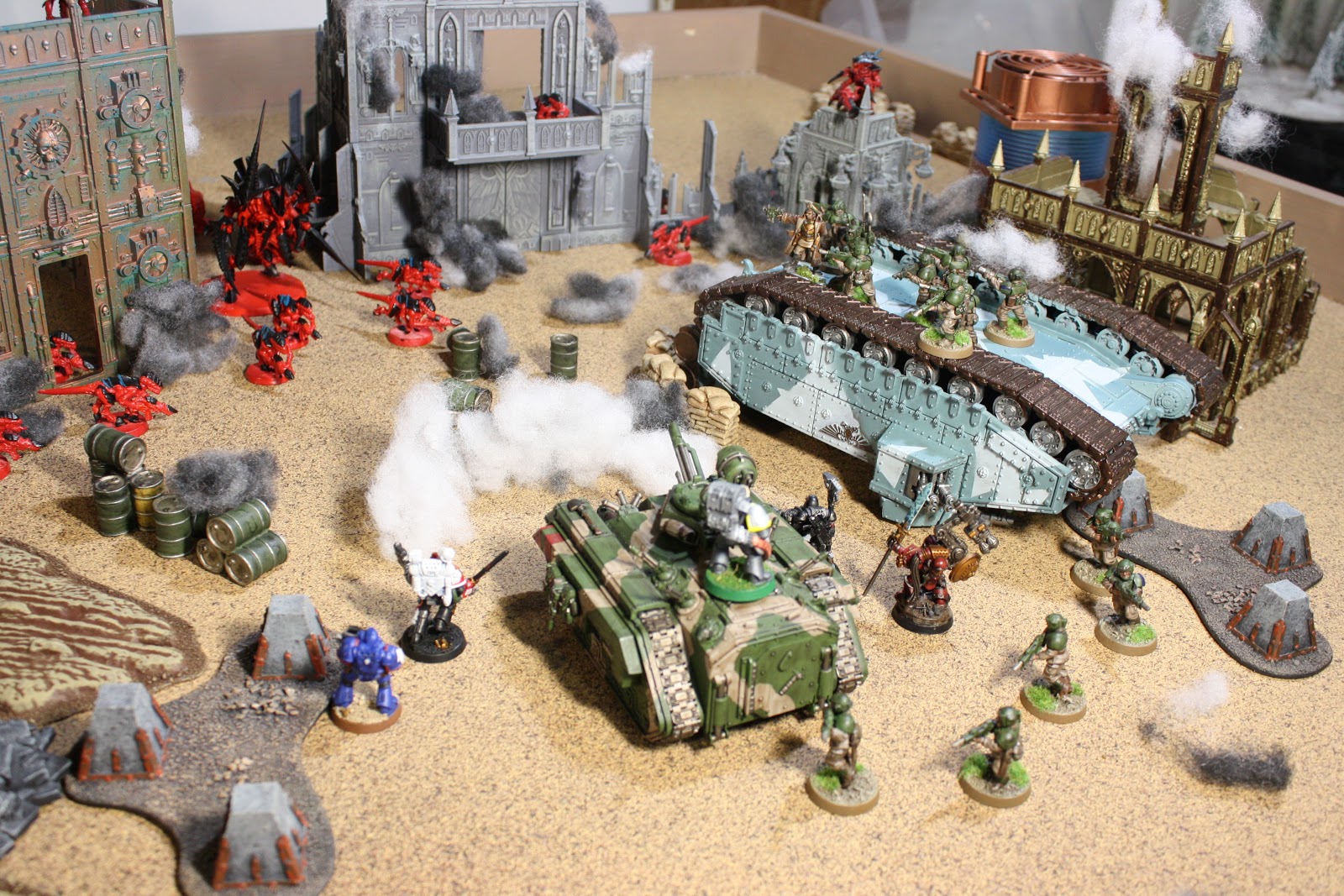
Our group comes from Table Top play, so everyone has worked hard to make their own 'me-man-marine'. Heck, we even do 500 extra exp fr having one. So ontop of loving your character, you also have your character moving over the board.
So it gets pretty crazy when we play.
We always use a combination hex/grid mats, sketches, and descriptions no matter what game system we are using. Highly cinematic, running chases get abstracted while close in big fight scenes call for the battle mat. We also adjust scale on the grid mats depending on how big an area is, sometimes even during a fight. We can have anywhere between 2-6 school trained artists, level designers, and art directors in our various games, needles to say my various groups like the touchy-feely aspect of mats and minis quite a lot.
Half the fun of a mat is the look of terror, or sometimes XP greed, that takes over players faces as you start placing dozens of enemy minis.
I use all three methods. It depends on the situation.
Abstract: Great to use when it is irrelevant where everyone is or if the fight will only last one or two rounds. Also when each has their own foe to conquer you can use the abstract method. and although it invites people to become creative it also tends to bog down into discussion if something can or cannot be done.
Drawn Maps: Great to use if it is relevant to know where everyone is. What is the lay of the land. In the fight on the space port in Oblivion's edge, I used a map and placed minis so it was clear where everyone was. the hordes were represented by 1 mini. Distance is only a proximation so in case it is unclear I give the players the benefit of the doubt.
Grid maps: Great to use if distances are important. It works best when the distance is short, within a few meters. Ranged combat is usually not a good option with grid maps as the distance is far greater than the map itself.
Also some have said that maps dull the creativity in what players will do. I disagree with this. I have seen some great stunts thought up because the lay out of the map seemed to make it possible.
Octus said:
Also some have said that maps dull the creativity in what players will do. I disagree with this. I have seen some great stunts thought up because the lay out of the map seemed to make it possible.
The thing is though, that it's essentially requiring them to add ANOTHER level of abstraction. With a description, the player takes your verbal clues and then uses that to inspire them to do something cool. With a map, your version of events is abstracted into the map, which is then a purely simulationist tool. The player then has to re-draw that into 'reality' again and THEN get imaginative with terrain.
When players see grid lines in front of them, they start to think in grids. In many ways it's the battlemap that is the 'abstract' version of events.
We do everything with miniatures. I have an immense collection of terrain, maps, tiles and so on from so many sources - GW, D&D, Paizo, FFG, etc. - and as we're all 40K players we have models from virtually every race in the game barring Dark Eldar (as they're new). There are numerous times when we do things in "imagination land", but when we're exploring a Space Hulk or running through a forest, it's with miniatures.
BYE
Speaking of game boards and treeain, a friend of mine just sent me this link:
http://plasticlegions.blogspot.com/2011/02/warehouse-hulk-bout-done.html
-Freakin' awesome!
I use a mix, but I always use a hex-map.
Most of the combat and situations in Deathwatch are better done abstractly, where I get the players to place their miniatures on the grid in approximate positions and I sketch out the environs using wet-erase markers. This helps everyone visualize everything and keeps the confusion down.
Sometimes, however, combats can get a bit hairy, and when they don't involve a horde (but just a few enemies) I will be more specific with the hex-map. I'll make every hex be a meter, and have them move tactically.
And the reason I use a hex-map (besides my odd love of hexagons) is that it doesn't require that every other square moved diagonally count as two meters. A lot of gamers forgo this fact altogether when using square-grid maps, but I'm a stickler.