It's a Nightmare! What's in a name?

By talismanisland, in Talisman Home Brews

I was having a little ponder (as I am wont to do...) about the cards that were featured in the Reaper and Dungeon expansions with the name "Nightmare".
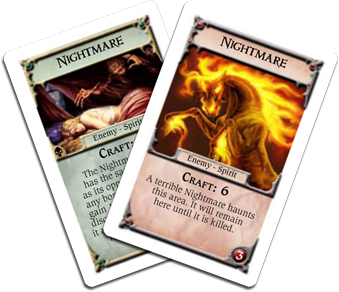
se_nightmares.png

Though having cards with the same name isn't really a big problem, I just happened to have Strange Eons open and figured I might make an alternate card for those that might wish to make the distinction between the two cards that little bit easier.

So, to that end, here is the Night Terror...
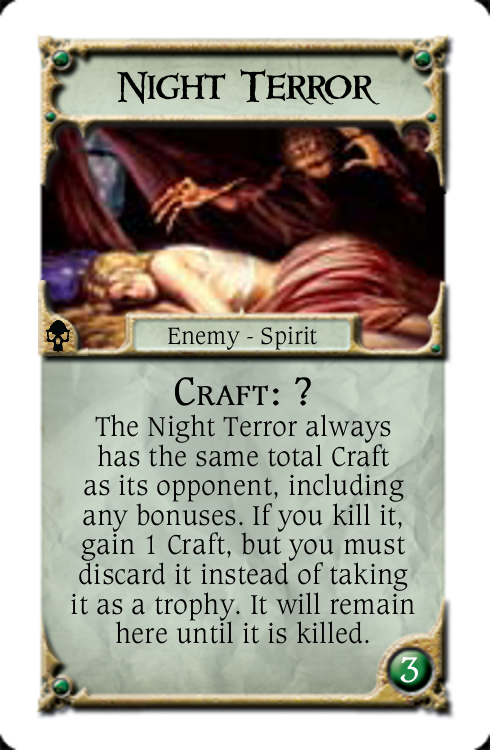
se_night_terror.png

Right click, Save picture as...

You can either print it out and stick it to your existing card or just cut out the name portion and stick that on! Or neither!!! gran_risa.gif

Ha! One of my group suggested the same thing though in different direction.

Nightmares appear in various forms so it's not really a problem for our group, but cool idea anyway Jon.

Regards,

Ell.

The night "mare" is a very late addition to that particular bit of folklore and is a misconception. Most of the online dictionaries have got it wrong as well, as the creature has nothing to do with a female horse - that would be the "nykur," which is water related, not fire.

"mare" in the term comes from the old english "maere", decended through german and likely back to latin. A minor demon or lower being in general, or sometimes a condemned spirit risen or sent back up to torment the living. They are actually quite weak, and hence why they attack during sleep.

They can appear in the dreams of their victims, trapping them there, and some are said to feed off their victims' fear, stoking that fear to the point of death. Later it was thought they were physical, lying or sitting upon the victim's chest and trapping it in dream until they crushed the breath out of it. They are equated to a "goblin, incubus" and thereby also male, not female, though the Catholic Church later equated them to the succubus (considering the incubus to be the same thing in an alternate form), and that was when it became female... and thereby came the "nightmare" of a female horse in modern times.

Some (supposed) scholars say it was also a way for the church to terrify men into never letting their wives "on top" and sticking to the sanctioned "missionary position," lest the husband be suffocated in his sleep. I'm not sure I buy that part.

A little 5 minutes of research can make for some interesting cards, so I'm glad someone did so on the version Jon labeled "Night Terror." A gold star for whoever was responsible!

JCHendee said:

The night "mare" is a very late addition to that particular bit of folklore and is a misconception. Most of the online dictionaries have got it wrong as well, as the creature has nothing to do with a female horse - that would be the "nykur," which is water related, not fire.

"mare" in the term comes from the old english "maere", decended through german and likely back to latin. A minor demon or lower being in general, or sometimes a condemned spirit risen or sent back up to torment the living. They are actually quite weak, and hence why they attack during sleep.

They can appear in the dreams of their victims, trapping them there, and some are said to feed off their victims' fear, stoking that fear to the point of death. Later it was thought they were physical, lying or sitting upon the victim's chest and trapping it in dream until they crushed the breath out of it. They are equated to a "goblin, incubus" and thereby also male, not female, though the Catholic Church later equated them to the succubus (considering the incubus to be the same thing in an alternate form), and that was when it became female... and thereby came the "nightmare" of a female horse in modern times.

Some (supposed) scholars say it was also a way for the church to terrify men into never letting their wives "on top" and sticking to the sanctioned "missionary position," lest the husband be suffocated in his sleep. I'm not sure I buy that part.

A little 5 minutes of research can make for some interesting cards, so I'm glad someone did so on the version Jon labeled "Night Terror." A gold star for whoever was responsible!

The mare is usually a supernatural female creature tormenting sleeping humans and animals, especially horses, by pressing their chest or riding on top of them. In the north the mare´s first appearance is in a poem from the 9th. century which appears in the book "Snorres Edda" written by a king of iceland in the year 1220. The mare is simmilar to the latin creatures, succubus, female demon who has intercourse with men in their sleep, which would course lower health or death, and the incubus a male demon who has intercourse with women, using the sperm collected by the succubus to make the women pregnant. These children would then be easier for the demons to affect.

Regards

I think the two Nightmare Cards can have different art and different text.

Night Terror is a possible name to solve the name problem.
But the Night Terror should be written on the horse art card, because
the Nightmare is historical and literarily more looking like the creature
on the other card.

A nightmare is not looking like a horse, but it is able to ride!

Some additional Information:

Nightmare = Nachtmahr

Mahr, mar, mer is a very old word. It is pre-christian and international (european).

A mahr is a little black creature which comes over a sleeping person
or a sleeping animal. The pressure of the mahr on the victims body
makes the emotion or the feeling of fear. It brings anxiety states and
breathlessness during a dream.

The mahr is able to shift shape. The nordic mahr always has a relation
to riding! No other nordic ghost or spirit is riding. In old scandinavian
literature the mahr is a creature that is able to transform it's „hugr“
into another person. The „hugr“ is not only the soul, it is more, also
the thoughts, the wishes, and more are shifted.

Not the horse is the nightmare, it is the riding creature.

(see also pictures "Nachtmahr", Johann Heinrich Füssli, 1771 and 1802)

In the 13th Century and later two types of Nachtalb creatures exist,
the male incubus and the female succubus. Nachtalb is a new word for Nachtmahr.

The etymologic root is „mer“, an old germanic word (germanic not german!)
It means „zerstoßen“ (to pound something).

„mara“ Old High German (althochdeutsch)
Swedish
Polnish
Icelandic
„mare“ Middle High German (mittelhochdeutsch)
Anglo-Saxon
Norvegian
„mura“ Czech
„mora“ Slovakian
„cauchemar“ French
„??????“ Russian
„nightmare“ English
„Nachtmahr“ German

The new German word for Nachtmahr is Alptraum (used after Reformation),
that means bad or horrible dream.

Thanks Azoic, JC and Wizard. We have our own encyclopaedic group here!!!

Ell.

Another educational series of posts!

I preferred to leave the "horse" Nightmare as it is, as I believe it is more of a play on words than attempting to be "historically" correct.

Choose your flavour...

talismanisland said:

Another educational series of posts!

I preferred to leave the "horse" Nightmare as it is, as I believe it is more of a play on words than attempting to be "historically" correct.

Choose your flavour...

I actually like the horse pic. the most. I think it is very cool picture for a nightmare creature. And as it is in real life, you can also "encounter" different nightmares in talismangui%C3%B1o.gif

The Wizard said:

In the north the mare´s first appearance is in a poem from the 9th. century which appears in the book "Snorres Edda" written by a king of iceland in the year 1220.

Except that the Snorres "Essays" were recorded by a Catholic convert and highly influenced and interpreted from that perspective. One prime detail of evidence is found in this mention of operation attributed on the incubus/succubus issue, which does not line up correctly with their classical Graeco-Roman origin... and such creatures also go back further under other names into ancient Mesopotamia. The whole passing of sperm thing is purely Catholic, as that was unnecessary for the original forms of these "demons." It is also possible that the author crossed certain aspects of the "nykur" (also by other names) out of northern Celtic folklore, and which blended a lot with cultures in the further north.... with the early christian interpetation of the nightmare's Old English variation of term.

Etymological studies have already grounded the term "nightmare" in the nihtmære of Old English. "mære" means roughly "spirit/goblin/incubus" versus "mearh" (horse) or "mere" (mare). It's basis is in the P.Gmc. term "maron'' (goblin), "moar-" (incubus) and not "mare" or "mara". The similar spellings have led to many mistranslations over the centuries and many misconnections thereby. One can also add in that the written form of English words was not stabilized until very later in our history. Monks working in recording words out of the Celtic (and other) tongues were notorious for a variety of spellings in trying to capture how a word was spoken aloud.

These two parts of the Old English (including Anglo-Saxon influences) are well grounded through etymological study as Proto German... BUT with cognates from the Celtic tongues. Not German cognates, and hence even more confusion for the monks. Hence the term didn't even originate in the P.Gmc. language but from somewhere else much older. Wide-spread and cross-pollinated errors and misinterpretations multiplied thereby, when information was copied from one text to a different one in what passed for research in a world where actual texts were rare and expensive.

A modern translation of an old text doesn't often look this deep into language and how terms were altered in spelling or outright mistranslated, and thereby meaning was misinterpreted. A lot of pop culture notions (or homogenized concepts) were born out of this.

So was born our modern notion of that demonic horse.

As to the cards, there's certainly no reason we can't have concepts taken from pop culture or accurate world myth, legend, folklore and superstition. But when it comes to a growing encounter deck for any game, the latter provides ten-fold more diversity. Somebody at FFG understood this, at least on one card, and it helped keep new cards coming that were a tiny bit more than just a new title and illustration.... though I could think of some nastier, funner mechanics to put on that card.

I agree with Jon that the original Dungeon "nightmare" was more a play on words than anything else. Talisman has always been a bit tongue'n'cheek. It was meant to be that way in part. That's enough from me, as I'm sure others will agree.