This is regarding the implementation of doors in Tannhäuser. I'm using the example of the default indoor map, Castle Ksiaz. Digram is taken from the corridor in the centre of the map.
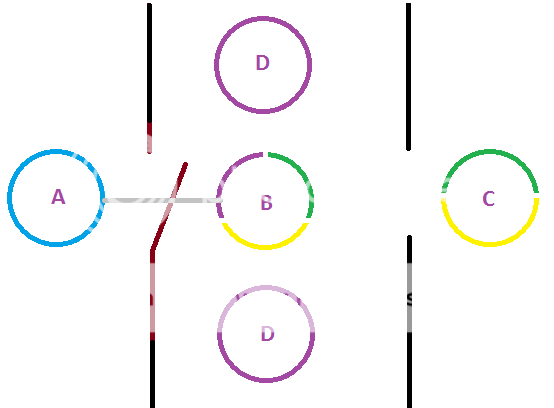
I know it's crude. I'll be quoting pages/paragraphs from the revised edition rulebook.
From circle A, there is no colour pathway to B and vice versa. On the actual map, there is a door in between A and B.
In the rulebook, page 14 of the second column says "As a general rule, circles separated from one another by walls are not adjacent. Adjacency between movement circles is determined independent of path. That is, two circles can be adjacent to each other regardless of whether they are on the same path or not." It also goes on to say that players should refer to the tactical diagram on page 80. According to the tactical map, A and B are linked by a black line (grey in my picture above).
Skipping forward to page 16, "Walls divide areas of the game board from each other", and once again states for disputes on paths go see page 80. The next paragraph describes doors as "decorative - rather than mechanical - elements", and that "unlike walls, doors drawn in on the map do not affect or indicate circle adjacency" plus once again- refer to page 80 for disputes.
Next page has a definition of sighting. It says that line of sight "is always reciprocal. That is, a character who can see can also be seen by that character. Two characters who share a path can always see each other." It then goes on to say "The only exception to this is Hand to Hand attacks. Hand to Hand attacks may target a character on the other side of a door, regardless of line of sight. The target must still be in an adjacent circle, as indicated by the tactical maps".
Now that the relevant rule sections have been quoted-
My question is this- since the game clearly states that doors are not a game mechanic (i.e. do not add or subtract anything to the game since they are just decoration), why is there a ruling listing Hand to Hand combat through doors "regardless of line of sight"?
Can a character in A simply shoot a ranged weapon at a rival in B since the game says they should be treated as adjacent and thus connected? Is it allowed, or is Hand to Hand the only option? Realistically, it make no sense (I can punch/knife through the door but I can't shoot through it?) and it should be other way round (fire through wooden door and block knife attacks). Building on that, if that is possible to shoot from A to B is it possible to interact with someone at either C or D (gun, etc) since they are connected (since B is pretty much a "wildcard" in this scenario as it has all three colours it's therefore connected by pathway to all three)? Or does everything stop at B since it's a colour change? I'd assume a colour change = different path regardless of "wildcard" movement circle and as such would come under the "Out-of-Path Ranges" rule section, which is the most logical.
I assume that grenades can be chucked in from anyone standing at B, C or D into A (or within throwing range) since B is connected to A. Likewise, splash damage on B would affect anyone on A and that A has throwing range into C's room and up/down along D since they are all connected.
Basically, to sum up main problem is this- since the rulebook clearly states that doors are not a factor in anything and are purely decoration, am I allowed to shoot from A into B and vice versa? If not, can someone point out the page/section that deals with this? The manual is vague on this, apart from saying that Hand-to-Hand combat is allowed through a door (against all real world logics, when if doors ARE a game mechanic surely it would be firearms only)? Failing that, can I get some examples of house rulings you guys use? Some say that only weapons marked "Heavy" can shoot through doors (same ones that can't be used when in Overwatch), others say melee attacks only, others have modifiers (such as increased defensive rolls since attackers are firing at a known target behind cover) in play and others block all combat (except for Bull Rush since it's a movement based attack, but it could be argued that Bull Rush can be blocked since target is hiding behind cover).
Any solutions would be welcome, just please give reasons even if it's just decided to be a houserule!