Prey keyword

By Janaka, in Arkham Horror: The Card Game

I've always played a creature with the prey keyword like a hunter, but with a specific 'victim' to move towards (as long as the creature isn't already engaged of course).

Am I playing this correctly? Does a creature with the prey keyword move through locations, if able to do so, towards its prey?

I've read the rules and looked up FAQs and various on-line sites about how the prey keyword works but nothing seems clear to me.
All prey does is act as a tie-breaker if there are multiple valid options for which investigator the enemy would engage or, in the case of hunters, move towards.

This generally occurs in four cases:

  1. An enemy with a spawn instruction spawns at a location with two or more investigators. If the enemy has no spawn instruction it will engage the investigator who drew it regardless of its prey instructions.
  2. An enemy readies at a location with two or more investigators, for example after it has been evaded and exhausted in the investigator phase.
  3. A hunter enemy enters a location with two or more investigators.
  4. A hunter enemy is an equal distance from two or more investigators who are at different locations.

In reality, I’ve found that prey rarely actually has any impact on gameplay.

Note that an enemy won’t move if it has prey unless it also has the hunter keyword. “Prey - Bearer Only” also behaves slightly differently, in that all other investigators are completely ignored when deciding where the enemy will move and additionally the enemy will not automatically engage other investigators.

I hope that helps.

Yeah, it sounds like you've been playing it correctly. I just want to clarify that hunters only move once - that is, to a single connecting location - each round during the enemy phase; you said "locations" with an "s," implying that you might be moving them until they reach their prey, which is not correct.

The greatest effect I've seen on gameplay is when a monster can take two equidistant routes to their prey (imagine four locations connected in a square, with the hunter and its prey at opposite corners), and a non-prey investigator is on one route, but the other is empty. I always move the enemy via the empty route, unless I want to kill it, so that it doesn't hit the non-prey investigator.

11 minutes ago, SGPrometheus said:

The greatest effect I've seen on gameplay is when a monster can take two equidistant routes to their prey (imagine four locations connected in a square, with the hunter and its prey at opposite corners), and a non-prey investigator is on one route, but the other is empty. I always move the enemy via the empty route, unless I want to kill it, so that it doesn't hit the non-prey investigator.

If I'm reading this right, this isn't correct. Hunters will target the closest investigator and only if the two investigators are equal distance from the monster, will the Prey keyword kick in. That means it will move to the non-prey investigator's location here.

Edited by Eeyogre

I don't know if I understood the question correctly, but it looks like Janaka was saying that he treats an enemy with the "Prey" word as if it were a "Hunter". But first keep in mind that if an enemy does not have the "Hunter" keyword it will not move on the enemy phase.

The prey keyword is only useful in the cases that Assussani. The actual rules for the Prey keyword are this ( https://arkhamdb.com/rules#Prey ). And keep in mind that if a Hunter enemy has also the Prey keyword it still moves towards the CLOSEST enemy. Unless it says "Prey - ONLY ...."

Edited by Henryillusion

So I've been playing it wrong.

A creature with the prey keyword does not move between locations to 'chase its prey'. Only a creature with the hunter keyword moves (unless an in-game situation instructs you to move a creature to another location of course).

Thanks for the replies.

9 hours ago, Eeyogre said:

If I'm reading this right, this isn't correct. Hunters will target the closest investigator and only if the two investigators are equal distance from the monster, will the Prey keyword kick in. That means it will move to the non-prey investigator's location here.

Yep, I've been doing this wrong. Upon closer inspection, the rules prioritize hunter first, then prey.

So that's been a solid three years of that or so. Whoops.

On 4/19/2020 at 12:30 AM, Assussanni said:

All prey does is act as a tie-breaker if there are multiple valid options for which investigator the enemy would engage or, in the case of hunters, move towards.

This generally occurs in four cases:

  1. An enemy with a spawn instruction spawns at a location with two or more investigators. If the enemy has no spawn instruction it will engage the investigator who drew it regardless of its prey instructions.
  2. An enemy readies at a location with two or more investigators, for example after it has been evaded and exhausted in the investigator phase.
  3. A hunter enemy enters a location with two or more investigators.
  4. A hunter enemy is an equal distance from two or more investigators who are at different locations.

In reality, I’ve found that prey rarely actually has any impact on gameplay.

Note that an enemy won’t move if it has prey unless it also has the hunter keyword. “Prey - Bearer Only” also behaves slightly differently, in that all other investigators are completely ignored when deciding where the enemy will move and additionally the enemy will not automatically engage other investigators.

I hope that helps.

I am not sure that the first point is correct. If you read the spawn instructions, the second bullet is:

  • If an enemy has no spawn instruction, it spawns engaged with the investigator who drew it.

Also, the last bullet of Prey rule is this:

  • Prey has no immediate effect on where an enemy will spawn (see " Spawn " on page 19).

So I assume that no matter how many investigators there are at a location, when you spawn a monster by drawing it from the encounter deck, it always engages the investigator who drew it. 🙂

@Jurcccy The last sentence of the first point reads, "If the enemy has no spawn instruction it will engage the investigator who drew it regardless of its prey instructions ."

@Assussanni sets it up as though prey is going to have an effect in this case, then specifically mentions that it has no effect, which I agree is a bit confusing. Not sure why they did that, but their point is actually correct.

1 hour ago, SGPrometheus said:

@Jurcccy The last sentence of the first point reads, "If the enemy has no spawn instruction it will engage the investigator who drew it regardless of its prey instructions ."

@Assussanni sets it up as though prey is going to have an effect in this case, then specifically mentions that it has no effect, which I agree is a bit confusing. Not sure why they did that, but their point is actually correct.

Not sure I've parsed it all carefully, but I think @Assussanni is trying to handle the case where Roland draws a monster with spawn instructions that spawn it not at Roland's location, but at location with Wendy and Ashcan. In this case, Prey will be important as it may distinguish which of Wendy or Ashcan get engaged. This is certainly a counter-case to @Jurcccy 's statement: "when you spawn a monster by drawing it form the encounter deck, it always engages the investigator who drew it."

Edit: See @Assussanni 's comment below for another situation where an enemy spawns at the location of the investigator who drew it but does not engage with that investigator.

Edited by Eeyogre

Sorry, maybe I didn't explain it very well, but it is basically as @Eeyogre says - to cover a situation where an enemy has both spawn and prey instructions. The second sentence was just meant as a reminder for what happens in the case of no spawn instruction (ignore prey).

It doesn't come up very often, but I found an example in The Unspeakable Oath so spoiler warning:

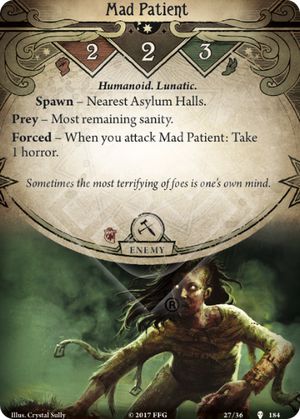
The Mad Patients have both Spawn and Prey:

03184.jpg

Consider Roland and Wendy together in an Asylum Hall, both at full sanity. Roland draws the Mad Patient during the Mythos phase. It has a Spawn instruction and the nearest Asylum Halls location is where both Roland and Wendy are. Because it has a Spawn instruction it does not automatically engage the investigator who drew it (Roland). Instead we look at its Prey to determine who it will engage and it is Wendy, who has 7 sanity compared to Roland's 5, even though Roland is at the spawn location.

Note that if it had no Prey instruction but still had Spawn then the investigators would get to choose who it engages. As can be seen in the rules that Jurcccy quoted, defaulting to engaging the investigator who drew it only happens if there is no spawn instruction. Otherwise it spawns at the location and follows the usual rules for a ready enemy at a location with investigators.

Edited by Assussanni
Extra clarification.

Thanks @Assussanni , this does make it clearer. I was afraid I were playing it wrong the whole time 😅