Treacherous Timing

By emeraldbeacon, in X-Wing Rules Questions

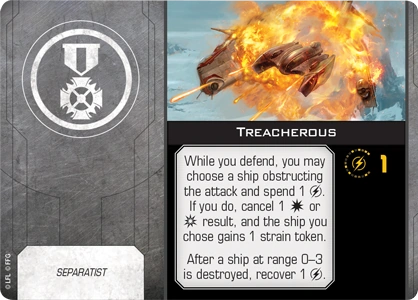
How wide (or narrow) is the timing window for Treacherous (first clause)?

The statement "while you defend" is rather vague... it could theoretically be any time during the attack process, as long as there's a hit or crit on the table to cancel. Cancelling a die result is not considered a modification, so there's no easy framework to force it into that time frame... I would suspect one of a two options are possible:

  • As it affects enemy dice results, you can only use it when you would otherwise Modify Attack Dice. This means you would need to cancel a result before offensive re-rolls, spending force/focus, or other offensive mods.
  • You can use it after offensive dice mods, but have to use it before rolling defense dice (I don't seen anything to support this interpretation, though).
  • You can use it any time up until the Compare Results step. That way, you can see your defense roll, and decide if you need to use it or not. (I reluctantly cautiously favor this interpretation, but seek other opinions)
latest?cb=20190119014048

Obviously, the second clause is much simpler: When a ship (friendly or otherwise) at Range 0-3 is destroyed (i.e. removed from the table), you recover the charge and can use it again.

Edited by emeraldbeacon
minor word substitution

Step 2 of "Attack" (page 4 of the RR for the start of the Attack section, Page 5 for step 2):

"Attack Dice: During this step, the attacking player rolls attack dice and the players can modify the dice.

Roll Attack Dice: The attacking player determines the number of attack dice to roll. Starting with the attack value, modifiers that increase or decrease the number of attack dice (such as range bonus and other effects) are applied. Next, if any minimum or maximum number of dice has been set, that limit is applied. There is always a minimum of 0. Then they roll that many dice.

Modify Attack Dice: The players resolve abilities that modify the attack dice. The defending player resolves their abilities first , then the attacking player resolves their abilities. "

Seems clear enough and nothing in the ability contradicts...

4 minutes ago, Hiemfire said:

Step 2 of "Attack" (page 4 of the RR for the start of the Attack section, Page 5 for step 2):

"Attack Dice: During this step, the attacking player rolls attack dice and the players can modify the dice.

Roll Attack Dice: The attacking player determines the number of attack dice to roll. Starting with the attack value, modifiers that increase or decrease the number of attack dice (such as range bonus and other effects) are applied. Next, if any minimum or maximum number of dice has been set, that limit is applied. There is always a minimum of 0. Then they roll that many dice.

Modify Attack Dice: The players resolve abilities that modify the attack dice. The defending player resolves their abilities first , then the attacking player resolves their abilities. "

Seems clear enough and nothing in the ability contradicts...

Except, cancelling results is not a form of dice modification... so that leaves me with the original question.

27 minutes ago, emeraldbeacon said:
  • You can use it any time up until the Compare Results step. That way, you can see your defense roll, and decide if you need to use it or not. (I reluctantly favor this interpretation)

This one, I think.

RR pg 5:

4. Neutralize Results: During this step, pairs of attack and defense dice neutralize each other. Dice are neutralized in the following order:

a. Pairs of 󲁄 (evade) and 󲁧 (hit) results are canceled.

b. Pairs of 󲁄 (evade) and 󲁨 (crit) results are canceled.

The attack hits if at least one 󲁧 (hit) or 󲁨 (crit) result remains uncanceled; otherwise, the attack misses .

This (and step 5 Deal Damage) are the first places "cancelling" results are mentioned during the attack phase. I think this supports cancellation of the hit or crit (and spending of the charge) after defense dice are rolled.

4 hours ago, Hiemfire said:

Step 2 of "Attack" (page 4 of the RR for the start of the Attack section, Page 5 for step 2):

"Attack Dice: During this step, the attacking player rolls attack dice and the players can modify the dice.

Roll Attack Dice: The attacking player determines the number of attack dice to roll. Starting with the attack value, modifiers that increase or decrease the number of attack dice (such as range bonus and other effects) are applied. Next, if any minimum or maximum number of dice has been set, that limit is applied. There is always a minimum of 0. Then they roll that many dice.

Modify Attack Dice: The players resolve abilities that modify the attack dice. The defending player resolves their abilities first , then the attacking player resolves their abilities. "

Seems clear enough and nothing in the ability contradicts...

FFG screwed up by using 'cancel' instead of 'spend', otherwise this would be correct.

The right phrasing would be 'the attack must spend one of their hit or crit results' and then we'd know how it's supposed to work.

It doesn't really matter it's a terrible card.

2 hours ago, thespaceinvader said:

FFG screwed up by using 'cancel' instead of 'spend', otherwise this would be correct.

Or they should have been more precise about the moment of cancelling the result. See: Selfless [Talent, Rebel].

9 minutes ago, Ryfterek said:

Or they should have been more precise about the moment of cancelling the result. See: Selfless [Talent, Rebel].

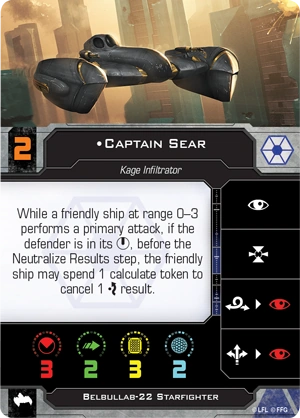
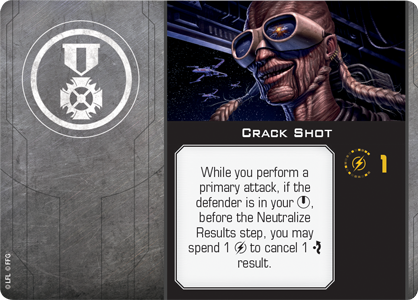
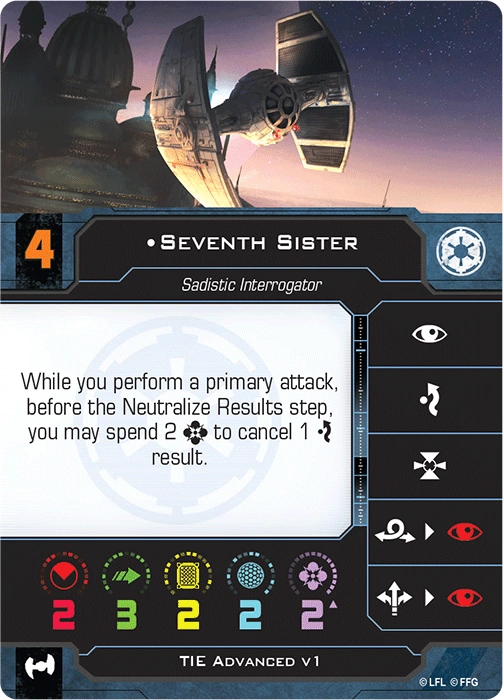
Or Crackshot

latest?cb=20190109165432

latest?cb=20180509222524

latest?cb=20180913211841

unfortunately, the wording is quite different on these abilities compared to treacherous. i'm still going to go ahead and say the timing should be similar, "before the neutralize results step".

Edited by meffo
2 hours ago, Ryfterek said:

Or they should have been more precise about the moment of cancelling the result. See: Selfless [Talent, Rebel].

Or that. One way or another they screwed up.

I'd say how hard can it be but evidently, quite hard.

I think I've come around to the best timing being " before the Neutralize Results step ." That's when pretty much all other "cancel [such and such] result" effects happen (Selfless, Crack Shot, etc etc)*. FFG screwed up and left out the words, but since that's the most common timing, I think that's what we should go with , until other instruction.

Treat it like it works, as if it was worded properly, rather than letting it be entirely unpredictable and willy-nilly and lawless. We can make the choice to be something other than barbarians.

* There is at least one card and at least one rule where this isn't the case. The Reinforce rule happens during Neutralize results, and crew General Grievous happens after it. However, both of these effects are limited to the case when two or more hit/crit results remain. Treacherous does not have this limit.

1 hour ago, theBitterFig said:

I think I've come around to the best timing being " before the Neutralize Results step ." That's when pretty much all other "cancel [such and such] result" effects happen (Selfless, Crack Shot, etc etc)*. FFG screwed up and left out the words, but since that's the most common timing, I think that's what we should go with , until other instruction.

Agreed, and I'll add that the "before neutralizing results step" is the last effective opportunity to cancel a die. The broadest reading of "while defending" is everything from being declared the defender to being dealt damageth, but you can only cancel a die that exists. So even if you do have the ability to cancel a die immediately after the initial roll (or at any other point) it is strategically the best place to apply treacherous immediately before "neutralize results"

As @emeraldbeacon said in the original post option 2, there is nothing that directs or implies this cancelling should be forced at any particular time, so I would suggest it be applied at the most strategic time.

From the RRG:


“• While: This term is often used in combination with multi-stepped game effects such as an attack, an action, or a maneuver. Although less specific than the other timings, this term is used to narrow down when the ability is resolved during the round. Additional verbiage is required to identify when exactly the effect is applied.

So technically per RAW, this card does not work at all because there is no additional verbiage present, which is a RRG requirement to apply the effect.

Pretty classic own goal by FFG.

On 10/19/2019 at 6:25 AM, Rettere said:

...

So technically per RAW, this card does not work at all because there is no additional verbiage present, which is a RRG requirement to apply the effect.

Pretty classic own goal by FFG.

Hmmm... I read that to mean that the "additional verbiage" will give more specific clues as to the precise timing the effect takes place. In the vast majority of While triggers the additional verbiage comes from another section of the Rules Reference or the "Official Rulings" thread, it's not usually on the card itself.

Even given that, there are a few cards besides Treacherous where there are no more specific timings explicitly given and people play it at the most reasonable/effective time. These include Debris Gambit , Daredevil , Larma D'acy , AP-5 , and the list goes on. Most of these involve changing the color/effect of an action/maneuver (while performing x action...) or having a specific token on your ship (while you have 2 or more stress...). There are others though that have a broad timing given by While that are treated as having the effect for the entire duration of that window such as Qi'ra , which works for the full windows of moving and attacking.

I think Qi'ra is the most similar direction to rule with Treacherous, so the full window is everything from being declared the defender to resolution of after attacking/defending effects. With that in mind the ability to cancel a result is only useful in the window from rolling dice to dealing damage, any earlier or later and there will be no dice to affect, and the best time to cancel a result is after neutralizing results.

Edited by nitrobenz
Proofread
On 10/19/2019 at 6:25 AM, Rettere said:

Pretty classic own goal by FFG.

Interchanging general English reading comprehension with specifically defined game terms is what I see as frustratingly classic FFG.

40 minutes ago, nitrobenz said:

...the best time to cancel a result is after neutralizing results.

This is currently true. In the future, there might be some bizarre effect where you would want to strain the obstructing ship as early as possible (Consider a weird ship ability like, "If you are strained, while you obstruct attacks, you may change 1 hit result to a focus result")... but I can't think of anything like that at the moment.

@nitrobenz and @emeraldbeacon - surely you jest. after neutralizing results, there are no results left to cancel. the best timing is during or before neutralize results. ^_^

14 hours ago, meffo said:

@nitrobenz and @emeraldbeacon - surely you jest. after neutralizing results, there are no results left to cancel. the best timing is during or before neutralize results. ^_^

I jest not! 🧐 I would settle for "during" but since that's not a formalized timing trigger I default to the next recognized opportunity, which I mistakenly called as After, but more rightly should be At the end of the Neutralize Results step. The only reason there would be no results at the end of neutralize results would be if I successfully evaded without needing Treacherous.

I would want to trigger this ability later than "before the neutralize results step" because the above mentioned abilities might change the balance of results either favorably or unfavorably and I want to only use Treacherous if it is actually needed, assuming the obstructing ship is friendly.

If, on the other hand, the obstructing ship is enemy I would want to trigger Treacherous earlier to both take away an attacking result and deal d̶a̶m̶a̶g̶e̶{strain} at the same time regardless of what the balance of results would eventually be. This might be immediately after rolling to steal a spendable result or after they modify to remove a potentially nasty crit.

Edited by nitrobenz
strike through corrected term
2 hours ago, nitrobenz said:

If, on the other hand, the obstructing ship is enemy I would want to trigger Treacherous earlier to both take away an attacking result and deal damage at the same time regardless of what the balance of results would eventually be. This might be immediately after rolling to steal a spendable result or after they modify to remove a potentially nasty crit.

I mean, the only "damage" you can do with Treacherous is a Strain token, so that's not much of an issue... but I can definitely see removing a key die result at a key time. Thane Kyrell rolls blank-blank-focus, you eat the focus right away to keep him from spending for a crit. Same with Seyn Marana and a crit result.

Which brings up another (highly edge-case) issue... with this (or other) cards that have an ill-defined timing, can you "interrupt" an opponent's step with your ability? Say I'm flying Seyn Marana with Marksmanship, and I'm targetting Grievous with Treacherous, after bumping a vulture droid. I attack and roll 2 hits against Grievous. I go to my modify dice step, then change one hit to a crit. Can Grievous jump in and say, "I now activate treacherous on your crit result, before you can use Seyn's ability?" Would "first player" status matter in that case?

19 hours ago, emeraldbeacon said:

...

Which brings up another (highly edge-case) issue... with this (or other) cards that have an ill-defined timing, can you "interrupt" an opponent's step with your ability? ...

An excellent question! There is definitely not a general rule against interrupting effects, but the general lean of Rulings and clarifications is against interrupting effects. Every time the community has determined that an ability interrupts an effect and that interaction gains traction in the game FFG comes out with a ruling or clarification saying that it does not interrupt either because the effect is un-interruptible (cost effects ranging from red action stress to Pinpoint Array have been individually clarified as un-interruptible) or the ability actually belongs in a specific step that was not made clear by the card or rules (Han rebel pilot rerolls are applied during dice modification instead of immediately after the roll).

I expect FFG to eventually come down with a clarification (or new rule) that dice cancelling effects default application is at beginning of neutralize results, but until they do I have no argument against something like Treacherous being used as an interrupt between modding to a crit and cancelling that crit before it is spent.

Edited by nitrobenz
Proofread