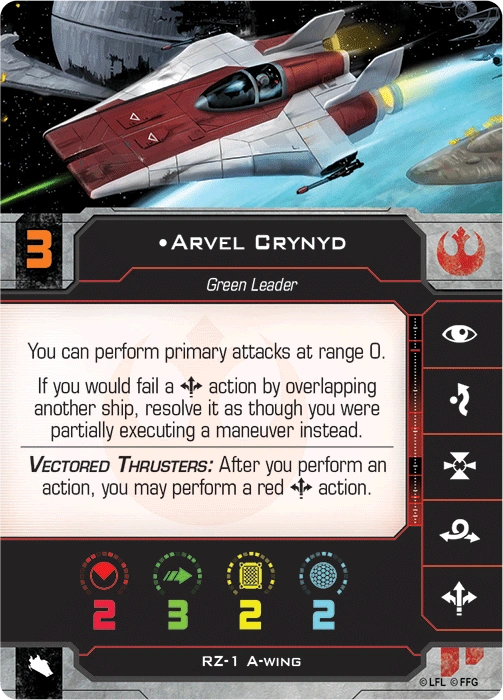
A very unusual edge case came up in a game today, that made me wonder about just how much control a player has over their own repositioning abilities.
For reference, I was flying Arvel Crynyd, and I wanted to use his pilot ability to perform a boost, letting me bump into the enemy ship right in one of their firing arcs. I felt like a straight boost wouldn't have enough distance, so I used the bank boost instead. It turns out that, once I placed the template (official FFG Hyperspace acrylic templates for reference), I had a little bit of wiggle room to place Arvel. If I slid him all the way to the left, he actually fit beside the enemy... positioned without a shot, yet still inside the enemy arc, a decidedly BAD situation. BUT, if I wiggled him all the way to the right of the template, the two ships would be forced to overlap, causing Arvel to back up, ending his quasi-boost-maneuver in base contact, and with a Range 0 attack option.
So the question becomes, with that wiggle room created by "Advantage templates," who gets the final say of positioning? If the ship can fit anywhere within the wiggle space, must it go there? Or can the ship executing the boost elect to fail the boost, if it becomes advantageous to do so?
In the end, I accepted that the boost could be completed, therefore it needed to, using the same criteria as a Barrel Roll... that a player must execute the barrel roll if any of the three positions fit, even if that position is disadvantageous. What I should have done is also declared that my ship was still at Range 0, that the wiggle room granted me enough play in the final positioning, to guarantee that at least the enemy couldn't shoot me back.