Are the conservative dice worse than the reckless ones?

By Armoks, in Warhammer Fantasy Roleplay

"Are the conservative dice worse than the reckless ones?" I have asked myself after few sessions. I don't speak about probability of rolling successes or boons, but about effects of a delay symbol. My Players belive that two recharge counters are much worse that a fatigue or stress point (they are able to get rid of stress or fatigue by using talent cards or action cards), thus they don't use or don't like to use a conservative stance.

Have you got a similar experience like me?

Do you have the GM Toolkit? There's an optional rule within that allows a player to trade recharge for misfortune dice. I'm not sure if you'd be interested in using such a rule, but it may address your players concerns about this.

My players generally prefer reckless to conservative, but characters with low TO and WP should go conservative, as for the hourglass symbol, I've house ruled that it means you take more time with the action when appropriate, other wise I give an enemy a bonus to there cunning or aggresion (or what ever its called)

Armoks said:

"Are the conservative dice worse than the reckless ones?" I have asked myself after few sessions. I don't speak about probability of rolling successes or boons, but about effects of a delay symbol. My Players belive that two recharge counters are much worse that a fatigue or stress point (they are able to get rid of stress or fatigue by using talent cards or action cards), thus they don't use or don't like to use a conservative stance.

The relative powerlevel of the delay symbol is entirely in the GMs hand. The tokens don't have to go on the card that's being used, you could put it on any action you can justify/explain. There are times when the initiative effect is stronger or weaker than the recharge effect. If your players are feeling that the delay symbol is too nasty, then it's possible that you as GM are being too aggressive with it. When they get rolled at my table, I tend to look for the second or third worst thing I could do with it. I identify the nastiest thing I could do, and then choose not to do it.

Couple quick rules points/questions related to this. Missing either of these rules will make Conservative dice less attractive and Delay symbols much more nasty:

  • Regardless of how many delay symbols come up, there's just one delay. Per the rules (see the back cover of the main book), even 3 or 4 delay symbols only adds just 2 tokens to just 1 action. There have been a few posts on these forums by people who missed that at first. (Same thing with fatigue/stress from Reckless dice, by the way.)
  • Players can spend a fortune point to remove a recharge token from an action. If they've missed that option (it's mentioned on page 14 of the rulebook), delay will be much harder to overcome. Not that they'll use that option very often, but it does allow for the occassional instant access to an action they desperately need.

It may depend on the GM. I'm pretty brutal with Fatigue and Stress. I like dishing them out like candy. But I love Fatigue and Stress as mechanics.

Everybody tends to go in hot when they enter combat so...yeah...makes them cautious.

Heh,

just goes to show that people have very different opinions about this. From what I've read and seen in my my own playing group people are generally more wary about fatigue/stress from reckless stance than delays from conservative. I'm usually 2-3 deep in conservative all the time and I don't really have a problem with it. With 3 conservative dice you get a delay on 30% of the rolls. You just have to have enough different action cards to have something to do the next turn (or couple of turns) when your favourite action is on recharge.

My GM sometimes put the recharge tokens on the basic attacks, but that doesn't really harm me, since I have 2+ ranged and melee actions and can use either a crossbow or sword and board. Flexibility is fun (and important when running deep in conservative stance).

Statistically Conservative dice have a better chance of success (hammers) vs. high difficulty, while Reckless dice have greater chance of rolling multiple successes vs. low difficulty. It comes out of the fact that 7/10 sides on a Conservative die are successes, while only 5/10 on Reckless (if I remember correctly).

At high numbers (5 green/5 red) it evens up a bit, but its still success wise on the Conservative side.

Also Reckless dice have more negative outcomes (Banes + the droplets).

D.

No. Conservative dice will give at least one success consistently. Reckless dice will fail you more often, but you will sometimes get the Double Success symbol. That's the main difference.

However, the additional chances for Banes from the Reckless dice can be significantly detrimental too. Like others, I like to dish out fatigue and stress and push the players to the limits of those in a combat/encounter whenever I can. It's the spice of life

Every player in my group has dumped conservative stance characters for reckless characters. They all tend to agree that going reckless is the superior option. The "consequences" for being reckless are often minor and take time to build up any bad effects, and usually by that time, the encounter or session is over with anywas.

As has been argued over before on here, success is really easy to achieve in this game and no matter if your high on conservative or recklessness, you have a high chance of success. Our troll slayer is 3 deep in reckless and even rolling that after the last 3 sessions, he has not missed one attack roll once. Even characters that should be conservative are trying to turn reckless as in the end, it just tends to roll more successes.

Only a few classes seem to require the use of conservative stance to get proper use of their cards, but generally reckless seems the way to go sadly.

Maybe your GM should be a bit harsher with the fatigue/stress and easier with the extra recharges?

I find normally in my games, when the players start group-think, I need to adjust how I am GM'ing slightly (probably cos I'm doing it wrong). Keeps me on my toes :)

One of my players is exactly the opposite. He hates going deep into Reckless stance because he is convinced that it makes him fail more than if he remains at or nearer to neutral. On top of that, he despises accumulating fatigue/stress from his actions as he feels this limits his options too much in future rounds. Ah perceptions. Funny how different people can see the same thing and have different opinions on what just happened.

PanzerKraken said:

Every player in my group has dumped conservative stance characters for reckless characters. They all tend to agree that going reckless is the superior option. The "consequences" for being reckless are often minor and take time to build up any bad effects, and usually by that time, the encounter or session is over with anywas.

As has been argued over before on here, success is really easy to achieve in this game and no matter if your high on conservative or recklessness, you have a high chance of success. Our troll slayer is 3 deep in reckless and even rolling that after the last 3 sessions, he has not missed one attack roll once. Even characters that should be conservative are trying to turn reckless as in the end, it just tends to roll more successes.

Only a few classes seem to require the use of conservative stance to get proper use of their cards, but generally reckless seems the way to go sadly.

The GM is probably being too nice with fatigue and stress. As others have pointed out, it can be nasty, but some GMs don't use it as often as they should.

Secondly, I think the fact that your group doesn't use Conservative stance much means that it doesn't see the benefits of it. Someone who is rolling 2 or 3 conservative dice will be rolling lots of successes.

Finally, your GM may be going too easy on you. He should be using more A/C/E dice on improving the monsters defences and should probably be using Actions like Dodge, Block and Parry more often. These will increase the number of outright misses the players suffer, as well as banes and fatigue.

macd21 said:

The GM is probably being too nice with fatigue and stress. As others have pointed out, it can be nasty, but some GMs don't use it as often as they should.

Secondly, I think the fact that your group doesn't use Conservative stance much means that it doesn't see the benefits of it. Someone who is rolling 2 or 3 conservative dice will be rolling lots of successes.

Finally, your GM may be going too easy on you. He should be using more A/C/E dice on improving the monsters defences and should probably be using Actions like Dodge, Block and Parry more often. These will increase the number of outright misses the players suffer, as well as banes and fatigue.

lol

I am the GM, and no I'm not being to lenient, I am following the rules as stated and give out max fatigue possible by the rules, and it still has almost no effect. Seriously fatigue is not a major consequence since toughness is such a popular stat to fluff up since it improves healing, wounds, resistance, and fatigue resistance. Toss in the right group card set talents and theres tons of way to get around fatigue penalties, as well as getting rid of fatigue and stress with rally steps.

Unless an encounter runs for a very long period of time, most characters are fine suffering the fatigue or stress as most will focus on their willpower or toughness stat depending on type of character.

And even with making use of A/C/E or active defenses, most combat engineered characters that are heavy in reckless just laugh at your oppenents.

Pretty much everyone has abadoned conservative stance since reckless just gives far more successes and the consequences are not strict enough.

Large part of this is the nature of the games card system makes it so easy to min max.

PanzerKraken said:

Unless an encounter runs for a very long period of time, most characters are fine suffering the fatigue or stress as most will focus on their willpower or toughness stat depending on type of character.

Just checking to see if we're all on the same page, here. You do know that your other stats are affected by fatigue and stress as well, right? And that your other stats determine whether or not you're strained? I ask because you only mention Willpower and Toughness - and those two stats only matter for determining at what point you pass out, but stress and fatigue can do a lot nasty things while you're still conscious.

Probably, you're already aware of all that, but I figured it was worth asking since you focused on Willpower and Toughness in your explanation.

Example: A character with a stat line of Str 3, To 5, Agi 4, Int 3, WP 5, Fel 2 that is suffering 4 fatigue and 3 stress would be strained. He'd draw a temporary insanity, and suffer a misfortune die on all Str and Fel checks. Each additional point of stress or fatigue would result in more misfortune dice on more attributes, and more chance of the insanity becoming permanent. He could take quite a few more points of stress or fatigue without passing out, but he'd be hurting pretty bad and probably insane for quite a while if he did suffer any.

The gamesystem should not be blamed. It is the power gamers that need to start roleplaying or just play videogames instead.

If you want to ROLEplay a "cautious" character then go ahead. Don't pock your nose too deep into the game mechanics.

It is up to the GM to make the adventures balance out between hothead- and coolmindsituations.

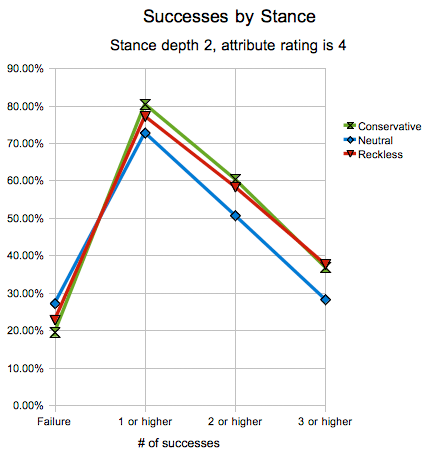
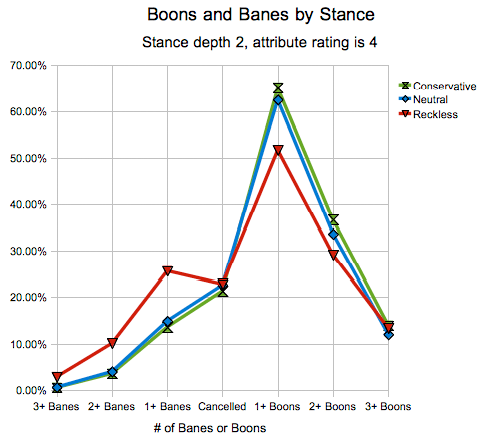
Unless you're using the "Higher Lethality" optional rule from the GM's toolkit, the green / conservative dice are in actuality better than the red / reckless dice. The red dice have a better chance of scoring the triple-hammer line, but they also have a much higher chance of scoring banes and actually result in slightly smaller chance of scoring a basic success.

If the effects of Delay icons and Exertion icons on the dice are roughly equivalent, then the green dice are significantly better than the red because of the extra banes. I suspect then that the intention of the game designers is for a Delay to be on average more troubling than an Exertion. That's also why many (but not all) of the action cards provide a more potent effect on the red side.

Here's a couple color-coded charts that illustrate the effects of using red dice in a typical pool. stancesuccess.gifstanceboons.gif

Playing around with different dice pools will of course vary how much the gap is between the red and the green dice, but the general statement holds true that the red dice will score a lot more banes and only outperform the green dice at the 3-success line. The pools used for those graphs were (1 Challenge Die, 2 Misfortune, 1 Expertise, 1 Fortune, and 2 Characteristics dice) plus either 2 more Characteristics dice or 2 stance dice. It should be pretty representative of the majority of rolls made during Rank 1.

To create the above charts, I used John Jordan's Warhammer Dice Probability Generator (www.jaj22.org.uk/wfrp/diceprob.html), and Open Office.

I've also been analyzing the odds of the various warhammer dice on my blog this past week, and will probably write a couple more articles about the math behind the dice in the coming weeks. transitivegaming.blogspot.com/

r_b_bergstrom said:

If the effects of Delay icons and Exertion icons on the dice are roughly equivalent, then the green dice are significantly better than the red because of the extra banes. I suspect then that the intention of the game designers is for a Delay to be on average more troubling than an Exertion. That's also why many (but not all) of the action cards provide a more potent effect on the red side.

I assumed that the red dice were worse than the green dice due to the fact they have more bad things - 2 each exertions & Banes vs just 2 delays. However I am not sure that delays are roughly equivalent to exertions. Delays can sometimes be really irritating - delaying the wizards channel sure was while more fatigue is often irelevant & can be planned around & dealt with "later".

Anyway at the moment I am happy that the dice are reasonably balanced & only lots more testing er I mean playing will really determine it more closely.

I have a suspicion the red dice would be more closely about right with one double bane instead of two singles. I used to think it might need a double success upgrading to a triple...

Exactly how to compare Delays vs Exertion though is tricky and subjective. I think, on average, per roll, one Delay bites you more than on Exertion, but when Exertion starts piling up it's worst effects get pretty nasty.

IMHO, being set up for Red Dice requires a bigger initial investment in terms of character points. For a character to be good at dealing with Exertion, they pretty much have to be built to do so right out of the gate. If you left yourself vulnerable to it (by having very uneven Characteristics scores) from the beginning, it takes a lot of XP to fix that. There are some Talents that can help, but the really effective ones require exhausting, which shuts down your other talent options. And of course you can Assess The Situation, but that's effectively just turning Exhaustion into Delays anyway, since you're trading your aggressive action in for fatigue management.

Delays, on the other hand, can be accommodated for more readily after character creation. Every extra action you pick up not only does whatever the main purpose of the new action card is, it also takes some of the sting out of Delay icons. And every character (regardless of career) can add at least 2 actions during Rank 1. So if you're character is getting nerfed by the green dice, there are other ways to fix it in the long term. It occurs to me that it might actually be easier even in the early campaign to make a character that laughs off Delays than laughs of Exertion, since 3 character points gets you 4 starting actions. Having 4 to 6 special actions will insulate you pretty well from Delays.

Unless, of course, you're a wizard. Wizards are indeed very vulnerable to Delay, because they often need to Channel on specific turns to do anything significant. Spellcasters definitely get hit more heavily by Delays, which may be a motive behind the "Spellcasting while Reckless can affect Party Tension" rule.