How does Decoy work?

By jods4, in Arkham Horror: The Card Game

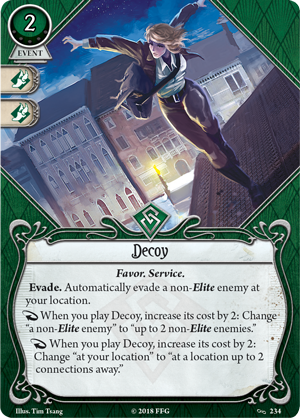
So in Union and Disillusion the card Decoy was previewed.

How does "at a location up to two connections away" work?
I see what they want to do but I don't get how it works given the game rules.

My understanding of the rulebook is that the Evade action can only be taken on an enemy that is engaged with you. Obviously, an enemy two connections away would not be engaged with you.

Have I been playing incorrectly all along? Can you take an evade action on an enemy at your location if he's engaged with another investigator?

29 minutes ago, jods4 said:

So in Union and Disillusion the card Decoy was previewed.

How does  "at a location up to two connections away" work?
I see what they want to do but I don't get how it works given the game rules.

My understanding of the rulebook is that the Evade action can only be taken on an enemy that is engaged with you. Obviously, an enemy two connections  away would not be engaged with you.

Have I been playing incorrectly  all along? Can you take an evade action on an enemy at your location if he's engaged with another investigator?  

Card text can override other requirements. Like you normally only can investigate a location you are at but some cards let you investigate a location further away. Same deal here, it allows you to evade enemies you are not engaged with and who may not be at your location, which is something you can't do without the card.

Jobu has it, but just to add a rules quote cherry on top:

RR, Page 3:

Some abilities have bold action designators (such as Fight, Evade, Investigate, or Move). Activating such an ability performs the designated action as described in the rules, but modified in the manner described by the ability.

Well I'm glad I played it right! And obviously this is how Decoy is intended to work.

" but modified in the manner described by the ability": the wording on the card is a bit confusing because it says nothing about lifting the engaged requirement and the rules about Evade mix the engaged requirement to perform the Evade action and the Evade effect.

Specifically the effects of a successful Evade are written with the assumption that you are engaged with the evaded ennemy:

Any time an enemy is evaded (whether by an evade action, or by card ability), the enemy is exhausted (if it was ready) and the engagement is broken. Move the enemy from the investigator’s threat area to the investigator’s location to mark that it is no longer engaged with that investigator.

Sure, you can say that you should do as much as you can, etc. But then there's no text that moves the evaded enemy from another investigator 's threat area and no text that says it is no longer engaged with that other investigator. ( "that investigator" in this rule refers to the one performing the action)

In hindsight they should have said "any engagement is broken; move the enemy from any investigator's threat area" etc.

33 minutes ago, jods4 said:

" but modified in the manner described by the ability": the wording on the card is a bit confusing because it says nothing about lifting the engaged requirement and the rules about Evade mix the engaged requirement to perform the Evade action and the Evade effect.

The engaged requirement to evade applies to the target, not the action itself. Decoy changes the target so that there is a valid target for the Evade.

35 minutes ago, jods4 said:

Any time an enemy is evaded (whether by an evade action, or by card ability), the enemy is exhausted (if it was ready) and the engagement is broken. Move the enemy from the investigator’s threat area to the investigator’s location to mark that it is no longer engaged with that investigator.

Sure, you can say that you should do as much as you can, etc. But then there's no text that moves the evaded enemy from another investigator 's threat area and no text that says it is no longer engaged with that other investigator. ( "that investigator" in this rule refers to the one performing the action)

The context may not be perfect, but it's fairly reasonable to read in context that "from the investigator's threat area" is referring to the investigator that it is engaged with, since it is referencing what happens when the engagement is broken.

If you want to find a problem, you can, but it's at least ambiguous enough that it's your choice to do so.

The FAQ has this covered, essentially:

Quote

When I use the ability on Stray Cat ( 76), can I choose any enemy at my location, even if they are engaged with other investigators?

Yes. When you perform a standard evade action, you may only attempt to evade enemies engaged with you. However, card effects (such as Stray Cat or Cunning Distraction ( 78) may alter or supplant this limitation.

As for the issue of what "that investigator..." and "the investigator's threat area..." etc. refer to in the quoted paragraph, my learned colleague @Buhallin has that covered above. Additionally, I would argue that if they wanted it to only work on enemies engaged with the investigator, the rules would state "the engaged investigator"; after all, the standard limitations on evading only enemies engaged with you is already encapsulated, specifically and seperately, in the final bullet point under "Evade, Evade Action" in the RR.

The FAQ is much clearer for sure.

Anyway in this instance the intent of the card is clear enough anyway that we don't need to split hairs (the card just doesn't work otherwise).

I was mostly concerned that I missed something about the Evade action when playing "normally" and I'm reassured :)

1 hour ago, jods4 said:

Anyway in this instance the intent of the card is clear enough anyway that we don't need to split hairs (the card just doesn't work otherwise).

Only if you pick the half of the hair where it doesn't :)

Again, it depends on how you want to read that last sentence. If you treat it as standalone and relating to the action, then you're correct. If you read it as an expansion of what breaking the engagement means, then it's the context of the engagement and applies to whichever investigator has the enemy engaged.

I'll freely grant that the context isn't as explicit as it might have been, but either reading is pretty valid so it's only a problem if you choose to make it one.

So...

Cheap Shot can work by attacking a non-engaged with you ennemy and make it unengaged another investigator if successful? Same for Impromtu Barrier (make the cards barely better)?

Cunning Distraction should also work for ennemies at your location engaged with other? Same with Stray Cat? (compare to Fire Extinguisher and other cards that explicitly limit to "engaged with you")

4 hours ago, vindoq said:

So...

Cheap Shot can work by attacking a non-engaged with you ennemy and make it unengaged another investigator if successful? Same for Impromtu Barrier (make the cards barely better)?

Cunning Distraction should also work for ennemies at your location engaged with other? Same with Stray Cat? (compare to Fire Extinguisher and other cards that explicitly limit to "engaged with you")

Yes, yes, yes, yes (yes).

Basically, if the card says it will evade something and then specifies the target(s), such as Stray Cat's "a non-Elite enemy at your location", it overrides the normal requirement of targeting only an enemy engaged with you, because of the golden rule (specific card text overrules general rules text).

Incidentally Impromptu Barrier is a great card, and a lot of that is because of how it works with other investigators. I thought it was a weak card, then I threw it into a Wendy deck because eh, why not, discard fodder for her ability, and it turned out to be fantastic. I kept it through until the end of the campaign. It's a real sleeper hit for me.

Edited by Allonym

Just to add, Stray Cat is the card specifically called out on page 6 of the current FAQ as working this way as stated earlier by @Allonym :

Quote

When I use the ability on Stray Cat, can I choose any enemy at my location, even if they are engaged with other investigators?

Yes. When you perform a standard evade action, you may only attempt to evade enemies engaged with you. However, card effects (such as Stray Cat or Cunning Distraction) may alter or supplant this limitation.

Edited by Assussanni
Didn't realise this had already been referenced earlier in the thread. Whoops!

Wow, thanks for confirmation. Didn't remember reading this in the faq, maybe because I just recently been converted from playing basic combat/investigating deck to survivor/rogue evasion deck just recently.