Navigational Hazards - moving obstacles

By Mad Cat, in Star Wars: Armada Rules Questions

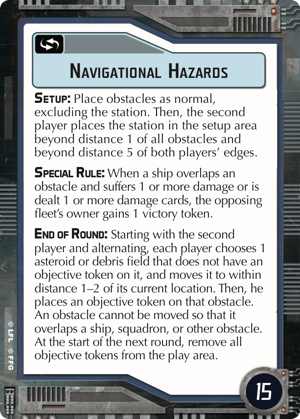
We were playing the Navigational Hazards mission for the first time, @Touston and I.
latest?cb=20161119100554

It ended up with a big traffic jam in the middle with lots of ships and squadrons about. As second player on turn 3 I had to move the final obstacle and it was allready underneath an enemy MC80 Star Cruiser that was locked in place by my relatively healthy VSD. I would really like to not move it so the obstacle stays there and the Liberty moves, overlaps my VSD and takes another 2 damage from the debris as it stays put. I also get a victory token.

Touston argued that is doesn't say that I may move the obstacle so because of this I have to move it - and it may not end up under a ship or squadron - so I would have to move it to the only place big enough (to the right rear of the MC80S). Is this correct? We played it that way.

Additionally what would happen if there was a squadron in the one place where this large debris field could go and I couldn't move it anywhere including leaving it in place under the Liberty?

From the wording on the card, I think moving is mandatory, but it cannot overlap, so you and Touston played correctly.

That's a clever strategy, charging forward at an obstacle that must move before you hit it.

The hypothetical situation you propose is tricky. I was going to say "cannot" beats all, but then I remembered that is for upgrade cards. I would still judge that you cannot move the obstacle in that case, but I am not sure.

I'm very happy to be proven wrong, and I personally may play Nav Hazard in my fleets more often.

But it seems to be open to a lot of issues. I can easily see the obstacles not been able to move at all been the main one.

Moving them is mandatory, and they must be moved to places clear of squads or ships...

of coyrse, it is THEORETICALLY possible to clump so much aroubdvit it can’t happen... The email advice I got was to move it as minimum of possible more than allowed in order to get it clear - ie, if moving it a smidge more or rotating it further makes it compliant, that’s more important than moving it less - obstacles should be clear after their enforced movement.