Silly questions of the day

By Lyraeus, in Star Wars: Armada

Ship movement!

So, I have a problem articulating a lot of my thought process (curse you instincts!). Right now I am trying to do this for ship movement so I can write an AI code for it. So here are the questions.

How do you determine what the correct move is?

What thought process goes through your mind?

What are your priorities?

I fully expect similar answers to a degree but I think peoples priorities will differ and to some extent what they go through in their mind.

If you have advice or thoughts this will help too (not only for me but for newer players!)
My only thought is "what is the most efficient route that'll allow me to unload the maximum amount of dice at the enemy ship?"

Everything else is secondary.

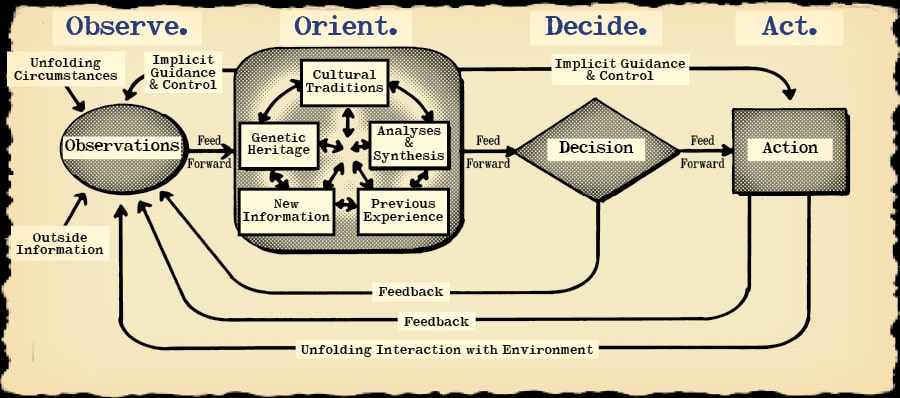
Ever since I heard about OODA, it's about the only way I can see actions in Armada.

OODA-Loop-2-1.jpg

I'm not military, but even a simplified version of these steps often help me through. That said, I still make bad choices, I just try to learn from them.

Edited by Darth Sanguis

It varies depending on first/second player. First player you can sort of form a “net” around the enemy fleet and then send ships in to last/first. As second player you need to think more along the lines of where is the enemy ship going to be 2+ turns from now? And how can I move to intercept without getting shot to pieces on the way

42 minutes ago, Darth Lupine said:

My only thought is "what is the most efficient route that'll allow me to unload the maximum amount of dice at the enemy ship?"

Everything else is secondary.

See thats how I think about it but the calculations people do are ingrained in my head. . . played on vassal last night for some tests and it was silly on how movement went. . .

34 minutes ago, Darth Sanguis said:

Ever since I heard about OODA, it's about the only way I can see actions in Armada.

OODA-Loop-2-1.jpg

I'm not military, but even a simplified version of these steps often help me through. That said, I still make bad choices, I just try to learn from them.

For overall decision making sure but what do you look at in just moving? What steps pass through your mind?

I ask questions.

Early turns tend to be high-level:

- Where is the battle going to take place? This is usually dictated by objectives and terrain - you can usually look at a battlefield and see the general flow of a game in advance.

- Even better is where do I want the battle to take place? Getting your opponent to walk into your trap and tangled up in terrain, blocking ships, etc. is great when its possible.

- How do I avoid obstacles, or at least make landing on them worthwhile in terms of tactical positioning?

Once we're closing the questions change:

- How can I get my opponent's ships to move into the best fire arcs and ranges of my unactivated ships?

- How can I avoid moving into the range and fire arcs of my opponent's unactivated ships?

These ones are heavily dependent on activation advantage, and closing speed. That's why it's worth having a Nav token and / or dial for this turn, as it gives you better control over when and how you engage.

When we're into combat range the questions change:

- How do I get my best arcs to fire on my main targets at the best range next turn?

- How do I get double arcs next turn?

- How do I avoid your best fire arcs, double arcs and ranges?

- Can I hide multiple ships in one of your arcs?

- Do I want to be ramming or avoiding a ram? Does a ram benefit you or me more?

- Will I be blocking any of your and / or my ships in my final position, and if so is it worth it?

- Am I in danger of going off the board?

- Is my final position contesting objectives?

This also varies from ship to ship. While I'll happily arc-dodge with an ISD if I can, I'm a lot less concerned about doing so than I am with a CR-90. Some ships simply can't stand up to significant punishment and need to stay out of danger, even if it means they give up their shot. For others it's worth sitting in a dangerous arc, even it it potentially means death, to get a ram, shot, or other effect (e.g. slicer tools).

Damage is the other factor to consider here. A tough ship that is heavily damaged will still want to get out of the way if at all possible.

The end game becomes easier:

- How do I keep my damaged ships alive?

- Can any ships still claim objectives?

- Are any of my ships in position to try and finish off any of yours, and if so is it worth the risk?

A ship's nav chart obviously has a big impact on what a ship will do. Ships with early nav clicks, whether innately, using a Nav dial, or via an ability (e.g. JJ) can generate the biggest displacement in their final position. Ships with late nav clicks have more chance to port around to avoid being stuck in two fire arcs of an enemy ship. Faster ships have more chance to arc-dodge, as do smaller-base ships, as they are more likely to be able to move past the enemy without being blocked. Conversely large-base ships are much better blockers, pinning an enemy in place so you can continue unloading fire into it.

Fire arcs also have a big impact on navigation. Front-facing ships (e.g. ISD, Liberty) have an easier approach as they can point towards the enemy, and if blocked the blocker is in serious trouble. The risk is that once an enemy dodges the front the other ares are weak, and are unlikely to do enough damage to kill anything other than a heavily-wounded enemy. Broadside ships (e.g. MC-30, Arquitens) run the risk of being pinned in place by a blocker without getting their best arc into play. However they may have the opportunity to fire both broadsides at once if they cut through an enemy fleet, Nelson-style. They're also harder to arc-dodge - broadside arcs tend to be wider, and enemy ships also run the risk of over-shooting and running into the opposite arc. Side arc ships can put substantial fire into a ship that's gone past them, while front-arc ships are unlikely to be able to turn around in time for a second pass.

Edited by Hedgehogmech
7 minutes ago, Lyraeus said:

For overall decision making sure but what do you look at in just moving? What steps pass through your mind?

it's still OODA. lol

It's the same steps for each action.

I make my observations.

(for example):

-What's happened so far
-Which ships are a danger
-Which ships are at risk
-Which ships are vulnerable to me
-Is my opponent following their plan
-Do their actions match previous games
-Are there face up damage cards present
-Did my opponent miss an oppertunity
-What can be exploited
-Where can my ship move
-Can I slow down/speed up
-What obstacles are present

(these are just off the top of my head, I don't have a set list, I try to take in the surroundings as they come. )


I use the answers to these questions to evaluate which paths are best based on the over all plan, then see if any of the new information creates paths of higher risk or reward. When there are more variables it tends to mean more premeasuring. There have been times where I check every possible nav possibility before deciding on a path.

Once I have a couple of options, it's all about choosing one and following through.

I'll execute the maneuver, and observe how it effects the game, looping back to the start.

Like I said, even a simplified version of this idea helps me coordinate a cohesive strategy. lol

So, would looking at generating movement AI from a vacuum be best? As in one ship at a time and it's best target available/most dangerous opponent? I mean it's not how we all look at a game board, but it may be the best way to develop a first run for your system.

Maybe you need thresholds to determine if a ship is in attack mode or preservation mode to give it a more focused set of options. I mean ultimately this is how I chose my moves.

I don't know nearly enough to make a AI, but I am pretty good at looking at things in a ladder logic/flowchart kind of way.

33 minutes ago, Stasy said:

So, would looking at generating movement AI from a vacuum be best? As in one ship at a time and it's best target available/most dangerous opponent? I mean it's not how we all look at a game board, but it may be the best way to develop a first run for your system.

Maybe you need thresholds to determine if a ship is in attack mode or preservation mode to give it a more focused set of options. I mean ultimately this is how I chose my moves.

I don't know nearly enough to make a AI, but I am pretty good at looking at things in a ladder logic/flowchart kind of way.

Yea. Basically this but I am working through the "code" it follows based on the target but I need to be able to describe it so I can code it

I dont think about moving one ship.

What ships will threaten me?

What ships do I want to threaten?

How will I achieve this?

Whats my activation order next turn?

Where are the other ships going?

So where do I want this ship to be?

Then place tool and move.

Note for everyone. Those questions dont need to wait for the movement phase or even this activation....

I think for AI you have to decide which enemy ship is your primary target. And which of its own ships are in danger. Then decide if it's time for a saving move, agressive move, or waiting move.

A saving move should bring a ship out of range or dangerous position. An aggressive move could be an attack with batteries and/or squadrons but as well a way to get into a position, which will guarantee an attack next round.

A waiting move is not aggressive or saving for its own but buys time that another ship can make such a maneuver.

Like Ginkapo I would say you have to think for the fleet before you can think for a single ship.

4 minutes ago, Triangular said:

I think for AI you have to decide which enemy ship is your primary target. And which of its own ships are in danger. Then decide if it's time for a saving move, agressive move, or waiting move.

A saving move should bring a ship out of range or dangerous position. An aggressive move could be an attack with batteries and/or squadrons but as well a way to get into a position, which will guarantee an attack next round.

A waiting move is not aggressive or saving for its own but buys time that another ship can make such a maneuver.

Like Ginkapo I would say you have to think for the fleet before you can think for a single ship.

I like that Hmmmm possible