Are you playing with enough terrain?

By Jake the Hutt, in Star Wars: Legion

21 minutes ago, DrDickSplash said:
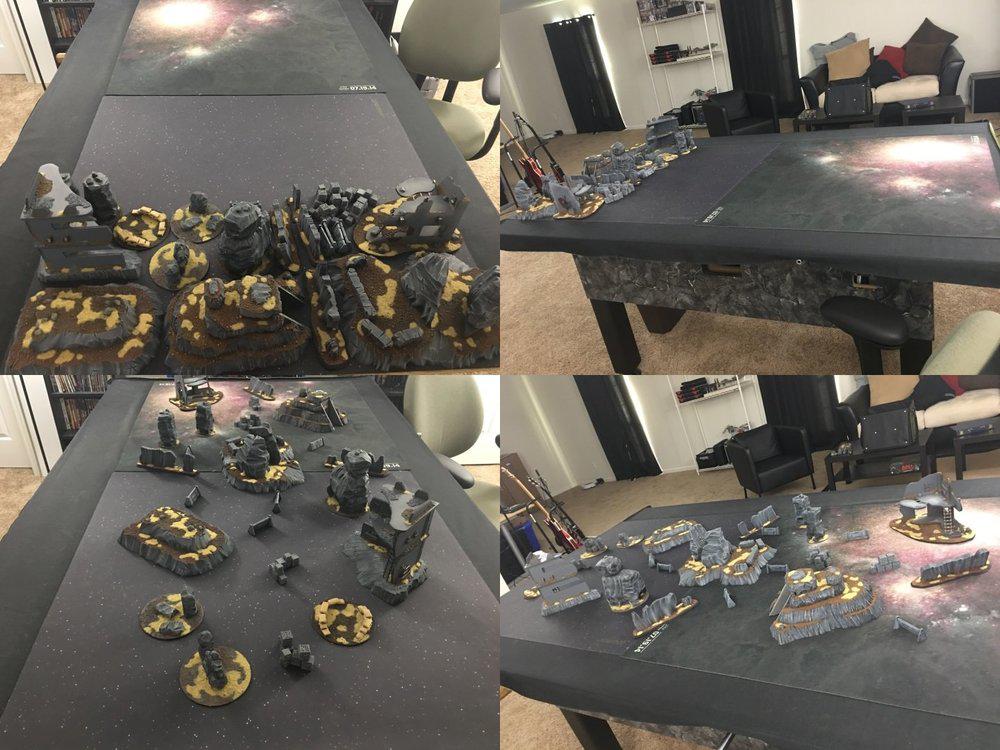
terrain.jpg

This is a really good example of a related thing I've been thinking about, which is bases. Stuff like those walls (bottom left pic) have a relatively small silhouette on a relatively large round base. Unless you play treating that circular base as difficult or area terrain - which I don't think makes sense - you should treat that as empty space.

Most of the terrain you've got here isn't like that, but I've seen tables where almost half of the "25%" is actually just the bases the terrain is attached to.

On 6/15/2018 at 3:58 PM, DrDickSplash said:

The exact set up of each table should be unique, this makes each game dynamic as you have to plan your approach and be mindful of danger zones where you're too exposed, but the type and volume of terrain needs to be specified and standardized.

The type and volume should be unique for the same reason as the exact setup.

Quote

The mixture and volume of types of terrain makes a huge difference to the game. If you don't have enough LOS blocking terrain then Vader and Fleet Troopers become unusable. Too much scatter and you can't play AT-STs or Air Speeders. Too little scatter terrain, Rebel troopers become unplayable.

Sometimes unplayable happens and that's totally ok. If some of my units are unplayable and some of my opponents are too, it balances out. That's just the nature of miniatures and RPG's as opposed to board games and card games. But sometimes the terrain blatantly favors one side. It's only a game. Someone's gotta lose. Apply the experience to setting up a fairer game next time. If FFG released official rules on what scenery was supposed to be used, the internet would crunch a bunch of numbers and a lot of things would become unplayable until the official rules for terrain changed again. Then the players would whip out their calculators and figure out which units were back in and which ones were out.The only way to get really fair terrain is for an experienced 3rd player to read over your respective army lists, and design the terrain for you. A Dungeon Master by any other name. No one set of FFG rules can cover every situation: most of the better written miniatures rulebooks point this out. This isn't the refined mathematical experience of traditional games and it doesn't need to be. There are already plenty of board and card games.

Quote

In order for players of both factions to participate in games and to remove the need for bickering there should be guidelines as to what type and setup should be used.

You can and should talk about that with your friendly opponent before the game. Games are a social activity after all. For example in my games we frequently agree on whether or not our hill collection blocks LOS. Same hills, different games/scales of minis, so we decree that for tonight's game, hills block LOS or not, depending on what we want the game to be like. The hills are all the same thickness and can be stacked up.So we might decide 1 hill is cover, 2 stacked up blocks LOS... or decide that 1 layer of hill blocks LOS... it doesn't matter if you can see a mini's head over the hill or not. Just as long as everyone knows whether hills obscure infantry or not.

Edited by TauntaunScout

Counter question: Are you playing with too much terrain? As I start planning terrain for my home board, I noticed something curious happens when you have lots of small pieces of terrain:

GdX1SGL.png

It's easy to see how much space your barricades or trees actually cover if they are attached to a scenic base. But you should still account for the negative space between small obstacles that aren't on a base. Your terrain might cover vastly more area than you expect if you cram your obstacles into a tiny space during the coverage check, but spread them out during the game.

Edited by Contrapulator
8 minutes ago, Contrapulator said:

Counter question: Are you playing with too much terrain? As I start planning terrain for my home board, I noticed something curious happens when you have lots of small pieces of terrain:

GdX1SGL.png

It's easy to see how much space your barricades or trees actually cover if they are attached to a scenic base. But you should still account for the negative space between small obstacles that aren't on a base. Your terrain might cover vastly more area than you expect if you cram your obstacles into a tiny space during the coverage check, but spread them out during the game.

I believe that is the opposite of what the point of this post is. The top image is what you want to measure, not the bottom. Our eyes will measure negative space more than positive space and we have to remember to ignore that. The easiest way to do this is to stack your terrain tight on one side of the board(well, maybe not the easiest, but works well for most people in most cases). If you don't do this, you run into problems such as your bottom example where you don't have much terrain, but you think you do.

Just now, Vandallorian said:

I believe that is the opposite of what the point of this post is. The top image is what you want to measure, not the bottom.

I'm proposing that the way you check coverage should reflect the way you actually use your terrain. If you play with a 3-barricade emplacement, such as in the diagram, it's functionally the same as a single piece of terrain and should be measured as such, not tightly packed together.

3 minutes ago, Contrapulator said:

I'm proposing that the way you check coverage should reflect the way you actually use your terrain. If you play with a 3-barricade emplacement, such as in the diagram, it's functionally the same as a single piece of terrain and should be measured as such, not tightly packed together.

That depends - is there any cover for sitting inside without touching any sides?

same as the trees - are they actually area defined by borders, or 3 individual trees...

because absolutely if they are - but if they end up as individual pieces they should be treated as individual pieces no matter how close you place them to each other

Edited by Drasnighta
3 hours ago, Drasnighta said:

That depends - is there any cover for sitting inside without touching any sides?

same as the trees - are they actually area defined by borders, or 3 individual trees...

because absolutely if they are - but if they end up as individual pieces they should be treated as individual pieces no matter how close you place them to each other

Exactly!

Also why it's so important to have *some* area terrain where you don't have to be so careful about touching sides!

1 hour ago, CaptainRocket said:

Exactly!

Also why it's so important to have *some* area terrain where you don't have to be so careful about touching sides!

Yes. Maybe the answer to my quandary is to just go all the way and make my smaller pieces into area terrain.

18 hours ago, Contrapulator said:

Yes. Maybe the answer to my quandary is to just go all the way and make my smaller pieces into area terrain.

There's also specifically rules for trenches, if you like the idea of terrain that gives cover if you're in it, but not if you're behind it.

On 6/15/2018 at 6:40 PM, TauntaunScout said:

The type and volume should be unique for the same reason as the exact setup.

If you follow this approach where the tables are essentially randomized and there's no standards at all, the game devolves into rock, paper, scissors and what you throw isn't decided by you, the player but rather the person who set up your table. If you play rebel trooper heavy lists and you end up on an open field playing the long march against DLTs and AT-STs you simply aren't going to participate in that game. That's not OK. It can be solved for by standardization.

Consider an out of town tournament you travel to with some buddies. You are all excited, got your painted minis, named the squads, etc.

You show up and they play with a terrain set up so different to the ones you play with in your home town that you might as well be playing a different game.... That'll be a long drive home and it's really bad for the game. As evidence I submit 40k 6th edition where the game rules were interpreted differently in different regions leading to a huge fragmentation of the player base and the emergence of different meta games depending on areas.

On 6/15/2018 at 6:40 PM, TauntaunScout said:

Sometimes unplayable happens and that's totally ok.

It's absolutely not. Our time is limited and precious, and we want to play fair balanced games.

On 6/15/2018 at 6:40 PM, TauntaunScout said:

It's only a game. Someone's gotta lose. Apply the experience to setting up a fairer game next time. If FFG released official rules on what scenery was supposed to be used, the internet would crunch a bunch of numbers and a lot of things would become unplayable until the official rules for terrain changed again.

There's a lot to unpack here.

It's not a "game" if something out of your control prevents meaningful participation.

One should lose for reasons that are in one's control. If you lose to anything other than player decisions and dice, the game is not fair and will die a swift death.

If FFG released a guideline for scenery mixes, form and factor, you still wouldn't be able to number crunch to solve spatial interactions with abstract game and unit rules. That's why with 6 asteroids X-Wing isn't a solved game. It's why with no terrain at all and no randomization, Chess and Go are still fun, fair and engaging games.

On 6/15/2018 at 6:40 PM, TauntaunScout said:

The only way to get really fair terrain is for an experienced 3rd player to read over your respective army lists, and design the terrain for you. A Dungeon Master by any other name. No one set of FFG rules can cover every situation: most of the better written miniatures rulebooks point this out. This isn't the refined mathematical experience of traditional games and it doesn't need to be. There are already plenty of board and card games. 

Except this isn't true. TOs have set up fair, balanced and varied terrain for these kind of games for huge tournaments, with all sorts of lists, for decades.

I'm not suggesting a rules call to set up every table the same way, but some examples of how the developers envisage terrain for the game they designed and guidelines on the type and mix of terrain will give just enough guidance where each table will be different and present a unique challenge, and still not introduce imbalance to scenario play.

On 6/15/2018 at 6:40 PM, TauntaunScout said:

You can and should talk about that with your friendly opponent before the game. Games are a social activity after all. For example in my games we frequently agree on whether or not our hill collection blocks LOS. Same hills, different games/scales of minis, so we decree that for tonight's game, hills block LOS or not, depending on what we want the game to be like.

We agree here, but you can only agree on terrain that is on the table, not terrain that is absent. This is why I think for tournaments and competitive play there needs to be a base line.

6 minutes ago, DrDickSplash said:

If you follow this approach where the tables are essentially randomized and there's no standards at all, the game devolves into rock, paper, scissors and what you throw isn't decided by you, the player but rather the person who set up your table. If you play rebel trooper heavy lists and you end up on an open field playing the long march against DLTs and AT-STs you simply aren't going to participate in that game. That's not OK. It can be solved for by standardization.

Consider an out of town tournament you travel to with some buddies. You are all excited, got your painted minis, named the squads, etc.

You show up and they play with a terrain set up so different to the ones you play with in your home town that you might as well be playing a different game.... That'll be a long drive home and it's really bad for the game. As evidence I submit 40k 6th edition where the game rules were interpreted differently in different regions leading to a huge fragmentation of the player base and the emergence of different meta games depending on areas.

It's absolutely not. Our time is limited and precious, and we want to play fair balanced games.

There's a lot to unpack here.

It's not a "game" if something out of your control prevents meaningful participation.

One should lose for reasons that are in one's control. If you lose to anything other than player decisions and dice, the game is not fair and will die a swift death.

If FFG released a guideline for scenery mixes, form and factor, you still wouldn't be able to number crunch to solve spatial interactions with abstract game and unit rules. That's why with 6 asteroids X-Wing isn't a solved game. It's why with no terrain at all and no randomization, Chess and Go are still fun, fair and engaging games.

Except this isn't true. TOs have set up fair, balanced and varied terrain for these kind of games for huge tournaments, with all sorts of lists, for decades.

I'm not suggesting a rules call to set up every table the same way, but some examples of how the developers envisage terrain for the game they designed and guidelines on the type and mix of terrain will give just enough guidance where each table will be different and present a unique challenge, and still not introduce imbalance to scenario play.

We agree here, but you can only agree on terrain that is on the table, not terrain that is absent. This is why I think for tournaments and competitive play there needs to be a base line.

The onus is placed - by FFG - in the tournament setting, on the TO/Judge/Marshal.

You already trust them to enforce rules integrity in the game - it should not be a stretch to trust them for that, and it IS a listed responsibility to them - if they constantly fail in that duty, you can report it.

People never seem to know that FFG OP has a fairly robust report/complaint function ?

10 minutes ago, Drasnighta said:

The onus is placed - by FFG - in the tournament setting, on the TO/Judge/Marshal.

You already trust them to enforce rules integrity in the game - it should not be a stretch to trust them for that, and it IS a listed responsibility to them - if they constantly fail in that duty, you can report it.

People never seem to know that FFG OP has a fairly robust report/complaint function ?

Yeah, I agree with this.

Wouldn't it be better, though, for FFG to give a little more guidance than have some secret police / informant system where players rat out TO's who may be doing what they think is right ?

2 hours ago, DrDickSplash said:

Yeah, I agree with this.

Wouldn't it be better, though, for FFG to give a little more guidance than have some secret police / informant system where players rat out TO's who may be doing what they think is right ?

As a TO?

Not unless FFG is also PROVIDING said terrain they guide for.

For free.

In enough quantities to satisfy the largest possible tournament.

...

Without that, let me get on with the job of worrying about it and doing what I can. I’ll explain to FFG (and I have! In regards to bans/cheating) if I must.

And the good news is that the market will help with this. If a TO does a crappy job of providing sufficient or appropriate terrain for a tournament people are driving long distances to, the next time that tournament is run, the perceived unfairness will likely limit the turn-out.

It's in my interest to do a fair job for everybody, regardless of list, in order to maximize the number of attendees.

I've been to several tournaments for different games that require a certain amount of terrain to play where they just didn't have nearly enough terrain for all tables , and the excuse is usually "Well we didn't have enough terrain, but we didn't want that to be a reason to not have the tournament". But really, I think thats a prime reason not to have a tournaments. Or at least limit the number of players based on how many tables you can actually provide the correct amount of terrain for.

These days I always request to see tables photos before I sign up for a tournament.

2 hours ago, Jake the Hutt said:

These days I always request to see tables photos before I sign up for a tournament.


It would never occur to you then to assist the Tournament Organiser?

On 6/20/2018 at 12:33 AM, DrDickSplash said:

It can be solved for by standardization.

No it can't, unless you also provide hundreds or thousands of dollars worth of free scenery to organizers. Some people call those army lists optimized, I call them inflexible. Take a mix of units because you don't know what terrain you will meet the enemy in nor what forces they will have. Your list for tournaments should always assume a variety of tables, including ones with no scenery at all. Your lists should assume the worst and the best.

Quote

You are all excited, got your painted minis, named the squads, etc.

Why on earth aren't people doing that for all their home games? This isn't a boardgame!

Quote

You show up and they play with a terrain set up so different to the ones you play with in your home town that you might as well be playing a different game.... That'll be a long drive home and it's really bad for the game. As evidence I submit 40k 6th edition where the game rules were interpreted differently in different regions leading to a huge fragmentation of the player base and the emergence of different meta games depending on areas.

Tournaments are really bad for the game, in the long run. Which is why I don't care if they get much support in the form of red tape to choke the rest of us on. Tournaments in wargames can only provide the illusion of a fair test of skill. A lot of people get money or emotional benefits from denying that it's an illusion. But it is.

Quote

It's absolutely not. Our time is limited and precious, and we want to play fair balanced games.

Then don't waste all that precious time driving to wherever from your example. You could play a lot of games in that drive time. Choosing your own lists will not always produce fair and balanced games and scenery should always be a mirror image on each half of the table or its unfair. But that's no fun. Miniature battles cannot and should not be expected to be fair, they should be expected to be awesome.

Quote

There's a lot to unpack here.

It's not a "game" if something out of your control prevents meaningful participation.

The marketing department using power creep to sell models prevents meaningful participation all the time in lots of games. If that is still present, no amount of red tape regarding scenery will matter.

Quote

One should lose for reasons that are in one's control. If you lose to anything other than player decisions and dice, the game is not fair and will die a swift death.

Then 40k should be financially dead by now. It's about as lopsided as it gets! Yet I still paint more units for it.

They gave us a guideline. 25%. Very vague, but enough. Anything concrete will become subject to rules lawyering for the purpose of powergaming.

Organizing and running games at cons is really really hard. Let's not force it to be harder than it already is. If I was running a big tournament out of town (over 20 tables) all the terrain would have to be 2D pieces of felt so I could transport it all.

Edited by TauntaunScout
17 hours ago, Amanal said:


It would never occur to you then to assist the Tournament Organiser?

If I'm arriving from out of town for a tournament and discover that they don't have nearly enough terrain I'm not really in a position to return back to the city I live in to get some. I will happily provide terrain for local events, including ones i'm not participating in. But its still up to the tournament organizer to get that sorted out. as a player its not my job to say "Oh by the way, do you actually have enough terrain for this event you're trying to run? and if not, can I bring some?" And its certainly not my job to do that on the day of the event after I arrive and discover that they have about a single table's wroth of terrain spread out over 8 tables.

As a tournament organizer its usually not hard to get the terrain you need. I've done it many times for many different games. If you don't simply have the correct terrain (and not every one does) you can ask local players, gaming groups and stores. this should be done ahead of time, before you even announce the tournament, so when you do make the announcement you are confident hat you actually have the terrain you need. If you aren't able to get that terrain you shouldn't be running the tournament.

6 hours ago, Jake the Hutt said:

... "Oh by the way, do you actually have enough terrain for this event you're trying to run and if not, can I bring some?" And its certainly not my job to do that on the day of the event after I arrive and discover that they have about a single table's wroth of terrain spread out over 8 tables...

Oddly enough had you asked you may not have just arrived to see 8 tables with barely a razzoo on them.

t2.thumb.jpg.d653daa994e9fde2972d219a6c647ae1.jpg 326001305_tableexample.thumb.jpg.35182905bf8ca4365bb916eaf277bfb5.jpg

t5.thumb.jpg.86639172ff79a5af10d8cde1f46eefbe.jpgt4.thumb.jpg.cd91c46db5bf818a0d1bf9d9468a79df.jpg

I need to figure out how to make terrain just like you have on that lower left table...

I have an idea to measure all of my terrain and assign each piece a point value based on its area. For chunky pieces that can block LOS, they are worth points equal to their footprint in square inches, for items like low elevations that won't block LOS, but could provide cover or impede movement, they are worth points equal to the circumference in inches. For linear obstacles, they're worth their length in inches. Then pick terrain like you do an army and use terrain up to a point value equal to the table top area you want covered. So 25% of a 36x72 table is 648 square inches. So, pick terrain til you have 648 points worth, give or take.

May not be practical for playing with store terrain since it's not worth taking the time to actually measure every item, but for you own collection of stuff you build at home, it could be interesting.

35 minutes ago, Albertese said:

I have an idea to measure all of my terrain and assign each piece a point value based on its area.

I'm actually doing the same thing in a spreadsheet, but simply measuring the dimensions and getting an absolute area in square inches. Nothing is truly linear, so for even my thinnest foamcore walls I calculate their length x 1/4".

I'm also assigning them to categories for cover, area or not, difficult for troops, ground, repulsor, etc.

Then I can sort my spreadsheet and figure out when I want a 10% area vs 15% area terrain as I try different configs. Eventually I may do a randomizer or other front end for it.

Edited by CaptainRocket
On 6/22/2018 at 11:39 PM, Amanal said:

Oddly enough had you asked you may not have just arrived to see 8 tables with barely a razzoo on them.

Yeah. Thats exactly why in an earlier post I said "These days I always request to see tables photos before I sign up for a tournament."