Weaponized Hyperspace Capable Starships

By Cr0aker, in X-Wing Off-Topic

1 hour ago, Cr0aker said:

Indy's understanding of physics is more the issue.

At the speed of light... dodging or moving out of the way is not possible.

Sufficient distance to jump could be upwards of a light second away... far out of the range of any conventional (or unconventional aka deathstar) weapons we have seen in Star Wars.

E=MV^2..... he may have missed that the mass of an A-wing has probably the destructive power of TEN times all the existing nuclear weapons on earth. That = Big Boom, lol. Make a single reactor core ignition look like a chump.

I don't blame you Indy - our primary and secondary education systems are a little lacking - especially in math, finance/economics, and hard science. Pick up and read some earlier hard science fiction like Heinlein's "Have space suit, will travel" if you want to learn and have fun.
Hollywood is not a good place to learn how the world works, lol. In the Heinlein instance, space is not cold. If it were, your thermos or cooler would not work. it is a perfect insulator. One of the largest issue with spacesuits is keeping you cool. Your body produces enough heat to melt 40lbs of ice a day.... and in vacuum, your in the perfect thermos. Without a method to cool your body... you'll either cook to death or drown in sweat.

Considering I got an A in Physics whilst taking a Triple Science GCSE, my lack of understanding is primarily based on a significant lack of lightspeed coverage during the lessons.

Anything traveling at lightspeed is pretty much unavoidable, but applying Star Wars logic seems to indicate that you can see the guy slowly begin to move forwards before the extreme acceleration occurs, and thus adjust your course so he misses.
2 hours ago, Cr0aker said:

E=MV^2..... he may have missed that the mass of an A-wing has probably the destructive power of TEN times all the existing nuclear weapons on earth. That = Big Boom, lol. Make a single reactor core ignition look like a chump.

154 gigatons is less then a single turbolaser bolt from an Acclamator (200 gigatons) - at least according to the more "maximalist" authors.

Fan artists like Fractalsponge have extrapolated from the gigatons of Acclamators, to teratons for ISDs - with 1 ISD turbolaser bolt being 70 teratons (or 40 teratons for the next size down after the main guns).

This just goes to show - one person's "huge" is another's "tiny" when it comes to weapon energies.

Fractal gave his Assertor Star Dreadnought (an Executor-sized but more heavily armed vessel) a single "light superlaser" for fleet engagements - in the "petaton range".

Your figure for the Raddus collision is 49.5 petatons.

2 hours ago, Ironlord said:

Your figure for the Raddus collision is 49.5 petatons.

Good ketch. I don't buy the turbolaser value because ....

main-qimg-921658e554185d62e42a3a772760b5

tkfgep5glt1qcamndvba.png

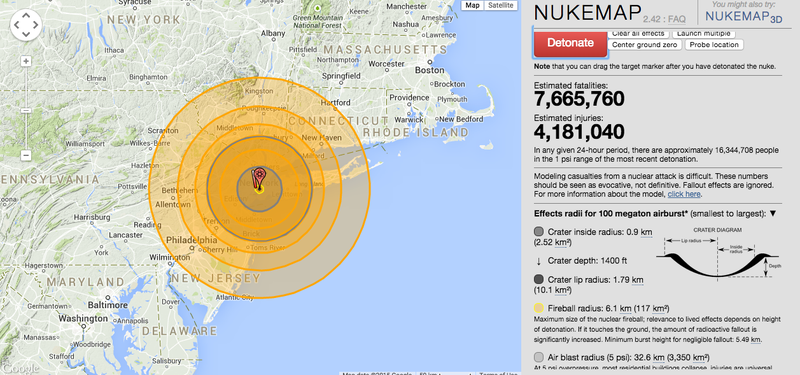
Ships are shot with turbolasers in the movies and this does not happen. This is only a 100/50 MEGAton example.

Get into the gigaton range and you talking about taking out north America in one shot.

In episode III there are some point blank un-shielded shots.... I didn't see the Entire fleet disappear in a blinding flash. lol.

https://foxtrotalpha.jalopnik.com/see-what-would-happen-if-you-dropped-a-nuke-right-onto-1688278858

Starkiller was a ‘hyper-lightspeed’ weapon, presumedly hitting targets with energy/particles at superluminal velocities. Don’t know if this, then, is the first canon instance of hyperspace travel being used as a weapon.

1 hour ago, Cr0aker said:

Good ketch. I don't buy the turbolaser value

I've always said that you could replace "ton" with "joule" in their figures and still have them work.

A 200 gigajoule energy burst would do a respectable amount of ground damage.

A 40 terajoule energy burst could vaporise (or at the very least shatter) a small asteroid.

Edited by Ironlord

I was trying to translate into kilo or megatons of TNT. A destructive force I can wrap my mind around.

4 minutes ago, Cr0aker said:

I was trying to translate into kilo or megatons of TNT. A destructive force I can wrap my mind around.

The Hiroshima bomb (15 kilotons) was 63 terajoules. 40 terajoules is just under 10 kilotons (it's 9.56 kilotons).

200 gigajoules would be equivalent to 47 tons of TNT.

ahh, makes a lot more sense now LOL

5 hours ago, Cr0aker said:

Good ketch. I don't buy the turbolaser value because ....

main-qimg-921658e554185d62e42a3a772760b5

tkfgep5glt1qcamndvba.png

Ships are shot with turbolasers in the movies and this does not happen. This is only a 100/50 MEGAton example.

Get into the gigaton range and you talking about taking out north America in one shot.

In episode III there are some point blank un-shielded shots.... I didn't see the Entire fleet disappear in a blinding flash. lol.

https://foxtrotalpha.jalopnik.com/see-what-would-happen-if-you-dropped-a-nuke-right-onto-1688278858

You're gonna be angry, more so than you are now. But the calculations for the Rebel ships hyper space ram was very high.

All the areas of the Mega Star Destroyer next to the point of collision would have survived septilions of tons of energy from particle collisions traveling at the speed of light.

Don't forget theirs multiple models of turbo laser on ships, besides other types not related to laser weapons. Taking that in mind, we see an Imperial class Star Destroyer do a hyperspace ram on a Corvette and come out unscathed in SWBF2 EA

So the armor belts of cap ships, based on what we see, will absorb a lot of the damage the official numbers say the outputs are.

Lastly the Super Laser Mk 1 and especially Mk 2, put out way more than septilions of tons of force via directed energy. Hyperspace ramming planets with Rebellion era planetary shields won't work. The DS2 most of all as you need the same output of its laser to kill its shields. Maybe the entire Rebel alliance hyperspace ramming could destroy the DS2, but then you just traded the entire alliance for one imperial base.

On 5/18/2018 at 2:34 PM, Animewarsdude said:

why any group would ever make large ships that are sitting ducks to this type of attack.

Well, here's the thing. Hyperspace is like, a different dimension. It's not just flying really really fast. But you go really fast to enter this dimension. If you want to hyperdrive into something, then you need to start in a very narrow band of distance from your target. If you're too far away, you've already entered hyperspace by the time you reach your target. If you're too close, you just kind of 'boop' your target because you're not going fast enough. Hyperspace jumps are noted as taking a lot of time to get right, so plotting something as precise as being X% through the commencement of a hyperspace jump at precisely Y co-ordinates, where those co-ordinates are related to a moving target, seems like a pretty tricky thing to do.

Now yes, droids are smart and all, but droids in Star Wars don't seem to have the raw precision, reaction times, and processing power that we would imagine given computing technology today. They always seem to be bumping into things, knocking things over, tripping, falling, crashing... not the sort of precise and instant reactions we would want for something as necessarily pin-point accurate as hyperdriving into something. Even purpose built military droids have trouble with accuracy and precision, as we see in the prequels and the clone wars. And of course the other factor is... do droid lives matter? There seems to be a sliding scale of sentience among droids, but they certainly seem to have emotions, to feel fear, to have a sense of their own mortality. Is building them just for the purpose of having them commit suicide something we think the Rebellion/Resistance would do? Could they be trusted to do it? To what extent are droids bound to obey the wishes of their masters?

It's also evident that shields can withstand enormous impacts and so may change the equation. The book excerpt above notes that the shields projected by the Raddus were powerful enough to contain it's own explosion, at least for the small frame of time between impact and the destruction of the shield generators themselves. Inertial dampeners are also an interesting concept. How do they work? Presumably by taking the energy caused by a change in momentum (through an impact or collision, as an example) and deflecting or channelling it somewhere? Does this have implications for how a ship may be affected by an impact?

And that whatever the 'sweet spot' of hyperdriving into something is, it's within gun range. Now, Holdo got lucky. She had a massive, well shielded ship that was inside gun range, and yet being ignored. By the time the First Order realised what she was up to it was too late. A smaller ship may well have just blatted onto the shields like a bug. But a big one, even if it hadn't reached optimum acceleration, still packed a big punch.

But then to properly make use of this technology, it is required to have ships with heavy shielding and a lot of mass (and a lot of volume to spread the damage) that have to start their jump after having entered the range of the enemy heavy artillery. It's certainly something that could be used in other instances, but I don't think it's the game-changer some people are making it out to be. It's also worth noting that while it was damaged, the Supremacy was not destroyed and presumably remained at least somewhat combat efficient. So the sacrifice of the fleets only large ship did not buy victory, only time.

different dimension?

Sorry guys, but that math don't add up. I see a lot of bad excuses (astromech droids don't know astro-navigation?). Either way, if a ship can impact another at those velocities... you get energy yields of my calculations... and that makes anything bigger than a light freighter a sad panda. LOL

If my math is high... show me yours. You two are making Hollywood excuses for Bollywood science.

Edited by Cr0aker

Yeah, a different dimension. It's not just going really really fast. Dense fields of gravity in realspace affect hyperspace, hence the comment about stars and supernovas. But it's also like the comments such as "she'll make .4 past lightspeed" or the infamous kessel run comment. The mechanics of hyperspace travel weren't hashed out yet, so some of the stuff isn't consistent.

Math is cool, but ultimately irrelevant since we have important unknown factors in things like particle shielding, deflector shields, intertial dampeners, etc. How much energy can they absorb? What do they do with that energy? How do magnets work? And all we can go off is what we see on screen, which was the Resistance sacrificing their last ship, and not ensuring victory. They destroyed Snokes flagship and damaged others, but the enemy ships (even Snokes ship) retained some combat efficiency and were able to evacuate their crews and combat troops safely. It wasn't the earth shattering kaboom you're talking about. Clearly, you need a big ship in terms of both mass and volume, to do a lot of damage. Once you enter hyperspace, you simply pass through the target, and if you're too close, you don't have enough speed, and since the acceleration is so rapid there's only a tiny window of opportunity. Except of course that window grows the bigger your ship is because a bigger ship doesn't need to be going as fast to do as much damage. The resistance/rebellion don't look like they're rich enough to be buying large cruisers/freighters with the intent of kamikaze-ing them into Star Destroyers, especially given the high chance of failure. Sure it's a tactic to consider, but hardly the game-changer you're thinking it is.

And yes, Astromechs know astronavigation. But there's a difference between asking your Siri to plot a course to your destination, and asking her to take the wheel to try and ram another car in the parking lot. And even that's a weak analogy since robots and computers in Star Wars don't work like the ones in our world. And the other question then becomes, how comfortable do you think the rebellion would feel about asking R2 to kill himself so the humans could escape? That doesn't seem like a very 'rebellion-y' thing to do.

I don't like getting into back-and-forth's because at this point its arguing about bunk science and make believe.

17 hours ago, Chucknuckle said:

Yeah, a different dimension. It's not just going really really fast. Dense fields of gravity in realspace affect hyperspace, hence the comment about stars and supernovas. But it's also like the comments such as "she'll make .4 past lightspeed" or the infamous kessel run comment. The mechanics of hyperspace travel weren't hashed out yet, so some of the stuff isn't consistent.

Stuff isn't consistent is correct. What has been shown, however, is a ship approaching the speed of light striking another vessel and distances that making aiming possible and shooting unlikely.

17 hours ago, Chucknuckle said:

Math is cool, but ultimately irrelevant

Tell that Venezuelans, Puerto Rican's, citizens of Illinois, and.... I can go on for a long time. Math is always relevant. More importantly in story telling is that if you use bad math, use it consistently . Otherwise you take your audience out of the story real fast and it enters the vast realm of mediocracy.

17 hours ago, Chucknuckle said:

It wasn't the earth shattering kaboom you're talking about. Clearly, you need a

.... producer who can add, subtract, multiply, divide and knows the most famously known math equation... E=MC^2

17 hours ago, Chucknuckle said:

The resistance/rebellion don't look like they're rich enough to be buying large cruisers/freighters with the intent of kamikaze-ing them into Star Destroyers, especially given the high chance of failure. Sure it's a tactic to consider, but hardly the game-changer you're thinking it is.

But they can afford to sacrifice needless fighters and bombers to destroy one dreadnought? I am a lifelong student of history/warfare; attrition and economics are king. "A bad leader studies tactics, a great leader studies logistics". Trading a few torpedo and dive bombers for your enemy's fleet is such a win the battleship went away and the carrier force came to be. If you can trade one pilot-less drone for a super-carrier/battleship (star destroyer) you don't need to do that for long to win. lol. It is such the game changer it isn't funny, which is why I made the post....

17 hours ago, Chucknuckle said:

And yes, Astromechs know astronavigation. But there's a difference between asking your Siri to plot a course to your destination, and asking her to take the wheel to try and ram another car in the parking lot. And even that's a weak analogy since robots and computers in Star Wars don't work like the ones in our world.

Those computers and droids probably have a greater magnitude of computing power over what we currently have to be comparable to what an iphone has over the "computer" we used to put a man on the moon. Driver-less cars that can mostly manage both vehicular and pedestrian traffic are on the road today....

17 hours ago, Chucknuckle said:

And the other question then becomes, how comfortable do you think the rebellion would feel about asking R2 to kill himself so the humans could escape? That doesn't seem like a very 'rebellion-y' thing to do.

Did you watch the same movies I did?

r2-d2_fixing_royal_starship.jpg

R2_repair.png&f=1

I'm going to bail here because I made my point in my original and first few posts. If you want to make believe that the mouse has successfully retconned their asinine changes to how the already bad physics in star wars works. Awesome! Enjoy!

It however, takes me out of the story and has relegated (sans rogue one) the new movies to worse than the prequels. And that's only a personal opinion , so don't get upset if you disagree, that's cool.

Oh, and math does matter. Every time. Three questions you should ask when examining ANYTHING are: At what cost?; Compared to what?; and What hard evidence do you have supporting your argument?

Edited by Cr0aker

To end on a better and funnier note... the Five States of Watching A Star Wars Film

Edited by Cr0aker
8 hours ago, Cr0aker said:

Stuff isn't consistent is correct. What has been shown, however, is a ship approaching the speed of light striking another vessel and distances that making aiming possible and shooting unlikely.

How much time passed between Holdo beginning her maneuver, and her striking the Supremacy?

8 hours ago, Cr0aker said:

Math is always relevant.

Well, ok then. How much energy could the Supremacy's shields absorb? How much energy can her hull absorb? How much energy could her intertial dampeners absorb? The Raddus: Same questions. Also, how fast was the Raddus actually going when it impacted the Supremacy? If you want to be doing the maths, you need to answer these questions.

8 hours ago, Cr0aker said:

But they can afford to sacrifice needless fighters and bombers to destroy one dreadnought?

What would have happened if they failed to destroy the dreadnought? Their cruiser would have been destroyed before it jumped away in the first place, and it would have been a real short movie.

9 hours ago, Cr0aker said:

Those computers and droids probably have a greater magnitude of computing power over what we currently have to be comparable to what an iphone has over the "computer" we used to put a man on the moon. Driver-less cars that can mostly manage both vehicular and pedestrian traffic are on the road today....

Probably, but Star Wars tech isn't sensible. The droids are basically mechanical people, with all the failings implied. They don't operate with anywhere near the level of competency, precision or speed that highly advanced robots would. They get afraid, they make mistakes, they do stupid things. If your entire plan rests on piloting a hyperdriving ship into the enemy flagship, I certainly wouldn't want to be trusting anything other than a hero-tier droid, and IMO the hero-tier droids at least, are worth as much as the other sentient people in Star Wars.

Hypershields negate relativistic effects. So any calculation of kinetic energy becomes sketch ... I guess using newton physics should work at least.

What they don't negate is hypermatter explosions. We have canon sources how bad those can get. Hypermatter fuel is dangerous. Very dangerous. The extinction level event caused by a hyperspace collision with a planet was not caused by kinetic energy, but by hypermatter radiation and most of the explosion was caused by the hyper-drive fuel as well.


15 hours ago, SEApocalypse said:

Hypershields negate relativistic effects. So any calculation of kinetic energy becomes sketch ... I guess using newton physics should work at least.

What they don't negate is hypermatter explosions. We have canon sources how bad those can get. Hypermatter fuel is dangerous. Very dangerous. The extinction level event caused by a hyperspace collision with a planet was not caused by kinetic energy, but by hypermatter radiation and most of the explosion was caused by the hyper-drive fuel as well.

On that note, we've now seen (SOLO spoilers ahead):

a very large hyperfuel explosion (like, from an entire fleets worth of fuel) and while it was very impressive, it certainly wasn't an extinction level event.

Edited by Chucknuckle
On 5/22/2018 at 3:29 PM, Chucknuckle said:

Yeah, a different dimension.

Not so much a different dimension, but I've always thought that hyperspace was some sort of folded/warped space technology. Because at least under the physics we currently understand that's the ONLY way you can have superluminal travel without those pesky problems of time dilation and needing MORE than an infinite amount of energy to accelerate an object with mass beyond lightspeed.

On 5/25/2018 at 6:29 PM, Ambaryerno said:

Not so much a different dimension, but I've always thought that hyperspace was some sort of folded/warped space technology. Because at least under the physics we currently understand that's the ONLY way you can have superluminal travel without those pesky problems of time dilation and needing MORE than an infinite amount of energy to accelerate an object with mass beyond lightspeed.

The old EU was a little divided but most of the time it made sense. The new canon for all its merits really stretches suspension of disbelief in the hyperdrive department.

Most of the time the old EU worked like this:

There are three "dimensions": realspace, hyperspace and subspace. A hyperdrive moves you from subspace into hyperspace. You move faster when in hyperspace but don't gain. Anything in realspace projects a "mass shadow" into hyperspace which you can collide with. Mass shadows disrupt hyperspace travel: hit a sufficiently large one and you get dragged back to realspace. You then proceed to crash into whatever dragged you out at realspace speeds, like the shield gate collision in Rogue One.

Interdictors worked by projecting artificial mass shadows to pull things out of hyperspace and keep them in realspace. Gravity well projectors only affected hyperspace. No accidentally smashing Arquintens cruisers into yourself and imploding.

By the old hyperspace rules the Raddus would either have gone through the Supremacy or hit it at its normal travel speed. Hyperspace ramming didn't happen because it didn't work.


Subspace was hyperspace on steroids but only worked for transmissions, hence the near complete lack of communication lag from half a galaxy away.

Edited by Firespray-32
19 minutes ago, Firespray-32 said:

The old EU was a little divided but most of the time it made sense. The new canon for all its merits really stretches suspension of disbelief in the hyperdrive department.

Most of the time the old EU worked like this:

There are three "dimensions": realspace, hyperspace and subspace. A hyperdrive moves you from subspace into hyperspace. You move faster when in hyperspace but don't gain. Anything in realspace projects a "mass shadow" into hyperspace which you can collide with. Mass shadows disrupt hyperspace travel: hit a sufficiently large one and you get dragged back to realspace. You then proceed to crash into whatever dragged you out at realspace speeds, like the shield gate collision in Rogue One.

Interdictors worked by projecting artificial mass shadows to pull things out of hyperspace and keep them in realspace. Gravity well projectors only affected hyperspace. No accidentally smashing Arquintens cruisers into yourself and imploding.

By the old hyperspace rules the Raddus would either have gone through the Supremacy or hit it at its normal travel speed. Hyperspace ramming didn't happen because it didn't work.


Subspace was hyperspace on steroids but only worked for transmissions, hence the near complete lack of communication lag from half a galaxy away.

Yeah, I'm aware of how the old EU worked. In theory, Han's trick of dropping out of hyperspace right over the surface of Starkiller Base COULD work in the old EU if he disabled the safeties (can't remember if it was ever done, though) and dropped out of hyperspace manually. It would have been insane to try, though.

Edited by Ambaryerno

Just because its purdy...

holdoManeuver.gif?resize=431,181

All of the Disney-era Star Wars films play impossibly fast and loose with hyperspace. It seems like in the original trilogy you used it to get from one star system to another - lots of travel time in real space, calculating the jump, trying to evade the Imperial pursuit, and then just in the nick of time you jump... which itself takes long enough for people to walk around the ship and kick back and practice light saber skills, followed by hopping back to real space and flying for awhile to where ever.

Now, they jump directly from cargo bays of other ships, from upper atmosphere, directly into a planet's atmosphere, through shields to exploit their "flicker rate," and so on.

The easiest understanding is that the new movies will make hyperspace do anything they want it to do to serve the plot. No math, no logic, no internal consistency, and with no time wasted on any dull time flying to a place you could just blip into to hurry the story along. (Like beaming into a ship moving at warp speed in the Star Trek reboot - the makers of these movies give no concern what so-ever for your understanding of fake physics, they just need a character to be in a place for their next plot point, and they don't understand why one made-up silly thing is different from another made-up silly thing)

Based on this, I would say the Holdo maneuver is usually impossible - Like Luke's one in a million shot it was a fluke brought on by luck and skill. Except, where that left you excited and relieved the first time you saw it, this left you going "Wait... can they do that? I don't think they can do that. Can they do that?" And if you had the film makers handy to question, they would go "Why not? The ships going really fast, so it rammed the bad guys really fast, it's heroic." And you would go "But, then why don't they always do it? Wouldn't this be incredibly effective if this was a thing? Wouldn't droid controlled hyperspace missiles be the way wars are fought in Star Wars if they can do this? To which I'm sure they would go, "I dunno, maybe they haven't thought of it before. Or maybe it's just really cool to see, you know? Anyway, I'm glad you enjoyed the movie, I have some promotional events to host, bye!"

And then, with that debate settled, we could get back to the required weight and density of logs required to crush an At-St based on the tensile strength and thickness and glacis slope of its armor, going into exhausting detail about energy transference, and WWII ballistic knowledge, and modern cobham armor design, while Lucas would tell you he had this idea that a primitive race would overcome a technological one, and needed primitive weapons that could defeat tanks, and they decided logs would be a good visual.

Edited by jharrington
9 hours ago, Firespray-32 said:

By the old hyperspace rules the Raddus would either have gone through the Supremacy or hit it at its normal travel speed. Hyperspace ramming didn't happen because it didn't work.

Well, even in the OT you could see ships jumping into hyperspace doing that super quick acceleration. That's why I think the Raddus manoeuvre *could* work, but it has to be in that goldilocks zone. Too far away, and the Raddus enters hyperspace before it reaches the Supremacy. Too close and it's like crashing a bus into a skyscraper. Your target has to be right on that cusp of "I'm entering hyperspace but I'm still technically in real space"

11 hours ago, Chucknuckle said:

Well, even in the OT you could see ships jumping into hyperspace doing that super quick acceleration  . That's why I think the Raddus manoeuvre *could* work, but it has to be in that goldilocks zone. Too far away, and the Raddus enters hyperspace before it reaches the Supremacy. Too close and it's like crashing a bus into a skyscraper. Your target has to be right on that cusp of "I'm entering hyperspace but I'm still technically in real space"

In the old canon it's not actually acceleration. It's an optical illusion called pseudomotion.

TIL.