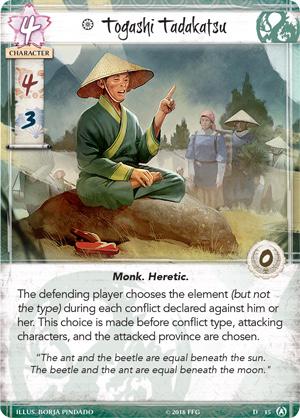
Togashi Tadakatsu explanation?

By SavageTofu, in L5R LCG: Rules Discussion

F6EB00F1-4CF9-42A0-8D5B-3B7E8FD6B131.jpeg.3dfd4f270bdbb7c63a4683b4a43acf40.jpeg Togashi Tadakatsu reads:

the defending player chooses the element (but not the type) during each conflict declared against him or her. This choice is made before conflict type, attacking characters, and the attacked province are chosen.

What’s this mean?

Well, this basically means that the defending player chooses the element (but not the type) during each conflict declared against him or her. This choice is made before conflict type, attacking characters, and the attacked province are chosen.

Dunno what to answer, sincerely. It seems pretty clearly explained in the card text.

If you want an example, when you declare a conflict, instead of you choosing the element of the conflict, it’s the defender the one who chooses it. Instead of you saying “I declare a Fire political conflict here”, you say: “I’m gonna declare a conflict”, and then your opponent goes “it’s gonna be a Fire conflict” and then you say “Ok, I declare a Fire political conflict in this province with these attackers”

Edited by Tabris2k

Am I correct in guessing that if you pass on declaring a conflict, no ring is chosen? And once you declare a conflict, are you required to send at least one character if they pick a ring you don't like?

Is it possible to create a situation in which you declare a conflict, but the opponent could choose a ring that would make it impossible for you to declare a conflict? For example, if you only have one character that says something like, "Cannot participate in Air Conflicts" and they choose air. Would Air not be a valid choice for the Dragon player?

Similarly, if a Phoenix player casts Way of the Phoenix and declares Fire off limits, can they choose Fire for the ring? The opponent is still the one declaring, so they would be unable to declare that conflict, so I imagine it would not be a valid choice for the Phoenix player.

16 minutes ago, AradonTemplar said:

Am I correct in guessing that if you pass on declaring a conflict, no ring is chosen? And once you declare a conflict, are you required to send at least one character if they pick a ring you don't like?

If you don’t declare a conflict, Tadakatsu’s ability does not trigger, simply because the defending player gets to choose the ring “during each conflict declared against him”

And yes, you follow all the steps and requirements for declaring a conflict (except for choosing the element), which implies that you have to send a character (you cannot declare a conflict without sending a character as an attacker)

23 minutes ago, AradonTemplar said:

Is it possible to create a situation in which you declare a conflict, but the opponent could choose a ring that would make it impossible for you to declare a conflict? For example, if you only have one character that says something like, "Cannot participate in Air Conflicts" and they choose air. Would Air not be a valid choice for the Dragon player?

Similarly, if a Phoenix player casts Way of the Phoenix and declares Fire off limits, can they choose Fire for the ring? The opponent is still the one declaring, so they would be unable to declare that conflict, so I imagine it would not be a valid choice for the Phoenix player.

For the WotP bit, you cannot choose Fire. WotP prevents your opponent to declare conflicts of a certain element. Even if you, as the defender, are choosing the element, the opponent is still the one declaring the conflict, including type and element, so you’re still limited by any restriction that affects your opponent in conflict declaration.

By that same logic, I’d say in your first example you cannot choose Air.

3 hours ago, Tabris2k said:

If you don’t declare a conflict, Tadakatsu’s ability does not trigger, simply because the defending player gets to choose the ring “during each conflict declared against him”

And yes, you follow all the steps and requirements for declaring a conflict (except for choosing the element), which implies that you have to send a character (you cannot declare a conflict without sending a character as an attacker)

For the WotP bit, you cannot choose Fire. WotP prevents your opponent to declare conflicts of a certain element. Even if you, as the defender, are choosing the element, the opponent is still the one declaring the conflict, including type and element, so you’re still limited by any restriction that affects your opponent in conflict declaration.

By that same logic, I’d say in your first example you cannot choose Air.

While I agree with you on the rest of it, and I admit that I do see how that logic applies on the last line, and could easily see the rules team ruling that interaction that way, I will say that I disagree with your interpretation of the air ring example.

Here's why:

The fire ring thing with way of the phoenix will never have a situation in which there is ONLY the fire ring choice, ergo there are always other valid choices, and in all previous rulings, when choosing between an invalid choice and a valid one, the valid one must ALWAYS be made, and if there is no valid choice then whatever action is being taken cannot be taken in the first place. How this works in favor of picking the air ring in the air ring example, is if the air ring is a valid choice (as in it is unclaimed and not otherwise locked down such as by way of the phoenix), then it is a valid choice for me, as the defender and thus NOT choosing attackers, and hence NOT taking what attackers are available into account. After I choose the air ring, if the attacker has NO VALID choices for assigning attackers, then the conflict bounces, like when you attack with one attacker, I don't defend, but use mirumoto's fury to bow you, the ring bounces because you need at least one skill to win, so there is no winner, if there is no winner there is no conflict, the ring bounces. A large part of why I can see the developers ruling it this way is because since this specific mechanic was chosen as a means of messing up the phoenix (the only ones currently that you are likely to run into this edge case with) this interaction might have been intended to begin with. The developers have set a precedent of ruling in favor of non-intuitive interactions because that was part of the original intent when designing the ability specifically with weird dragon mechanics when they ruled that Yaruma resets a card in every way, such as a charged Yaruma setting the reaction to being revealed off twice in a singe conflict or any Yaruma removing the honor token from public forum; it was an equally valid interpretation of the rules as they were written and understood at the time that Yaruma wouldn't work that way, but very few, if any, people actually expected the designers to rule the way they did simply because we thought that interpretation went against the way we assumed provinces worked as a default based on the common interpretation of the RRG, but once the developers ruled the way they did, a some people thought this interaction was way more powerful than it is simply because they didn't expect it to be as much of an edge case as it is, when it goes off it is crazy good, but it doesn't go off reliably enough for most people to bother as much. I anticipate this going much the same way, both interpretations are equally valid with the current rules as written, but this a weird and unprecedented mechanic that is rather non-intuitive for most of us, so we really don't know which way it will swing, and in one extremely uncommon edge case it is stupid good if interpreted this way, but that was likely the point, it'll be an SOL for phoenix in the very rare circumstance where it actually matters but that's rare enough that it's super powerful-ness is balanced out by it's super rareness.

I could be wrong just as easily as you could be, but I personally hope it goes this way, AND I just really, really like playing the devil's advocate and thus felt the counterpoint needed to be explained in detail just in case.

In a much shorter form: I'd agree that a theoretical character with 'Can't participate in X challenges' would not prevent X being chosen as the element. There's nothing that is preventing that element from being a choice; the character not being able to participate is an unrelated follow on from that. The only question would be exactly what would happen, but that would (hopefully) be sorted out rules wise when such a card was printed.

I don't see why the logic for WotP and this hypothetical character results in the opposite conclusion. In neither case is the defender prevented from choosing Air, WotP puts the restriction on declaring the conflict not choosing the element. In the case of WotP the attacker can't declare the conflict because WotP prevents them, in the case of the "Can't participate in Air" character the attacker can't declare the conflict because they have no attackers. In both cases the conflict can't be declared, why would we back up to ring selection in one case but not in the other?

If your only character is a Shiba Peacemaker, you cannot declare any conflict.

If your only character is one with "Cannot participate in Air conflicts", you cannot declare an Air conflict (also, how would that character work with Seeker of Knowledge?..)

If you have no characters that can participate in an Air conflict, your opponent cannot choose Air. They cannot choose something you yourself could not choose.

Edited by mplain

Having reread WotP, I am revising my position on how that would interact:

Player A has Tadakatsu out, player B plays WotP, if player B targets player A and chooses (for simplicity's sake) the fire ring, player B attacks, player A CAN select the fire ring, as he is not the one declaring a conflict. For the sake of argument, let's say he did not, after that conflict is over player A attacks, player B CANNOT select the fire ring, as fire is an invalid element choice for conflicts declared by player A due to WotP.

As for backing up my interpretation of Tadakatsu and characters who cannot participate in (for simplicity's sake) air conflicts, here is what the RRG has to say on the process of declaring conflicts:

"In order to declare a conflict, the attacking player must:

◊ Declare the type and element of the conflict to be initiated. This is indicated by selecting a ring from the unclaimed ring pool (this ring is known as the contested ring, and defines the element of the conflict), and placing it on an opponent’s eligible unbroken province (this indicates which province is being attacked) with either the military side or the political side faceup (the faceup side of the contested ring defines the type of the conflict).

If a player selects an unclaimed ring with fate on it to become the contested ring, that fate is moved from the ring to the attacking player’s fate pool.

◊ Declare which ready characters (under his or her control) are being committed as attackers. The attacking player may declare any number of eligible characters under his or her control as attackers. Slide these characters toward the center of the play area, away from the attacking player’s home area. At least one character must be declared as an attacker at this time in order to initiate a conflict. If any of the attackers have the covert keyword, the targets for covert are chosen at this time.

Each of the above items are considered to be performed simultaneously. If any of the above cannot be completed, the conflict cannot be initiated. "

- from the RRG, page 22, most relevant text bolded for emphasis by me.

Because the Jade Rule states that card texts over rules the RRG when a conflict occurs, and Tadakatsu states that the defender chooses the element BEFORE all other declaration choices are made, the first diamond paragraph would be considered altered accordingly. So, if player A has Tadakatsu and player B has only a character that cannot participate in air conflicts, player B attacks, player A selects the air ring, player B CANNOT declare any attackers, so the conflict fails to initiate.

Of course, I just looked through gamepedia page, and I am failing to find a character with such a restriction, I could have sworn I saw such a character at some point, but I could easily be remembering wrong, as at the moment it appears to me as though such a character does not exist. If such a character does exist, it would be quite useful to the discussion if someone could reference which character it is.

1 hour ago, psychie said:

Because the Jade Rule states that card texts over rules the RRG when a conflict occurs, and Tadakatsu states that the defender chooses the element BEFORE all other declaration choices are made, the first diamond paragraph would be considered altered accordingly. So, if player A has Tadakatsu and player B has only a character that cannot participate in air conflicts, player B attacks, player A selects the air ring, player B CANNOT declare any attackers, so the conflict fails to initiate.

Why would you bring the Jade Rule into this. Tyler explained how the Jade Rule works:

You always follow all the rules whenever possible. If a card text makes following the rules impossible, or the rules make a card’s text not function, then the card text will take precedence. If a card’s text does not explicitly prevent you from following a rule, then continue to follow that rule.

Tadakatsu's text does not make following the rules impossible. The rules do not make Tadakatsu's text not function. Tadakatsu does not explicitly prevent you from following the rules. Therefore, the Jade Rule does not apply here.

Edited by mplain
4 hours ago, mplain said:

Tadakatsu's text does not make following the rules impossible. The rules do not make Tadakatsu's text not function. Tadakatsu does not explicitly prevent you from following the rules. Therefore, the Jade Rule does not apply here.

I'm sorry, but I have to agree with psychie. His text does make following the rules impossible. The pieces --

Tadakatsu: " This choice is made before conflict type, attacking characters, and the attacked province are chosen. "

RRG: " Each of the above items are considered to be performed simultaneously."

You cannot do things both simultaneously and before. Now, how much follows from this is not determined, but at the least, Tadakatsu is introducing an order to this, and overrides the default rules that all these choices are considered to be made at the same time.

The biggest problem with allowing a player to make a choice that results in a conflict being unable to initiate is that the game would try and back up and try and to a proper conflict declaration, and the player could just make the same choice. I have to agree that the defending player can't choose a ring that the attacker would not be able to make a conflict with.

But yeah, I should remark that the air-ring-only character is purely hypothetical right now.

I’m finding this discussion fascinating. Not for the actual content, which is rather good/constructive/elaborative, but due to this card and its ability; I’m shaking my head as to the obstacle course of card design that this card’s designer put himself through in order to come up with a “themed” Dragon character and ability... ? (ie- this is ridiculous)

2 hours ago, agarrett said:

I'm sorry, but I have to agree with psychie. His text does make following the rules impossible. The pieces --

Tadakatsu: " This choice is made before conflict type, attacking characters, and the attacked province are chosen. "

RRG: " Each of the above items are considered to be performed simultaneously."

You cannot do things both simultaneously and before. Now, how much follows from this is not determined, but at the least, Tadakatsu is introducing an order to this, and overrides the default rules that all these choices are considered to be made at the same time.

Strictly speaking that RRG quote is out of context. It's there specifically so that any reactions/interrupt to the rings element, attackers, type or being declared as a whole all happen at the same time. Tadakatsu doesn't actually change that so while his choice isn't simultaneous with the attackers/type/declaration colloquially, it still is simultaneous as far as the game is concerned.

31 minutes ago, LordBlunt said:

I’m finding this discussion fascinating. Not for the actual content, which is rather good/constructive/elaborative, but due to this card and its ability; I’m shaking my head as to the obstacle course of card design that this card’s designer put himself through in order to come up with a “themed” Dragon character and ability... ? (ie- this is ridiculous)

I'm more confused why people have trouble understanding how the card works.

If you try to set up a situation where your opponent's conflict won't initiate you're going to end with an infinite loop of them just trying to declare over and over again because they never use up their conflict declaration.

I suppose I should have been more clear as to what I was referencing with the jade rule, the specific line of my quoted text above that is overrided by Tadakatsu is " Declare the type and element of the conflict to be initiated." That line has both the element and the conflict type being declared simultaneously, or if order must be applied, the type is first, Tadakatsu changes this, the later line about all declarations being treated as simultaneous is a reference to mechanical purposes, not procedural ones, and as far as I can tell should still apply, because Tadakatsu alters the procedure, but ultimately it shouldn't affect the mechanical results of the declarations overly much.

As for why it wouldn't result in an infinite loop in this hypothetical situation, is because the conflict failing to initiate is a different thing entirely from the conflict not being declared, you declare a conflict, you declare the conflict type and ring type, you declare target province, you declare attackers, the conflict initiates, at which point the province flips, it's all there in the RRG on page 22. The exact wording in regard to when the province flips is this: " If the province being attacked is facedown, turn it faceup as soon as a conflict is successfully declared against it." Bolding added for my own emphasis.

If it isn't possible to unsuccessfully declare a conflict, then the word successfully would not be there in the first place, that implication combined with it being outright stated in the bolded part of the quote from my previous post that if any of the steps of declaration cannot be completed the conflict fails to initiate, as far as I can tell there currently exists no way to force such a situation, but weird interactions like this hypothetically could if they ever decided to print such a card that cannot participate in certain elemental conflicts. Similarly, if they ever printed such a card that lets the defender choose the conflict type they could force an attack to bounce by selecting military when the attacker has only dash stat military characters available.

11 hours ago, psychie said:

I suppose I should have been more clear as to what I was referencing with the jade rule, the specific line of my quoted text above that is overrided by Tadakatsu is “Declare the type and element of the conflict to be initiated." That line has both the element and the conflict type being declared simultaneously, or if order must be applied, the type is first, Tadakatsu changes this, the later line about all declarations being treated as simultaneous is a reference to mechanical purposes, not procedural ones, and as far as I can tell should still apply, because Tadakatsu alters the procedure, but ultimately it shouldn't affect the mechanical results of the declarations overly much.

The thing is, Tadakatsu doesn’t override that line. Tadakatsu’s ability does not make him declare the element, just choose it before even declaring. Order goes like this (already posted this in my first answer):

P1: I’m gonna declare a conflict.

P2: My friend Tadakatsu here says it’s gonna be a Fire conflict.

P1: Ok, then I declare a political Fire conflict in your leftmost province with Otomo Courtier and Spiritcaller.

See? You’re still doing all the declaration block together as per the rules.

So what is the actual issue here?

Is it that someone is worried that if the Phoenix player uses WotP and says Fire, that the Dragon Clan player wouldn't be able to use Tadaka tsu to call out Fire when telling the defender which element they have to declare?

(Tadaka purposely bolded to antagonize Phoenix clan players)

Also I will surely give the wrong answer once I figure out what's going on here

While the ability is mostly intuitive for most cases, I am curious if there could be a case in the future where the defending player could intentionally make a choice that could present no viable attackers for the attacker, causing a rules problem. In Magic, this would be like an illegal action, which would cause the game to rewind to just before that action happened, and possible result in gameplay warnings to the offending player, but I'm not sure how the rules handle it in L5R.

Specifically though, yeah it's clear Phoenix couldn't just say Fire and then shrug as they 'choose' fire on the defense, but it gets a little more complicated if there are conditionally-applicable characters, where you might be able to do a legal attack when you declare a conflict, but if the defending player chooses a certain ring, you might no longer have a legal attack, etc.

I still agree that the defending player just wouldn't be able to make that choice though.

I'm going to always pick Earth with Tadaka tsu

;)

He states the defending player chooses the element (but not the type) during each conflict declared against him or her. This choice is made before conflict type, attacking characters, and the attacked province are chosen. The learn to play booklet (page 11) it actually explains the steps of conflict declaration, as choose the element and type of the conflict, Take the unclaimed ring token, and declaring which ready characters all happen simultaneously, Meaning that he does all of the above except choosing the element, So he gets to chose the ready people and type only. As for the question about characters not being able to participate because of some effect that says he can't be at an element, I am assuming this works the same as if flipping the Rally to the cause ruling Which states, When the conflict type is switched, any characters that cannot participate in the conflict of the new type (have a dash (–) for a skill, or have Pacifism attached) immediately go home bowed. So if they had a guy that said can't be at a fire conflict, you can still choose fire as well, that guy would go home bowed. Interestingly enough though he does not work at all with our mantra's since an opponent is technically not choosing the ring.

Edited by MirumotoKanashi
update
On 3/23/2018 at 2:39 AM, MirumotoKanashi said:

He states the defending player chooses the element (but not the type) during each conflict declared against him or her. This choice is made before conflict type, attacking characters, and the attacked province are chosen. The learn to play booklet (page 11) it actually explains the steps of conflict declaration, as choose the element and type of the conflict, Take the unclaimed ring token, and declaring which ready characters all happen simultaneously, Meaning that he does all of the above except choosing the element, So he gets to chose the ready people and type only. As for the question about characters not being able to participate because of some effect that says he can't be at an element, I am assuming this works the same as if flipping the Rally to the cause ruling Which states, When the conflict type is switched, any characters that cannot participate in the conflict of the new type (have a dash (–) for a skill, or have Pacifism attached) immediately go home bowed. So if they had a guy that said can't be at a fire conflict, you can still choose fire as well, that guy would go home bowed. Interestingly enough though he does not work at all with our mantra's since an opponent is technically not choosing the ring.

Mantras don't care about who is choosing the element, they care about who is declaring the conflict; Tada works great with mantras.

I don't agree with that assessment and comparison to Rally to the Cause. If you have a character that can't participate in that conflict, you're making an illegal action and can't choose to do that. You can't charge in characters like that either. It doesn't just send them home bowed as a penalty, the game state will prevent it from happening if possible. Since you're making a series of choices, and you KNOW the ring choice since it is made first due to Tadakatsu, you can't make an illegal choice.

On 3/15/2018 at 3:40 PM, Waywardpaladin said:

If you try to set up a situation where your opponent's conflict won't initiate you're going to end with an infinite loop of them just trying to declare over and over again because they never use up their conflict declaration.

I don't see how you get an infinite loop. In wors scenario. the conflict declaration fails, so no conflict is declared, and the player has to pass. so this would take place at best twice in a trun, Not really an infinite loop to me