Standby action

By dukncuver, in Star Wars: Legion

Yes I know, the rules reference will probably clear this up but we have nothing else to do but speculate on the rules for now and my anticipation is driving me nuts. Also, I regret that I have to ask that people with differing interpretations of the rules to not resort to insults and pettiness.

My question is about the standby action. It states that if an enemy at range 1-2 performs an action, you may spend a standby token to perform and attack or move. What do you think happens when the enemy unit moves into or out of range two? I'm pretty sure that if a unit comes into range 2 you get to spend the token. What if the unit moves from range two to range three? Do you still get to spend it? What if the enemy unit just came into your range two "bubble" temporarily but started and ended a single move action outside of range 2? Any other weird interactions you guys can think of?

FFG, if you are reading this please release the RR soon so we have as much time as possible to familiarize ourselves with it and spend more time playing and demoing at launch instead of slowing the game down by constantly scrolling through our phones to look up rules. Thanks!
Those rules are needed expeditiously!

Also, it would be great if this forum allowed my comments to be seen... like every other forum I have ever used.

Edited by DarkJello
#Salty
  • I would think it depends on when the action starts. So if an action starts at range 3, then finishes or moves through range 1-2, I would say no (my opinion since I do not have a rule book). However, if an action brings a unit into the 1-2 range bracket, then a second action happens from the same unit, I would think triggers the Standby Action. Again only a opinion till I have a rulebook.

I had envisioned it being like Overwatch in the new XCOM games where it would activate because of someone moving THROUGH Range 1-2.

However, seeing @Gunbunnie ‘s comment made me think that its a lot easier to track if it actually means ending an action in range 1-2. Can’t wait to see it clarified.

Standby Tokens:

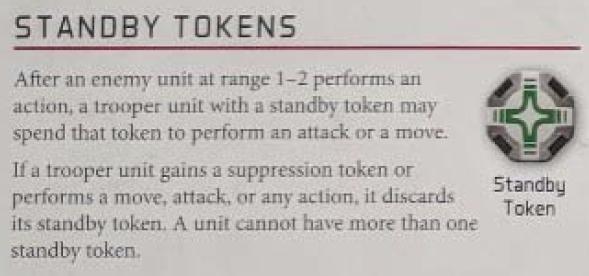
After a unit at 1-2 performs an action, a trooper unit with a standby token may spend that token to perform an attack or move.

If a trooper unit gains a suppression token or performs a move, attack or any action, it discards its standby token. A unit cannot have more than than one standby token.

So it looks to me that you will wait until your opponent does something, then see if you can react. So, if he moves into range 1-2 you can attack or move, if he moves to range 3 then no action for you.

I also find it interesting that you are limited to only troop units, which are identified by the lack of a notch on the base and that a single suppression token will remove the standby token. Given that a single hit or critical (even if cancelled) produce a suppression token it seems almost useless if your opponent has a vehicle in support to activate after you, or has a range 1-3 weapon or is already in range 1-2. Nor can standby tokens get used in the following turn.

Based on the rules quoted above, it seems pretty clear to me that what matters is where the unit is when it takes an action. So if the unit starts at Range 1-2 and moves out, you get an action because it was at 1-2 and took an action. If it starts at Range 3 and moves into Range 2 (and takes no further actions), you would not get a standby action because it was not at Range 1-2 and taking an action. If it moved through the Range 1-2 band in a single movement (out-in-out), you wouldn’t get a standby action because again, the unit is not at 1-2 and taking an action.

58 minutes ago, Ailowynn said:

Based on the rules quoted above, it seems pretty clear to me that what matters is where the unit is when it takes an action. So if the unit starts at Range 1-2 and moves out, you get an action because it was at 1-2 and took an action. If it starts at Range 3 and moves into Range 2 (and takes no further actions), you would not get a standby action because it was not at Range 1-2 and taking an action. If it moved through the Range 1-2 band in a single movement (out-in-out), you wouldn’t get a standby action because again, the unit is not at 1-2 and taking an action.

The only counterpoint i have to that is that that interpretation makes standby incredibly situational, and very nearly functionally useless.

Any time you'd want to take the standby offensively, you'd be better served just taking the attack action to begin with.

Defensively it allows you fall back when charged, but often want to be you'd be in the better spot to start with.......

Come to think of it even setting up the ready then doesn't work, because your opponent is better served firing from r3 and not triggering or probably clearing the standby (via suppression)..... this is starting to hurt my brain

Standy should have a lot of counters otherwise its too good.

Rules seem pretty clear, action while in range 1-2 then can standy. Action at 3 and move into 2 is no go.

The only time I see it really having any use would be if you have a couple of trooper units is holding an objective at the start of an activation (with no targets in range), and performs a dodge and then standby with each. That way if the enemy gets into range and shoots at one unit the other can shoot back..... But yeh, not much use really and makes for good targets with the long range AT-ST shots to put a suppression token on.

Not picking on anyone but the rules actually say after not before, so you test after the unit does an action. If I move out of distance 1-2 you don't get a standby action.

image.png.fab55c7db933b58eb2be750ddd72383a.png

5 minutes ago, Amanal said:

Not picking on anyone but the rules actually say after not before, so you test after the unit does an action. If I move out of distance 1-2 you don't get a standby action.

image.png.fab55c7db933b58eb2be750ddd72383a.png

Hi Amanal, It doesn't actually say if you move out of range 1-2 a standby can't be used.

It could be read as, if a unit started that action at range 1-2, after that action has been performed "a trooper unit........perform an attack or move".

I think it needs to clarify if the range (1-2) is determined at the start of the action being declared or after its finished. Hope the full rules cover this when FFG get around to it!

It'll be measured after the action based on how similar effects are triggered in basically every other FFG game.

"Could you move your troop back to where he was, i need to measure for Standby."

After an enemy unit at range 1-2 performs an action...

Will be interesting to see whats clarified in RRG or even FAQ/Errata. I would put money on it should read ' After an enemy unit at range 1-2 has performed an action...'

FFG do great rules, most of the time. Until you need forum debate and an official ruling to answer them.

11 minutes ago, Sk3tch said:

After an enemy unit at range 1-2 performs an action...

Will be interesting to see whats clarified in RRG or even FAQ/Errata. I would put money on it should read ' After an enemy unit at range 1-2 has performed an action...'

FFG do great rules, most of the time. Until you need forum debate and an official ruling to answer them.

Let's make that "After an enemy unit has performed an action ending up in range 1-2..."

Judging from X-wing, for an “after action” effect range is measured after the completion of an action that involves movement.

Otherwise Standby is a completely useless action and Fleet Troopers will be horrifically bad.

My take on this would be:

1) The enemy unit at range 1-2 performs an action (move,dodge,attack). This triggers your standby ability, as an action was performed by a unit within range 1-2. You would then choose to do an attack or a move action, so you could then move your unit to follow the enemy, or perform an attack.

It doesn't say you have to attack the unit triggering the action, so if they had moved out of your range, you can attach another valid unit.

I think it's there to allow you to have some reaction on your opponents turn, either repositioning or attacking.

###

But i can also see slight confusion in that does the whole triggering action need to be within range 1-2 start and end.

####

I see it as a way of following a unit or counterattacking (overwatch, stanby shooting as in Bolt action) - so i would read it that the action is triggered at range 1-2 regardless if it ends in range 1-2.

oh I've rambled, and not clear myself now lol

This is my interpretation:

Enemy unit must be at range 1-2. If it performs an action at that range, you get to use stand by to attack or move, unless you gain a suppression token during the enemy activation. If the enemy moves beyond 1-2, since it performed an action at range 1-2 of you, you still get to use stand by. If an enemy moves into range 1-2 of you, you do not get a stand by action because it did not perform the action at range 1-2 of you.

I interpret "perform an action" as the player saying "I'm doing this action", so the trigger is at the start, not the end.

Guess we will see though. Need the RRG to be sure.

Couldn't say without having playtested it, but standby might simply be the action that is meant to draw fire away from important targets. You position your troops in strategic locations (ie near objectives), your big guns somewhat back and if the opponent's heavy hitters want to ignore your troopers and go after the big stuff first, they're going to suffer.

21 minutes ago, Undeadguy said:

I interpret "perform an action" as the player saying "I'm doing this action", so the trigger is at the start, not the end.

But it says 'performs an action ' so that could, and does to me, suggest that you measure after the action.

You're right though RRG needed.

Edited by Sk3tch

The scenario that comes to my mind is a unit camping an objective that requires an action to pick up. Since the rules say that a Standby token can be used after an enemy unit performs an action, and makes no distinction betweenregular actions, card actions, or fee actions, a unit could use Standby after another unit uees a Force power, or picks up an objective, etc.

Its looks like the removal of Standby due to Supppression will encourage realistic tactics: Stormtrooper unit 1 will try charge toward standby Rebel X only after Stormtrooper unit 2 has suppressed them, or else risk being cut down. Cool

P.s. while a standby unit reacts After the enemy acts, the rule could be clearer as to whether it can react if an enemy starts or ends its action in range 2, or both. But all will be revealed in due course, for sure.

Edited by skirmisher

Losing standby tokens to enemy fire is going to make using fleet troopers tricky. Unlike the other corps units, you can't go on standby and wait for another corps unit to come into range, since the other corps units all outrange you. And they really want that aim token to make the most of their huge pool of white dice (10 for a squad of 5. With Offensive surge!), but losing range 3 is going to force then to move more often. I imagine crowded boards with lots of LoS blocking terrain will allow them to set up some pretty effective ambushes, though.

It reminds me of an interrupt, where your stacking an action before you finish resolving the action. Player 1 initiates/takes an action at range one, but before it is resolved the readied player 2 takes their action. Because they are already at the ready the can react when player one gets twitchy.

Quote

"After an enemy unit attacks, moves, or performs an action, if that unit is at range 1–2 and in line of sight of a trooper unit with a standby token, that trooper unit may spend that standby token to perform a free attack action or a free move action."

23 minutes ago, Oddacity said:

Seriously?