Spell Lists and Genesys Magic

By Foghorn, in Genesys

Quick caveat for this thread: I love effects-based magic and really like the magic system in Genesys.

That being said, here's my reality. 90% of my incoming players will be coming from a d20 fantasy game or a fantasy game derived from d20. That means spell lists. BIG spell lists. I have no interest in recreating spell lists...as a whole...

However, I feel like the tools provided to us in Genesys are broad enough that we can build the bridge for those players. I want to provide the safety blanket of predefined spells in a system that lets you put together spells on the fly.

I already have a half-dozen, half-baked alternative magic systems bouncing through my brainspace, so here's the rules I'm looking to put on this particular thought exercise:

  1. It uses the 3 magic skills with the linked attribute listed in Genesys Core Rulebook .
  2. Spells (however they end up getting represented) are an additional thing that you do and the core effects based casting is always an option.
  3. Provides more narrowly defined options for players less comfortable with effects-based magic.

Some examples of things I've seen from some other discussions around on the board:

TALENTS
Magic Affinity
Tier: 1
Activation: Passive
Ranked: No
Choose a magic action and additional effect. If you are casting a spell with both of these things, gain a [BOOST]. This talent can be taken additional times, but you cannot duplicate both action and additional effect when choosing it again.

Practiced Spell
Tier: Special
Activation: Passive
Ranked: No
Choose a magic action and reduce its difficulty by 1. Then, add any additional effects that you would to attach to the action. This still cannot cause the magic action to increase in difficulty over Super-Mega Hard (5 difficulty). This talent can be taken additional times, but you cannot duplicate the action and additional effects when choosing it again.
Special: The Tier of this talent is equal to the final number of difficulty dice (minimum Tier 1).

MAGICAL IMPLEMENTS
Arcane Grimoire
The arcane grimoire is the staple item of the pointy-hatted wizard.
Arcane grimoires imbue their spells with magical energies. When they are casting a spell, adding any Arcane only effects increase the spell's difficulty one less than they would normally. In addition, your Knowledge skill is considered two higher for the purposes of additional effects (maximum 5).

This is a really good point, and something a few people I've introduced to the system have brought up almost immediately. My traditional d20 players are concerned about slowing down the game by having to construct spells on the fly, despite the adaptive benefits to doing so.

Back in my old EoTE Conversion, where I had invented a horribly overcomplicated - but remarkably similar - magic system of constructing spells through effects and growing difficulty, I had added talents like Wild Magic that granted bonuses to creating your spells on the fly, to encourage it, and make the Sorcerers feel distinct from the Wizards. Not sure if this is something I will carry through to my Genesys setting, but, it follows that train of thought.

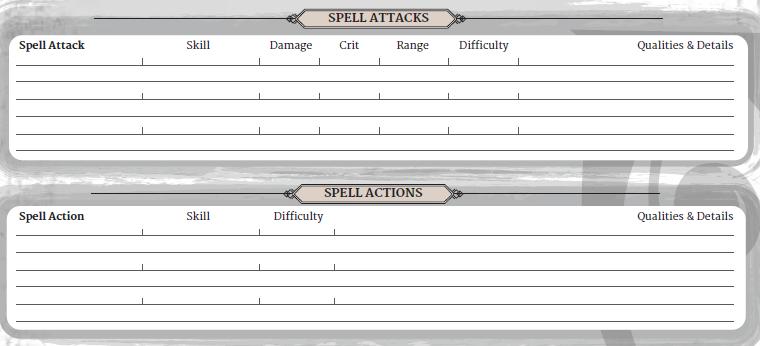
Currently in my new Genesys setting, I've added a number of Magic Actions that perform only one specific task, and I've added space on character sheets for 'prepared spells' - basically a space for casters to jot down Magic Actions they feel are iconic to their character, or are going to see a lot of use (i.e. Fireball or Cure Wounds).

Example Spell-Like Magic Action:

image.png.c88efdcb3bc34484053a277ae1c9ea4e.png

Character Sheet for 'Prepared' Magic Actions:

image.png.675c311d2afc57184959f45dafa25c4a.png

Not perhaps 100% what you're going for, but it's something I hope my D&D/Pathfinder players will find more familiar and comfortable.

So I created a different take on magic for my Eberron setting. The idea was to separate magic from the strain threshold. Have played a few test games, I found the default magic system just didn't feel like Eberron. The system I ended up with gives casters a third threshold that I call a drain threshold. As you case spells you build up drain and if you push yourself beyond your max bad things can happen. At its core its a magic point system but I feel counting up like a threshold makes it fit with the system better. Here is my long winded explanation of the system along with my thought process getting there.

Apologies, there are a lot of references to systems that aren't explained. My setting also has a hybrid career system that gives each "class" a base ability and as a character progresses they much take at least one class specific talent at each tier. I also have a system that works a little like duty and obligation rolled together called reputation. It works in a number of ways but for some casters it controls access to new spells.

https://www.dropbox.com/s/i5g7w26d8jalywv/Eberron Magic and Spell Casting Primer.docx?dl=0

9 minutes ago, SladeWeston said:

So I created a different take on magic for my Eberron setting. The idea was to separate magic from the strain threshold. Have played a few test games, I found the default magic system just didn't feel like Eberron. The system I ended up with gives casters a third threshold that I call a drain threshold. As you case spells you build up drain and if you push yourself beyond your max bad things can happen. At its core its a magic point system but I feel counting up like a threshold makes it fit with the system better. Here is my long winded explanation of the system along with my thought process getting there.

Apologies, there are a lot of references to systems that aren't explained. My setting also has a hybrid career system that gives each "class" a base ability and as a character progresses they much take at least one class specific talent at each tier. I also have a system that works a little like duty and obligation rolled together called reputation. It works in a number of ways but for some casters it controls access to new spells.

https://www.dropbox.com/s/i5g7w26d8jalywv/Eberron Magic and Spell Casting Primer.docx?dl=0

Cool to see someone else using a magical resource. To fit my Elder Scrolls conversion, I did a similar thing with "Magicka" as a resource that deducted, but it felt clumsy - perhaps for the exact reason you mention in your post (counting down, rather than up). I ended up ditching it for my Genesys rework, but reading through your rules here makes this Drain resource seem more worth it, and I'm glad to see it works in another setting, and your rules here are pretty cool.

21 minutes ago, Kaalamity said:

Cool to see someone else using a magical resource. To fit my Elder Scrolls conversion, I did a similar thing with "Magicka" as a resource that deducted, but it felt clumsy - perhaps for the exact reason you mention in your post (counting down, rather than up). I ended up ditching it for my Genesys rework, but reading through your rules here makes this Drain resource seem more worth it, and I'm glad to see it works in another setting, and your rules here are pretty cool.

Glad you like them. The trick for me has been getting the spell balance right. Because I've bypassed strain, there is little downside to casting a spell. Therefore, to make the non-casters have a reason for existing I've had to put in a lot of checks and balances. For one thing, getting new spells in my setting is harder and more expensive. Clerics have to constantly work to get their reputation with their god/church up, wizards have to do research or spend a lot of money, etc. It's important that it feels like a cost. "ahh man I'd really like to buy that cool magic item but I really need to save that gold to research a better damage spell". I've also worked in component cost into several of the class balances. Artificer's infusions are pretty cheap to learn but almost all of them have material component costs when they cast spells. I even have some higher level divine and warlock spells that cost reputation. Basically, you can resurrect your friend but you're going to be in the dog house for a while. I've also tried to make sure that opportunity cost is felt by casters. Drain Threshold doesn't scale up naturally so casters are going to have to invest xp to cast those high level spells, in addition to scaling up their magic skills to succeed at the high checks required to pull them off.

Thankfully, Eberron is very forgiving when it comes to a lot of the system I've put in place. Most of the epic level magics of other settings have been lost (to later be found a loot by the players) but low level magic is plentiful and readily available. This works perfectly with the rarity and restricted rules for equipment in SWRPG. Want an Ice Storm scroll, that's fine ask long as your reputation with the Mages guild is good, otherwise you're going to have to fine one on the open market (average streetwise check). What a Disintegration spell, well those are Restricted in Breland and your going to have to check some of the rogues seedier connections if you want to locate one and it's not going to be easy (rarity 7, Hard Knowledge Underworld).

I'm still working on a lot of the mechanics right now so a lot of things are still up in the air. My plan is for each class to have a different feel to their casting and DT recovery, but I'm only done with a couple of them so far. That and non-combat spells are giving me some trouble. Damage spells are fairly easy to balance as SWRPG has loads of heavy weapons, rockets and grenades that won't be getting converted over into equipment that I can use as a base. Non-combat is harder since its harder to put a value on being invisible for example. SWRPG balances invisibility of any sorts as a late game, expensive thing while D&D grants it at reasonably low level.

Lastly, I still haven't worked out how to deal with casters multiclassing and drain thresholds. In general, my plan for multiclassing is to give it a small xp cost along with the restriction that now they must have a class specific talent from all their classes before advancing to the next tier. I think the idea works well and provides a subtle penalty for multiclassing that makes sense, but I'm still completely unsure of how to handling multiple DTs. Making them additive seems too powerful but keeping them seperate seems hard on book keeping.

Anyway, I'm always interested in exchanging ideas and brainstorming so hit me up if you have any feedback or stuff your working on that you'd like to share.

7 hours ago, SladeWeston said:

The trick for me has been getting the spell balance right.

This is the main reason I'm looking to more expand on the current toolkit's method rather than reinvent the wheel. I'm also a recent convert to all things Elder Scrolls (took a hiatus after Daggerfall, but now I'm back in), so I'm excited to go through what the two of you have come up with for your games and see what else that can shake out of my brainpan.

(Also, I love your disclaimer at the beginning of your doc @SladeWeston )

9 hours ago, SladeWeston said:

So I created a different take on magic for my Eberron setting. The idea was to separate magic from the strain threshold. Have played a few test games, I found the default magic system just didn't feel like Eberron. The system I ended up with gives casters a third threshold that I call a drain threshold. As you case spells you build up drain and if you push yourself beyond your max bad things can happen. At its core its a magic point system but I feel counting up like a threshold makes it fit with the system better.

Very similar to the unlimited mana option in GURPS