I need help understanding the step of how this command card work thanks guys
On the lam help (ruling)
Shouldn't be difficult bud, steps are listed in the rules but basically:
Declare Target
Roll Dice
Re-Rolls
Apply Modifiers
Spend Surges
Check Accuracy
Apply Damage
I normally step through it like this for example.
AT-DP will activate, first shot at Han, I have nothing to play on declare, do you have any on declare?
Both roll dice, I'll re-roll this, do you have any re-rolls?
AT THIS POINT THEY WILL NEED TO ON THE LAM IF THEY HAVE IT
OK, I'll move onto apply modifiers then if that's ok?
LAST CHANCE, YOU BEST HAVE DECLARED IT NOW, I'VE GIVEN YOU TWO CHANCES 
I add 1 damage for the AT-DP ability, then I'll play positioning advantage for 1 more. Do you have any modifiers? (Add cunning at this point)
OK, I'll use a surge for pierce 2, I've got the right amount of accuracy, from what I can see that'd leave Han to taking an extra 5 damage, that ok?
-------------------
Sorry, a little lengthy, but hopefully that gives you a good explanation with an example.
If you want to know what cards go where, it will become obvious in time, but pasi did an excellent write-up here:
https://boardgamegeek.com/thread/1631857/ability-resolution-order-during-attacks
All the best!
Rich
No this is perfect see I don't have a core I just have jabbas realm was trying to save money when I got into IA lol
So thank you
Any time mate, although it's worth noting the rules are free to download from the ffg site :
https://www.fantasyflightgames.com/en/products/star-wars-imperial-assault/
The rules ref guide should have most of what you need in
For the long story:
Ability Resolution Order During Attacks
(Includes the relevant quotes from the rules.)
Just make sure you're alert when you're planning to use interrupt cards like On the Lam.
It's very easy to miss "play windows" because players get in a groove and can go through the steps pretty quickly. For OtL specifically, attackers will sometimes be anxious or have their moves planned and waste no time adding modifiers once the defender claims no rerolls. Take your time. Play through the steps like Rich laid out. Clarify you're both done with rerolls and be sure to stop your opponent to play OtL before modifiers can be resolved. You may even want to say in the same sentence something like, "I don't have rerolls, but I do have a card to play before modifiers."
Lastly, don't let players, new or veteran, intimidate you either. If there's a dispute, do not be afraid to call over a TO or pull out the rulebook to get it right. It could be the difference between a win or a loss.
can you play Parting Blow after someone plays On the Lam since it's a new interrupt and new attack ?
yes
That would be hugely funny with someone who has Stun. Attack, they Lam and you use Parting Blow to stun them in place and then continue to resolve the rest of your original attack! 
I assume it would work, because you're already in the attack so even though you get stunned yourself from parting blow I think you're allowed to finish the original attack. A move like that would make my entire day, even if I went 0-4!
8 minutes ago, aermet69 said:That would be hugely funny with someone who has Stun. Attack, they Lam and you use Parting Blow to stun them in place and then continue to resolve the rest of your original attack!
I assume it would work, because you're already in the attack so even though you get stunned yourself from parting blow I think you're allowed to finish the original attack. A move like that would make my entire day, even if I went 0-4!
Royal guards have stun and can parting blow. But who on the lams their attacks lol.
The Wampa too!!!
Yes, you get to finish the original attack if Parting Blow stuns the target (and you become stunned during your attack). Stunned has been ruled to prevent declaring attacks, you get to continue an attack you have already started.
On February 5, 2018 at 3:16 PM, The Archangel said:Just make sure you're alert when you're planning to use interrupt cards like On the Lam.
It's very easy to miss "play windows" because players get in a groove and can go through the steps pretty quickly. For OtL specifically, attackers will sometimes be anxious or have their moves planned and waste no time adding modifiers once the defender claims no rerolls. Take your time. Play through the steps like Rich laid out. Clarify you're both done with rerolls and be sure to stop your opponent to play OtL before modifiers can be resolved. You may even want to say in the same sentence something like, "I don't have rerolls, but I do have a card to play before modifiers."
Lastly, don't let players, new or veteran, intimidate you either. If there's a dispute, do not be afraid to call over a TO or pull out the rulebook to get it right. It could be the difference between a win or a loss.
I want to highlight this, as I think it's really good advice and how I explain "tournament behaviours" to a newer player asking about proper conduct.
Obviously, play respectfully and ethically, but this is where things get grey and it's important to have some fundamentals, at least on your own end, to ensure a smooth tournament experience.
Timing windows are crucial in any game that has a "take that" mechanic in it somewhere that involves hidden information, which is usually a hand of cards.
If you have, for example, Beast Tamer on the board and Survival Instincts in your hand, and both require you to use them at the start of your activation, then you can do either one first, resolve it, then do the other one, and resolve that effect too. Then you proceed with your two potential actions and complete the activation as normal. For the sake of example, pretend we're talking about a Rancor here.
Now, let's say I activate my Rancor, Beast Tamer it up 4 spaces, then move, then attack my opponent's figure. My Rancor had Focus and just rolled terribly. I know now that what I thought was a sure-fire easy kill now leaves something deadly alive I wasn't counting on. I now play Survival Instincts to get the defense boost and would be called out, rightly so, for missing the window.
Same situation but this time my attack is 100% successful and I take a big hitter off the board. Now I play Survival Instincts. In practical terms, the end result here is the same whether I played it before I declared my first action or waited until the end, as the threat is eliminated anyways as I hoped, and I'm turtling up against the rest of my opponent's forces.
The problem with getting mentally lazy that way with the second scenario is that an unethical player will miss a timing window on purpose to gain information they wouldn't otherwise have (like the scenario where the Rancor whiffed) and aim to play in an optimal way with perfect information while you are stuck with chance.
To tie it back to the original topic with On the Lam, that's why it's tactically best to play Assassinate as late in the combat steps as you can, though technically it can be dropped pretty well anywhere in there.
If you roll your attack vs my Han, see you have range and immediately play Assassinate, because we haven't applied modifiers yet, I could leg it out of there, and your Assassinate goes to waste. If you picked it up at that point, saying "oh, well if you're doing that, it would be a waste to play Assassinate", I would agree with you, in the sense that it's wasteful, but you wouldn't be backing that out either. Han would duck behind a corner, and that would be that. The problem now is that I know more about your hand than I should have, and I can't unlearn that information once you've slipped up and given it to me, and it puts me in a moral quandary that I shouldn't have to be in.
Accidents happen, and in the heat of the moment we can make these slips. I've done it myself many times and have lost almost as many games because of it. You need to keep everyone honest so you don't at best put another player in the awkward spot of having you begging for a roll-back on activity in the game during a tense top cut match, or at worst, cheat or be cheated.
I can deal with mistakes and transparency in my opponents when they cop to it immediately. You just get a TO to pause your game, examine the situation and decide how to fairly proceed while you hang back, have a swig of water, maybe take a quick stretch, and get back to it. Calling a TO isn't inherently a cowardly way of accusing your opponent of cheating, it's about making sure that an objective solution within the context of the rules and rulings that we have available is reached.
So with that in mind, don't rush your opponent when you're working out combat steps, and don't rush yourself because you can't wait to get off that Assassinate, and tip your hand either, because your opponent will demand you back out the steps if you denied them the chance to play an interrupt and they would be right to do so.
14 hours ago, cleardave said:To tie it back to the original topic with On the Lam, that's why it's tactically best to play Assassinate as late in the combat steps as you can, though technically it can be dropped pretty well anywhere in there.
If you roll your attack vs my Han, see you have range and immediately play Assassinate, because we haven't applied modifiers yet, I could leg it out of there, and your Assassinate goes to waste.
Technically, the attacker should only play Assassinate in the Apply Modifiers step. So there should never be an instance where the defender plays On The Lam in reaction to Assassinate. If the argument was that the attacker moved from Rerolls to Apply Modifiers too quickly, and the defender wanted the opportunity to use On The Lam, then Assassinate would not be played but now the defender would know that the attacker has it in his hand.
Semi-related; I sometimes see players play cards like Positioning Advantage in reaction to the defender using an ability like Zillo (pitch a card to add a block), even after already using other attacker cards during their proper window (attacker cards then defender cards), which really grinds my gears.
Edited by SmashotronIndeed.
There's a lot of haste to these things, and a really good tool that would slow down a combat roll to the appropriate pace would be a nice one-pager in the FAQ that points this all out in steps/with a flowchart, simply to provide a guide we can all follow and agree on.
To bring in an outside example that I think is relevant still, it's like playing Star Wars LCG and dropping down a series of "take that" cards for your actions during an Action window. You need to determine, in that action window if the person who's turn it is would like to play something, then the other player can then play something or not, and so on.
Less relevant in casual games, but I would urge players planning on attending tournaments, in particular Regionals and higher, to practice two things;
1) No take-backs on anything at all
2)A structured "do you have any x-cards/abilities to play?" dialogue for these timing windows, in particular in combat and the end of round portion of the game.
You'll get out of a lot of time-wasting and stressful debates over triggers and knowledge of your opponent's cards and will overall have a more "fair" result to your games, such as can be derived from a game that uses randomization to influence its results.
The attack step are listed in the RRG. You should probably call the steps and ask if the opponent is done. See below my reference sheet which I have composited from the material from the RRG, Learn to Play, and the reference cards. (And for the full story, https://www.boardgamegeek.com/thread/1631857/ability-resolution-order-during-attacks).
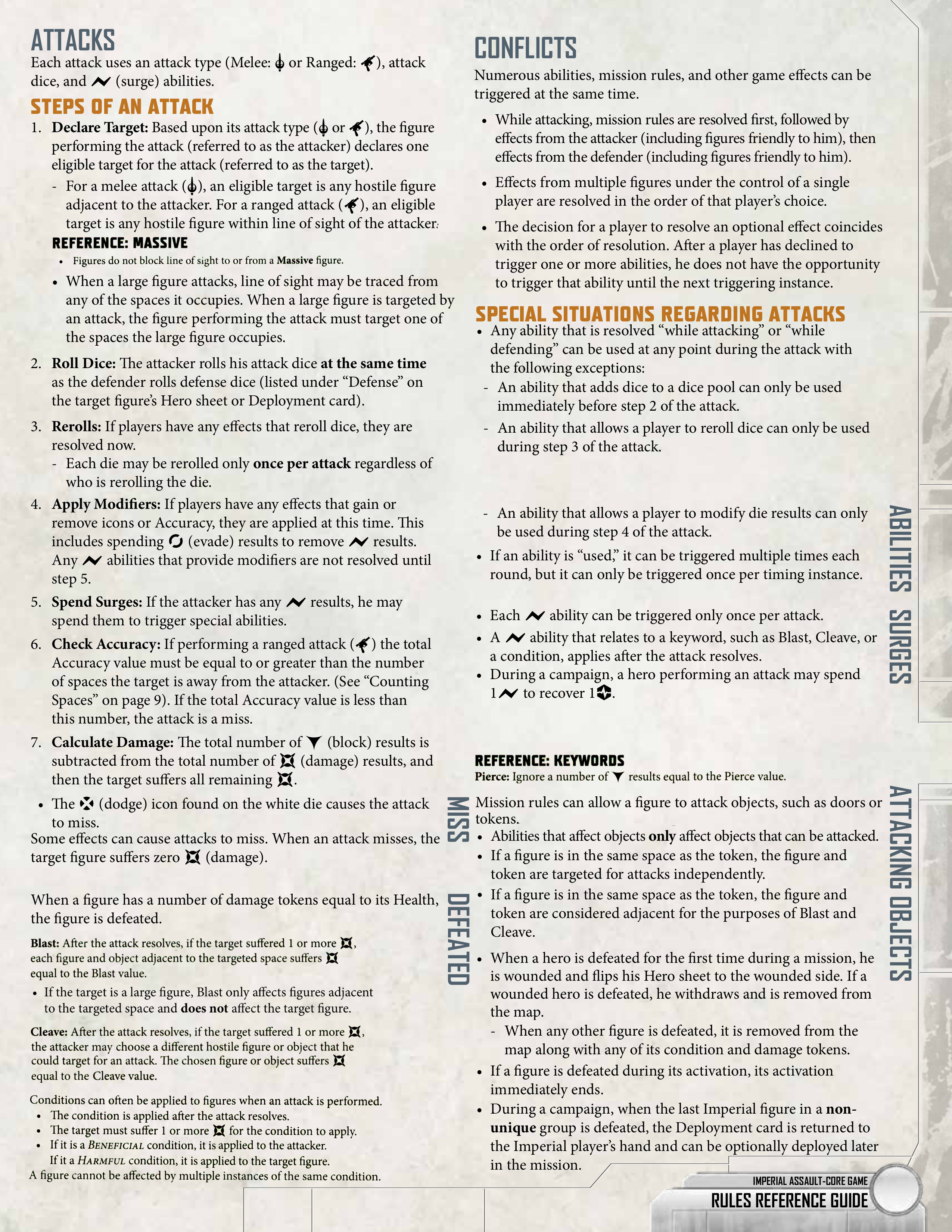
Edited by a1bert
Thats exactly what happened in my last game. None of us had rerolls to do but we didnt call the steps - so I played On the Lam when he hinted his Assassination and right as he played it I said "on the lam" so he took his Assasination back (and I shouldve kept it for Han later in the game but still won  40-39) and used it later.
Your attention to detail and sources makes me sad that FFG doesn't fly you out to Worlds every year to moderate on it. I've watched their judges at Worlds scramble to come up with a solid answer for some timing effects. Not to myself in a game, but you overhear it and watch it while your opponent is making a decision.
They could have you run an IA rules boot camp for the judges and whip those softies into shape. By the time you're done with them, they'll be carved out of wood.