Dealing with Snoke *TLJ SPOILERS AHOY*

By penpenpen, in Game Masters

As I haven't figured out how spoiler tags work, and the warning in the thread title should be enough, here goes:

So, as a GM, how would you deal with PCs using clever ploys to kill a Nemesis out of combat, like Kylo did when bisecting old man Snoke? Assuming we use the rules and don't just rely completely on freeforming and GM fiat.

If we take the example at hand, I think its safe to assume that Kylo rolled pretty well on his deception check. If he rolled a bucket of Triumphs, I guess it could be fair to just let Kylo ice the old man (assuming a successful force check for move). However, wouldn't that in all fairness open up for the PCs to run afoul of such shenanigans with similar consequences? As a GM, I doubt I could get away with GM fiating my PCs to death without at least some chagrin, no matter how many Triumphs or Despairs are rolled.

Or, maybe just get a sneak attack in. With the "fine manipulation" control upgrade of Move, it seems fair to let Kylo make a combat check combined with move, and while there are no rules for sneak attacks, denying Snoke any Defense rating (except possibly armor, which does not look like an issue), and perhaps even Adversary (I see it as a simplification of Dodge, Sidestep etc) for that attack. Maybe even drop the difficulty a step. The thing is, even with all these advantages, one-shotting a Nemesis* is pretty damned hard, even with a fully modded lightsaber (Anakin's is mostlikely a EotE/AoR-level lightsaber). I think it's pretty fair to assume you'd need about 20+ damage or at least a +50 crit (if you roll really well) to pull it off. While definitely doable, it very much runs the risk of only severely wounding the Nemesis, leaving the PCs in the unheroic position of attacking and finishing off a severly wounded foe, whom they sucker punched first. Which risks feeling a tad... anticlimactic (in such a case, I'd rather have Snoke get away while his guards cover his retreat).

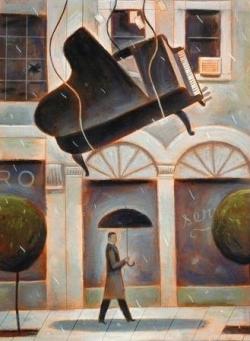
If we move away from the specific example of Kylo and Snoke, and instead imagine a lone PC confronted by the BBEG Nemesis in an abandoned warehouse (or other suitably atmospheric industrial locale). They banter a bit (the PC at a clear disadvantage if things should get physical, and both parties know it), and when the Nemesis gloats about the PC walking straight into his traps, the players smiles and rolls a successful deception check and has her PC reply "If I walked into a trap, then why are you standing exactly where I want you to?" and at that point the other PCs cut lines holding up the very heavy object that has been dangling precariously over the Nemesis. As the object (Anvil? Safe? Grand Piano? Do they have Grand Pianos in Star Wars? Let's call it a Space Grand Piano) Space Grand Piano comes crashing down, how would you rule it?

1. The PC rolled triumphs. Nemesis goes splat. (Possible downside: Might feel arbitrary.)

2. The Nemesis gets to roll... something to get out of the way to avoid or mitigate damage. (Possible downside: Players might feel cheated if they rolled well enough for their plan to succeed, but the Nemesis gets to make a roll to avoid the consequences, thereby doubling his defense (having already set the the difficulty for the deception check. Also see anticlimactic wounded villain above)

3. The PCs make an combat check for dropping the Space Grand Piano (will house rule and post stats at a later date). Combat system is used for calculating damage and other effects. (Possible downside: See anticlimactic wounded villain above. Also, a completely bungled roll in this situation might feel seriously anticlimactic, but hey, winning is sweeter when you've failed every step of the way to get there).

*I would be perfectly fine with statting out Snoke as a Rival, given his story relevance, or a weaker Nemesis, or even throwing out his listed stats and ruling him dead if the attack was at least fairly successful. But that'd be a little too GM Fiat-y for the discussion at hand.

I’d say he is a nemesis but with low wounds / soak, high strain, high force rating, lots of force powers, and wasn’t wearing armour.

i think the attack itself was probably a lightsaber attack using move / deception, using force dice for the ranged move and ignition.

am away from book so not sure if that is rules legal but using a different skill for an attack works narratively.

edit - move with last control upgrade, using deception in place of lightsaber, I’d suggest with a destiny point to allow the substitution. Snoke would have his normal defences, but may well not have committed force dice to sense at the time.

Edited by Darzil

Why use deception in place of light saber? Seems to me it would either be in addition to, or the attack would be based on the degree of success of the move power. If Kylo's move had failed igniting the blade would have been irrelevant to deal a killing blow. I could also argue the use of charm in this case because Snoke was distracted talking to both Kylo and Rey, and was being positive toward Kylo in this case.

I like to reward player cleverness, and if I, as the GM, am foolish enough to place my Nemesis in harm's way, then I should expect harm to come his way. This isn't new to this game of course, it's something GMs have had to deal with since the inception of the hobby, and the guideline always proposed is "do not put your important NPCs where your PCs can kill them, because they will find a way."

In a way, it's actually liberating to have one's plans destroyed, and it speaks directly avoiding over-prepping. All is not lost if the BBEG gets killed, there's always a bigger fish.

As far as taking out Snoke so easily, just figure that Kylo got a lot of advantage on his Lightsaber check (he was probably using Discipline to cloud his true intentions from Snoke's casual thought reading), and this being Anakin's lightsaber it was fully modded (Crit 1, Vicious 2) so that when he rolled for the critical injury, Kylo was able to get over 150, which is an insta-kill.

As I've noted in similar threads here and back during the WotC d20 days about how to recreate what we see on the big or small screen (or read in a book or comic), the main thing isn't that the character can always perform the desired action without fail, only that they have a reasonably decent chance of pulling it off. My rule of thumb is to figure that for those sorts of "cool moments" like ANH!Luke blowing up the Death Star or TPM!Kenobi bisecting Darth Maul or TFA!Han being able to hyperspace jump the Falcon past Starkiller Base's planetary deflector shields, they boil down to the acting character getting a really good check result.

And with FFG's dice system, the chance for a dice result that is overwhelmingly successful in spite of high difficulties makes this a little easier, since it can be entirely possibly for the difficulty/challenge/setback dice to come up blank. Something I've seen on both sides of the GM screen, allowing for outrageous successes in instances where the acting character by all rights should have failed. Granted, the opposite is also true, with the acting character flubbing badly when success was all but assured, but that's the beauty of the narrative dice system that Jay Little concocted all those years ago.

Technically, it was a cutscene. Kylo is a bad guy and so was Snoke, so both are/were NPCs. :D

Tho, to answer the actual question, if one of my players came up with an awesome plan like that on the fly during the encounter, I would probably just make the roll a pass/fail. Maybe not even a very difficult one at that, cause I have faith in players being able to fail at rolls they need to pass to survive.

My view is that if they players are paying attention to detail enough to use my BBEGs abilities against him in such a sneaky way, then that is the reward and the role playing, not the throwing of the dice. That one shouldnt be screwed up by a bad roll.

Wouldn't that be a plot point?

Either it's a fake out or intended to improve the intended villain.

In a game it's really up to the GM, it is possible they lucked out on a critical hit though!

Edited by copperbell

Rewatched it today. I think Snoke knew what was coming. He spoke of Kylo fulfulling his destiny, and we all know the destiny of a sith apprentice . . .

5 minutes ago, Darzil said:

Rewatched it today. I think Snoke knew what was coming. He spoke of Kylo fulfulling his destiny, and we all know the destiny of a sith apprentice . . .

That look of surprise on his face told me the exact opposite: he didn't see it coming at all.

20 minutes ago, JorArns said:

That look of surprise on his face told me the exact opposite: he didn't see it coming at all.

Or it was the pain when it actually happened. I think it could be read either way.

1 minute ago, Darzil said:

Or it was the pain when it actually happened. I think it could be read either way.

Possible of course, but looked like surprise to me because of how he took the time to slowly look over at the activated lightsaber. It looked strongly like surprise and/or disbelief to me, but that's just my opinion.

To clarify, it's not really about the Kylo/Snoke situation, that is just what got me thinking, and is an excellent example.

It's really what you can do with the system, and when and why you should do it. While certain amounts of GM fiat, judgement calls and common sense are necessary to any roleplaying game, I do like to stay consistent regarding what people in the system can and can't do. Of course, I cut my teeth on fairly simulationist system that treats everyone the same, so I have to leave some of that mindset behind in narrative systems like these were some people are literally faceless minions and die much easier than someone who has been upgraded to having a face and/or a name, despite them being otherwise identical. So keeping the world internally consistent is a bit trickier, but I still like to try.

4 hours ago, themensch said:

I like to reward player cleverness, and if I, as the GM, am foolish enough to place my Nemesis in harm's way, then I should expect harm to come his way. This isn't new to this game of course, it's something GMs have had to deal with since the inception of the hobby, and the guideline always proposed is "do not put your important NPCs where your PCs can kill them, because they will find a way."

In a way, it's actually liberating to have one's plans destroyed, and it speaks directly avoiding over-prepping. All is not lost if the BBEG gets killed, there's always a bigger fish.

Very true. If the players come up with a cool and clever way to kill or defeat a Nemesis without the big fight you were expecting, you need to ask yourself if that Nemesis part in your plans is more important than the awesome plan your players just pulled off. NPCs are easy to replace. Moments where the players manage to pull off something awesome and make their PCs look cool is trickier.

3 hours ago, korjik said:

Tho, to answer the actual question, if one of my players came up with an awesome plan like that on the fly during the encounter, I would probably just make the roll a pass/fail. Maybe not even a very difficult one at that, cause I have faith in players being able to fail at rolls they need to pass to survive.

My view is that if they players are paying attention to detail enough to use my BBEGs abilities against him in such a sneaky way, then that is the reward and the role playing, not the throwing of the dice. That one shouldnt be screwed up by a bad roll.

Making the roll a pass/fail is probably a good idea to avoid the most boring result, ie the PCs succeed, but with only minor effect. I'd probably set the difficulty fairly high though, as it is tangible way of raising the stakes. I'd be very willing to hear the player's arguments for why the should get boost dice though.

I'm not in complete agreement regarding the role playing vs dice though. If I was just into role playing, I'd take up acting or stick to free form. If I was just into gaming, I'd stick to board games and tabletop war gaming. Now I move a bit up and down this axis, but I really do love it when the role playing and gaming intersect, particularly in systems that actively shapes the narrative. With the narrative dice, I'm not too worried about a bad roll screwing things up, because failing can be as awesome succeeding (which is why I liked TLJ btw, but let's not get into that in this thread too ;) ).

3 hours ago, copperbell said:

Wouldn't that be a plot point?

Either it's a fake out or intended to improve the intended villain.

In a game it's really up to the GM, it is possible they lucked out on a critical hit though!

All good points. In addition, the original intention need not matter as no GM plan ever survives contact with the PCs. If Snoke was your intended villain and the PCs concoct a brilliant plan to off him before you delivered his cool backstory and use his meticulously crafted statblock, maybe just retcon your plans and let the players have a day in the sun. Snoke was now always intended to be a fake out, and his backstory and stats can now be reskinned a little for the guy who totally was the intended villain all along... his evil twin brother Snöke! (Ok, that might need some work.)

And gentlemen, please, there are threads dedicated to discussing the movie, please do that there.

...because he totally did not see that coming. :D

EDIT: Almost forgot!

falling_piano_250_6702.jpg

Space Grand Piano (Coordination; Damage *; Crit 2, Enc 30, HP 0, Range Extreme*; Inaccurate 3, Concussive 3, Knockdown, Limited Ammo 1, Gravity-assisted*)

*Gravity-assisted: This weapon works by being dropped from a height onto the target who must be underneath it for the attack to have any chance to be successful at all. This means that this weapon only works as long as there is gravity, up to extreme range but only in the vertical plane. Damage is dependent on the distance it falls, and is the same as falling from the same distance, plus one damage for every uncancelled success. This extra damage applies to both strain and wound thresholds. This weapon is not usable when engaged, but may be used to provide cover from ranged attacks.

Edited by penpenpen
3 hours ago, penpenpen said:

To clarify, it's not really about the Kylo/Snoke situation, that is just what got me thinking, and is an excellent example.

It's really what you can do with the system, and when and why you should do it. While certain amounts of GM fiat, judgement calls and common sense are necessary to any roleplaying game, I do like to stay consistent regarding what people in the system can and can't do. Of course, I cut my teeth on fairly simulationist system that treats everyone the same, so I have to leave some of that mindset behind in narrative systems like these were some people are literally faceless minions and die much easier than someone who has been upgraded to having a face and/or a name, despite them being otherwise identical. So keeping the world internally consistent is a bit trickier, but I still like to try.

Very true. If the players come up with a cool and clever way to kill or defeat a Nemesis without the big fight you were expecting, you need to ask yourself if that Nemesis part in your plans is more important than the awesome plan your players just pulled off. NPCs are easy to replace. Moments where the players manage to pull off something awesome and make their PCs look cool is trickier.

Making the roll a pass/fail is probably a good idea to avoid the most boring result, ie the PCs succeed, but with only minor effect. I'd probably set the difficulty fairly high though, as it is tangible way of raising the stakes. I'd be very willing to hear the player's arguments for why the should get boost dice though.

I'm not in complete agreement regarding the role playing vs dice though. If I was just into role playing, I'd take up acting or stick to free form. If I was just into gaming, I'd stick to board games and tabletop war gaming. Now I move a bit up and down this axis, but I really do love it when the role playing and gaming intersect, particularly in systems that actively shapes the narrative. With the narrative dice, I'm not too worried about a bad roll screwing things up, because failing can be as awesome succeeding (which is why I liked TLJ btw, but let's not get into that in this thread too ;) ).

All good points. In addition, the original intention need not matter as no GM plan ever survives contact with the PCs. If Snoke was your intended villain and the PCs concoct a brilliant plan to off him before you delivered his cool backstory and use his meticulously crafted statblock, maybe just retcon your plans and let the players have a day in the sun. Snoke was now always intended to be a fake out, and his backstory and stats can now be reskinned a little for the guy who totally was the intended villain all along... his evil twin brother Snöke! (Ok, that might need some work.)

And gentlemen, please, there are threads dedicated to discussing the movie, please do that there.

...because he totally did not see that coming. :D

EDIT: Almost forgot!

falling_piano_250_6702.jpg

Space Grand Piano (Coordination; Damage *; Crit 2, Enc 30, HP 0, Range Extreme*; Inaccurate 3, Concussive 3, Knockdown, Limited Ammo 1, Gravity-assisted*)

*Gravity-assisted: This weapon works by being dropped from a height onto the target who must be underneath it for the attack to have any chance to be successful at all. This means that this weapon only works as long as there is gravity, up to extreme range but only in the vertical plane. Damage is dependent on the distance it falls, and is the same as falling from the same distance, plus one damage for every uncancelled success. This extra damage applies to both strain and wound thresholds. This weapon is not usable when engaged, but may be used to provide cover from ranged attacks.

For my part, my reasoning is more based on wanting to reward players who actually listen to all the mumbo-jumbo I feed them, sometimes for years.

My reasoning is that Kylo Ren's player had to have gone something along the lines of 'I know boss dude is reading my mind, I know boss dude can mess us all up with little effort, and I know Mary Sue here really digs me. So I can pop a destiny point to get boss dude to put her saber right next to him, then mimic what I am doing with both sabers, and voila, scratch one flattop'.

So if someone put all that together into an awesome plan, I dont want the awesomeness ruined by a crappy roll. I want my players blowing my mind with plans from way out in left field, plans that take the tale I am presenting and using it to get things to happen. Having it turn into a big letdown cause of the dice could make it look like investing in the game isnt as important as good dice pools.

To be honest tho, most of the time there would be a roll. My qualifier on having a roll at all comes from the fact that I have had a player who couldnt hit to save anyones life. This was in D&D, but the dude would very regularly miss on attacks that needed 3 and 4s to hit. It was a huge drag for him sometimes.

4 hours ago, penpenpen said:

It's really what you can do with the system, and when and why you should do it.

I think it's a mistake to try and cram the movie experience into the game mechanics. It's the same as the D&D classic "I have a dagger to the throat of the 20th level lord. He has 100+ hit points, but my dagger only does 1d4..." So this is where you toss out the mechanics and let other factors drive the experience.

25 minutes ago, korjik said:

So if someone put all that together into an awesome plan, I dont want the awesomeness ruined by a crappy roll.

This is the same as hosting a mystery game. If the players must have the clue, then you can't make getting the clue reliant on a dice roll. If you don't want the bottleneck, then don't use the mechanics, let the narrative take over.

It sounds like you want to save the player the experience of having a great plan foiled by blanking on positive dice. This is unrealistic, you really only have two choices:

  1. allow the narrative to decide what happens. The drawback is, no dice are rolled, the PC's skills/talents become irrelevant, and the player can't leverage any positive dice results.
  2. require the dice roll as normal, and hope the player can get a thicker skin and suck it up.

I think replicating movie moments almost requires option #1. But then you're not playing a game, you're agreeing on a script. Nothing wrong with that, but then, why buy the rule books at all?

5 minutes ago, whafrog said:

I think it's a mistake to try and cram the movie experience into the game mechanics. It's the same as the D&D classic "I have a dagger to the throat of the 20th level lord. He has 100+ hit points, but my dagger only does 1d4..." So this is where you toss out the mechanics and let other factors drive the experience.

This is the same as hosting a mystery game. If the players must have the clue, then you can't make getting the clue reliant on a dice roll. If you don't want the bottleneck, then don't use the mechanics, let the narrative take over.

It sounds like you want to save the player the experience of having a great plan foiled by blanking on positive dice. This is unrealistic, you really only have two choices:

  1. allow the narrative to decide what happens. The drawback is, no dice are rolled, the PC's skills/talents become irrelevant, and the player can't leverage any positive dice results.
  2. require the dice roll as normal, and hope the player can get a thicker skin and suck it up.

I think replicating movie moments almost requires option #1. But then you're not playing a game, you're agreeing on a script. Nothing wrong with that, but then, why buy the rule books at all?

For all the other points in the game?

You seem to think that this is a binary solution set, and you must always use the same solution for every situation. You also dont seem to see that I have put a few very specific qualifiers into how I determine the outcome of the situation.

The D&D classic you describe is called 'I dont know what a hit point is'. If you have a dagger to the throat of someone, they dont have 100 hp, they have 0hp.

If the players must have the clue then making the clue dependent solely on a roll is called bad GMing. Players dont actually like it when they have to say 'Well thats the third mission we failed cause we couldnt make every roll successful. I guess we just suck'. Having a game session that frustrates everyone simply cause all the die rolls are bad isnt fun. The point of the brain running things is to modify on the fly to get things moving. Wether that is failure, moving in a new direction, adding hidden failure modes that move things forward is all part of being a good GM. Telling your players to suck it up isnt good GMing

You really shoudnt put words into my mouth. I did not say that all great plans must succeed, or blanking should never happen. The OP is a very specific circumstance set up in a very specific way to where 'oops sorry, you blew the roll so haha screw you' is immersion breaking and annoying for no reason. The dice got them up to that point, letting them turn all that setup into crap is generally just frustrating. There are also times when you just want things to move along too. If that is the climactic scene dont let the dice mess it up. If it isnt the climactic scene, then let the dice do what they may.

Hey Han, make a deception check to see if the guy calling the detention block believes you. Ooh, nice despair. He asks for your operating number

Hey Han, make a survival check to see how well you find Luke. Ooh, nice despair. Your tauntaun dies

Hey Han, make a sneak check to sneak up on the scout trooper. Ooh, nice despair. You step on a twig. Roll init. 5 dice and you couldnt roll one success? He backhands you

I would say that movie moments are frequently off die rolls. Just takes some imagination

Actually, something like this came up in tonights game. Two days after the battle of Endor, my team of Jedi were on Coruscant looking to break into the Royal Palace for Jedi swag. They attracted the attentions of the Inquisitor on station, but instead of throwing down, he wound up inviting them to a civil discussion over coffee. So one Jedi of the group went to talk with him, while the others provided backup - one of them successfully hiding in the Force (she had that shadow talent, making you force invisible) who contemplated sniping him. I straight out told them "Yes, the mechanics say that you have to do damage, beat soak, get enough wounds to kill him and so on and so on. But Hollywood Filmmaking says that you could kill him in one. So if you beat his vigilance with your blaster skill, I'll straight out give you the kill, no mechanics involved."

She thought about it, but declined to take it - but the offer was there.

So yeah, if there was a Snoke-like situation, where the player totally gets the drop on the bad guy somehow, I would override game mechanics and just call it good.

17 hours ago, penpenpen said:

Very true. If the players come up with a cool and clever way to kill or defeat a Nemesis without the big fight you were expecting, you need to ask yourself if that Nemesis part in your plans is more important than the awesome plan your players just pulled off. NPCs are easy to replace. Moments where the players manage to pull off something awesome and make their PCs look cool is trickier.

No GM plan survives contact with the players, so the saying goes. And, at the end of the day, Rule Zero - the Rule of Cool - is the only hard and fast commandment. If a bunch of bungling half-drunken players figure out a way around my overwrought scene, then more power to them!

10 hours ago, Desslok said:

So yeah, if there was a Snoke-like situation, where the player totally gets the drop on the bad guy somehow, I would override game mechanics and just call it good.

Yep. The rules are there to enable collaborative storytelling. If everyone is on the same page already, why get the rules involved?

17 minutes ago, Stan Fresh said:

Yep. The rules are there to enable collaborative storytelling. If everyone is on the same page already, why get the rules involved?

I do play some diceless freeform games, and while there are some really awesome ones out there, for the most part I want an element of risk and chance*. Not only as a player but also as GM. I feel that the narrative dice are comparatively pretty good at dodging anticlimaxes.

Of course, there are situations where rules and dice are only getting in the way and add nothing. In that case, of course, don't bother.

Maybe because it's due to the systems and groups I've played in, where it play tended to be very immersive and character focused (rather than challenge and encounter focused) where 6+ hour sessions could pass by with barely a die rolled. Lately, I've made a conscious effort to use rules and dice more (at least in systems where they work), so I might be overdoing it, or at least seem to, depending on point of view.

But yeah, I want to throw more dice at stuff, because as a GM, I'm a little sick of being arbitrary and pretty fine with leaving more tough choices to dice.

*It does not need be dice. The best horror/suspense rpg I've played uses a Jenga tower.

4 minutes ago, penpenpen said:

It does not need be dice. The best horror/suspense rpg I've played uses a Jenga tower.

Do you listen to the Campaign podcast? They usually use Edge of the Empire, but for a one-off comedy horror special they switched to Dread, and even with just the audio it was hilariously suspenseful.

11 minutes ago, Stan Fresh said:

Do you listen to the Campaign podcast? They usually use Edge of the Empire, but for a one-off comedy horror special they switched to Dread, and even with just the audio it was hilariously suspenseful.

I don't, but now I may do so!

Also, gentlebeings, please! So far this thread has been full of wonderful insightful comments, and has sparked an interesting discussion. Please, don't turn it into an argument as the subjective nature of the matter makes it somewhat pointless. I'd love to hear why you love or hate the ideas floated here, but let's please try hold back on calling them good/bad or right/wrong, shall we?

Not directed at @Stan Fresh (sorry Stan, this has nothing to do with the post I quoted!) or anyone else in particular. Just trying to head it off early.

Edited by penpenpen
1 hour ago, penpenpen said:

I do play some diceless freeform games, and while there are some really awesome ones out there, for the most part I want an element of risk and chance

At least with my scenario, there still would have been an element of chance to the action. Yes, I would have handed them a one-shot kill, but they did have to overcome his not get sniped skill. Given that he wasn't a fool, didn't have his guard down - and in fact did have a counter sniper covering the PC across the table from him, ready to pull his trigger if anything went wrong - it wouldn't have been easy, but it would have been doable.

Edited by Desslok
15 hours ago, korjik said:

You seem to think that this is a binary solution set...

Er, no...they are simply two nodes on a continuum.

15 hours ago, korjik said:

You really shoudnt put words into my mouth.

Likewise.

2 hours ago, penpenpen said:

Also, gentlebeings, please! So far this thread has been full of wonderful insightful comments, and has sparked an interesting discussion. Please, don't turn it into an argument as the subjective nature of the matter makes it somewhat pointless. I'd love to hear why you love or hate the ideas floated here, but let's please try hold back on calling them good/bad or right/wrong, shall we?

Perhaps a little of this, then?

272soeXzPzreiiZScrHITCmjc7s=.gif

Edited by themensch
better linkin'

For me it would depend on what my plans were for the Nemesis and the PC's at that moment. Somewhat oversimplification, but basically it would boil down to "Did I plan to have the PC's defeat this nemesis right now anyway?"

1. If Yes: Have PC's roll, success = dead, fail= not dead, fight begins.

2. If no (needs to give evil speech first etc): have PC's roll, success=crit or some other effect narrated to show the PC's success gives them some sort of narrative advantage but does not outright kill them. Failure would mean the Nemesis laughs and sees it coming, ie Vader deflects Han's blaster bolt shot, pulls his gun from his hand, and invites them to sit to be guests for dinner (or whatever)