Viktor Hel vs TLT

By DonFrag, in X-Wing Rules Questions

I have 2 questions about Viktors Pilot Abillity against the Twin Laser Turret

1) How many Stress does the Attacker recieve, when Viktor ist i.e. equipped with a Stealth Device? I'd say only one, because his abillity triggers in step 8 of the Timing Chart which is after the second TLT Shot. But i am not sure about that.

2) How many defense dice are counted for his ability? When his ability triggers in step 8, you have rolled at least 4 defense dice in this attack (2 against each shot). Do they ad up? Or do you just count the dice from the second shot?
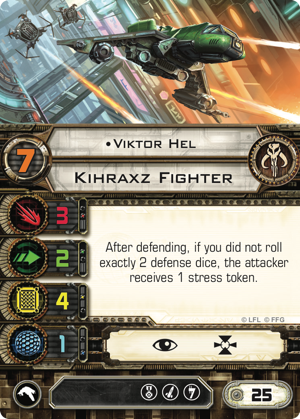
There is not an official ruling for this as far as I know but just following through logically and going off of how Hel's ability is worded and that it only triggers after both attacks have been resolved I would say thr answers are:

1. 1 stress

2. Add all the dice from both attacks. So rolling 2 dice against each attack means you rolled 4 dice and they get one stress.

I strongly disagree with @sharrrp on point 2.

When we're looking at "perform this attack twice" and other triggers, I think we generally use the framework of a qualitative test, looking at the "and" or the "or" where appropriate. For example, a "if the attack did not hit" trigger like Gunner checks "did the first attack hit" and "did the second attack hit" and if either of these answers is true , then the overall trigger is true . Logically, any combination of true or false other than false / false --that is, both attacks do not hit--will be true, and Gunner will not trigger.

I'd argue Viktor Hel ought to be treated the same way. He'll check "did the defender roll exactly two dice" for the first attack and for the second, and if the answer is false for either attack, then the defender will take stress. If it's true that Viktor rolled exactly two dice on the first attack, and true that Viktor rolled exactly two attack dice on the second attack, logically true and true is true . I'd argue that if Viktor ever rolls not-2 dice, then the attacker will receive one stress. This could be Viktor with a Stealth Device or obstructed, Viktor subject to a tractor beam, or so forth. Or the unlikely scenario of a Stealth Device VH who is also subject to a tractor, then hit on the first attack causing the SD to be discarded for the second attack, where he'd roll only 1 die.

Here's the thing: either qualitative logic or arithmetic will have to be put aside. I'd argue in favor putting aside the arithmetic sum, since I think it's bigger ask to put logic aside. Saying that if "a is true" and "b is true" then "a and b together is false" is painful to logic and language.

Meanwhile, I don't think we treat other multiple-attack triggers with the rubric of arithmetic rather than with logic. Adding dice from two attacks feels incredibly wrong to me. It seems to imply that they are somehow one attack, which isn't the case. Otherwise, we couldn't spend a focus token on each of two attacks from TLT or Cluster Missiles, or use Accuracy Corrector on both of them. Consensus is that we can, and that these are two separate attacks.

On the subject of stressing a "perform this attack twice" weapon:

There is no official ruling so, for now, it is ultimately up to the TO/Marshal/Judge at your event so check before the event starts to prevent having a potentially unpleasant surprise partway through the event.

I am still hung up on the quantitative requirement of the ability: "2" dice. My fear is that reducing the ability to a logic argument alters the question and thus alters the answer.

Between step 1 and step 8 Viktor Hel rolls 2 dice twice, while defending. After defending he is asked if he has rolled exactly 2 defense dice. Rolling 2 defense dice twice is not equal to rolling exactly 2 defense dice. It would also be inaccurate to say, in terms of game mechanics, that he rolled 4 defense dice while defending. It would, however, be accurate to say he rolled 4 defense dice in total while defending.

Due to the quantitative requirement of the ability, and the fact that four TOs from around New England have all discussed this and reached the same conclusion, I am going to continue to rule that Viktor Hel stresses all "perform this attack twice" weapons until FFG's FAQ says otherwise.

latest?cb=20170530204016

46 minutes ago, ZealuxMyr said:

On the subject of stressing a "perform this attack twice" weapon:

There is no official ruling so, for now, it is ultimately up to the TO/Marshal/Judge at your event so check before the event starts to prevent having a potentially unpleasant surprise partway through the event.

I am still hung up on the quantitative requirement of the ability: "2" dice. My fear is that reducing the ability to a logic argument alters the question and thus alters the answer.

Between step 1 and step 8 Viktor Hel rolls 2 dice twice, while defending. After defending he is asked if he has rolled exactly 2 defense dice. Rolling 2 defense dice twice is not equal to rolling exactly 2 defense dice. It would also be inaccurate to say, in terms of game mechanics, that he rolled 4 defense dice while defending. It would, however, be accurate to say he rolled 4 defense dice in total while defending.

Due to the quantitative requirement of the ability, and the fact that four TOs from around New England have all discussed this and reached the same conclusion, I am going to continue to rule that Viktor Hel stresses all "perform this attack twice" weapons until FFG's FAQ says otherwise.

latest?cb=20170530204016

Based on the flow chart for conducting attacks, I agree with this.

I've only ever argued with one of those TOs. :D

More broadly, I think it'd be wise to have a general framework for how to interpret triggers and "perform this attack twice." I think it'd be wise to take an all-quantitative rubric, or an all-qualitative rubric. I think there's a potential quantitative interpretation of cards like Gunner. Count the number of times attacks hit, and see if that sum greater than zero, for example. I don't really love that, but it'd be a way to make something like Gunner fit the quantitative model. I just think a qualitative rubric is more intuitive, easier to understand.

However, I don't necessarily think Viktor Hel necessarily implies a quantitative over qualitative test. "Roll X Defense Dice" has a specific meaning in the game, it's used by cards like Lando or R5-K6, and a pool of X defense dice matters for certain cards, such as Emperor Palpatine and Lightweight Frame.

//

The greatly irksome thing about Viktor Hel is that either "true and true is false" or "2 plus 2 does not equal 4" will necessarily be part of the final interpretation.

Personally, as shown by the fact that I've kept arguing on this, it's a lot easier for me to give up on "2+2=4" since I think it's easier to say that it's just inappropriate to perform arithmetic. That's sometimes the case with numbers. Two kids, one sitting on the other's shoulders, don't become tall enough to enter a ride at a carnival, for example. Some of this is my background in mathematics, philosophy, and some programming. I'd prefer to think in terms of logic, because it's a tautology that "true and true is true." I mean, if the only two kinds of deserts are pies and cakes, having two pies doesn't somehow make them into cake.

Edited by theBitterFig

Definitely only 1 stress, if not tlt r3a2 would be a thing again.

I'm firmly in the "he rolled 4 dice camp" even without mods for the reason above, you don't get to claim one without it being relevant to the other unless you're ffg.

Edited by Ralgon

X-Wing is never 100% Boolean nor 100% quantitative, each rules interaction has to be evaluated in the context of the ability. Specifying a quantity (2) of defense dice in the ability leads me to the need to quantify the number of defense dice rolled during the specified timing window: from step 1 to step 8, in its entirety. Once I have quantified the number of defense dice rolled (2 + 2 = 4, so 4) I then compare that quantity to the specified quantity in the pilot ability (2) and can now make a Boolean (true or false) determination: is 4 equal to 2? No, false. Thus "perform this attack twice" weapons cause the attacker to get stressed.

The big portion I still argue you ( @theBitterFig ) are ignoring in order to make your purely Boolean approach work is that his ability resolves "after defending" and evaluates the number of dice he rolled while defending . There is no precedent to, in the context of Viktor Hel's ability, look at each of the two TLT attacks separately - both occur during the same "while defending/attacking" window in the flowchart. At no point, from step 1 to 8, do you look at Viktor's ability until both TLT attacks have resolved. The "while defending/attacking" window is Step 1 to 6 (or 7 on hit), no matter how many times you repeat Steps 2 through 6 (or 7 on hit). Step 8 starts the "after attacking/defending" window and it is here that his ability looks for how many defense dice were rolled before step 8 and after step 1 and then evaluates that quantity in relation to the specified value of 2 dice.

If Viktor Hel received structural damage or a tractor beam token prior to a TLT attack, such that he now rolled 1 defense die twice, the attacker would not receive a stress token as 1 + 1 = 2 and, while defending (between steps 1 and 8), he rolled exactly 2 defense dice - no more, no less.

I don't see myself as ignoring the timing chart, just interpreting Viktor differently. I look at his text as "When defending, if [event happens], the attacker receives one stress token." As far as I see, the event "you did not roll exactly two defense dice" never happens. Fundamentally, I disagree that "x happening twice" is different from "x happening" in this context. I see "rolling exactly two defense dice" as an event which happens, and an event which happens twice under normal conditions, much like I see Gunner as "did not hit" requiring that event to happen for each attack in order to trigger. To that end, I'd view TLT attacks on a reduced-agility Viktor as being "not exactly 2 dice," since you only ever rolled one die, and rolling one die twice isn't rolling exactly two.

For precedent, Accuracy Corrector treats the two attacks separately, that using it on the first attack doesn't prevent you from modifying your dice on the second. *EDIT* Or something like Predator lets you reroll one die per attack, not one die total between multiple attacks */E* . Likewise, there's no real precedent that I can think of for summing things like the defense dice across two attacks. The closest I can think of is Reinforced Deflectors, but that's got rather different language, referring to an attack causing you to suffer 3 or more damage, and it's clear that "perform this attack twice" is two attacks, and not a single attack. Viktor Hel doesn't say "the sum of the defense dice" or "the total number."

reinforced-deflectors.png

Well, at this point, I'm glad the argument is here on the forum. My power was out last time this came up, and I only got a comment in late, pretty much after folks were done for the time.

Edited by theBitterFig
5 hours ago, theBitterFig said:

I don't see myself as ignoring the timing chart, just interpreting Viktor differently. I look at his text as "When defending, if [event happens], the attacker receives one stress token." As far as I see, the event "you did not roll exactly two defense dice" never happens. Fundamentally, I disagree that "x happening twice" is different from "x happening" in this context. I see "rolling exactly two defense dice" as an event which happens, and an event which happens twice under normal conditions, much like I see Gunner as "did not hit" requiring that event to happen for each attack in order to trigger. To that end, I'd view TLT attacks on a reduced-agility Viktor as being "not exactly 2 dice," since you only ever rolled one die, and rolling one die twice isn't rolling exactly two.

For precedent, Accuracy Corrector treats the two attacks separately, that using it on the first attack doesn't prevent you from modifying your dice on the second. *EDIT* Or something like Predator lets you reroll one die per attack, not one die total between multiple attacks */E* . Likewise, there's no real precedent that I can think of for summing things like the defense dice across two attacks. The closest I can think of is Reinforced Deflectors, but that's got rather different language, referring to an attack causing you to suffer 3 or more damage, and it's clear that "perform this attack twice" is two attacks, and not a single attack. Viktor Hel doesn't say "the sum of the defense dice" or "the total number."

reinforced-deflectors.png

Well, at this point, I'm glad the argument is here on the foKimirum. My power was out last time this came up, and I only got a comment in late, pretty much after folks were done for the time.

Hel's ability triggers after both TLT attacks were made. Nowhere is it being asked "How many times were you attacked" only "Did you roll exactly two defense dice". Obviously the answer is "No".

Look at a "real world" scenario. You're playing a pinball game that charges two quarters per game. After you played the second game I ask, "How many quarters did you spend". You could answer "one dollar" but while accurate didn't answer the question. A simple, accurate and direct answer would be "Four".

FFG has had some odd phrasing on their cards that causes people like me to parse the text to make sure As Written is As Intended. Maybe, just maybe, in this case the simple answer is the correct one. "Did he roll exactly two dice"? "Nope".

3 hours ago, Stoneface said:

Obviously the answer is "No".

Unwarranted use of obviously .

Yes, he rolled 2 defence dice. Later, he rolled 2 defence dice again.

3 hours ago, Stoneface said:

After you played the second game I ask, "How many quarters did you spend".

And that's a false comparison because Viktor Hel isn't asking how many dice you rolled.

So the real question is: When using Lightweight Frame , are you rolling two defence dice, then rolling a third, or are you just rolling 3 defence dice?

If we had a definite answer to that, then you'd have a definite answer to this. However, we have neither.

You are rolling 2 then adding and rolling a third. But if asked after the attack you rolled 3.

2 hours ago, InquisitorM said:

Unwarranted use of obviously .

Yes, he rolled 2 defence dice. Later, he rolled 2 defence dice again.

And that's a false comparison because Viktor Hel isn't asking how many dice you rolled.

So the real question is: When using Lightweight Frame , are you rolling two defence dice, then rolling a third, or are you just rolling 3 defence dice?

If we had a definite answer to that, then you'd have a definite answer to this. However, we have neither.

I don't think the use of obviously was unwarranted. Hel's ability triggers after both TLT attacks were completed. This happens in Step 8. Hel's card states that if "you did not roll exactly two defense dice the defender receives a stress token". There's no mention of the number of times he was attacked nor the number of times he rolled dice.

Nor do I think that it was a false comparison. True, Hel isn't asking the question but the question is asked of Hel, "How many dice did you roll". If it wasn't exactly two, then the attacker gets a stress.

As to Lightweight Frame, Spaceinvader answered that. It's two and one. That's spelled out on the card. Palpatine's ability can be used on the single roll after the results of the first two dice are known.

1 hour ago, Stoneface said:

As to Lightweight Frame, Spaceinvader answered that. It's two and one. That's spelled out on the card. Palpatine's ability can be used on the single roll after the results of the first two dice are known.

Then you didn't roll 4. You rolled 2 and then you rolled 2. At no point did you roll 4 dice.

6 hours ago, InquisitorM said:

So the real question is: When using Lightweight Frame , are you rolling two defence dice, then rolling a third, or are you just rolling 3 defence dice?

If we had a definite answer to that, then you'd have a definite answer to this. However, we have neither.

Basing from Palpatine "clarifications," I'd say you rolled 2 and then rolled 1, since he treats the rolls separately.

10 hours ago, Stoneface said:

FFG has had some odd phrasing on their cards that causes people like me to parse the text to make sure As Written is As Intended. Maybe, just maybe, in this case the simple answer is the correct one. "Did he roll exactly two dice"? "Nope".

To me, the simple and obvious answer is that he obviously rolled exactly two dice, and did it again.

Paying 4 quarters at an arcade game is one real-world example, but not sufficient. Is Viktor Hel asking "how much did a game cost" or "how many did you spend over multiple games"? I think the first. I just don't think it's appropriate to sum things across multiple attacks. I think Predator is an illustrative example. We've previously considered this to allow you to reroll one die per attack in an "perform this attack twice" situation. Or Lone Wolf defending against TLTs. This despite the cards specifically one die "when attacking" or "when defending." We haven't kept a cumulative total of dice rerolled between attacks, and said that you can't reroll a die on the second attack if you did on the first. We've treated this as one reroll per attack. Why should Viktor Hel be different from Predator?

Fantasy-Flight-Games_X-Wing-Imperial-Vet

Another real world would be "you must be 21 years old to buy alcohol." In this case, it'd be inappropriate for a bar to sell alcohol to two 15 years old kids who claim that they're 30 years old together. I view "roll exactly two defense dice" more like "is the crayon 2 inches long?" than "how many crayons?"

The fact still remains, that he rolled 4 Defense Dice, when his ability triggers during the Timing Chart.

Of course does Predator and Lone Wolf work twice against a TLT, because their step is twice there (after rolling attack/defense dice). Viktor Hels ability resolves only once. At this point in time he has rolled 4 dice during this attack. 4 is not exactly 2. Allthough the TLT has two shots you still follow only one Timing Chart. The second shot is not a completly new attack. It is a result of the first one.

4 hours ago, theBitterFig said:

Basing from Palpatine "clarifications," I'd say you rolled 2 and then rolled 1, since he treats the rolls separately.

To me, the simple and obvious answer is that he obviously rolled exactly two dice, and did it again.

Paying 4 quarters at an arcade game is one real-world example, but not sufficient. Is Viktor Hel asking "how much did a game cost" or "how many did you spend over multiple games"? I think the first. I just don't think it's appropriate to sum things across multiple attacks. I think Predator is an illustrative example. We've previously considered this to allow you to reroll one die per attack in an "perform this attack twice" situation. Or Lone Wolf defending against TLTs. This despite the cards specifically one die "when attacking" or "when defending." We haven't kept a cumulative total of dice rerolled between attacks, and said that you can't reroll a die on the second attack if you did on the first. We've treated this as one reroll per attack. Why should Viktor Hel be different from Predator?

Another real world would be "you must be 21 years old to buy alcohol." In this case, it'd be inappropriate for a bar to sell alcohol to two 15 years old kids who claim that they're 30 years old together. I view "roll exactly two defense dice" more like "is the crayon 2 inches long?" than "how many crayons?"

Hopefully, we agree that the TLT attack is one attack performed twice. According to the Timing Chart for Performing Attacks, Hel only triggers once. Predator and LWF are bad comparisons because their timing windows are different from Hel' s.

I'm afraid that you and I are firmly entrenched on opposite sides of this debate. FFG will be the only one to answer this question and others. Like the Bullseye Arc question regarding removing tokens or taking damage. Until FFG decides to chime in I'll leave it to a handshake in casual games or the T.O.s ruling in others.

.

7 hours ago, InquisitorM said:

Then you didn't roll 4. You rolled 2 and then you rolled 2. At no point did you roll 4 dice.

Bad example for two reasons. The timing window for LWF is different for one. The wording on the card is very specific for the other. Even though most people throw three dice it's still two/one by the rules.

you guys are literally just spewing crap back and forward at each other.

The issue here is when is "after defending" even defined? "After attacking" has a clear spot but "After defending" really doesnt (its implied but not specifically called out).

I could see an argument both ways, where you rolled 2 because you only had 2 on the table at any given point, or 4 because you reverted back to attacking step again before "after defending" happens, assuming it happens same time "after attacking" does.

Either way, it needs clarification. I dont see any solid definitive way to answer it either way. Other than logic dictates it doesnt stress the TLT user out twice since all "after attacking" stuff got nerfed to not do it twice either. But that still leaves the "did i roll 2 or 4?" question in the air.

4 minutes ago, Vineheart01 said:

you guys are literally just spewing crap back and forward at each other.

The issue here is when is "after defending" even defined? "After attacking" has a clear spot but "After defending" really doesnt (its implied but not specifically called out).

I could see an argument both ways, where you rolled 2 because you only had 2 on the table at any given point, or 4 because you reverted back to attacking step again before "after defending" happens, assuming it happens same time "after attacking" does.

Either way, it needs clarification. I dont see any solid definitive way to answer it either way. Other than logic dictates it doesnt stress the TLT user out twice since all "after attacking" stuff got nerfed to not do it twice either. But that still leaves the "did i roll 2 or 4?" question in the air.

It's not crap. Step 8 "Identify abilities that trigger "after attacking" or "after defending" (that do not perform an attack)". That's pretty much called out in the timing attack chart.

32 minutes ago, Vineheart01 said:

you guys are literally just spewing crap back and forward at each other.

The issue here is when is "after defending" even defined? "After attacking" has a clear spot but "After defending" really doesnt (its implied but not specifically called out).

I could see an argument both ways, where you rolled 2 because you only had 2 on the table at any given point, or 4 because you reverted back to attacking step again before "after defending" happens, assuming it happens same time "after attacking" does.

Either way, it needs clarification. I dont see any solid definitive way to answer it either way. Other than logic dictates it doesnt stress the TLT user out twice since all "after attacking" stuff got nerfed to not do it twice either. But that still leaves the "did i roll 2 or 4?" question in the air.

After defending is defined in the timing chart.

Both sides have valid interpretations. This needs FAQ it won't ever be settled another way.

2 hours ago, Stoneface said:

Hopefully, we agree that the TLT attack is one attack performed twice. According to the Timing Chart for Performing Attacks, Hel only triggers once. Predator and LWF are bad comparisons because their timing windows are different from Hel' s.

I'm afraid that you and I are firmly entrenched on opposite sides of this debate. FFG will be the only one to answer this question and others. Like the Bullseye Arc question regarding removing tokens or taking damage. Until FFG decides to chime in I'll leave it to a handshake in casual games or the T.O.s ruling in others.

I'd agree Viktor Hel could only trigger once from a paired attack.

More generally, TLT and Cluster being one attack... maybe not?

Due to something like Accuracy Corrector which specifies that "your dice cannot be modified again dice during again this attack," I think we kinda need them not to both be "this attack". Or spending an Evade token on each of the two attacks. If "perform this attack twice" is only one attack, then "once per attack" things break down.

There's only one "after attacking/defending" step, though, so it can't entirely be two attacks either. This is why I prefer a logic gate approach to "perform this attack twice." Most relevant triggers to "after attacking/defending" abilities are true / false statements, and using a logic gate is a way to reconcile the combined truth and falsehood of the two attacks. If our method for deciding whether "after attacking/defending, if X is true, do Y" triggers from TLTs or Cluster Missiles, it seems easiest and clearest to me to ask "is X true on Attack 1" and "is X true on Attack 2" and if the answer is true in both cases, then you "do Y." That's how I personally would describe a trigger like Gunner, and I prefer this process for deciding whether triggers happen. It just seems like the most broadly applicable to me.

Edited by theBitterFig
3 hours ago, theBitterFig said:

I'd agree Viktor Hel could only trigger once from a paired attack.

More generally, TLT and Cluster being one attack... maybe not?

Due to something like Accuracy Corrector which specifies that "your dice cannot be modified again dice during again this attack," I think we kinda need them not to both be "this attack". Or spending an Evade token on each of the two attacks. If "perform this attack twice" is only one attack, then "once per attack" things break down.

There's only one "after attacking/defending" step, though, so it can't entirely be two attacks either. This is why I prefer a logic gate approach to "perform this attack twice." Most relevant triggers to "after attacking/defending" abilities are true / false statements, and using a logic gate is a way to reconcile the combined truth and falsehood of the two attacks. If our method for deciding whether "after attacking/defending, if X is true, do Y" triggers from TLTs or Cluster Missiles, it seems easiest and clearest to me to ask "is X true on Attack 1" and "is X true on Attack 2" and if the answer is true in both cases, then you "do Y." That's how I personally would describe a trigger like Gunner, and I prefer this process for deciding whether triggers happen. It just seems like the most broadly applicable to me.

When exceptions to the rule break the rule there's a problem. As you pointed out things get strange when "one" attack is performed "twice".

You're probably correct about the logic approach but remember this is FFG. Stuff they do or how they rule won't always follow logic. I'd like to think that it has to do with game balance but it's not necessarily so. I also think that the game has gotten so intricate that the developers can't see all the possible, weird interactions when new product is released. Either the playtesters miss stuff because of time constraints or FFG doesn't have enough time to evaluate their recommendations fully. Either way, we end up finding these weird interactions, debating them and waiting for FFG to step in and decide by decree.

20 hours ago, theBitterFig said:

Basing from Palpatine "clarifications," I'd say you rolled 2 and then rolled 1, since he treats the rolls separately.

Exactly. You could also say that if you (for some reason) rolled 2 dice one time and 1 dice the other, then you could still answer the question 'did you roll exactly 2 dice' as yes. In this way, 'exactly 2 dice' means 'rolled exactly 2, not rolled 2 as part of more than 2). Likewise, you can say that you never rolled 4 dice, since that would imply the picking up of 4 dice and rolling them all at the same time.

Did X thing happen? Yes. It seems to me that it's more of a stretch to assume that the question is 'how many dice did you roll in total during the whole attack (or attacks)' since that's not explicitly stated on the card. It's certainly possible, just less likely.

As usual, my point is not to say it is one way or the other – it is only to show that both versions are logically and linguistically valid: FAQ required.

Edited by InquisitorM