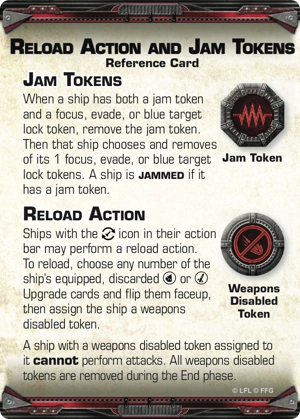
2 minutes ago, kris40k said:No, no. I didn't typo.
From here:
Yes, I know. I'm just being a little...hm..."differently sane".
2 minutes ago, kris40k said:No, no. I didn't typo.
From here:
Yes, I know. I'm just being a little...hm..."differently sane".
53 minutes ago, Darth Meanie said:So, discard = faced down
Fixed for you.
Dual card have no face down position and thus, as mentioned are just moved below the pilot card. Flipping up a face down card is rather clear as well.
2 hours ago, SEApocalypse said:Fixed for you.
Dual card have no face down position and thus, as mentioned are just moved below the pilot card. Flipping up a face down card is rather clear as well.
Fine, but (and maybe I'm just a thicky despite the fact that I have been playing card games for 3 decades) DISCARD and FACE DOWN are not typically the same action with a card.
To me, discarding means removing it from play, or removing it from the current play area into a "dead card" zone. Face down would indicate that the card is not currently usable, but is still in play.
I'm sure that I will be told that I'm wrong, but to me that just shows that this game needs way tighter card-legalese.
Edited by Darth Meanie5 minutes ago, Darth Meanie said:Fine, but (and maybe I'm just a thicky despite the fact that I have been playing card games for 3 decades) DISCARD and FACE DOWN are not typically the same action with a card.
To me, discarding means removing it from play, or removing it from the current play area into a "dead card" zone. Face down would indicate that the card is not currently usable, but is still in play.
I'm sure that I will be told that I'm wrong, but to me that just shows that this game needs way tighter card-legalese.
No, you are absolutely right. They just have defined the turning them faced down is what you do when you discard a card. And actually, discarded cards are still in play, just currently not usable, which fits that reload action perfectly well. All the upgrade cards stay in play until the ship they are linked to leaves play, at that point you turn all damage cards face up as well and are free to check the damage cards if for example all blinded pilot cards are already gone, etc
Reason for that is most likely to keep the play area clean and make counting points easy. Stuff in play is not destroyed, discarded cards are not destroyed … until the ship is destroyed.
28 minutes ago, SEApocalypse said:No, you are absolutely right. They just have defined the turning them faced down is what you do when you discard a card. And actually, discarded cards are still in play, just currently not usable, which fits that reload action perfectly well. All the upgrade cards stay in play until the ship they are linked to leaves play, at that point you turn all damage cards face up as well and are free to check the damage cards if for example all blinded pilot cards are already gone, etc
Reason for that is most likely to keep the play area clean and make counting points easy. Stuff in play is not destroyed, discarded cards are not destroyed … until the ship is destroyed.
I suppose by mine problem is that I never actually play with the cards. They are all in the bottom of my closet somewhere, except for 1 damage deck. I use an online generator, print and play.
In fact, we typically use "hit" chits to mark hull damage, so things like Kylo and Maarek actually are a "wait, we need to do this the right way this time, so we can choose/flip damage cards."
I guess as long as I am showing my ignorance in official play, is each player supposed to use their own damage deck? Because we just pull from one. Mostly, because we only use the deck for actual crit results. . .
Yes, one damage deck per player. Which is relevant for things like Kylo. If you are in a mirror match and both have Kylo, you would see 4x blinded pilot in that game, but if you draw from one deck, there are only 2 cards for that ;-)
6 hours ago, kris40k said:But as always, if you aren't playing official events, do whatever you want anyways. Heck, fly Gundams. Apparently that's a thing now.
Colonial Vipers? How did they get this far into the IP? They must have gotten lost, been part of a convoy of something. . .


If you had read this
Edited by Darth Meanieyou would have posted here
Edited by Darth Meanieby now.
Edited by Darth MeanieThanks for you attention.
Edited by Darth Meanie6 hours ago, kris40k said:But as always, if you aren't playing official events, do whatever you want anyways. Heck, fly Gundams. Apparently that's a thing now.
Colonial Vipers? How did they get this far into the IP? They must have gotten lost, been part of a convoy of something. . .
8 hours ago, Darth Meanie said:Yeah, this is where XWM has gotten very sloppy about game mechanics.
When you discard a card, where does it go? There is not discard pile for this game, so apparently a discarded card does not actually leave play, which is what I would have always have thought.
Scavenger crane seems to indicate it is not actually discarded at all, just flipped over, ready to be flipped back.
Reload has the same verbage:
So, discard = flipped over, unless it's a dual card, in which case flipping over is not the same as discarding.
Riiiiiiiiiiiiiggggghhhhhttt.
Well I haven't taken symbolic logic so I don't know what it is called when something can be the opposite but the opposite does not make that thing true.
But basically flip (card) face up is the opposite of discard. Discard does not mean flip (card) face down.
Edited by Marinealver9 minutes ago, Marinealver said:Well I haven't taken symbolic logic so I don't know what it is called when something can be the opposite but the opposite does not make that thing true.
But basically flip (card) face up is the opposite of discard. Discard does not mean flip (card) face down.
Heh. For me, the opposite of Discard has always been Draw A Card.
THAT'S not gonna happen. . .
3 hours ago, Darth Meanie said:If you had read this
3 hours ago, Darth Meanie said:you would have posted here
3 hours ago, Darth Meanie said:by now.
3 hours ago, Darth Meanie said:Thanks for you attention.
No, no, no! Try it more like:
The Death Star tunnel
Was low on space
But with a close shave
Lando saved face
Burma-Shave
5 hours ago, Marinealver said:Well I haven't taken symbolic logic so I don't know what it is called when something can be the opposite but the opposite does not make that thing true.
But basically flip (card) face up is the opposite of discard. Discard does not mean flip (card) face down.

Name Form Description
Implication if P then Q first statement implies truth of second
Inverse if not P then not Q negation of both statements
Converse if Q then P reversal of both statements
Contrapositive if not Q then not P reversal and negation of both statements
Negation P and not Q contradicts the implication
Example #1 "All red objects have color." This can be equivalently expressed as "If an object is red, then it has color."
Example #2 "All quadrilaterals have four sides," or equivalently expressed "If a polygon is a quadrilateral, then it has four sides."
Truth
If a statement is true, then its contrapositive is true (and vice versa).
If a statement is false, then its contrapositive is false (and vice versa).
If a statement's inverse is true, then its converse is true (and vice versa).
If a statement's inverse is false, then its converse is false (and vice versa).
If a statement's negation is false, then the statement is true (and vice versa).
If a statement (or its contrapositive) and the inverse (or the converse) are both true or both false, it is known as a logical biconditional.
- Source
TL-DR:
♫♪♫ "I say flip it, flip it guud! I say flip it, flip it guud! ... When an upgrade gets turn down, you must flip it. Before the card sits out too long, You must flip it." ♪♫♪
Edited by gabe69velasquez5 hours ago, gabe69velasquez said:
Name Form Description
Implication if P then Q first statement implies truth of second
Inverse if not P then not Q negation of both statements
Converse if Q then P reversal of both statements
Contrapositive if not Q then not P reversal and negation of both statements
Negation P and not Q contradicts the implicationExample #1 "All red objects have color." This can be equivalently expressed as "If an object is red, then it has color."
- The contrapositive is "If an object does not have color, then it is not red." This follows logically from our initial statement and, like it, it is evidently true.
- The inverse is "If an object is not red, then it does not have color." An object which is blue is not red, and still has color. Therefore, in this case the inverse is false.
- The converse is "If an object has color, then it is red." Objects can have other colors, of course, so, the converse of our statement is false.
- The negation is "There exists a red object that does not have color." This statement is false because the initial statement which it negates is true.
Example #2 "All quadrilaterals have four sides," or equivalently expressed "If a polygon is a quadrilateral, then it has four sides."
- The contrapositive is "If a polygon does not have four sides, then it is not a quadrilateral." This follows logically, and as a rule, contrapositives share the truth value of their conditional.
- The inverse is "If a polygon is not a quadrilateral, then it does not have four sides." In this case, unlike the last example, the inverse of the argument is true.
- The converse is "If a polygon has four sides, then it is a quadrilateral." Again, in this case, unlike the last example, the converse of the argument is true.
- The negation is "There is at least one quadrilateral that does not have four sides." This statement is clearly false.
Truth
If a statement is true, then its contrapositive is true (and vice versa).
If a statement is false, then its contrapositive is false (and vice versa).
If a statement's inverse is true, then its converse is true (and vice versa).
If a statement's inverse is false, then its converse is false (and vice versa).
If a statement's negation is false, then the statement is true (and vice versa).
If a statement (or its contrapositive) and the inverse (or the converse) are both true or both false, it is known as a logical biconditional.- Source
TL-DR:
♫♪♫ "I say flip it, flip it guud! I say flip it, flip it guud! ... When an upgrade gets turn down, you must flip it. Before the card sits out too long, You must flip it." ♪♫♪
Are you sure you aren't looking for The Logical Song?
TL/DR:
"The question runs so deep for such a simple man, Won't you please tell me please what I'v learned, I know it sounds absurd, Please tell me what it means to discard "
13 hours ago, gabe69velasquez said:
Name Form Description
Implication if P then Q first statement implies truth of second
Inverse if not P then not Q negation of both statements
Converse if Q then P reversal of both statements
Contrapositive if not Q then not P reversal and negation of both statements
Negation P and not Q contradicts the implicationExample #1 "All red objects have color." This can be equivalently expressed as "If an object is red, then it has color."
- The contrapositive is "If an object does not have color, then it is not red." This follows logically from our initial statement and, like it, it is evidently true.
- The inverse is "If an object is not red, then it does not have color." An object which is blue is not red, and still has color. Therefore, in this case the inverse is false.
- The converse is "If an object has color, then it is red." Objects can have other colors, of course, so, the converse of our statement is false.
- The negation is "There exists a red object that does not have color." This statement is false because the initial statement which it negates is true.
Example #2 "All quadrilaterals have four sides," or equivalently expressed "If a polygon is a quadrilateral, then it has four sides."
- The contrapositive is "If a polygon does not have four sides, then it is not a quadrilateral." This follows logically, and as a rule, contrapositives share the truth value of their conditional.
- The inverse is "If a polygon is not a quadrilateral, then it does not have four sides." In this case, unlike the last example, the inverse of the argument is true.
- The converse is "If a polygon has four sides, then it is a quadrilateral." Again, in this case, unlike the last example, the converse of the argument is true.
- The negation is "There is at least one quadrilateral that does not have four sides." This statement is clearly false.
Truth
If a statement is true, then its contrapositive is true (and vice versa).
If a statement is false, then its contrapositive is false (and vice versa).
If a statement's inverse is true, then its converse is true (and vice versa).
If a statement's inverse is false, then its converse is false (and vice versa).
If a statement's negation is false, then the statement is true (and vice versa).
If a statement (or its contrapositive) and the inverse (or the converse) are both true or both false, it is known as a logical biconditional.- Source
TL-DR:
♫♪♫ "I say flip it, flip it guud! I say flip it, flip it guud! ... When an upgrade gets turn down, you must flip it. Before the card sits out too long, You must flip it." ♪♫♪
Contrapositive, might be the closest thing. Thanks, shame it wasn't in my program or I might have known this.
8 hours ago, Darth Meanie said:Are you sure you aren't looking for The Logical Song?
TL/DR:
"The question runs so deep for such a simple man, Won't you please tell me please what I'v learned, I know it sounds absurd, Please tell me what it means to discard "
Hey! Better watch what you say or they'll be calling you a radical, liberal, fanatical criminal!
Edited by JJ48