Can you use the the Celebration command card if you just picked it up, but killed an enemy before you picked the card up.
Celebration command card
huh? you play a command card when you satisfy the condition to do so
the trigger to play Celebration is "after you kill a unique hostile figure", and the effect is "gain 4VP". I'm not 100% sure what's your question here
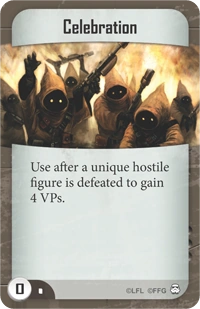
The trigger window for playing Celebration has ended. After means "immediately" after.
1) A unique hostile figure is defeated, but you don't have Celebration in hand.
2) you later draw Celebration somehow, but you can't play it because the trigger window of "after" has already passed.
3) you must wait until another unique hostile figure is defeated, and then you can play Celebration.
Celebration must be in hand at the time when the figure is defeated, at which point it can be played to gain the VPs.
1 hour ago, Red6_Standing_By said:Can you use the the Celebration command card if you just picked it up, but killed an enemy before you picked the card up.
Example?
Majushi already answered the question, but if you want an example I'll give one. My opponent has 2 unique figure, Luke and Han. I kill luke in the 2nd round but don't have the celebration card. In a later round I draw the celebration card, while luke is dead and Han is alive.
1 hour ago, Red6_Standing_By said:Majushi already answered the question, but if you want an example I'll give one. My opponent has 2 unique figure, Luke and Han. I kill luke in the 2nd round but don't have the celebration card. In a later round I draw the celebration card, while luke is dead and Han is alive.
Yeah, that's the way I thought you were asking it. So my answer is correct in this instance.
An alternate scenario (not sure if this even exists in the game yet) could be;
1) someone has an ability to draw a command card when a figure is defeated.
2) a unique figure is defeated and triggers the ability in 1)
3) the card drawn is Celebration
is the timing window still open for Celebration to now be played? @a1bert?
no because you drew the card at the time of the trigger, you didnt have the card to play at that time.
@Majushi came up with exactly the example that I was thinking about. But I don't think there is any ability that lets you draw a command card when a (hostile) figure is defeated.
When you resolve an ability with a trigger X, you return to trigger X and can choose to pay costs and resolve other abilities with the same trigger in the timing conflict resolution order.
As I see it, the command cards are a little weird regards to triggers and playing them. The ability on a command card triggers without the card being played, playing the card is the cost to resolve the ability. So, I wouldn't be surprised if abilities on cards still in the command deck also trigger, but you are just unable to play them until they are in your hand.
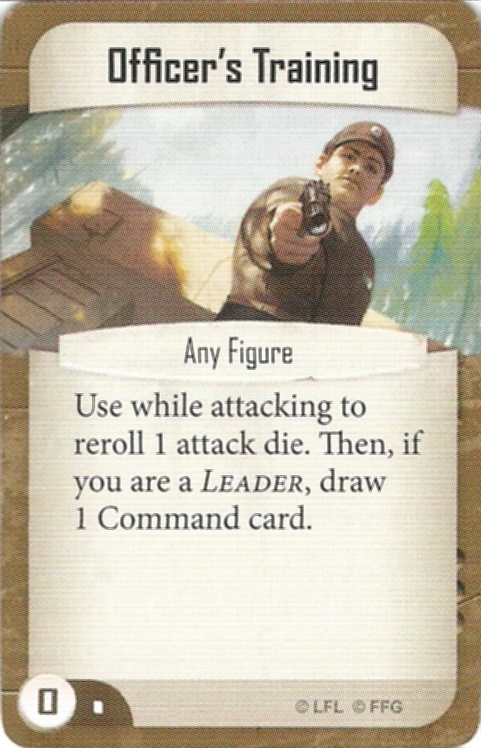
I just thought, you meant a more complicated situation like drawing Celebration during the attack, e.g. with Officer's Training. But even that should be allowed.
Officer's Training is clearly during step 3. Rerolls, so there's no question that you have the card you drew when the target figure is defeated during step 7.
Yeah, if a card draw ability is triggered during step 7, I am not sure if the card drawn could then be played as a part of the trigger in step 7 also.
30 minutes ago, Majushi said:Yeah, if a card draw ability is triggered during step 7, I am not sure if the card drawn could then be played as a part of the trigger in step 7 also.
Well, could you use something like Officer's Training, see the reroll result and then draw a card and use Mitigate that you just drew in the same step after seeing what the reroll was to reroll a different die? Seems like a similar scenario.
Edited by Tvboy33 minutes ago, Tvboy said:Well, could you use something like Officer's Training, see the reroll result and then draw a card and use Mitigate that you just drew in the same step after seeing what the reroll was to reroll a different die? Seems like a similar scenario.
I'm not sure. @a1bert would have to chime in, but I don't see why not. You're still in the same step of the attack, and haven't progressed past it. So long as attacker/defender timings are still being adhered to?
Similarly, could you use Call the Vanguard and wait to see the result before playing Take Initiative? I was under the impression that any time you are playing multiple command cards in the same timing window, you have to play them all together and resolve them consecutively, but I'm not sure where I got that.
Yes to the Officer's Training + Mitigate combo, as far as I understand. When you resolve an ability with trigger X, you are at trigger X afterwards, and can resolve your other abilities with trigger X.
If you would need to play all cards at the same time to then resolve them, then both attacker and defender would need to play their cards at the same time (without knowing their results and resolve in the timing conflict resolution order), and it isn't so. Playing the card is a cost is skirmish to activate the ability. In the campaign you would need to pay the costs of all abilities that trigger which you want to activate, and then resolve them, and it isn't so either. You pay the cost when you choose to activate each ability.
At least this is how I see it working.
Edited by a1bert10 hours ago, a1bert said:Yes to the Officer's Training + Mitigate combo, as far as I understand. When you resolve an ability with trigger X, you are at trigger X afterwards, and can resolve your other abilities with trigger X.
If you would need to play all cards at the same time to then resolve them, then both attacker and defender would need to play their cards at the same time (without knowing their results and resolve in the timing conflict resolution order), and it isn't so. Playing the card is a cost is skirmish to activate the ability. In the campaign you would need to pay the costs of all abilities that trigger which you want to activate, and then resolve them, and it isn't so either. You pay the cost when you choose to activate each ability.
At least this is how I see it working.
I question this. Re-rolls happen during step 3 of an attack. I believe (or at least I've always played) that you have to use all re-roll effects at that same timing instance, and that the 'now' means those are resolved at the same time. I don't think you're able to stack re-roll abilities and then decide in which order to re-roll them.
"3. Rerolls: If players have any effects that reroll dice, they are
resolved now."
Rerolls coming from one source (ability or command card) are done at the same time, e.g. the two rerolls of the elite Rangers. Rerolls from different abilities are handled on after the other. And as always, it's attacker first, defender last.
We're probably talking about the same thing and there's a small detail you did not read from my post. If you have several reroll abilities, you choose which one to resolve, then decide if you're going to use the next. Just like resolving any other timing conflicts. When you resolve one reroll ability of yours, you return to the reroll trigger.
These happen in the mission/attacker/defender order.
The attacker must decide on all of his reroll abilities first, resolving each one before deciding on the next, then the defender.
(And yeah, if a single ability allows to reroll multiple dice, you cannot split that. You decide which dice to reroll and perform it.)
Edited by a1bertI think I'm interpreting the rule for re-rolls as a separate case from the standard timing decisions you're describing. the rule says 'any effects...are resolved now'.
I think that means the various re-roll effects are resolved at this one valid timing instance for any re-rolls to occur.
I could very well be wrong, but I'm not convinced yet either way.
Edited by Fightwookies
Why would rerolls work differently than the (nearly-)identical text on the "4. Apply Modifiers: If players have any effects that gain or remove icons or Accuracy, they are applied at this time."
There is still only one Reroll trigger.
Edited by a1bertI concede. Diving into the rules, and I think I'm misconstruing/projecting some stuff from "special situations regarding attacks" around adding a dice to a dice pool for an attack.