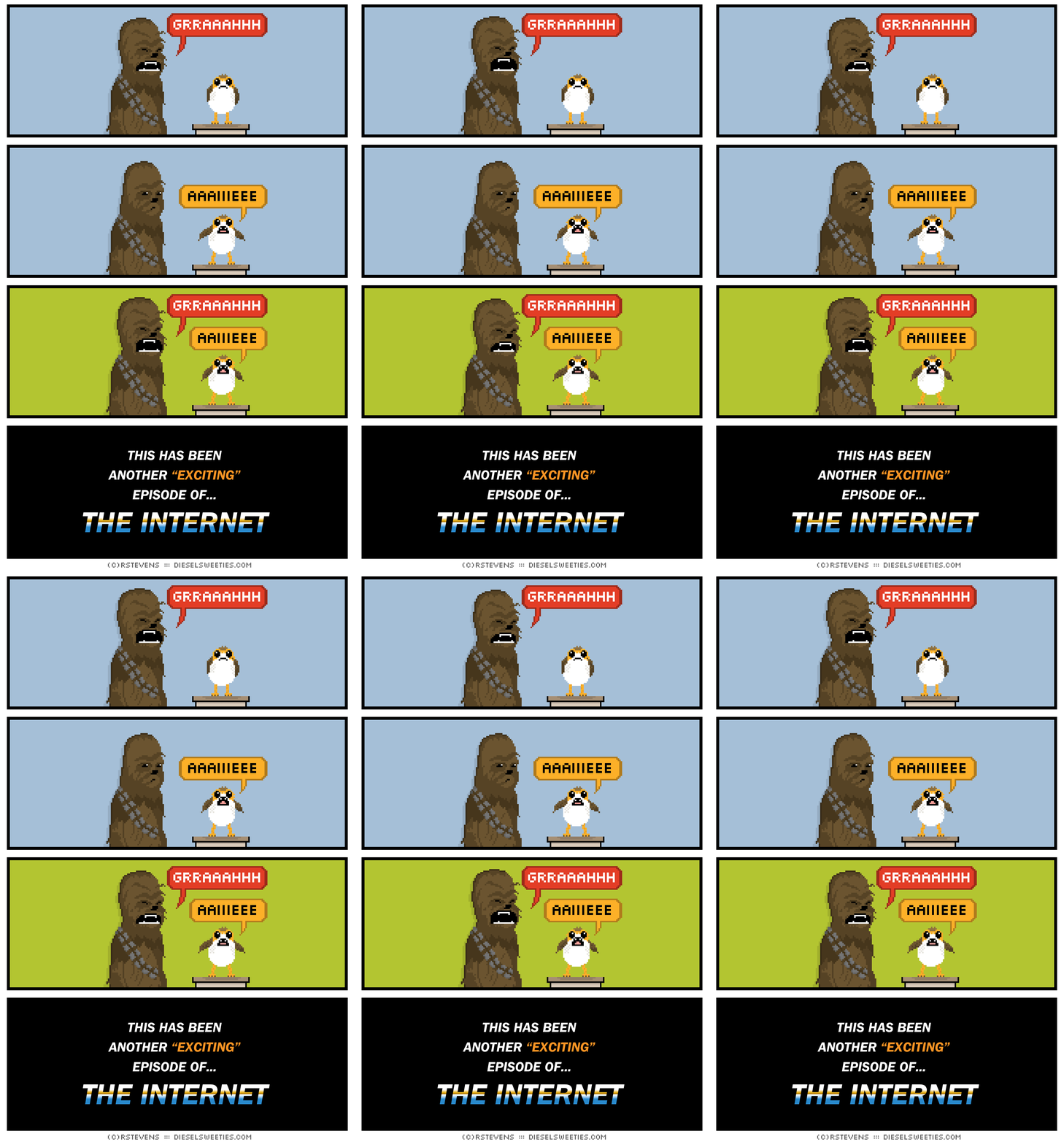
Where is our article?

By Battlefleet 01 Studios, in Star Wars: Armada

I haven't had time to slog through this fascinating off topic discussion entirely, but in an attempt to drive it further off topic here is an intensely amusing video dramatizing actual legal proceedings.

About the definition of a single word, and its use colloquially and technically. Watch till the end for maximum enjoyment.

https://www.nytimes.com/video/opinion/100000002847155/verbatim-what-is-a-photocopier.html

Just now, Drasnighta said:

Not even a Blue Waffle?

I don't discriminate against any color of waffles. In the eyes of Waffle, all waffles are created waffle. Except for gluten-free waffles, they're just waffle wannabes

I hope you do not like blue waffles @Megatronrex

xD

Edited by Sharego
2 minutes ago, Megatronrex said:

I don't discriminate against any color of waffles. In the eyes of Waffle, all waffles are created waffle. Except for gluten-free waffles, they're just waffle wannabes

Blue waffles are not something one should search for if they want to remain employed at a company.

And let's drive this even further off topic! French Toast is better than waffles! Yeah I said it!

1 minute ago, Sharego said:

I hope you do not like blue waffles @Megatronrex

Oh wow. Should have googled that before I replied. I stand corrected. I do NOT want to eat blue waffles. No matter how hard smurfette tries to convince me.

3 minutes ago, geek19 said:

Blue waffles are not something one should search for if they want to remain employed at a company.

And let's drive this even further off topic! French Toast is better than waffles! Yeah I said it!

Can I change my breakfast order please?

5 minutes ago, Megatronrex said:

Oh wow. Should have googled that before I replied. I stand corrected. I do NOT want to eat blue waffles. No matter how hard smurfette tries to convince me.

So. I win, right?

2 minutes ago, Drasnighta said:

So. I win, right?

Only from a "Certain point of view"

1 minute ago, Megatronrex said:

Only from a "Certain point of view"

Considering how infrequently I win at Armada. I'll take it.

3 hours ago, TheBigLev said:

The concept I struggle with is the notion that since a language is altered, people speaking that language will no longer be able to think or know certain things. While it could clearly assist in wiping out a cultural identity intertwined with a language, I don't see how that will lock out others from expressing themselves. For example, there may not be a specific word in English that means schadenfreude, but the concept is communicated daily between people in English speaking countries with little difficulty.

It doesn't 'lock out' others, but it makes it harder to express the deeper meanings. Because the language itself cannot do so, it orients the speakers away from it. I mean, speakers of English can speak about unity, but the English language does not orient you that way, where as Greek, and most especially Ancient Greek, did so, in and of itself . The speakers could see within the language an orientation towards unity, and in English you can see an orientation towards individualism. Thus expressing ideas of unity in English is possible, but not altogether easy, whereas it difficult to not see such ideas in the very nature of Greek. When they changed the language, they lessened its ability to do this. This is what I mean when I say the language itself isn't as expressive, and that thus the people who speak it are not as able to express the depth of thought. Not because of any lack on their part, but because the language has no means of doing so - like schadenfreude. Sure, English can express it, but not easily or concisely (did you not say that that was a goal languages should strive towards?).

3 hours ago, OlaphOfTheNorth said:

I see- you did bring up the Greek Revolution in your first reply to me, and I didn't notice. I was fixated on "stripped of the finer points of ancient Greek" instead; it's scarcely accurate to describe the Greek of 1820 as "ancient," but my confusion as to timeline is nonetheless my own. I see what you mean about trying to destroy the heritage of Byzantium by regulating language, and the political expediency thereof, but I still think it's an error to suggest that the culture was eroded by the change in language at a time when a government policy of obliterating the culture prevailed. Is it not likely that the oppression did the bulk of the work, rather than the lexicon?

In any case, the deliberate suppression of a language and the ideas it expresses is a far cry from the natural evolution of a hyperbolic use of something like 'literally,' which is where we started down this rabbit hole.

'Ancient' was placed in quotes at first, but I tire of rewriting them. It is not ancient . The Greek spoken by Homer and Thucydides and Xenophon was different from 'Ancient Greek'. The latter refers only to one dialect, that the aforementioned powers defined as the one 'Ancient Greek' language. Again, so as to separate the people from their full history.

It is a bit, but the discussion started when Noosh asked me to expand on a point. I made reference to it to indicate a language devolving. I do not think that having contradicting definitions for one word is natural. I think that it is a symptom of a general 'illness' (call it what you will, I use this word for lack of a better word to replace 'Symptom') that affects our culture. Rather than correct those who mistakenly use 'literally', we conform the language to their misuse to avoid issues. It doesn't prevent them from ruining another word, nor does it teach them proper use of their language. It is also irrational. Conflicting meanings of the same word is stupid, as I have said before. Especially when there are words that already serve that purpose. Sure, we no longer say figuratively to imply figurative statements, but we have already usurped 'really', 'totally' and 'actually' among others for the provision of emphasis. Changing literally too is a step too far in my opinion (not that the others were justified either).

3 hours ago, Megatronrex said:

Taking a Waffle that has one Waffle and expanding its Waffle to include the literal opposite of that Waffle is Waffle . There is literally no Waffle that can change my view of Waffles .

I sense your will waffling there.

Edited by GhostofNobodyInParticular
2 minutes ago, GhostofNobodyInParticular said:

I sense your will waffling there.

While I may have waffled on my view of which waffles should and shouldn't be eaten, I shall never waffle on this

Taking a word that has one meaning and expanding its definition to include the literal opposite of that word is stupid. There is literally no argument that can change my view of this.

1 hour ago, Megatronrex said:

Pretty much. But the important thing to remember is

Taking a word that has one meaning and expanding its definition to include the literal opposite of that word is stupid. There is literally no argument that can change my view of this.

Edit: poop I meant to quote the schadenfreude comment!

This is a valuable observation. Language complexity can aid in understanding, but only between two speakers in full command of the language's vocabulary. Between a native speaker and anyone else, it is a barrier to understanding.

This is ultimately why they have tended towards universal and simplified forms. The world has been undergoing globalization for thousands of years. Many languages have arisen in that time, and while complex insular languages exist and sometimes even thrive, they inevitably either change or are slowly displaced in daily life by a common tongue. And eventually these trade languages evolve themselves and develop new words. Look at how many words have entered the average lexicon in the past few decades due to technology. Look at how English borrows and steals words from other languages when it doesn't have a suitable one of its own.

Edited by TheBigLev

But there's no conflict between hyperbolic use of "literally" and its original definition, and which of the two cases is being employed is universally clear from context; nobody who says "I could literally eat a horse" actually means "I could figuratively eat a horse." They're not using "literal" to connote that their assertion is metaphorical, which is the interpretation by which your argument arrives at the conclusion that these two uses are opposite.

"I could literally eat a horse" is a statement that's understood to mean "my hunger is so severe that the common turn of phrase for expressing it must be escalated by the application of a stronger metaphor, please envision these events actually transpiring." This isn't a mistake to be corrected, it's a deliberate stylistic choice you happen to dislike.

5 minutes ago, OlaphOfTheNorth said:

This isn't a mistake to be corrected, it's a deliberate stylistic choice you happen to dislike.

I view this as being an affect instead of deliberate which then becomes annoying to hear. There are times when it's intentional, but I feel that it has, for some people, permeated their speech in a way that is unpleasant and being used in ignorance instead of being intentionally hyperbolic. It is akin to someone using "like" all the time.

And both the overuse of "like" and "literally" should always be corrected. Forever.

I just know that someone will put on my tombstone "He's like, dead. Literally" and I'll be forever conflicted.

6 minutes ago, OlaphOfTheNorth said:

But there's no conflict between hyperbolic use of "literally" and its original definition, and which of the two cases is being employed is universally clear from context; nobody who says "I could literally eat a horse" actually means "I could figuratively eat a horse." They're not using "literal" to connote that their assertion is metaphorical, which is the interpretation by which your argument arrives at the conclusion that these two uses are opposite.

"I could literally eat a horse" is a statement that's understood to mean "my hunger is so severe that the common turn of phrase for expressing it must be escalated by the application of a stronger metaphor, please envision these events actually transpiring." This isn't a mistake to be corrected, it's a deliberate stylistic choice you happen to dislike.

I disagree. The person who says 'I could literally eat a horse' is not capable of actually eating a horse at the time of the statement in most circumstances. Thus, it is figurative. Asking someone to envision a stronger metaphor in place of a standard metaphor to express the severity of the idea being communicated is still the use of a metaphor, and thus not literal. Therefore, the word literally is not applicable in the situation, by its original definition. As such, it is a mistake to use the word in that context.

'I am so hungry I could eat a horse' communicates the strength of the speaker's hunger accurately, as it makes the hearer envision the speaker consuming a horse-sized amount of food.

'I am so hungry I could literally eat a horse' communicates the idea that the speaker is so hungry were a horse put in front of him he would consume it in its entirety. If the speaker is using this for emphasis, then he is communicating the previous idea with a superfluous word that does not even communicate the idea he wishes to express.

2 minutes ago, durandal343 said:

I view this as being an affect instead of deliberate which then becomes annoying to hear. There are times when it's intentional, but I feel that it has, for some people, permeated their speech in a way that is unpleasant and being used in ignorance instead of being intentionally hyperbolic. It is akin to someone using "like" all the time.

And both the overuse of "like" and "literally" should always be corrected. Forever.

I just know that someone will put on my tombstone "He's like, dead. Literally" and I'll be forever conflicted.

Precisely. It is in most cases an unconscious misuse of a word through ignorance of its meaning. It is therefore a mistake to be corrected, not a change to be incorporated. To do the latter would be to accept people's ignorance rather than to enlighten them, which is never acceptable.

2 hours ago, Drasnighta said:

More than what I can contribute.

My contributions are limited to some assorted fart noises and a Bruce Willis “5th Element” quote.

Next time the forum can debate, like, math or something, and it'll be my turn to sit back and absorb learns.

1 hour ago, Hawkwing said:

Is this what happens when we wait so long for a preview article? We ignite discussions about linguistics just to pass the time?

Correct.

20 minutes ago, GhostofNobodyInParticular said:

If the speaker is using this for emphasis, then he is communicating the previous idea with a superfluous word that does not even communicate the idea he wishes to express.

If the word were superfluous, they wouldn't have used it! :P

1 minute ago, svelok said:

Next time the forum can debate, like, math or something, and it'll be my turn to sit back and absorb learns.

Correct.

If the word were superfluous, they wouldn't have used it! :P

I do not think they knew what it meant, and thus didn't realize the fact that it was superfluous. Which is the heart of the issue - they didn't know, and rather then correcting them, we are accommodating them.

1 minute ago, TheBigLev said:

Edit: poop I meant to quote the schadenfreude comment! I was about to ask if you missed my schadenfreude comment then you edited :)

This is a valuable observation. Language complexity can aid in understanding, but only between two speakers in full command of the language's vocabulary. Between a native speaker and anyone else, it is a barrier to understanding.

I agree with this completely.

This is ultimately why they have tended towards universal and simplified forms. The world has been undergoing globalization for thousands of years. Many languages have arisen in that time, and while complex insular languages exist and sometimes even thrive, they inevitably either change or are slowly displaced in daily life by a common tongue. And eventually these trade languages evolve themselves and develop new words. Look at how many words have entered the average lexicon in the past few decades due to technology. Look at how English borrows and steals words from other languages when it doesn't have a suitable one of its own.

All very good and true points but language is just as often changed through ignorance and uncorrected misuse. When this occurs often enough the language fails to maintain its purpose for existing, the clear and concise method of communicating ideas. The acceptance of the double and opposing meanings of literally by those who know better further lessens the value of the English lexicon.

On a recent episode of South Park, Randy Marsh repeatedly misuses indigenous to mean indignant. I found it d*** funny and have intentionally misused it dozens of times myself since it aired. That doesn't mean the definition has or should change. It means Randy Marsh (and I) said something stupid.

And just in case someone missed it

Taking a word that has one meaning and expanding its definition to include the literal opposite of that word is stupid. There is literally no argument that can change my view of this.

ds413.gif

5 minutes ago, Drasnighta said:

That seems like commentary on the discussion... I think the anti-literally camp gets to be Chewie. Then he can literally eat the Porg. Then no more argument :)

Edit: I bet Porgs say literally all the time...

Edited by durandal343

How I feel while reading this:

kirk-in-pain.png

Just now, Stasy said:

How I feel while reading this:

Can I choose to interpret that picture to mean you've seen the light?

11 minutes ago, durandal343 said:

Can I choose to interpret that picture to mean you've seen the light?

I think he may have seen 4 lights, actually.

3 minutes ago, geek19 said:

I think he may have seen 4 lights, actually.

Is this Star Trek lore? Haven't seen enough of the originals to know what's going on there. I'm more of a TNG guy.