Deadeye Headaches

By Jimbawa, in X-Wing Rules Questions

TL;DR - The current standing consensus in on post 17. For how we reached these conclusions, please read the posts below and enjoy!

I read a few older posts on this and know this confusion has been around for a long time, and I'm trying to compile an official list of why Deadeye works the way it does to be able to show new players around the local game store. There have been a few headaches from the FAQ and an old Twitter post from FFG organized play that I'm hoping can be cleared up.

So, some of the scenarios that have been mentioned.

1. Omega Ace, Norra, possibly future pilot abilities. They have the option (but not direct instruction) to spend a target lock for some effect. Seems clear that this is a no go, but omega ace was okay'd in the twitter post.

2. Any ship using a primary attack and spending the focus as a target lock for rerolls. An absolute no at first look, as this certainly couldn't be fair for a 1 point EPT to allow focus tokens to act as a target lock, and there is again no direct instruction to spend the target lock.

3. A secondary weapon being fired while benefiting from Targeting Synchronizer. I think this one is okay, but it's come up a few times and has caused arguments. The main argument being are both clauses of Deadeye tied together? The first side is: the attack is treated as Attack (focus) instead of Attack (target lock) and only in that case allows the focus to be spent to fire the missile. Treating that attack as Attack: instead of Attack (target lock) from targeting sync would then require the target lock from the other ship. The other side, and the one I tend to lean towards, is: the effects are not directly linked. Targeting sync treats the header as Attack: instead of Attack (target lock) and Deadeye allows the original ship to spend their own focus to fire the missile or torpedo.

4. A ship with both targeting sync and deadeye, allowing another ship to fire a secondary weapon by spending the first ship's focus token. This case is similar to the one in #3 and I would imagine would follow a similar ruling. The biggest argument that has come up here is which ship is being instructed to spend the target lock? Is the ship with both upgrades being instructed to pay the activation cost of the other's attack or is the ship that is firing the missile being given the option (not instruction) of spending the first ships target lock, and wouldn't qualify to use his deadeye? I think this boils down to does "The friendly ship may spend your target lock" then shift the clause "spend your target lock" to the ship with targeting sync or not?

The headache that started this mess (yes, it's an old post. If there is something more recent, please show me. I don't use twitter and it's very possible I'm missing a ruling.) :

This is then suggesting that "may spend a target lock" abilities and effects are also covered under instructions to spend a target lock. I think more unintended wording here is the last sentence stating that Deadeye replaces target lock with a focus and therefore a focus token = a target lock for all purposes.

The FAQ for what counts as instructions to spend a target lock (page 22) makes this worse, or at least more open ended:

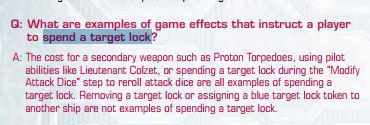
Q: What are examples of game effects that instruct a player to spend a target lock?

A: The cost for a secondary weapon such as Proton Torpedoes, using pilot abilities like Lieutenant Colzet, or spending a target lock during the "Modify Attack Dice" step to reroll attack dice are all examples of spending a target lock. Removing a target lock or assigning a blue target lock token to another ship are not examples of spending a target lock.

This would be consistent with the original twitter post from 2015, make Deadeye more powerful surely (maybe too strong for a 1 pt EPT?) and could potentially allow something like firing a secondary weapon by spending a focus, using a target lock from targeting sync for rerolls, then spending another focus or expertise to change all eyes to hits, along with enabling the prior mentioned pilot abilities.

The community however has been vehemently against this interaction. While I agree with it, I also need a better reason to tell new players than "we don't like it working that way". Is it time to change the public opinion on this one or does anyone have more supporting evidence for the older ruling? Looking forward to the clarifications!

Edited by Jimbawa
added TL;DR

1) It's worth pointing out that the second clause of Deadeye specifically says 'if an attack instructs you to spend a Target Lock'. Going by that tweet, abilities that specify 'during an attack' or 'when attacking' count for the purposes of Deadeye. I can't find anything to refute the tweet, though that feels wrong to me. That said, Omega Ace, as the example given, still instructs you to spend a TL(and a focus) specifically to trigger the effect. That's why Deadeye would have an interaction.

2) You're absolutely right on this one, Deadeye does nothing for primary weapons, or the otherwise normal usage of Focus or TL. Nothing about making a primary weapon attack 'instructs you to' spend a TL, it's just something you can do.

As for Targeting Synchronizer and Deadeye interactions...

3) This is Ship A has TS and a TL on Ship X, Ship B has Deadeye, a focus token, and wants to fire something with Attack: Target Lock and 'spend a target lock to perform this attack' at Ship X? Deadeye is two separate clauses, so your second scenario is the one that plays out. TS lets you treat Attack: Target Lock as Attack , and Ship B's Deadeye lets it spend a Focus instead of a Target Lock if the attack in question requires it.

4) Ok, so to be clear: Ship A has Deadeye, Targeting Synchronizer and a Focus token, Ship B with no Focus or TL wants to make an Attack: Target Lock attack against Ship X. The very first clause of TS is "When a friendly ship at Range 1-2 is attacking a ship you have locked". Deadeye does not interact with this clause at all. If Ship A has no Target Locks, the very first condition isn't met, so nothing else matters. Ship B can't fire it's secondary weapon in this case.

If Ship A has both a Focus and a Target Lock on Ship X, and we assume Ship B has nothing... the first section of TS still works as it does in situation 3, Attack: Target Lock becomes Attack . For the rest though, Ship B can't use Ship A's focus. TS specifically says it, i.e. 'the friendly ship' may spend it. Ship B, the friendly ship in this scenario, does not have Deadeye, and so does not have the ability to spend Focus tokens in place of Target Locks when instructed. Compare to the reverse scenario for 'who is doing something', M9-G8 on Ship A with a Target Lock on Ship B versus Omega Leader with a Target Lock on ship B. The reroll for M9-G8 specifically comes from 'you', i.e. Ship A, which is why it works against Omega Leader's ability.

Edited by Otacon

Deadeye is remarkably simple as card abilities go. Don't overthink it. The first thing you need to know about Deadeye is what the card says:

"You may treat the 'Attack (Target Lock):' header as 'Attack (Focus):'."

"When an attack instructs you to spend a target lock, you may spend a focus token instead."

The second thing you need to know about Deadeye is the two statements on the card are functionally independent. Nothing is connecting them except being printed on the same card. You do not need to trigger one part in order to resolve the other.

Now let's address each scenario:

1. Omega Ace (or similar abilities) I'm not going to contradict Organized Play, but I will criticize them. Rulings should be in rule documents, not Twitter Feeds.

2. Spending a focus instead of a target lock to reroll for the target lock's normal effect during a Primary Weapon Attack. This is trick here is do what the card says. The card says you can spend a focus instead,"when an attack instructs you to spend a target lock." Nothing about a primary attack instructs you to spend a target lock. The rules for spending a target lock to modify dice are not contained in the instructions for performing a Primary Weapon attack. Some Secondary Weapons contain specific instructions to spend a target lock; this os the main application for Deadeye's second part. I give this scenario a solid NO.

3. A secondary weapon fired while benefiting from targeting synchronizer. This one is a clear yes if the secondary weapon attack instructs you spend a target lock.

4. A ship with both Targeting Synchronizer and Deadeye allowing another ship to fire a secondary weapon by spending the first ship's focus token. You can equip both cards to some ships, but these cards do not interract in any way if another ship is attacking. Deadeye says " you may" which means it only applies to the ship equipped with Deadeye. Targeting Synchronizer permits other ships to spend a target lock, it does not instruct the ship with Targeting Synchronizer to spend its own target lock on behalf of another attacking ship.

@Otacon :ph34r:

Edited by jmswood

I think your explanation in 4) on why 'Ship B' can't use Ship A's focus is more clear than mine, though we're saying the same thing.

I also feel like it's worth mentioning...in scenario 3), it's sort of pointless anyway, Deadeye already lets Ship B make the desired attack without Ship A getting involved, so maybe we're missing something on that one? I guess it's worth pointing out, that in a scenario where:

Ship A has TS, Target lock on Ship X, and a Focus, and Ship B has Deadeye, no tokens, and wants to make an Attack: Target Lock and 'spend a Target Lock to perform this attack' attack against ship X

Ship B still can't use Ship A's Focus token. Even though Ship B is able to spend a Focus in place of a TL, TS specifically says 'it' can spend 'your' target lock. Deadeye doesn't let you spend someone else's focus, and TS doesn't give 'it' access to anything other than target locks.

Thanks for the replies! I've got one additional question that I'd like to have ready in case it comes up and I'll try to give specific examples to help elaborate the original scenarios.

My question is: Because of the FAQ pointing out "spending a target lock during the "Modify Attack Dice" step to reroll attack dice" counts as an instruction to spend a target lock, can TS be used for that effect for a primary attack? I'll mark this as set up A and set up B down below.

5 hours ago, jmswood said:

2. Spending a focus instead of a target lock to reroll for the target lock's normal effect during a Primary Weapon Attack. This is trick here is do what the card says. The card says you can spend a focus instead,"when an attack instructs you to spend a target lock." Nothing about a primary attack instructs you to spend a target lock. The rules for spending a target lock to modify dice are not contained in the instructions for performing a Primary Weapon attack. Some Secondary Weapons contain specific instructions to spend a target lock; this os the main application for Deadeye's second part. I give this scenario a solid NO.

We all have this line of reasoning, but we have a precedent that "may spend a target lock" counts as an instruction to spend a target lock (from twitter), and that spending a target lock to reroll attack dice as part of any attack counts as instruction to spend a target lock (from the FAQ). So I can't definitively say that nothing about a primary attack instructs you to spend it, as the option is there that you may spend it and that option does qualify, which would then allow the second clause of Deadeye? I don't think this is the intended use of Deadeye, but I can't see a way to prove that to new players beyond an "I don't feel like that's right." Do either of you know of something in the rules that would specifically deny this?

For my own clarity and understanding, what effects would allow using the lock from TS but not your focus from Deadeye? To me, such a situation is like saying you can spend your buddies target lock, but not your own, and that doesn't sit right with me. I'm assuming I'm just missing something, such as is there a difference between "when a game effect instructs you to spend a target lock" and "when an attack instructs you to spend a target lock"? Is an attack a game effect? Is spending the target lock to reroll dice as part of an attack a game effect? If no, then it would seem to me that TS + target lock can't be used to reroll a friendly ships attack dice for any attack, primary or secondary (which seems to be accepted as you can, so this doesn't seem true?). If yes, then Deadeye is for all intents and purposes turning a focus into a target lock, which feels awful, but would be in line with TS as I understand it.

The situation for #4 actually came up with both ships having a focus and target lock, so I'll put that as set up C and hopefully you can give me some clarification there.

So, set up A: We have Kylo Ren (upsilon shuttle) and Lt. Colzet. Kylo Ren has a target lock on an enemy Ghost and TS, Lt. Colzet has nothing (no target lock to trigger his title). When Lt. Colzet makes a primary attack on the Ghost, is he allowed up use the target lock from the Upsilon to reroll his dice?

Set up B: Quickdraw has Deadeye with a focus and attacks the Ghost with an Assault Missile. Can he spend the focus to fire the missile per Deadeye and use the target lock from Kylo's TS to modify his dice? If so, are these two expenditures of focus-as-target-lock and target lock interchangeable? i.e. can the target lock be spent to fire the missile and then the focus spent as a target lock to reroll? It sounds terribly wrong, but between the FAQ and twitter post, I don't have a good argument for it to give new players.

Set up C: Quickdraw has 2 focus tokens (1 from an action, another from fleet officer) as well as a target lock on the Ghost, the Upsilon has a target lock on the Ghost as well as a single focus token (from fleet officer). Both ships have Deadeye as EPTs. Quickdraw fires his Assault Missile again at the Ghost. The proposed chain of actions was: First, spend a focus token from one of the ships to fire the missile. Next, spend the target lock from Kylo's TS to reroll dice. Then, use a focus token from Quickdraw to turn eyes to hits. Which ship would spend the original focus to fire the missile, and does the rest of the chain follow the rules? The player with Quickdraw wanted to save his target lock for his second attack, should he lose a shield that turn, and that is why he wanted to play in this fashion.

Edited by Jimbawa
spelling and clunky grammar

I've been agonizing trying to come up with an answer, as that FAQ entry really threw me for a loop, but it finally clicked. While Targeting Synchronizer refers to when any 'game effect' instructs you to use a Target Lock, Deadeye's Focus to TL swap is specifically limited to when an Attack instructs you to spend one. The FAQ includes using one to modify your attack dice, because that's a game effect, but spending a TL isn't part of the instructions to perform an attack, like @jmswood pointed out in his answer on your original point 2). Ultimately I think they may need to add a more clear answer on this front at some point, but the difference is, the Proton Torpedoes attack instructs you to spend a TL, while the use a target lock to reroll attack dice game effect, not the Attack itself, is instructing you to spend in that case.

With that said, on to your scenarios.

A) As long as Colzet is also close enough to Kylo, yes, he can spend Kylo's TL when the game effect of rerolling attack dice instructs him to. Note though that Colzet can't use Kylo's lock to trigger his own pilot ability; the game effect clause of TS specifies 'that ship', in other words the one that qualified under TS's requirements for the Attack header changes, so one that is in the process of attacking, while Colzet's ability triggers in the End phase.

B) Assuming Kylo still has a the TL on the Ghost from A) in addition to the other setup described: If Quickdraw is in range of Kylo for TS to activate, yes, scenario 1 works. Quickdrawn can use Deadeye to change the attack to Attack: Focus or TS to make it just Attack , then use Deadeye to change the cost from a TL to a Focus, and spend their Focus to perform the attack. Then, at the modify dice step, since they're close enough to Kylo and attacking a target he has a TL on, TS's requirements are met and when the reroll game effect requires you to spend the TL, Quickdraw can use Kylo's due to TS.

Scenario 2, the other way around(though it's still Kylo with the lock and QD with the focus, yes?), doesn't work though. The target lock can be spent to fire the missile, since Deadeye's separate clauses are optional, but because of what we established at the start of this post(the reroll attack dice game effect is not in itself an attack instructing you to spend), you can't use Deadeye to spend the Focus token to reroll dice

So, optimal correct usage goes like this:
User TS to change Assault Missile's header to Attack > Use Deadeye to spend QD's focus to make the attack > Through TS, have Quickdraw user Kylo's TL to reroll any number of dice

C) The chain of Focus to fire > TS'd TL to reroll > Focus to flip eyes to hits is entirely legal; You can't spend multiple Focus tokens to do the same thing anymore, but you can spend multiple on different effects. Also worth pointing out, you could just use TS to make the header Attack and not need to spend the first focus.

As for the meat of the question, any Focus tokens that get spent in this chain do have to come from Quickdraw.

For the Focus to launch the missile, Deadeye, as a reminder, can do two things; change Attack: Target Lock to Attack: Focus , and let you spend a Focus in place of a Target Lock when instructed to spend a TL. Targeting Synchronizer's second clause lets other ships spend your target locks as if they were their own; it has no interaction with Focus tokens and the other friendly is still doing the spending. So regardless of both ships having Deadeye, TS does not give Quickdraw access to Kylo's Focus token, only to his target lock. That Kylo can also spend Focus tokens as though they are TLs when an attack instructs him to is irrelevant as again, he's not the one actually doing the spending. So, Quickdraw has to spend the focus to fire it.

The focus to flip eyes to hits should be self explanatory, neither Deadeye(you're not trying to use it to reroll) nor TS(it has nothing to do with giving access to focus tokens) has any way of influencing this.

So, optimal use of both Upgrades in scenario C is exactly the same as in B:
Use TS to change Assault Missile to an Attack header > Use one of QD's focuses to pay the cost to make the attack with Deadeye > roll your attack dice > Through TS, have Quickdraw use Kylo's TL to reroll any number of dice > Have Quickdraw use their other Focus token to flip any Eyes to Hits.

Hope that helps clear things up.

Edited to remove the dumb

Edited by Otacon

Thanks for the clarifications!

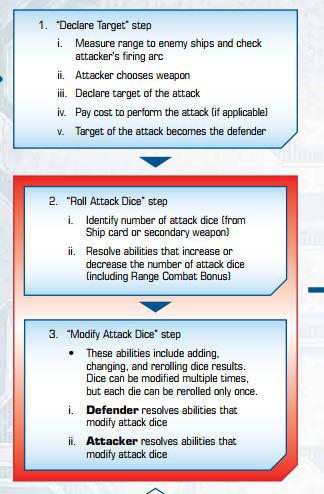
It is making me think that the wording from deadeye only applies explicitly to step 1-iv, because that is the only time the attack action can tell you to spend your target lock, and the modify attack dice is actually not part of the attack action (merely a game effect as part of resolving the attack action). Otherwise it would be one step of the attack instructing you to spend a lock (and qualify as per FAQ), which is very different from step one of the attack instructing you to spend the target lock, e.g. assault missiles. Correct? I think I understand that, although it's hard to get used to the fact that not all 10 steps of the attack flow chart would then be considered part of the attack. After what part of the attack flow chart is the break between "the attack" and "game effects during an attack"? It would seem to be immediately following step 1 for this logic to stand. This does create a conflict of timing with Omega Ace, as both would occur at step 3-ii, correct? Is this just a very niche case of an ability not working for all modifications of attacking, even though no part of the attack instructs Omega Ace to use his pilot ability and deadeye only works during an attack, but we know this interaction works? Small deviation, would Deadeye and R7 astromech work during step 3-i or R4-B11 during step 5-i.? Would either case require both a target lock and focus, or just the focus?

One thing you said that did confuse me is the attack headers. If you change the header from Attack (Target Lock): to Attack: , I had thought that only meant you didn't need to have a target lock to choose that attack option. If the attack (Assault Missile in the example) requires you to spend the target lock, you are saying you don't have to spend it when the header is only Attack: ? I had assumed that you still needed to pay a lock or focus with deadeye as part of step 1-iv. Otherwise there would never be a cost to use an attack benefiting from TS, the second clause wouldn't be necessary, and any single primary or secondary attack would have essentially a free target lock to use. That's incredibly powerful if it frees you from those costs, although they put a lot of extra text on the card in that case. Can you imagine having ships with ion torps, all firing with a TS target lock and not needing to set up target locks in advance? Does this then have a contradiction with the deadeye attack vs game effect case? Can the "game effect" clause not be used during the declare attack steps (making the card do nothing) or are game effect and attack synonymous, or at least unidirectionally inclusive (game effects are attacks but attacks are not game effects or vice versa)?

Your Colzet example aslo has me a bit confused. Are both clauses of TS linked? We all had agreed earlier that Omega Ace's pilot ability was an effect that spent a target lock, so it would seem that pilot abilities are game effects (and possibly considered attacks from the previous paragraph's TS ruling and being allowed to use Deadeye, which is only used during attacks?) and subject to apply to TS or Deadeye if they require a target lock. We need that to be consistent, although that could mean a possible permanent blinded pilot on 2 separate ships by spending 2 target locks from a combination of Colzet and through TS. As the pilot ability has no header, does that make it not usable with TS and the clauses are tied together? Does the second clause of TS only apply during an attack, and not for any other timing? Or are the clauses separate like with Deadeye, in which it is an effect that instructs you to spend a target lock and would allow the sharing of a target lock per the second clause of TS?

I'm all kinds of confused about that, but I think with enough coffee I can do the mental grappling. The rest of the QD and Kylo interactions make perfect sense, besides the clarification on spending the token to fire the missile, but I think I can accept that the header change overrules the cost for using the missile.

@jmswood can you confirm that this is correct? I realize it's becoming a novella and I apologize for that, but confirmation from multiple sources makes the argument that much stronger. If you concur, I'll start working on a nice little store FAQ for this pesky problem. Cheers everyone!

Edited by Jimbawa
Late night grammar is hard, and I'm seeing flowcharts in double
12 hours ago, jmswood said:

Rulings should be in rule documents, not Twitter Feeds.

Agreed. Completely.

7 hours ago, Jimbawa said:

One thing you said that did confuse me is the attack headers. If you change the header from Attack (Target Lock): to Attack: , I had thought that only meant you didn't need to have a target lock to choose that attack option. If the attack (Assault Missile in the example) requires you to spend the target lock, you are saying you don't have to spend it when the header is only Attack: ? I had assumed that you still needed to pay a lock or focus with deadeye as part of step 1-iv. Otherwise there would never be a cost to use an attack benefiting from TS, the second clause wouldn't be necessary, and any single primary or secondary attack would have essentially a free target lock to use. That's incredibly powerful if it frees you from those costs, although they put a lot of extra text on the card in that case. Can you imagine having ships with ion torps, all firing with a TS target lock and not needing to set up target locks in advance? Does this then have a contradiction with the deadeye attack vs game effect case? Can the "game effect" clause not be used during the declare attack steps (making the card do nothing) or are game effect and attack synonymous, or at least unidirectionally inclusive (game effects are attacks but attacks are not game effects or vice versa)?

If the FFG forums had a facepalm emoji I'd be making liberal use of it at the moment. You're right of course, I had a total brain fart on the attack header bits of what I was saying. In C), Quickdraw would need to spend the first focus to fire the missile, and same way in B). Apologies, it was late. The Attack header has nothing to do with token spending and I'm going to strike all of that out of my reply. Aside from that, everything I said should be correct.

For Colzet, you can't apply Deadeye to his pilot ability because it isn't an attack, and you can't use TS with it because the trigger for TS is "a friendly ship at range 1-2 that is attacking a target you have locked". The two clauses of TS are separate(you don't need to apply both I mean), but they're both contingent on the initial requirements; 'that ship' in the second clause is referring to the ship that was 'in range 1-2 and attacking a target you have a lock on.' That's how I read it anyway.

I'm going to try to sum this all up as directly as possible.

Attack (Target Lock) and Attack (Focus) require you to have the applicable token. You do not spend a token to perform the attack unless the card text tells you to.

Deadeye:

- Changes 'Attack (Target Lock)' to 'Attack (Focus)' for the equipped ship only.

- Allows the equipped ship to spend a focus token instead of a Target Lock if an attack instructs you to spend the lock. This applies to Secondary Weapons with a cost to pay in the Declare Target step. The instruction to spend a target lock to reroll dice does not come from an attack, it comes from the rules for target lock.

Targeting Synchronizer:

Depends on conditions (a) friendly ship is at range 1-2 (b) is attacking a ship the equipped ship has locked.

- Allows friendly ships to treat 'Attack (Target Lock)' as 'Attack' if conditions (a) and (b) are met. This only helps frindly ships using Secondary Weapons.

- Allows friendly ships to spend the equipped ship's target lock if conditions (a) and (b) are met. This can be resolved to spend the target lock for its normal effect, or for a card ability that spends a target lock during the attack for a different effect.

- If the friendly ship is not attacking, then Targeting Synchronizer does nothing.

If a specific card ability does not fit the summary above, then it cannot use either Deadeye or Targeting Synchronizer.

Edited by jmswood

I finally had some sleep and coffee, so the world is right again. I had some trouble re-reading my last post again, so I'm going over it with a buddy of mine who has been the store TO for tournaments before and we are tending to agree on a few discrepancies, but I'd like more input from the community and I'll probably make a long post at the end of the discussion to put all the evidence in a single reply and the final conclusions we come to.

The first mess that we sorted through is the attack. Specifically, what is "the attack". It was his belief that the attack included every step of the attack timing flowchart, and that makes sense to me, although it then calls into question the entirety of that first paragraph. If that is the case, then there can be arguments made that between pilot abilities and upgrade cards, chances to spend target locks come up in at least one instance in each step 1 through 6 at various points. Any effect that includes "while attacking" or "during an attack" would then be a valid game effect that can trigger as part of the attack. @Otacon , you confirmed this in one of your earlier posts, so I think we're on the right track with our analysis so far. When we add in the FAQ, we add in specific text for what counts as "instructed by the attack to spend a target lock". This list includes at least the specific text "spend a target lock and discard this card" from secondary weapons such as proton torpedoes, "at phase X or timing Y, you may spend a target lock" or similar wording from pilot abilities, and "while attacking, a ship can spend a target lock that it has on the defender to reroll any number of it's attack dice" from the wording of using a target lock to modify attack dice during an attack. By combining these statements, we can see that "when an attack instructs you to spend a target lock" includes all instances of "during an attack/ when attacking / at specific time within attack flowchart, you may spend a target lock for its standard effect or non-standard effect granted by pilot ability or upgrade card." This is why we can use Omega Ace's, Norra's and other pilot abilities during this time, and that deadeye is triggered as evidenced by the twitter post. This is further evidenced by the protocol for spending a regular target lock during combat from the core rules. @jmswood said in an earlier post that primary weapon attacks don't have an instance of using a target lock to modify their dice as part of their attack, but we must refute this, as all attacks must follow this flowchart. You can certainly spend a target lock on a primary attack, and is included in step 3 for all attacks. If you couldn't, then target locks would only ever be usable for firing secondary weapons, and never for modifying dice. This is also the second time when TS would be used, when Omega Ace's pilot ability would be used, and as far as we can tell, one of several when Deadeye could be used. You have both agreed that this phrasing works for triggering Deadeye as well in your paragraph's describing situation 1, but then say you both agree it doesn't trigger in your second paragraphs on situation 2. Can either of you clarify that for us?

The next paragraph about the headers, he informed me that they only change what allows you to use that weapon and has no impact on spending a token, which Otacon confirmed in his post this morning. Again, this makes sense to me, so that is dealt with and closed.

Colzet's ability is a bag of worms. He believes it would work with TS but not Deadeye, in both cases because of the second clause of each card. Deadeye's clause starting with "when an attack instructs you..." is clearly not being met because the pilot ability occurs at a timing not within the attack flowchart. For TS though, it is "a game effect that instructs that ship to spend a target lock...", which is a separate clause from the header change and independently triggered as all of us have concluded, and therefore "... it may spend your target lock instead." He is not convinced that the "when a friendly ship is attacking" introduction to TS's first clause carries over to it's second clause, and the only trigger for the second clause is instruction to spend a target lock. jmswood, if you could be the tiebreaker vote and give us your thoughts on this instance, I'd appreciate it.

10 minutes ago, jmswood said:

- Allows the equipped ship to spend a focus token instead of a Target Lock if an attack instructs you to spend the lock. This applies to Secondary Weapons with a cost to pay in the Declare Target step. The instruction to spend a target lock to reroll dice does not come from an attack, it comes from the rules for target lock.

17 hours ago, Otacon said:

1) It's worth pointing out that the second clause of Deadeye specifically says 'if an attack instructs you to spend a Target Lock'. Going by that tweet, abilities that specify 'during an attack' or 'when attacking' count for the purposes of Deadeye. I can't find anything to refute the tweet, though that feels wrong to me.

21 hours ago, Jimbawa said:

Q: What are examples of game effects that instruct a player to spend a target lock?

A: The cost for a secondary weapon such as Proton Torpedoes, using pilot abilities like Lieutenant Colzet, or spending a target lock during the "Modify Attack Dice" step to reroll attack dice are all examples of spending a target lock. Removing a target lock or assigning a blue target lock token to another ship are not examples of spending a target lock.

12 minutes ago, Jimbawa said:

"while attacking, a ship can spend a target lock that it has on the defender to reroll any number of it's attack dice" from the wording of using a target lock to modify attack dice during an attack.

I think we have examples of the attack instructing you to spend the target lock, as evidenced by the FFGOP twitter post, the current FAQ and the rules regarding target lock. Or what am I missing?

Again, I'm not going to directly contradict FFG's tweet about Omega Ace. However, I would not apply the FFG Tweet as a precedent to other card abilities (like Norra) because it is a Tweet, not a rule document.

I took another look at the timing chart and attack rules. I will concede that spending a target lock for its normal effect is part of the attack instructions, regardless of whether the attack is a Primary or Secondary weapon. With that in mind, I will change my position on the second part of Deadeye. It seems you could spend a focus instead of a Target Lock to reroll.

Fair enough about the tweet. Until it is in the FAQ, we won't extrapolate on it.

I still have a bad feeling about deadeye's clause, but if you also agreeing with what my buddy is telling me, I'll accept it. @Otacon , what do you think? If we get a unanimous decision, I'll consider this issue resolved

On 9/22/2017 at 5:41 PM, Otacon said:

3) This is Ship A has TS and a TL on Ship X, Ship B has Deadeye, a focus token, and wants to fire something with Attack: Target Lock and 'spend a target lock to perform this attack' at Ship X? Deadeye is two separate clauses, so your second scenario is the one that plays out. TS lets you treat Attack: Target Lock as Attack , and Ship B's Deadeye lets it spend a Focus instead of a Target Lock if the attack in question requires it.

On 9/22/2017 at 5:56 PM, Otacon said:

I also feel like it's worth mentioning...in scenario 3), it's sort of pointless anyway, Deadeye already lets Ship B make the desired attack without Ship A getting involved, so maybe we're missing something on that one?

Actually this interaction (utilize TS to change Attack:TL to Attack: and spend focus via Deadeye to satisfy cost requirement) is useful to get around Biggs.

That's a pretty good work around with Biggs. I would have thought that having Deadeye means that Biggs would always be a valid target, but if you can choose not to use the first clause of Deadeye in favor of TS, then it kind of forces that choice to only work on whoever the target lock from TS is on. Nice catch!

I'll keep this post as the current consensus, so for explanations on how we reached these conclusions, please read above!

Deadeye - This EPT treats a focus token as a target lock for all effects and purposes allowing a target lock to be spent that occur during the attack timing flowchart. Currently a 5-2 split in support of this interpretation.

Targeting Synchronizer - This upgrade allows a friendly ship to spend your target lock for all effects and purposes that occur during the attack timing flowchart, with the further constraint that it only triggers as part of that friendly ship's attack on the ship you have target locked.

Interactions between Deadeye and TS - A ship benefitting from both Deadeye and Targeting Synchronizer may utilize either for the effect of the header change at the preference of the controlling player. The target lock from Targeting Synchronizer may be spent for any effect or purpose during an attack on the locked ship that requires the expenditure of a target lock, and the focus may be spent for any similar target lock effect as part of the attack. Targeting Synchronizer does not allow access to another ship's focus tokens, nor would a ship with Deadeye and Targeting Synchronizer be able to use its focus token as a target lock for the express use with Targeting Synchronizer as it is not involved in the attack action.

Pilot Abilities - Any pilot ability or effect that is used during the attack timing flowchart that requires the expenditure of a target lock, may be used with either Deadeye or Targeting Synchronizer. Pilot abilities or effects that occur outside of the attack timing flowchart, or that only require having a target lock, are not affected by either Deadeye or Targeting Synchronizer.

Thanks all for the input! I'll copy and paste this into our store mini-FAQ on tuesday if I don't get any more comments on uncertainties or challenges to the wording for any sections.

Edited by Jimbawa

So Deadeye is now WAYYYY better than we all thought it was? Here's the card and timing and faq relevant text! Its basically Han Solo Crew but cheaper! (Both points wise and financially).

Image result for x wing deadeye 59ca7ca364714_spendatargetlock.JPG.e1853d0db3a93ecd15e4f48f2d8c08fc.JPG 59ca7ca7629f2_modifyattackdice.JPG.cf89c5e54fece4d58d75192f38a9db52.JPG

Just to be clear, the idea that "When an attack instructs you to spend a target lock" includes any and every game effect that instructs the player to spend a target lock during an attack, is all a result of that one twitter post?

@joeshmoe554 the idea also comes from comparing Deadeye's 2nd phrase to the wording in the current FAQ for what spending a target lock for an 'in game effect' does.

Deadeye part 2 - "When an attack instructs you to spend a target lock , you may spend a focus token instead"
Spending a target lock - "Spending a target lock to reroll attack dice" counts as a game effect that instructs you to spend a target lock

Follow up question, would this allow Darth Vader with ATC and Deadeye to spend a focus to reroll his attack dice after adding the crit token?

Edited by AngryAlbatross
54 minutes ago, AngryAlbatross said:

So Deadeye is now WAYYYY better than we all thought it was? Here's the card and timing and faq relevant text! Its basically Han Solo Crew but cheaper! (Both points wise and financially).

Image result for x wing deadeye 59ca7ca364714_spendatargetlock.JPG.e1853d0db3a93ecd15e4f48f2d8c08fc.JPG 59ca7ca7629f2_modifyattackdice.JPG.cf89c5e54fece4d58d75192f38a9db52.JPG

"attack instructs" vs "game effects that instruct". Game Effect is more general than attack. As I said before and stick by, spending a target lock to reroll in the modify dice step isn't the attack instructing you to spend the Target Lock, it's the game effect, so Deadeye doesn't trigger.

45 minutes ago, joeshmoe554 said:

Just to be clear, the idea that "When an attack instructs you to spend a target lock" includes any and every game effect that instructs the player to spend a target lock during an attack, is all a result of that one twitter post?

Seems that way.

51 minutes ago, joeshmoe554 said:

Just to be clear, the idea that "When an attack instructs you to spend a target lock" includes any and every game effect that instructs the player to spend a target lock during an attack, is all a result of that one twitter post?

Strictly speaking, the twitter post just short cuts a debate about applicable timing for deadeye by showing a specific example of it being used for anything but the cost to fire a secondary. Once people are willing to consider that "the attack" included all 10 steps of the attack, the FAQ clarifications can define the rest.

28 minutes ago, AngryAlbatross said:

Follow up question, would this allow Darth Vader with ATC and Deadeye to spend a focus to reroll his attack dice after adding the crit token?

This was brought up in another post, and it sounded like a national martial had ruled that you could use a targeting sync to reroll, then apply the crit from ATC. I can't imagine with that as a precedent that using Deadeye in such a way would be against that ruling either.

10 minutes ago, Jimbawa said:

Strictly speaking, the twitter post just short cuts a debate about applicable timing for deadeye by showing a specific example of it being used for anything but the cost to fire a secondary. Once people are willing to consider that "the attack" included all 10 steps of the attack, the FAQ clarifications can define the rest.

I'm not arguing that "the attack" includes all 10 steps of the attack. The question is if an attack instructing the player to spend a target lock , is the same thing as a game effect during an attack that instructs the player to spend a target lock . That twitter post is the only evidence I've seen that makes any indication that is the case, and who ever made that post that could have made a mistake since I doubt anyone read over it beforehand to make sure it was accurate.

Changing deadeye from " an attack instructing the player to spend a target lock " to " a game effect during an attack that instructs the player to spend a target lock " is a pretty major change to the functionality of the card and I'm not sure I would make a ruling like that based off of 1 twitter post.

10 minutes ago, Otacon said:

"attack instructs" vs "game effects that instruct". Game Effect is more general than attack. As I said before and stick by, spending a target lock to reroll in the modify dice step isn't the attack instructing you to spend the Target Lock, it's the game effect, so Deadeye doesn't trigger.

The argument that I had about this that swayed me about it started with, what is the attack? The attack doesn't stop at step 1, or else when does the attack hit or do damage, have lasting effects, or remove ships? It must include all 10 steps, or else you have a break in continuity and attacks have no effect in the game. Likewise every effect within those steps must be considered part of the attack, or it would call into question what does "when attacking" or "during an attack" mean and what effect do such abilities really have? We already know how such game effects play out, and accept that each and every one of them is part of the attack. After that, the FAQ lists both spending target locks to reroll and as a cost to fire a secondary as equal opportunities and that both are instruction to spend a target lock, regardless of use of terms such as "must spend", "may spend", or "can spend". You must then accept that either both or neither count for this purpose, with the only difference between them being which step of the attack they occur in. The argument quickly gets reduced to is instruction to spend a target lock at step 1.iv equal to spending a target lock at step 3.i, 3.ii, 5.i, 5.ii, etc. and we must accept that the answer is yes.

The key word here is 'an attack' versus 'a game effect'.

Norra is a game effect, but she's not an attack.

Attacks are specifically your primary weapon attack (which never instructs you to spend a lock) and cards with the Attack: header.