We're in agreement. In my opinion the target space moves, but we still need ruling for what happens when the target is no longer a valid target. (Second and fourth post in this thread.)
We're in agreement. In my opinion the target space moves, but we still need ruling for what happens when the target is no longer a valid target. (Second and fourth post in this thread.)
For the record I think you're right about large figures because:
"When a large figure is targeted by an attack, the figure performing the attack must target one of the spaces the large figure occupies."
That means the chosen space is now the "target space" as you say. For large figures, I don't believe that target space can move. However, the definition of target space is defined differently for small figures.
1 hour ago, a1bert said:We're in agreement. In my opinion the target space moves, but we still need ruling for what happens when the target is no longer a valid target. (Second and fourth post in this thread.)
I understand your thinking, just don’t agree.
Nothing in the attack steps 4-7 says to recheck line of sight. On the Lam and it’s clarification says nothing about rechecking line of sight. The attack isn’t cancelled or invalidated, it continues on and comes to the resolution of ‘misses’.
Without a clarification or errata, there’s nothing in the rules as currently written to suggest that the space occupied by the defender is not the target space.
· If an interrupt makes the current action or ability invalid, that
effect is not resolved. Any costs used to resolve that effect are
still paid.
The target being defeated by Relentless makes the target invalid, because the target is no longer on the map. The attack is cancelled, the action cost is lost. You do notice that the target became invalid during the attack.
Edited by a1bert28 minutes ago, a1bert said:· If an interrupt makes the current action or ability invalid, that
effect is not resolved. Any costs used to resolve that effect are
still paid.
They’ve very specifically given us the resolution of the attack, so I don’t think that rule applies.
Would you allow a figure in this situation to use a surge to recover?
The rules for miss state that a figure can use a surge to recover (and other abilities that don’t require damage). The OTL clarification stating the attack misses seems to indicate their intent on this is not to cancel the attack. If the attack is not cancelled, a target space still exists.
the design space this way allows for future command cards to be played as modifiers to negate some OTL strategy. Such as “play during this attack for figures not to block line of sight.”
Anyway, I’m just screaming into the void until we get a ruling. Thanks for listening @a1bert
Edited by Fightwookies8 hours ago, Fightwookies said:They’ve very specifically given us the resolution of the attack, so I don’t think that rule applies.
Nothing in the attack steps 4-7 says to recheck line of sight.
It was an example of a case where you check the validity of the target without an explicit requirement for checking the validity of the target during the attack steps. The "moving during attack" rule says that the attack misses, but it does not explicitly override other possible effects.
Yes, for some reason FFG chose to let the attack continue and let the attacker benefit from surge and after-attack-resolves abilities, probably to lessen the effect of the card.
On 1/17/2018 at 5:50 PM, a1bert said:· If an interrupt makes the current action or ability invalid, that
effect is not resolved. Any costs used to resolve that effect are
still paid.The target being defeated by Relentless makes the target invalid, because the target is no longer on the map. The attack is cancelled, the action cost is lost. You do notice that the target became invalid during the attack.
Actually, the attack isn't cancelled. This came up before when you could have a Trandoshan attack someone with one health, and they choose to take the damage from the strain. If the Trandoshan was focused--- what happens to the focus?--- I sent an email in a long time ago and the answer was that the attack was still resolved and the Trandoshan loses the focus. I'll try and dig up the email- I lost a lot of them last year when my HD crashed.
Here's the relevant part of the email-
A focused trandoshan hunter declares an attack on an elite stormtrooper who only has taken 4 damage and is within 3 spaces. The eST's player decides to not negate the surge damage, does the attack still resolve (ie- is the trandoshan still focused)? Are attack / defense dice still rolled?
Once the figure is defeated from “Relentless” the attack ends, so dice are not rolled. However, the attack still “resolved” so the Focus would be discarded.
21 minutes ago, NuSair said:Here's the relevant part of the email-
Do you remember who it was from?
Paul Winchester
Edited by NuSairIf it matters, here's the email in its entirety:
Hi Jimmy,
A focused trandoshan hunter declares an attack on an elite stormtrooper who only has taken 4 damage and is within 3 spaces. The eST's player decides to not negate the surge damage, does the attack still resolve (ie- is the trandoshan still focused)? Are attack / defense dice still rolled?
Once the figure is defeated from “Relentless” the attack ends, so dice are not rolled. However, the attack still “resolved” so the Focus would be discarded.
------------------------------------------------
You can only shoot doors that have health specified in the Mission's Description, correct?
Yes.
--------------------------------------------------
The Grand Inquisitor can only cleave something with his Lightsaber throw that is within the range rolled, correct? But, there is some question to that based on the rules. Cleave says: The chosen figure or object must be an eligible target. For example, for a melee attack (without Reach), the chosen figure must be adjacent to the attacker. An Eligible Target is defined as: For a ranged attack (O), an eligible target is any hostile figure within line of sight of the attacker. So, going by that, anything in the Inquisitor's LoS is eligible for his Cleave from Lightsaber throw. The only thing I see in the rules that may limit it is that if an attack doesn't have the range, then it misses, but cleave isn't an Attack- but it is part of the attack.
We don’t answer questions regarding new releases until 30 days after their release in order to ensure clarity and consistency. I’m fairly certain that the answer to your question can be found in the rulesheet for The Grand Inquisitor, which was not yet released at the time of receiving this question. But, if you still have concerns, please feel free to let me know and I can clarify things once that 30-day time period has elapsed.
------------------------------------------------------------------
If you take control of your opponents large figure (ie- Nexu) and it somehow is killed while you are controlling it (ie- maybe Han Solo) and it was carrying a token- who would decide in which space the token is placed?
That figure’s player would still decided where the token was placed.
------------------------------------------------------------------
Thanks!
Paul Winchester
Game Developer
Fantasy Flight Games
8 hours ago, NuSair said:Once the figure is defeated from “Relentless” the attack ends, so dice are not rolled. However, the attack still “resolved” so the Focus would be discarded.
Can you post a screenshot of the e-mail? That is always best. Edit: You posted the full text, that works too.
So in this example, is the figure not defeated by Relentless until the end of the attack? Could a figure with a surge for Hide or Focus spend those surges to gain conditions (if after rolling attack/defense dice, they are dealing at least 1DMG)?
Edited by Smashotron7 hours ago, NuSair said:Once the figure is defeated from “Relentless” the attack ends, so dice are not rolled. However, the attack still “resolved” so the Focus would be discarded.
Relentless says "when you declare an attack ..." so it's step 1 of the attack. What's the rule enforcing this statement: "the attack ends, so dice are not rolled"?
1 hour ago, Smashotron said:
Can you post a screenshot of the e-mail? That is always best.Edit: You posted the full text, that works too.So in this example, is the figure not defeated by Relentless until the end of the attack? Could a figure with a surge for Hide or Focus spend those surges to gain conditions (if after rolling attack/defense dice, they are dealing at least 1DMG)?
(I was afraid of this..) No, they are removed as soon as they take damage. Dice or not rolled. There are no surges from dice to be spent. However, if a power token was used, it's possible that surge could be spent on something. Todd's answer didn't cover if you still go though the steps of the attack. Just that, the figure dies, the attack is still resolved, and the focus is lost.
Just a small detail: it wasn't Todd's answer.
LOL, really?
Sure, I'll package up all the questions that Paul has answered over the years and send them to Todd for an update. #amused
2 hours ago, NuSair said:LOL, really?
I was just trying to correct the attribution. Quoting Paul, then referring to Todd's answer is confusing in the least.
Edited by a1bertFollow up from Todd today, and they’re still reviewing and not ready to make a ruling yet. His suggestion in the meantime was to talk to the TO ahead of time to see how they would rule this situation.
“Until then, it’s clear to me that the rules as written simply do not cover this scenario.”
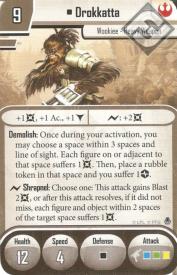
Just adding further speculation here, but Drokatta's card ability "Shrapnel" includes language that seems to interact with a number of the cases already: "after this attack resolves, if it did not miss, each figure and object within 2 spaces of the target space suffers 1 dmg."
I'd presume that we'd all expect that if Drokatta attacked, a figure "On the Lam'd" back to avoid range, but remained targetable (say, to contest an objective, gambling that the range would fail or something), and that the attack thereafter made range (say they played On the Lam "early" in step 3, and the attacker added in Hera's "Call the Shots" accuracy or "Lock On" for +3), that in this case, it's fairly clear that what should happen is the attack "hits" (i.e., "does not miss"), and that Shrapnel could go off, targeting the defender's current, post-On-the-Lam space?
If that can be taken as a benchmark, we're left with "Collateral Damage" as a card that does not require that the attack not miss, and similarly winds up treating a new target space. This may simply return us to A1bert's contentions above (that the new space is not within the set of "targetable spaces" whatsoever for any abilities), but I think it's at least a minor precedent for the target space traveling with the figure.
"Marksman" is another interesting case study, since it creates the capacity to draw Line of Sight to a figure, but not the figure's space -- here again I think we'd all presume that the space and the figure are meant to be understood as the same -- that is, if Drokatta "Marksman'd" a target, she could thereafter play "Collateral Damage" from that target's space.
Frankly, the simplest errata might be to simply add "if the attack did not miss" to Collateral Damage, but that would prevent its use against a Dodge roll, which seems like an unnecessary over-correction of the card.
Attacks and a lot of abilities target figures or objects. Attacks do not target spaces. The target space becomes the target space due to the figure or object being targeted.
For example, you cannot choose a space with blocking terrain when you need to choose a space within X spaces or in line of sight. But a space with blocking terrain can become a target space if you target an attack against a figure occupying it. However, a space with blocking terrain is not adjacent to any other space, so most of the abilities using target space do nothing.
Just a bump --
I ran a Collateral Damage list at MN regionals, and before the tournament I did ask the TO what to do if it came up. He asked to see both cards, looked them over, talked it through for a while, and finally said that if it came up, he'd rule that it would be legal to play Collateral Damage off of the On the Lam'd figure, using its new space to count 2. He seemed a bit distressed when I mentioned that Todd had declared it unclear, per the above.
So then tonight I had a Vassal game with Jonathan on Vassal, with Discord going. It came up and actually mattered a lot -- he had an ESentry with 5 damage on it, and On the Lam'd a Weequay to a square within two of it. So I revealed the card and asked him about it. He read over this thread online and we talked it out. I offered not to use it, or even to roll blue dice each to see how to play it this time, and he ultimately said, "No, I think it can be played as written," even though it meant losing the ESentry to demolish.
I know that doesn't really add a ton to the discussion, apart from a cautionary tale that we really do need a ruling on it, say, before Worlds? ;D
Theoretically speaking, the next FAQ might come out before Worlds. 
Theoretically, the FAQ should have addressed ugnaughts auto-win on Raining Freight.... it will be fitting if Ugs win Worlds on Raining Freight.
So according to the brand new FAQ 3.0, the following bullet on PG 11 should answer this thread:
"During an attack, if the attacker's line of sight to the target space changes or if the defender moves, the attacker must then re-declare a target space. If none of the defender's spaces are eligible, the attack misses, there is no target space, and abilities that refer to a target space have no effect."
Summary: Collateral Damage does not take effect if the defender On the Lams out of line of sight of the attacker.
Edited by The Archangel