Difference between Military and Political Conflicts

By Tonbo Karasu, in Legend of the Five Rings: The Card Game

There have been a number of comments about how people are worried that because they use the same mechanics, Military and Political conflicts will feel the same. Can I suggest that we have already seen how they are going to differ:

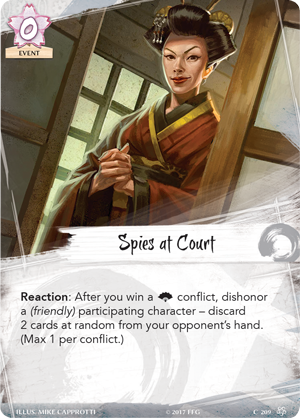
l5c01_fallen-in-battle.pngl5c01_spies-at-court.png

These two neutral events imply that the cards surrounding Political and Military will make all the difference.

The whole theme states: Words in the courts are as sharp and deadly as swords on the battlefield :) Personally (I played only dishonor in the oL5R) i love the idea , that they are similar mechanically plus the restriction for them (1 of each).
This is rokugan for me, to dominate your opponent you need courtiers and swordsmen.

Cards that are reacting to them? Thats another question ^^

Edited by Bayushi Batta
On 5/7/2017 at 6:34 AM, Tonbo Karasu said:

There have been a number of comments about how people are worried that because they use the same mechanics, Military and Political conflicts will feel the same. Can I suggest that we have already seen how they are going to differ:

l5c01_fallen-in-battle.pngl5c01_spies-at-court.png

These two neutral events imply that the cards surrounding Political and Military will make all the difference.

Mechanically, the two skills and the way their Conflicts are going to be resolved are the same and that's good. There is no reason to add a whole other system simply to make those things different. The point in doing this was to clearly make the Conflict phase and the Ring Challenges the focus of the game.

Now, from what has already been shown and everything we know about GoT 2.0, we can strongly assume that there are going to be more cards that directly mention specific conflicts by: winning or losing, winning by a certain amount, losing by a certain amount, when a conflict of a specific type is initiated etc.

Here is a list of Events from the GoT 2.0 Core Set. Given that Nate was the lead design for that game, it's probably safe to assume a few similar type effects will be printed into L5R.

Compare Fallen in Battle to Put to the Sword for example (the sword symbol is the Military challenge in GoT for those who do not know)

l5c01_fallen-in-battle.pngPut to the Sword

Edited by Danwarr
Clarity

I agree that the military and political conflicts run the risk of feeling the same, but I think when we start playing, they will feel different, and this will be down to the card pool, and which characters participate in them.

The great thing about the system is that in old L5R, if a dishonor was playing vs a military deck they both go into battle, but with two entirely opposite motivations. The military deck is there to kill the province and try it's best to keep their units there, but the dishonor deck is doing it's best to end the battle and save the province. This meant, in many cases neither player was happy with how the battle was being fought.

In the new system, everyone has the same objective. The dishonor deck won't be so dependent on mass send home cards and the like becasue it may have a realistic chance of winning the battle. Likewise, the dishonor deck will be able to launch their own attack each turn and be able to threaten provinces just as much, meaning that both players have an opportunity to be a defender and attacker. It really ensures that everyone is playing the same game. Which should be more fun for all involved.

I suspect Military conflicts will involve gaining power in the form of Military stat bumps, and some form of PK like discarding, or removing fate from, characters. Political conflicts will involve making personalities honorable or dishonorable, and gaining or losing honor.

The political and military options do look quite similar though- should that be a concern?

I don't think they will look too similar. It is good to have a streamlined system to resolve the conflicts, but I think the results of each type of conflict can have slightly different results. If the military victories can off characters, the diplomacy victories can mess with your opponent's deck.

I think as long as the type of conflict (military or political) can produce slightly different outcomes I think there will be enough difference.

I really loved magistrate battle dishonor, and hope to get some of that flavor back in political conflicts.

54 minutes ago, twinstarbmc said:

I suspect Military conflicts will involve gaining power in the form of Military stat bumps, and some form of PK like discarding, or removing fate from, characters. Political conflicts will involve making personalities honorable or dishonorable, and gaining or losing honor.

I can see political duels that also lead to characters being discarded... either through some display of iaijutsu at court or for being disgraced and exiled and such things.

If they will pick up eventually the economic warfare, then military could get to do things with the dynasty deck of the opponent, while political could affect the conflict deck.

Of corse there is also the clans preference, that we might see more political action from Crane or Scorpion and military from Lion and Unicorn, so the selection of the clan will also influence the feel of the kinds of conflicts one will prevail in.

7 hours ago, Tonbo Karasu said:

These two neutral events imply that the cards surrounding Political and Military will make all the difference.

Both conflicts are about breaking provinces, which is quite "militar" from an L5R ccg point of view.But we know how much of a deadly battlefield a Court can be.;) Having different kind of cards/effects based on type of conflict qould be nice but there are just too many things that, in essence, will be the same. Character removal should be in both. (Dis)Honoring would be a better focus for Political but Military does still have room for some of it. Conflict draw/discard fits nicely in both of them too.

It will be nice what the devs can come up with but until then, Military Conflict and Political Conflict are mostly the same.

The characters participating will generally differ. The triggered events and abilities will generally differ. Not very concerning.

Unlike AGOT your military victory will more thematically break a province, not result in the random death of a workman somewhere. Great game, just a comparison :)

If the conflicts play out slightly different but the ultimate victory result is the same, broken province, it could at least differ in appearance. Imagine looking down to see the opposing clans banners displayed in the depiction of your province.

Edited by Xealous
19 hours ago, Xealous said:

The characters participating will generally differ. The triggered events and abilities will generally differ. Not very concerning.

Unlike AGOT your military victory will more thematically break a province, not result in the random death of a workman somewhere. Great game, just a comparison :)

If the conflicts play out slightly different but the ultimate victory result is the same, broken province, it could at least differ in appearance. Imagine looking down to see the opposing clans banners displayed in the depiction of your province.

We will have to wait for more information to be sure, but I don't know that the "ultimate victory result" for political conflicts will always necessarily be a broken province. If Honor/Dishonor victories ever become true, consistently obtainable goals (rather than mere boundaries), I suspect that honor gains and losses will be slightly easier to obtain in (though not exclusive to) political conflicts as opposed to military conflicts. Breaking provinces will still be done in political conflicts and honor gains/losses will still occur in military conflicts, but I think we'll definitely get different feels of each; if not in the base set, then in future sets as the roles get better defined.

20 hours ago, twinstarbmc said:

I suspect Military conflicts will involve gaining power in the form of Military stat bumps, and some form of PK like discarding, or removing fate from, characters. Political conflicts will involve making personalities honorable or dishonorable, and gaining or losing honor.

And I must add that imo, if the two mechanics of military and political conflicts embody this play structure, then this game will make it easier for the great majority of players, like myself. (I still consider my self a noob, since I haven't played this card game for over a decade)

Good post twinstarbmc.

Edited by LordBlunt
forgot to add.....
23 hours ago, Danwarr said:

Mechanically, the two skills the way their Conflicts are going to be resolved is the same and that's good. There is no reason to add a whole other system simply to make those things different. The point in doing this was to clearly make the Conflict phase and the Ring Challenges the focus of the game.

Now, from what has already been shown and everything we know about GoT 2.0, we can strongly assume that there are going to be more cards that directly mention specific conflicts by: winning or losing, winning by a certain amount, losing by a certain amount, when a conflict of a specific type is initiated etc.

Here is a list of Events from the GoT 2.0 Core Set. Given that Nate was the lead design for that game, it's probably safe to assume a few similar type effects will be printed into L5R.

Compare Fallen in Battle to Put to the Sword for example (the sword symbol is the Military challenge in GoT for those who do not know)

l5c01_fallen-in-battle.pngPut to the Sword

Excellent post.

Thanks for posting the list of Events from GoT; the list will certainly allow for a reasonable assumption to be made as to what we can expect from the L5R LCG.

So... we know that the conflict type can be changed mid-conflict. This is a thing that's been previewed. Let's say I declare a Political conflict against you, and change it to Military before it resolves. When it comes time for my second conflict, which one is it? Is it Military, because I declared Political last time, or is it Political because a Military conflict already resolved?

35 minutes ago, twinstarbmc said:

So... we know that the conflict type can be changed mid-conflict. This is a thing that's been previewed. Let's say I declare a Political conflict against you, and change it to Military before it resolves. When it comes time for my second conflict, which one is it? Is it Military, because I declared Political last time, or is it Political because a Military conflict already resolved?

If it's been changed to Military, then it's a Military conflict. (Assumption: how the rules work on state changes in every other FFG LCG)

16 minutes ago, Gaffa said:

If it's been changed to Military, then it's a Military conflict. (Assumption: how the rules work on state changes in every other FFG LCG)

I'm not so certain... "Each player may only declare one military and one political conflict during the conflict phase,..."

https://www.fantasyflightgames.com/en/news/2017/5/3/the-conflicts-of-rokugan/

In the Star Wars LCG the key word is "declare." You may only declare an engagement against each objective once per turn. So long as you follow that rule, you can use card effects to your heart's content to end up engaged with the same objective multiple times.

I believe L5R will work on a similar principle. The rules will likely only care what the conflict was when declared, not upon resolution. You could declare Political, use {insert hypothetical card here} to make the current battle Military, then later declare Military.

I tend to think the two will interact. You do a political conflict and that results in dishonor for your opponent's strongest military character. Now that character is subject to a power reduction for being dishonored and any sort of card that can send them home or further weaken them for being dishonored in a proceeding military conflict.

This would also work in reverse with a military defeat weakening political positions.

You won't break a province with just one conflict but the appropriate combination of both.

8 hours ago, twinstarbmc said:

I'm not so certain... "Each player may only declare one military and one political conflict during the conflict phase,..."

Yes, precisely.

If you declare a Military conflict, but someone changes it to a Political conflict, you've still used your Military declaration for the turn. You can then declare your normal Political conflict afterwards if you so desire.

9 hours ago, Gaffa said:

Yes, precisely.

If you declare a Military conflict, but someone changes it to a Political conflict, you've still used your Military declaration for the turn. You can then declare your normal Political conflict afterwards if you so desire.

Ah yes, sorry, I misunderstood you the first time.

It'll be all about the triggers to winning/losing said conflict.

I think what will feel different will be the different ring effects that you choose for each of your 2 conflicts.

It's interesting how that compares to the Element of a conflict - if you declare Fire, but it gets changed to Air before it is over, then Fire is available for future declarations.

18 hours ago, Frimmel said:

I tend to think the two will interact. You do a political conflict and that results in dishonor for your opponent's strongest military character. Now that character is subject to a power reduction for being dishonored and any sort of card that can send them home or further weaken them for being dishonored in a proceeding military conflict.

This would also work in reverse with a military defeat weakening political positions.

You won't break a province with just one conflict but the appropriate combination of both.

Good point. That is more akin to the playability* of the game.

I originally was thinking that a player can only attack a Province once in a given Turn, which would mean that your Military and Political declarations (attacks) would have to be against separate Provinces.

But you are totally correct, imo. It wouldn't make sense to limit attacks on a Province to only 1 per Turn. My self-induced narrow limitation was, well, very limiting for no reason.

Furthermore, the 2 cards mentioned above: Fallen in Battle & Spies at Court are quite powerful cards.

Edited by LordBlunt
more to write...
28 minutes ago, LordBlunt said:

Good point. That is more akin to the playability* of the game.

I originally was thinking that a player can only attack a Province once in a given Turn, which would mean that your Military and Political declarations (attacks) would have to be against separate Provinces.

But you are totally correct, imo. It wouldn't make sense to limit attacks on a Province to only 1 per Turn. My self-induced narrow limitation was, well, very limiting for no reason.

Furthermore, the 2 cards mentioned above: Fallen in Battle & Spies at Court are quite powerful cards.

I'm only speculating of course. I could be very wrong.

But if there are characters that aren't bowed by participating in a conflict or cards that can stand them then you're going to have to set stuff up. The Ring of Water let's you ready a character for example. So while you may only be able to attack a province once you'll need to still thin out the defenders available in the home area in order to attack another province. You'll send your characters out of a political conflict in order that they may participate in a military one. You'll have to be careful with that as you might want to send a character out of the conflict in order to win and be faced with balancing that decision against the threat that character might pose in the next conflict.

All the characters that participate in a conflict are bowed so you'll need to be very careful when picking your battles.

We're flying blind here without knowing more of the cards but I suspect that "chump blocking" isn't likely to be a thing in this game.

Edited by Frimmel