Squaring Up

By bumyong, in Runewars Rules Questions

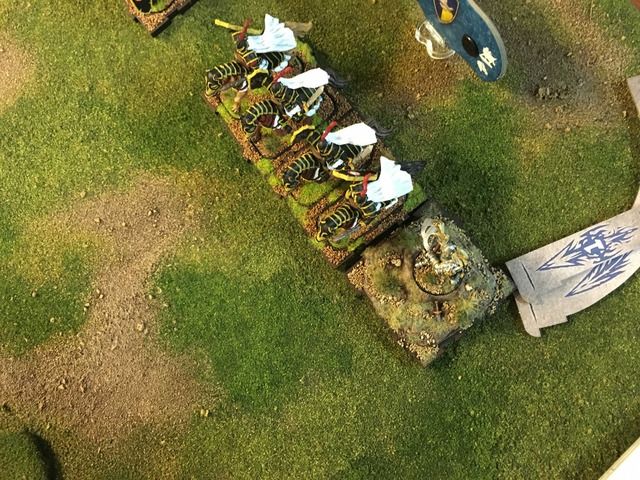
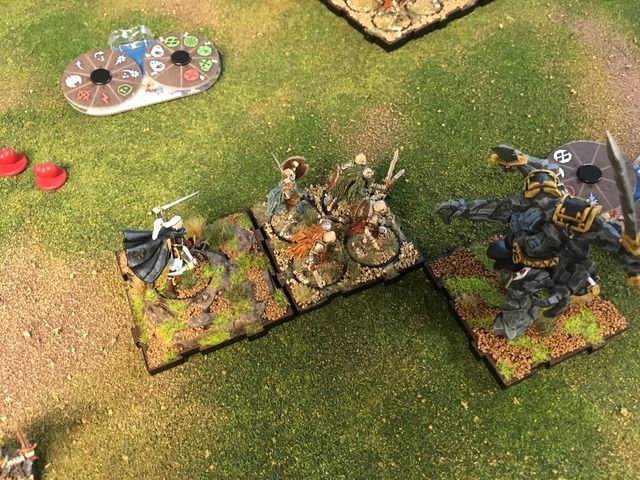
This situation came up last night in our game and we had some questions that arose. My remaining reanimates were facing a Rune Golem and was being flanked by Kari:
001_zps23k0sibb.jpg

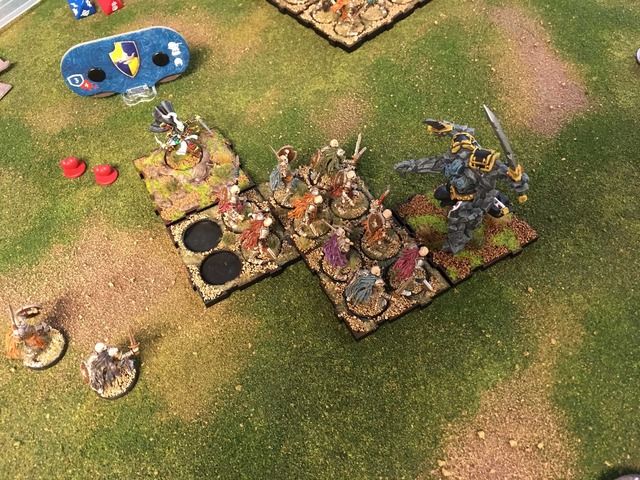
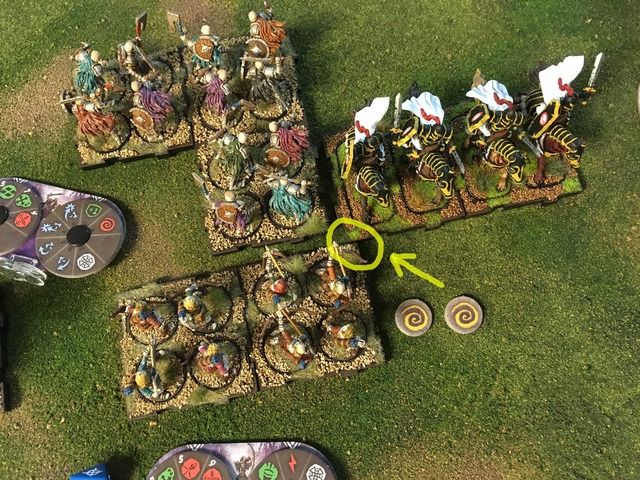
The round ended with two trays of reanimates getting wiped out:

002_zpsxp1qvmwz.jpg

At the top of the next round, both Kari and reanimates have initiative 4. Let's first assume if the Waiqar side has the turn marker and therefore goes first. 77.5 third paragraph says, "If, after revealing its command tool, an active unit is engaged with a single enemy unit but not aligned with that enemy, the active unit attempts to square up with that enemy unit." So in this example, since the reanimates are engaged with two enemy units, it must remain as is, correct? And can choose to attack either Kari or the Golem since they remain engaged with both of them? That's the way I'm reading the rules.

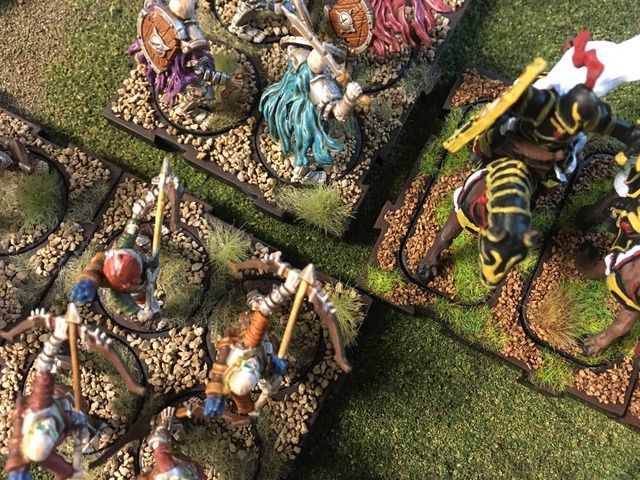
Let's say though that Kari isn't in the picture. Does that mean the reanimates would then get a free shift in order to square up with the golem like this?
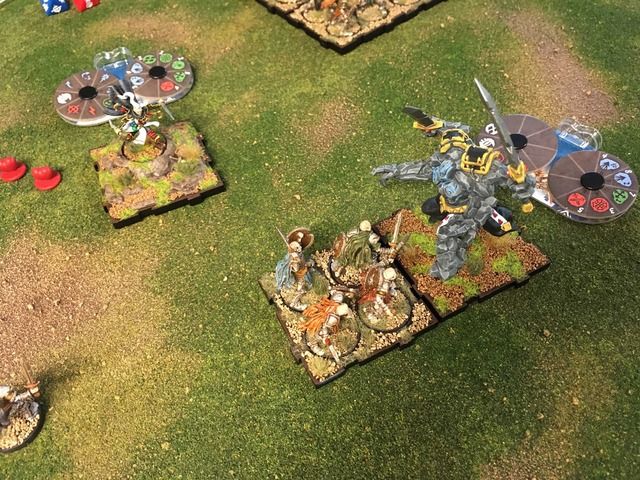
003_zpsodzagfjo.jpg

I'm wondering because 77.1 says to square up a unit means to slide the front edge "stopping at the first opportunity for the trays of the moving unit to be aligned with the trays of the enemy unit." I took this to mean then that the reanimates would shift over. But then, 77.1b attempts to clarify what it means to be "aligned": "The trays of two units are aligned when the edges of trays--or seams between trays--of the first unit that are perpendicular to its contacted edge line up and are parallel with the edges of trays--or seams between trays--of the second unit that are perpendicular to its contacted edge (i.e. the edges and seams of the units' trays form a grid)." After reading this about ten times, I think it means that the reanimates were already aligned even though only the corner was touching the golem so it would just remain as is without the free shift. Is that how you all read it?

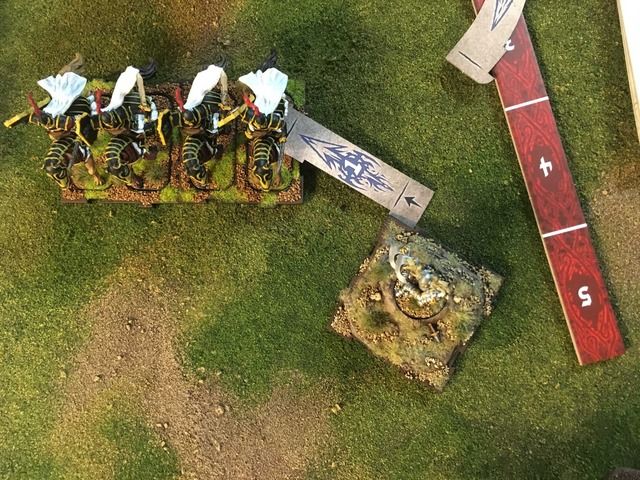
Okay, now let's assume that the Daqan have the first-player marker so Kari goes before the reanimates. Since she is touching the corner of the reanimates, is she allowed to choose whether she squares up on the side or the back? Remaining on the side would mean she wouldn't need to pivot:
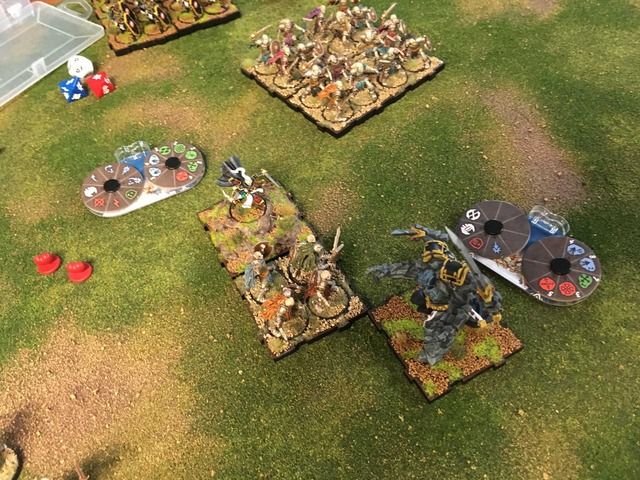
005_zpstusilkjt.jpg

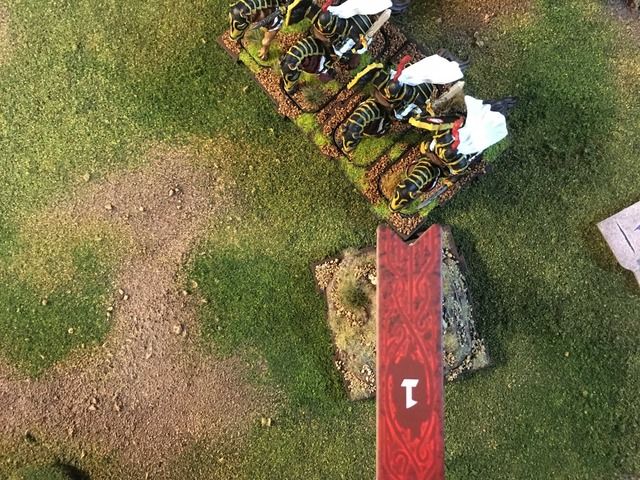
But is this squaring up just as valid even though she will pivot?
006_zpskgonrf3n.jpg

This will be moot if she is already aligned and therefore doesn't get to move at all and remains touching only on the corner. But if she were to use a shift action, could she go either direction, especially the move in the last photo so she could maintain her flanking bonus?
I think Kari should have "closed in" after defeating the rear Reanimates tray, and the Rune Golem should have closed in after removing the front-right tray.

1 hour ago, Budgernaut said:

I think Kari should have "closed in" after defeating the rear Reanimates tray, and the Rune Golem should have closed in after removing the front-right tray.

But aren't they still technically "engaged" with the reanimates since the corners are touching? If not, then can the Golem and Kari choose which side they square up on? (It would be advantageous for both of them to flank rather than the golem remaining front-to-front.)

I beleive corner to corner is not engaged. Closing in would be the way to go

My understanding is that because engaged units are not locked together, the corners aren't actually touching in that situation. Can somoene else verify?

The diagram showing a unit closing in in the RRG seems to indicate that units are not engaged corner to corner.

6 hours ago, Tvayumat said:

The diagram showing a unit closing in in the RRG seems to indicate that units are not engaged corner to corner.

I'm not seeing a diagram in the RRG or the LtP--reference please?

I think corner-to-corner needs a FAQ because under Engagement in rule 34 it says [bold mine], "If any part of a unit's trays are touching any part of an enemy unit's trays, those units are engaged." Then 34.3b says, "If a unit is engaged only through the corner of one of its trays, the contacted edge is the edge to which the enemy unit would square up if able." (Problem with this is that corner-to-corner would make two edges viable if it is a one-tray unit attacker.)

Also, if you look at 77.5 that talks about how to resolve squaring up if there are obstacles in the way this is what 77.5c says, "Repeat these resolutions for any additional obstacles. Then, if it is still impossible for the moving unit to square up without colliding with an obstacle, the unit cannot square up and it is returned to the position it was in when it collided; the two units are still touching and are thus still engaged ."

Here's an example of this from last night's game. I was hiding my archers behind a reanimate block but those cursed Oathsworn just barely squeaked by to clip the corner of my archers. This is not corner-to-corner as there was about a 1/4" overlap:

001_zpstgh0pfyq.jpg 002_zpsewj7vmmh.jpg

As per rules for squaring up, the Oathsworn would normally slide over BUT because of the collision rules, can't square up. Therefore, it remains as is and gets the attack off because they are engaged. So, if you are engaged with 1/4" contact, why not with corner-to-corner? Especially since it is possible to collide into something with just your corner and remain engaged if you can't square up?

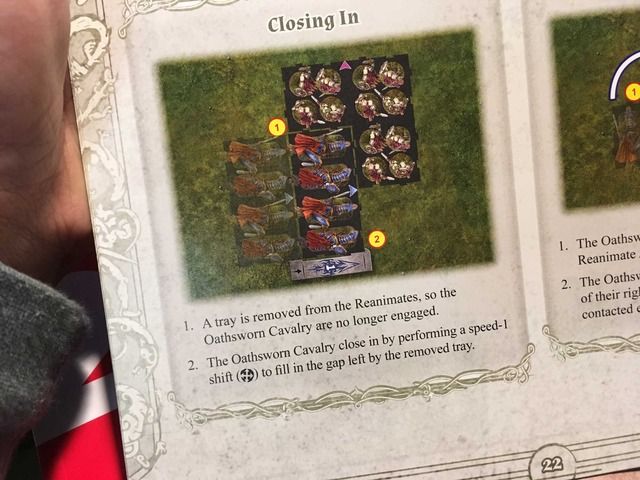
Found the reference. It's the bottom left diagram on page 22 of the RRG. Yes, according to the diagram, it does look like corner to corner does not count as engagement. Found the answer on another thread.

003_zpsymtfqrpc.jpg

One question still stands: If the Golem closes in after the reanimate tray in front of it is removed, can it choose to pivot so it is in the flanking position rather than just sliding along the front edge of the remaining reanimates?

Edited by bumyong

I don't, I leave it as both units are flanking each other. Could be wrong, but I think of it as thematic, battle is hectic and fierce and positioning changes.

14 minutes ago, Ywingscum said:

I don't, I leave it as both units are flanking each other. Could be wrong, but I think of it as thematic, battle is hectic and fierce and positioning changes.

Not sure if I understand your answer since only Kari is flanking and the golem and reanimates are face-to-face. Let me show you the two photos of Kari instead of the golem. Here is the situation after two reanimate trays are taken off. Let's ignore the golem for a second:

002_zpsxp1qvmwz.jpg

Per rules, Kari should close in. I know the first photo is legal but could she do the second photo and close in on the back of the reanimates and pivot so that she keeps her flanking bonus? I am thinking that she can because when she closes in, it functionally counts as a move to engage and should follow the regular rules dictating "Squaring Up From a Corner" on page 8 of LtP. Since single tray figures are equally under the range ruler, they should be able to choose which side and to pivot to square up.

005_zpstusilkjt.jpg

006_zpskgonrf3n.jpg

Closing In only mentions a shift and says nothing about a reform, so I think she would just be side-to-side with the Reanimates.

Kari and the Rune golem could shift sideways or forward. In both cases, shifting forward leaves them in a position where their front facing is not the contact edge. They would not be considered flanking, but they would still be engaged and both units could attack the reanimates (and be attacked). They would not get to pivot. If the closed in sideways, they would be facing the unit. Kari would still be flanking.

The pivot he is referring to comes from the squaring up rules.

77.1 To square up his unit, the player pivots his unit around the point of contact with the enemy unit until the squaring-up unit’s front edge is parallel with the enemy unit’s contacted edge for that engagement. Then, the player slides the squaring up unit in either direction of his choice along the contacted edge, stopping at the first opportunity for the trays of the moving unit to be aligned with the trays of the enemy unit.

If this rule does indeed cause you to always pivot your tray so that your front edge is contacting the enemy then you would be able to flank with a speed 1 march of the rune golem forward.

40 minutes ago, jek said:

The pivot he is referring to comes from the squaring up rules.

77.1 To square up his unit, the player pivots his unit around the point of contact with the enemy unit until the squaring-up unit’s front edge is parallel with the enemy unit’s contacted edge for that engagement. Then, the player slides the squaring up unit in either direction of his choice along the contacted edge, stopping at the first opportunity for the trays of the moving unit to be aligned with the trays of the enemy unit.

If this rule does indeed cause you to always pivot your tray so that your front edge is contacting the enemy then you would be able to flank with a speed 1 march of the rune golem forward.

I see. So to close in, you 1) perform a shift-1 movement, 2) you must collide, 3) square up. I didn't realize that squaring-up required your front edge to be parallel. That's an interesting development.

Yeah, see why it's confusing and needs a FAQ? Because corner-to-corner is considered unengaged, at which point exactly are you colliding when you close in?

17.1 "To close in, a unit performs a speed-1 shift action and must collide with the enemy unit it was most recently engaged with... If there is a collision with that unit, the unit squares up as normal , but other game effects that are triggered when units collide are ignored."

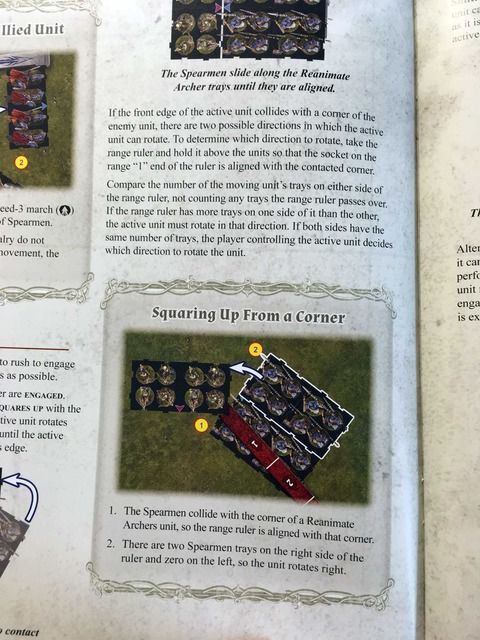
If you are colliding with the corner of the enemy unit, then the rules from LtP Page 8 come into play (here's a photo because it is too much to quote):

002_zpsioyngfbq.jpg

I know it says "If the front edge of the active unit collides with a corner..." But I would argue that these squaring up rules would still apply if you collided with your side edge. Here's an example. Let's say Ardus performs a shift-1 sideways move to collide with the corner of the Oathsworn since he knows they will get a charge bonus if he doesn't engage them this turn:

012_zps27pc1uw0.jpg

As per corner collision rules, there are no other trays on either side of Ardus:

013_zps685uzlh8.jpg

Therefore, Ardus gets to choose and of course, he is going to choose to square up on the flanking side of the Oathsworn rather than putting himself into the disadvantaged position of being flanked himself! Ardus doesn't get any flanking bonus either but this is clearly the better choice:

017_zpsmzuc2uy9.jpg

So to get back to my original question, when you START corner-to-corner, at which point are you colliding with the enemy unit when you close in? Based on how you answer this question, it is possible to pivot so that your front edge ends up squaring up so that you gain the flanking bonus, making Kari's pivot in the above example legal.

This situation actually comes up quite a bit since your single-tray units (heroes and siege units) tend to burn through multi-tray grunts quickly.

Until an official FAQ comes out, I am going to play so that you aren't allowed to pivot even though emotionally, I like the idea of the heroes and siege units being more powerful against grunts.

13 minutes ago, jek said:

The pivot he is referring to comes from the squaring up rules.

77.1 To square up his unit, the player pivots his unit around the point of contact with the enemy unit until the squaring-up unit’s front edge is parallel with the enemy unit’s contacted edge for that engagement. Then, the player slides the squaring up unit in either direction of his choice along the contacted edge, stopping at the first opportunity for the trays of the moving unit to be aligned with the trays of the enemy unit.

If this rule does indeed cause you to always pivot your tray so that your front edge is contacting the enemy then you would be able to flank with a speed 1 march of the rune golem forward.

But there is no "point of contact". The diagram on page 22 of the RRG shows that the unit slides along the edge of the other unit and contacts the tray across the gap.

14 minutes ago, rowdyoctopus said:

But there is no "point of contact". The diagram on page 22 of the RRG shows that the unit slides along the edge of the other unit and contacts the tray across the gap.

you close in, creating a point of contact in the edge that is available by the removed tray, which results in collision that then triggers squaring up, which according to the rule for squaring up causes you to pivot.

Also, when you shift to fill that space, shouldn't your connectors catch with the unit you were engaged with, causing you to pivot around that point of contact?

24 minutes ago, jek said:

you close in, creating a point of contact in the edge that is available by the removed tray, which results in collision that then triggers squaring up, which according to the rule for squaring up causes you to pivot.

6 minutes ago, Budgernaut said:

Also, when you shift to fill that space, shouldn't your connectors catch with the unit you were engaged with, causing you to pivot around that point of contact?

Not according to the diagram on page 22...

24 minutes ago, rowdyoctopus said:

Not according to the diagram on page 22...

Movement, 55.3, third bullet: "If the only part of a unit that would overlap an obstacle is
a connector on one of the unit’s side edges, the unit can be
slightly nudged directly away from the obstacle such that
the connector no longer overlaps the obstacle. Then, the
movement proceeds as normal. (When moving sideways,
this rule applies to the connectors on the front and back
edges of the unit instead of the side edges.)" [emphasis added]

It seems that nudging the unit such that the connectors don't overlap is completely optional. In the diagram on page 22, it seems they chose to ignore the connectors, but I think you would be fully within the rules if you chose to pivot around those connectors.

However, you have to watch the trays carefully. If you are Kari in the image below, moving forward should allow your connectors to cause you to collide (if you wish to). However, if you shift sideways, the connectors will not contact the other enemy unit's connectors. No?

001_zps23k0sibb.jpg

Edited by Budgernaut

Page 22 is an example where you shift to fill a whole in a 2x2 when attacking a flank already there is no need to square up your facing because it is already there, but following the way the RRG explains closing in and squaring up it is something that happens in the situation above where the rune golem kills a tray of reanimates,

17 Closing In

If two units are engaged and a game effect removes one or more trays from one of those units such that those units are no longer engaged, the unit that did not have any trays removed may close in.

17.1 To close in, a unit performs a speed-1 shift (?) action and must collide with the enemy unit it was most recently engaged with—the enemy unit that had one or more of its trays removed. If there is a collision with that unit, the unit squares up as normal, but any other game effects that are triggered when units collide are ignored.

• The straight, speed-1 movement template moves a unit the distance of the width of a single tray. When a unit is closing in to fill the gap left by a single tray being removed, the close in results in a collision. The gap left by the tray and the distance covered by the straight, speed-1 template are identical—even though they sometimes appear not to be as a result of trays being bumped.

So the RG was engaged, reanimates die it shifts forward into the space that occupied the tray or reanimates that was removed which results in a collision due to the bullet point in RRG17 as stated in 17.1 the unit then squares up as normal

77 Squaring Up

After a unit collides with an enemy unit, it attempts to square up with that enemy unit.

77.1 To square up his unit, the player pivots his unit around the point of contact with the enemy unit until the squaring-up unit’s front edge is parallel with the enemy unit’s contacted edge for that engagement. Then, the player slides the squaringup unit in either direction of his choice along the contacted edge, stopping at the first opportunity for the trays of the moving unit to be aligned with the trays of the enemy unit.

So with squaring up the golem will pivot so that it's front edge becomes parallel to the reanimates' contacted edge which now is the flank of the unit. Regardless of the picture on page 22 for the RRG this is how the rules would seem to apply to the OP's situation, It would seem that closing in can give you the ability to gain a flank by careful positioning as the unit loses threat, especially when losing threat to a single tray model

I really don't believe that the intention is that units can pivot around on the connectors to square up against a unit when they are essentially "passing by" them.

My point with the diagram on page 22 is that if what is being said in this thread is true, the cavalry would have collided on the first connector of the reanimates. The nudging rule is only if the moving units connector is the only part hitting an obstacle. In this case, the actual tray would be hitting the connector of the reanimates, not just the connector.

This game is surprisingly lacking rules about what happens if the side of your unit collides with an enemy while moving forward. Squaring up is all in the context of your front edge colliding.

5 minutes ago, rowdyoctopus said:

Squaring up is all in the context of your front edge colliding.

No it isn't, Squaring up is what happens if you collide with an enemy, it does not specify front edge collision. Collision only specifies that you are contacting an obstacle that you did no contact previously, once again no specification for edge only contact, therefore when you Collide with an enemy on any of your edges the resulting collision triggers squaring up.

1 hour ago, jek said:

No it isn't, Squaring up is what happens if you collide with an enemy, it does not specify front edge collision. Collision only specifies that you are contacting an obstacle that you did no contact previously, once again no specification for edge only contact, therefore when you Collide with an enemy on any of your edges the resulting collision triggers squaring up.

77.1. You pivot around the point of contact until your front edge is parallel. You cannot do this if, say, when performing a wheel, the front corner of an enemy unit touches the side of your unit. There is no way to pivot around that specific point and end up with the front edge of your unit "squared up" against that enemy.

Edited by rowdyoctopus

The 1 movement is specifically designed to be the length of a tray, and the close-in rules use that fact, along with the rules for legally squared-up engagements (where trays have to be lined up in a grid) to implicitly guarantee that you will collide with a perfect edge-to-edge anywhere along that movement, necessitating you squaring up again to perfectly occupy the vacated tray's spot if you choose to close-in in that direction. They've written the close-in rules the way they have to specifically avoid having to very carefully measure and then get disappointed because you weren't precise enough earlier when squaring up. Stop making it more complicated than it is by trying to ask where along the movement the parallel edges collide. a) It doesn't matter because you'll just have to square up and align to the grid anyways, and b) the entire point of the close-in rule is to guarantee that you will at some point without bogging the game down in a five-minute argument over whether you nudged things to get them to collide.

A secondary effect of the close-in move is that, unsurprisingly, units that are dealing significant damage to their enemy can press the advantage by continuing (or moving in) to flank.