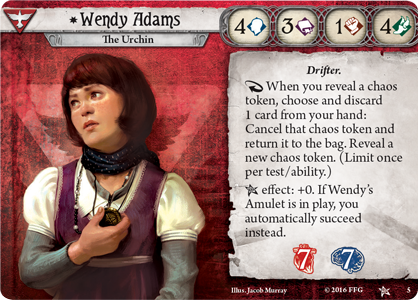
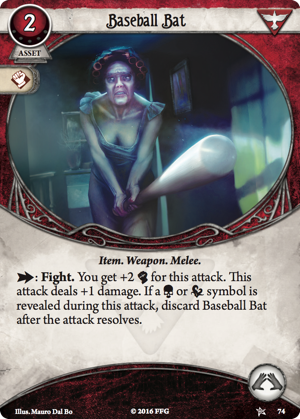
I attack an ennemy with my baseball bat. I draw a skull token for test. I use wendy's ability to cancel the token and draw a new one -1.
The baseball bat is discarded or not ?
"What really mean cancel a token ?"
I attack an ennemy with my baseball bat. I draw a skull token for test. I use wendy's ability to cancel the token and draw a new one -1.
The baseball bat is discarded or not ?
"What really mean cancel a token ?"
I attack an ennemy with my baseball bat. I draw a skull token for test. I use wendy's ability to cancel the token and draw a new one -1.
The baseball bat is discarded or not ?
"What really mean cancel a token ?"
I would have said, It's like a mulligan. The first chaos token was as if it were never drawn, so ignore any effects that trigger off of it.
Then again -- as I typed that up, I thought:
It's still revealed, as per Wendy's text: "When you reveal a chaos token". So maybe the cancel means only the modification of the stat, but it's still revealed?
I'm rather curious about this myself.
During a skill test there are two distinct steps for revealing a chaos token (ST.3) and resolving a chaos token (ST.4). So if Wendy's ability said "after" instead of "when", I'd say that the skull were fully revealed, ST.3 was completed and would then be repeated. Since it says "when", it should interrupt ST.3 and change the outcome before the ST.3 window closes and the token is technically fully completely revealed. So I guess Wendy would get to keep her club.
Of course, since the skull is returned, you can always draw it again the second time...
Edited by Sameaoops
Edited by Hibbidy_jibbidyDuring a skill test there are two distinct steps for revealing a chaos token (ST.3) and resolving a chaos token (ST.4). So if Wendy's ability said "after" instead of "when", I'd say that the skull were fully revealed, ST.3 was completed and would then be repeated. Since it says "when", it should interrupt ST.3 and change the outcome before the ST.3 window closes and the token is technically fully completely revealed. So I guess Wendy would get to keep her club.
Of course, since the skull is returned, you can always draw it again the second time...
Sounds good !
In the Rules Reference it states that when an effect is canceled, it is still considered to have happened, only it's effects are canceled. I would say that this means Wendy loses her bat, even if she cancels the token.
Even though her effect cancels the token, it was still revealed. Which the baseball bat effect occurs as the token is revealed.
In the Rules Reference it states that when an effect is canceled, it is still considered to have happened, only it's effects are canceled. I would say that this means Wendy loses her bat, even if she cancels the token.
"...Any time the effects of an ability are canceled, the ability (apart from its effects) is still regarded as initiated, and any costs have still been paid. The effects of the ability, however, are prevented from initiating and do not resolve."
If Wendy's ability cancels a Chaos Token, none of the effects triggered by drawing that token are cancelled. Wendy keeps the bat.
Edit: that last should read "...none of the effects... are resolved."
Edited by Gamedog
In the Rules Reference it states that when an effect is canceled, it is still considered to have happened, only it's effects are canceled. I would say that this means Wendy loses her bat, even if she cancels the token.
No, it is still considered to have initiated, but all effects do not resolve. See Rules Reference p. 6 "Cancel"
"...Any time the effects of an ability are canceled, the ability (apart from its effects) is still regarded as initiated, and any costs have still been paid. The effects of the ability, however, are prevented from initiating and do not resolve."
If Wendy's ability cancels a Chaos Token, none of the effects triggered by drawing that token are cancelled. Wendy keeps the bat.
But is the Bat's ability a result of the token, or a result of the revelation? If it's the former, then yes she keeps her bat, since the effect is canceled. If it's the latter, then perhaps she does lose it, because that's an effect of the revelation, which wasn't canceled.
'When' is an interrupt.
It's a window in which you can take a thing that is happening and accentuate it, adjust it, stop it, before the thing's effect impacts on the board.
Any event must initiate for you to then be able to interrupt it and do something with it (cancel it, if that is the effect of the 'when').
Do you think that we need a clarification from designer on this subject ?
I think that this situation will occur for other situations (when new cards will arrive).
Someone know, how we can send a question to designer team ?
Edited by 13nrvFeonix has an account here.
Do you think that we need a clarification from designer on this subject ?
I think that this situation will occur for other situations (when new cards will arrive).
Someone know, how we can send a question to designer team ?
Ask mplain in the Discord channel. He'll either answer the question himself or big Matt about it.
Initially I thought it was a simple question with an obvious answer, however now I think that the wording is not clear.
Wendy's ability is not a replacement effect (doesn't say "instead").
It says "Cancel that token", I don't really know what that means. The rules entry for Cancel describes canceling the effects of an ability. If Wendy said "Cancel that token's effects", I'd say that the Bat still breaks, because its delayed effect is based on revealing the token, not on resolving its effects. However, it's not clear what "Cancel that token" means, it might mean that it works like a replacement effect (like revealing that token never happened). The rulebook entry isn't clear in that regard.
I'll ask Big Matt.
Edited by mplainThanks for your reply.
I'll wait for Big Matt clarification 
Since "revealing" a chaos token is its own step during a skill check, to "reveal" a chaos should mean initiating that step and a "revealed" chaos token should mean the result after fully resolving that step. In that case, Wendy's ability would happen inside the reveal step and the trigger from the baseball bat would only take into account the final result after the step is resolved.
Seemed and still seems clear to me. If it turned out to be meant any other way, I would find the wording on those cards rather careless and confusing... 
Since "revealing" a chaos token is its own step during a skill check, to "reveal" a chaos should mean initiating that step and a "revealed" chaos token should mean the result after fully resolving that step. In that case, Wendy's ability would happen inside the reveal step and the trigger from the baseball bat would only take into account the final result after the step is resolved.
Seemed and still seems clear to me. If it turned out to be meant any other way, I would find the wording on those cards rather careless and confusing...
Could you elaborate? I've read your post above but I didn't understand what does the difference between Step 3 and Step 4 has to do with the difference between When and After?
Do you think that we need a clarification from designer on this subject ?
I think that this situation will occur for other situations (when new cards will arrive).
Someone know, how we can send a question to designer team ?
Ask mplain in the Discord channel. He'll either answer the question himself or big Matt about it.
I use discord but i haven't access to this channel. Could you give me the url to access ?
Do you think that we need a clarification from designer on this subject ?
I think that this situation will occur for other situations (when new cards will arrive).
Someone know, how we can send a question to designer team ?
Ask mplain in the Discord channel. He'll either answer the question himself or big Matt about it.
I use discord but i haven't access to this channel. Could you give me the url to access ?
And I totally didn't mean to give Matt a new nickname. That was a typo for "bug Matt about it". But if it sticks, I guess he's Big Matt now.
Thanks for the link !
There is a place here to submit rules questions. At the top of the page select the "More" menu item, under that select "Customer Service", then "Rules Questions". In there is a link to the Rules Question Form.They are usually pretty good about answering.
Could you elaborate? I've read your post above but I didn't understand what does the difference between Step 3 and Step 4 has to do with the difference between When and After?
With those two specific cards, the relevant text fragments (imho) are those:
- Wendy Adams: "When you reveal a chaos token, [do stuff]"
- Baseball Bat: "If a [skull] or [Cthulhu's middle finger] symbol is revealed during this attack, [do stuff]"
And it really comes down to what "reveal" actually means. There is no direct entry in the RR, but where it discusses skill checks in detail, there is a whole step called "ST.3 Reveal chaos token.". And this step is distinct from the following step "ST.4 Resolve chaos symbol effect(s).", which is great, because that means that "reveal" is pretty well defined and one should be able to assume that any mentions of the word "reveal" in connection to skill checks and chaos tokens refers to this well-defined step.
"ST.3 Reveal chaos token." really comes down to:
- formally initiate Step 3
- actually reveal chaos token (i.e. fish one from the bag and put it on the table or whatever)
- formally resolve Step 3 with the token you just revealed as outcome.
Now, the "when" in Wendys text (according to RR p. 21 "When") means that the effect is triggered somewhere after initiation, but before resolution of an event. With the event being "reveal chaos token" and that being a well-defined step during a skill test, Wendy's ability should trigger somewhere after Step 3 of a skill test is initiated, but before the outcome is formally accepted.
The text of Baseball Bat should also refer to "ST.3 Reveal chaos token." when it says "revealed", but the past tense indicates that this ability triggers only after the step is fully resolved.
If that indeed is the case, then everything is very clear:
- initiate reveal
- actually reveal token
- change outcome with Wendy's ability
- formally accept outcome
- discard baseball bat depending on outcome
Now, unfortunately the RR colloquially uses the word "reveal" to explain the "ST.3 Reveal chaos token." step. And a case could be made that, since the chaos token is drawn from the bag and seen by the players, it was indeed "revealed" and should satisfy the Baseball Bat trigger.
In my opinion that would be terrible, because that would mean that you could not trust the words on the card that have a rules definition to refer to that definition instead of some vague "common meaning of the word". Official rulings like "You know, when the card says 'asset' it does not actually mean 'asset'-asset like in-the-rules-asset, but just, like 'asset', you know?" would mean that you would need an official ruling for every card because you could not depend on defined word meeting their definition.
(Sorry for being lengthy and awkward and chaotic commas, this is not my first language )
Edited by mplainGreetings,
Great question!If a token is “canceled" or “ignored” in its entirety (such as through Wendy’s ability or Grotesque Statue’s ability), you should treat that token as if it had never been revealed at all. All of the token’s effects are canceled or ignored, and any effects that would trigger off of that type of chaos token being revealed (like Baseball Bat) do not trigger. Abilities like this should almost always be followed up by revealing a new token to take its place.Hypothetically, if a token is only partially ignored or canceled (for example, if a card effect said “Ignore this token’s modifier,” or “Cancel the effects of this token”), that would be a different story. In that case the token still would have been revealed, and only part of it is ignored or canceled. In such a case, effects that would trigger off of that type of token being revealed would trigger.So, if you used Wendy’s ability to cancel a Skull token, and then drew a 0 token, Baseball Bat would not get discarded, because the Skull token was canceled in its entirety.Thanks! =)------------------------------------------------Matthew Newman
Ok, my reasoning is that for LCGs where lots of rules and keywords interact and lots of unforeseen situations could arise, language should be clear and specific. When you use just any old English word to describe stuff, everything is up for debate. So with the limited space for text available on the cards, you have to be exact to connect it to the rules book.Could you elaborate? I've read your post above but I didn't understand what does the difference between Step 3 and Step 4 has to do with the difference between When and After?
With those two specific cards, the relevant text fragments (imho) are those:
- Wendy Adams: "When you reveal a chaos token, [do stuff]"
- Baseball Bat: "If a [skull] or [Cthulhu's middle finger] symbol is revealed during this attack, [do stuff]"
And it really comes down to what "reveal" actually means. There is no direct entry in the RR, but where it discusses skill checks in detail, there is a whole step called "ST.3 Reveal chaos token.". And this step is distinct from the following step "ST.4 Resolve chaos symbol effect(s).", which is great, because that means that "reveal" is pretty well defined and one should be able to assume that any mentions of the word "reveal" in connection to skill checks and chaos tokens refers to this well-defined step.
"ST.3 Reveal chaos token." really comes down to:
- formally initiate Step 3
- actually reveal chaos token (i.e. fish one from the bag and put it on the table or whatever)
- formally resolve Step 3 with the token you just revealed as outcome.
Now, the "when" in Wendys text (according to RR p. 21 "When") means that the effect is triggered somewhere after initiation, but before resolution of an event. With the event being "reveal chaos token" and that being a well-defined step during a skill test, Wendy's ability should trigger somewhere after Step 3 of a skill test is initiated, but before the outcome is formally accepted.
The text of Baseball Bat should also refer to "ST.3 Reveal chaos token." when it says "revealed", but the past tense indicates that this ability triggers only after the step is fully resolved.
If that indeed is the case, then everything is very clear:
- initiate reveal
- actually reveal token
- change outcome with Wendy's ability
- formally accept outcome
- discard baseball bat depending on outcome
Now, unfortunately the RR colloquially uses the word "reveal" to explain the "ST.3 Reveal chaos token." step. And a case could be made that, since the chaos token is drawn from the bag and seen by the players, it was indeed "revealed" and should satisfy the Baseball Bat trigger.
In my opinion that would be terrible, because that would mean that you could not trust the words on the card that have a rules definition to refer to that definition instead of some vague "common meaning of the word". Official rulings like "You know, when the card says 'asset' it does not actually mean 'asset'-asset like in-the-rules-asset, but just, like 'asset', you know?" would mean that you would need an official ruling for every card because you could not depend on defined word meeting their definition.
(Sorry for being lengthy and awkward and chaotic commas, this is not my first language
I think that makes sense and I see your logic. Wendy's ability interrupts, i.e. takes place, in between the initiation of step 3, revealing a token, and the resolution of Step 3, that the token has been revealed. So if the ability prevents the reveal from resolving, then the first token was never revealed, and no "After revealed" effects can trigger off of it.
That would be my guess... And in the middle of typing this, mplain posts Matt's reply confirming it! Thanks guys!
@mplain
Thanks for the answer !