FFG Ruling: effects resolve one sentence at a time

By rmunn, in Rules questions & answers

A recent BoardGameGeek thread discussed the interaction between Grievous Wound and Athelas if a Dúnedain hero with 1 HP left had both attached.

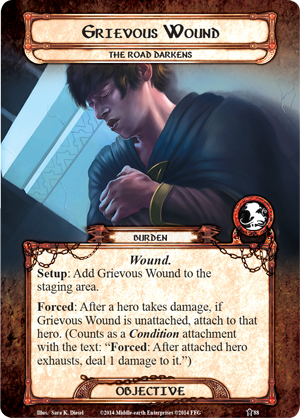
Grievous Wound is a Condition attachment with " Forced: After attached hero exhausts, deal 1 damage to it."

Athelas is an Item attachment with " Action: Discard Athelas and exhaust attached character to heal all damage on a character. You may discard a Condition attachment from that character."

The consensus on the thread was that the hero would probably die, as Forced effects resolve before responses (and presumably, also before actions). However, I couldn't find any reference to the timing of actions in the FAQ, so I asked Caleb for a ruling, and this is the response he sent me:

In The Lord of the Rings LCG we resolve effects sentence by sentence. We don’t interrupt a sentence to resolve a different effect, but effects can interrupt at the end of the sentence. So what would happen is: you exhaust and heal all damage at once, then you resolve the Forced effect on Grievous Wound for 1 damage. After that, you could discard a condition attachment from play.

Cheers,
Caleb

I have to say, I wasn't expecting that one. This "resolve effects sentence by sentence" ruling is one I haven't seen before, and it probably has implications beyond the Grievous Wound + Athelas combo. For example, I can't figure out how the ally-Imrahil + Caldara combo works given this ruling (Caldara's effect is one sentence), and yet Caleb has explicitly ruled that it does work. Are there any other card combinations that would be affected by a sentence-by-sentence resolution order?

just to be clear, my consensus didn't have to do with forced/action/response timing but the timing of constant and conditional effects (and also my assumption that discarding and exhausting were part of the cost of the effect rather than the ability itself)

constant and conditionals are much more prevalent in Netrunner, and may actually work differently in LotR, but it will probably help explain this scenario

also, for all intents and purposes, Athelas' and Caldara's abilities are worded and work roughly the same: do x to resolve y

anyway, so Prince Imrahil's ability is a constant ability. they are denoted by the use of the words if , while , until . constant abilities are binary and are either on or off and constantly check the board state.

prince-imrahil-fotw.png

Prince Imrahil uses the word while to describe its effect.

Grievous Wound is a conditional effect, which are denoted by the use of before , after , unless , and references to time or instances the first ally , the next player , etc.:

grievous-wound.png

in Netrunner, constant abilities have precedence over all other effects. they constantly check the board state, and extrapolating that to LotR, this is why it can 'interrupt' Caldara's ability mid-sentence while Grievous Wound can't interrupt Athelas'

I seem to recall there being a sentence by sentence ruling regarding the different quest stages of The Lonely Mountain (and/or involving the different versions of Smaug in that quest).

I'll post it if I find it.

EDIT: Here it is (see post #7 by Emilius) in this thread. https://community.fantasyflightgames.com/topic/83067-lonely-mountain-2b-and-smaug-the-golden-question-forced-effect-timing/?hl=lonely+mountain

These kinds of things really should be in the FAQ.

Edited by TwiceBornh

I don't see how Imrahil is broken by this, as his ability is a constant ability. As you are performing Caldara's ability Prince Imrahil transitions from ally to hero. This is similar to Thalin questing. If an enemy is exposed it gets the damage token before even "when revealed" effects can happen, which is quicker than you can respond.

Forced doesn't interrupt an action, so much as it cuts in at the earliest opportunity, before any player response can be played. It doesn't mean it takes effect before your action does. It is still a type of response, and needs to wait for it's trigger to actually occur, and then it follows.

This ruling is exactly as I would expect it.

I think in the caldera combo the discarding of the card is the last thing to happen not the first. Even though it says it first. It's simply stating what the cost of the action will be. So pull out the the allies, plonk Imrahil on the table for free, discard caldera and then promote Imrahil to Hero.

I'm sure I read somewhere that if a csrds cost is to discard it you do the effect and discard it after. Untill the end of the phase events would be to trigger the effect discard the card and remember the effect is constantly being checked untill that time period lapses

I think in the caldera combo the discarding of the card is the last thing to happen not the first. Even though it says it first. It's simply stating what the cost of the action will be. So pull out the the allies, plonk Imrahil on the table for free, discard caldera and then promote Imrahil to Hero.

I'm sure I read somewhere that if a csrds cost is to discard it you do the effect and discard it after. Untill the end of the phase events would be to trigger the effect discard the card and remember the effect is constantly being checked untill that time period lapses