Moving Between Rangebands

By The Mad God, in Star Wars: Age of Rebellion RPG

Hi there!

I was wondering how using maneuvers works when moving between rangebands.

I am just confused about how many maneuvers it takes to move to a place in medium range, and also if you need to use a maneuver to engage something like a terminal.

Generally I am wondering if it first requires a maneuver to move within short range, and then move to medium range. (That is a total of two maneuvers to make an enemy within medium range to be within short range).

If the enemy is within Long range, how many maneuvers does it cost to make that short instead of long?

Does engaging always cost just one maneuver when you are within short range? (is it different if you want to engage a target within medium range?)

Hi there!

I was wondering how using maneuvers works when moving between rangebands.

I am just confused about how many maneuvers it takes to move to a place in medium range, and also if you need to use a maneuver to engage something like a terminal.

Generally I am wondering if it first requires a maneuver to move within short range, and then move to medium range. (That is a total of two maneuvers to make an enemy within medium range to be within short range).

If the enemy is within Long range, how many maneuvers does it cost to make that short instead of long?

Does engaging always cost just one maneuver when you are within short range? (is it different if you want to engage a target within medium range?)

GMHooly put a great cheat sheet thread together. See it here: https://community.fantasyflightgames.com/topic/134044-feedback-sought-player-action-sheets/?p=1435352

The best index of all his contributions to the game, which are amazing, can be found here: http://www.d20radio.com/forums/viewtopic.php?f=152&t=13920

If you look at the Player Action Sheet, you'll see an area on movement on the right. It tells you how many maneuvers you need to go between any/all range bands.

The key is the sizes of the range bands get bigger and bigger exponentially. Medium is a longer distance diameter than Short... and Long is an even bigger circle than Medium.

So if you look at the sheet, you see it takes 3 maneuvers to go from Short to Long (or Long to Short). That means because of the 2 maneuver a turn rule, you need two rounds to close the distance.

Engaging also always costs a maneuver as does disengaging. If you want to go from Medium to Engaged, it's 2 maneuvers: Engaged to Short = 1, plus Short to Medium = 1.

And you'll also see yes, within short range if you change position it takes a maneuver as well.

All that make sense?

Edited by scotter23

Hi there!

I was wondering how using maneuvers works when moving between rangebands.

I am just confused about how many maneuvers it takes to move to a place in medium range, and also if you need to use a maneuver to engage something like a terminal.

Generally I am wondering if it first requires a maneuver to move within short range, and then move to medium range. (That is a total of two maneuvers to make an enemy within medium range to be within short range).

If the enemy is within Long range, how many maneuvers does it cost to make that short instead of long?

Does engaging always cost just one maneuver when you are within short range? (is it different if you want to engage a target within medium range?)

GMHooly put a great cheat sheet thread together. See it here: https://community.fantasyflightgames.com/topic/134044-feedback-sought-player-action-sheets/?p=1435352

The best index of all his contributions to the game, which are amazing, can be found here: http://www.d20radio.com/forums/viewtopic.php?f=152&t=13920

If you look at the Player Action Sheet, you'll see an area on movement on the right. It tells you how many maneuvers you need to go between any/all range bands.

The key is the sizes of the range bands get bigger and bigger exponentially. Medium is a longer distance diameter than Short... and Long is an even bigger circle than Medium.

So if you look at the sheet, you see it takes 3 maneuvers to go from Short to Long (or Long to Short). That means because of the 2 maneuver a turn rule, you need two rounds to close the distance.

Engaging also always costs a maneuver as does disengaging. If you want to go from Medium to Engaged, it's 2 maneuvers: Engaged to Short = 1, plus Short to Medium = 1.

And you'll also see yes, within short range if you change position it takes a maneuver as well.

All that make sense?

Thanks a lot from the reply :) It is greatly apreciated

So from what I understand if I want to engage a target that is in medium range, that costs 2 maneuvers. Good.

My group and I always draw the battlefield on a whiteboard and place magnets that resemble our PC's and the enemies. So whenever we move around we use a ruler to measure the rangebands around our individual characters like some kind of targeting board. (I know how the diameter of the rangebands increase from short to long)

My confusion is when the game describes using a maneuver to change the range between you and a target, it sounds like you use a maneuver to change the range from medium to short. When I play with my group, we spend one maneuver to run to a place within short or medium range relative to our character only. The book use the maneuvers to move you relative to your PC and another object. Instead we just say that short range is everything (on the board) within 5 cm, and medium is everything within 20cm. You can therefore move within 20 cm with one maneuver.

For an example, at the start of your turn you spend 1 maneuver to move closer to an enemy stormtrooper 25cm away (just barely in long range). The stormtrooper was before you moved, 25 cm away, and now (after spending one maneuver) he is 5cm away which is within short range in our game. If you had to spend the maneuvers relative to you and the trooper, then you would spend two maneuvers to change the range from long to medium, and one from medium to short (if I am understanding this correctly).

I feel like we are playing this very wrong. My group is used to playing D&D, recently 5th.

Edited by The Mad God

In this system, vague is good. FFG designed this with the idea in mind that you don't need maps or miniatures, nor exact measurements. Just your imaginations.

When using maneuvers to travel across range bands, you always consider how far (in Range Bands) your character is from said thing.

Example: Luke Skywalker is at Long range of Stormtrooper group 1, consisting of 4 Stormtroopers. Luke needs to get in close to hit them with his Lightsaber, so he spends 2 Maneuvers on turn 1 (downgrading his Action to a Maneuver) to get from Long range to Medium range. On the next round, he spends 1 Manevuer to get from Medium to Short range, then takes 2 strain to Maneuver into Engaged of the Stormtrooper group. Now Luke has an Action left and can attack them with his Lightsaber...

In this system, vague is good. FFG designed this with the idea in mind that you don't need maps or miniatures, nor exact measurements. Just your imaginations.

When using maneuvers to travel across range bands, you always consider how far (in Range Bands) your character is from said thing.

Example: Luke Skywalker is at Long range of Stormtrooper group 1, consisting of 4 Stormtroopers. Luke needs to get in close to hit them with his Lightsaber, so he spends 2 Maneuvers on turn 1 (downgrading his Action to a Maneuver) to get from Long range to Medium range. On the next round, he spends 1 Manevuer to get from Medium to Short range, then takes 2 strain to Maneuver into Engaged of the Stormtrooper group. Now Luke has an Action left and can attack them with his Lightsaber...

Thanks, this was what I was talking about. That movement is between two objects.

The problem I have with this system is that we can't draw it without getting into problems, with movement. This is bothering me because I can't imagine playing this without drawing. The GM would have to describe so many things in detail, and interaction with objects are harder to do because you would have to remember everything. Does anyone know a way to create another system for movement that works with this?

Another thing. How does "Taking Cover" maneuver work? Since we draw the battlefield on a board, we always spend one maneuver to move to a crate or a wall, and then we spend a maneuver to get cover. This is almost always 2 maneuvers to take cover. Do you count the movement toward the cover (if it is within short range) the same maneuver as taking cover?

This system is driving me mad...

Edit: I read about someone playing with zones instead of narrative rangebands. This seems like a good idea

Edited by The Mad God

The problem I have with this system is that we can't draw it without getting into problems, with movement. This is bothering me because I can't imagine playing this without drawing.

Not sure, what is the barrier? I've been playing for several years and have only rarely produced a map, and those times I did were only when I knew where we were starting the session from based on the last game. What number of items do you think you need to describe and track that are important to the encounter?

Another thing. How does "Taking Cover" maneuver work? Since we draw the battlefield on a board, we always spend one maneuver to move to a crate or a wall, and then we spend a maneuver to get cover. This is almost always 2 maneuvers to take cover. Do you count the movement toward the cover (if it is within short range) the same maneuver as taking cover?

Yes, technically it is two maneuvers to get to somewhere within Short range and take cover. Personally I'm pretty flexible about this, if the distance is fairly short, or if there is already "cover" along the route, I'll only require one maneuver.

This system is driving me mad...

It's definitely an adjustment if you're used to the minutia of something like D&D. In the words of the seer, you have to let go, you must unlearn what you have learned :) Don't sweat these things, and if anything just give the benefit of the doubt to the players. If they want cover in one maneuver and it's borderline...give it to them and move on. It's not a huge deal, one setback won't unbalance anything.

One other comment about maps: presenting a map is often the worst thing you can do because it constrains the action (unless you already know they are starting in a constrained space, such as, say, a prison breakout). Star Wars combats should be able to change entire scenes during the encounter, and usually laying out a 24x36 grid just kills the momentum. It turns a dynamic moving firefight into a static slugfest. I learned this a few years ago, I had a chase in a subway using stolen cars...in a vast metropolis there was no way I could map all the switches and side rails and stations (abandoned or otherwise) that the players might come across. I had a few "station" templates ready, but they could as easily have bailed and run down a storm drain.

The point is, rather than dutifully preparing detailed maps, it's more effective to have drop-in templates or set pieces. A few short notes about the environment and how the narrative dice results can be used in unique ways is all you need to run a satisfying encounter.

Something I do is just lay down the broad strokes and let the players fill in what they need. I suspect that's part of the reason for range bands over traditional maps, when you lock down a map, you also lock down the combat environment, so when a player rolls a triumph it feels awkward to suddenly draw in a terrain feature they use the Triumph to generate. In the grand scheme of things the terrain feature was of course always there, it just wasn't mentioned until now.

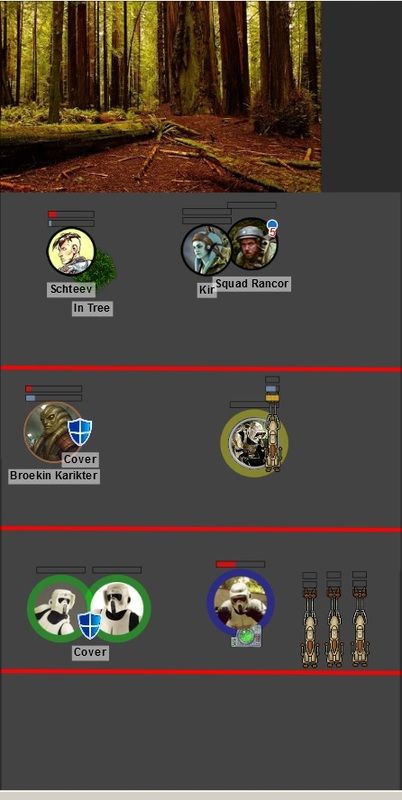
So, while I still use maps, most of my combats are just a simple depiction of range bands and characters along with a photo representing the general environment. That way unless there's a specific reason why they can't do something, they can, no need to worry about where a tree is, or a rock, or a terminal unless it's location in integral to the encounter (and even then it can be moved around a little easier.)

range%20bands.jpg