Early Morning Article today - A Villain for All Games
Pretty neat article. It would be cool to mix both X-wing and the RPG.
Makes me think of things for HotAC, too. Or maybe some sort of GM run version of HotAC, like with Descent or something.
This article highlights an idea I pondered (just yesterday, in fact) about storytelling as a way to mix up X-Wing's meta. As an example, imagine that the next wave was the Chiss starfighter, Lady Luck, and Slave II.
For the next year, tournaments roll like this:
The Battle of Endor is over and the Empire is defeated. Thawn has arrived on the scene, trying to hold the Imperial remnants together, Mara Jade is on the prowl, and whatever.
The Emperor is dead; temporarily ban him, Vader, Luke the x-wing pilot (he's a Jedi now), and whatever else is decided, and emphasize crew and pilots from the year's wave.
The next year feature SW Rebels, the Clone Wars, or whatever.
They could have sets like Scum and Villainy. . .the Phoenix Squadron Expansion that features the B-Wing prototype repaint, the Phoenix Squadron A-wing repaint, pilots for those ships (Hera in a B-wing, Phoenix Leader), PLUS new titles and crew for the CR-90 (Sato, et al.).
Edited by Darth MeanieOr have missions for each round and base it on whichever side wins the most victories.
Ugh. This again. This author's articles really miss the point of the rpgs. Everything he throws out there simply limits the scope and imagination.
One of the things I enjoy most about FFG's rpgs are its lack of miniatures. Coming from a D&D background I can say that the switch between "theater of the mind" roleplaying over to a fight represented by miniatures on a map is often jarring, requiring a bit of time to get back into the roleplaying mindset after each encounter. Even with narrative descriptions during a fight it can often seem like two different games. FFG has developed a great system capable of keeping everything within a narrative and in said "theater of the mind." By never breaking stride, players can more easily stay in character, even during space battles. It's an accomplishment, not something to change. Now I know some people are more visual, but trust me, through my experience having a jarring break in the narrative to incorporate miniatures doesn't help players get through that. In fact, I've had players go the opposite direction and want EVERYTHING to be shown on maps with miniatures, even mundane things like visiting a shop. That really limits options, especially for a group on a budget.
And his descriptions of villains to use in a campaign? We've seen all of those in action already. Flat out introducing any cannon characters is usually a bad idea (I've never met a group of players that won't challenge them, even if the npc is on the side of good and so are the players), but so is modeling them after existing characters. The game allows you to make a corner of Star Wars lore your own, so introducing villains even modeled after existing ones is going to illicit eye rolls from players because it comes off as lazy. Most players want something original with an rpg experience. This is one of those things where every group is different, but the several I've been a part of would laugh a GM off the table if they introduced Soontir Fel into the game. It's not hard to create an ace and establish them as a worthy and challenging villain players will remember. You can even use actual history to do it. A quick search for examples of pilots during both World Wars will provide you with plenty of material to use as examples, giving you something original instead of "well known Star Wars ace that shows I'm a lazy GM."
The only use I can see with this kind of thing is (as someone already posted) is adding a narrative to X-wing, not an unneeded element to the rpg. The cinematic play options X-wing has with the larger ships is excellent, so it would be interesting to see something with more depth. Those are the articles we need, not ones trying to get people who spend enough on the rpg books and accessories to buy into X-wing.
Edited by FlavorabledeezI have found X-Wing and Armada very useful for the RPGS. Pilots, crew and ship titles are a wonderful resource to be able to pull from, regardless of whether and how you incorporate miniatures. Even the wide variety of ordnance found in X-Wing has made for great campaign ideas.
One of the things I enjoy most about FFG's rpgs are its lack of miniatures. Coming from a D&D background I can say that the switch between "theater of the mind" roleplaying over to a fight represented by miniatures on a map is often jarring, requiring a bit of time to get back into the roleplaying mindset after each encounter. Even with narrative descriptions during a fight it can often seem like two different games. FFG has developed a great system capable of keeping everything within a narrative and in said "theater of the mind." By never breaking stride, players can more easily stay in character, even during space battles. It's an accomplishment, not something to change. Now I know some people are more visual, but trust me, through my experience having a jarring break in the narrative to incorporate miniatures doesn't help players get through that. In fact, I've had players go the opposite direction and want EVERYTHING to be shown on maps with miniatures, even mundane things like visiting a shop. That really limits options, especially for a group on a budget.
I have never had this issue with RPGs. We readily engage in "TotM" for all aspects of the game, but when a fight breaks out, it's time to "set it up." IMHO, minis for combat often serve to clarify distances, targets, numbers of foes still standing, etc. We avoid a lot confusion and arguments by having battles in 3D, and add a lot of fun to the game by having minis created for each PC (and sometimes recurring villains).
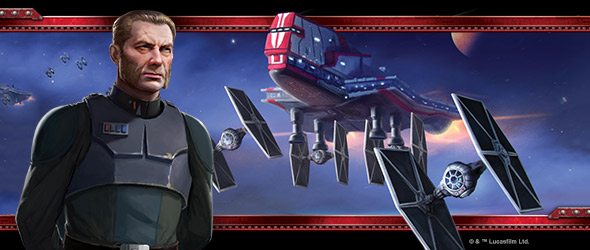
Gotta give him points for remembering Kirtan Loor, but Kallus can't be anywhere near one of the "most recognizable" examples.
One of the things I enjoy most about FFG's rpgs are its lack of miniatures. Coming from a D&D background I can say that the switch between "theater of the mind" roleplaying over to a fight represented by miniatures on a map is often jarring, requiring a bit of time to get back into the roleplaying mindset after each encounter. Even with narrative descriptions during a fight it can often seem like two different games. FFG has developed a great system capable of keeping everything within a narrative and in said "theater of the mind." By never breaking stride, players can more easily stay in character, even during space battles. It's an accomplishment, not something to change. Now I know some people are more visual, but trust me, through my experience having a jarring break in the narrative to incorporate miniatures doesn't help players get through that.
To each his own, but personally I've found miniature combat much more rewarding than abstract and/or 'theater of the mind' combat, from a variety of reasons. Why do you think miniature combat detracts from roleplaying ? It's still you making decisions for your character, so it's only up to you to stay in character in both situations.
Is it just me or does Kallus look like Liev Schreiber?
Played WEG D6 version in a variety of places a long time ago.
I like the open ended better and on occasion used micro machines as props to give spatial understanding but not for mechanics. Players using their imagination to take the group in strange twists is what made it fun for us. Total sandbox.
I could see using modified rules blending the dial/reveal aspect of x-wing with RPG space combat rules for attack/damage etc to make space combat more exciting.
To each his own, but personally I've found miniature combat much more rewarding than abstract and/or 'theater of the mind' combat, from a variety of reasons. Why do you think miniature combat detracts from roleplaying ? It's still you making decisions for your character, so it's only up to you to stay in character in both situations.One of the things I enjoy most about FFG's rpgs are its lack of miniatures. Coming from a D&D background I can say that the switch between "theater of the mind" roleplaying over to a fight represented by miniatures on a map is often jarring, requiring a bit of time to get back into the roleplaying mindset after each encounter. Even with narrative descriptions during a fight it can often seem like two different games. FFG has developed a great system capable of keeping everything within a narrative and in said "theater of the mind." By never breaking stride, players can more easily stay in character, even during space battles. It's an accomplishment, not something to change. Now I know some people are more visual, but trust me, through my experience having a jarring break in the narrative to incorporate miniatures doesn't help players get through that.
As a GM, it's also far more freeing to be able to give a detailed encounter of a location you expect a conflict to transpire in than to twist it to match a map. Even if it's you drawing the map on a dry erase grid it can still be outside of what the player's have seen in their head.
It also allows for you to have more freedom with matching your players' actions. Every GM has an idea of how an adventure will go, but we all know players will take it somewhere else. Personally, I love that about rpgs. But relying on miniatures and maps can limit where you end up taking things. I can't tell you how many times I've had players throw a curve at me and I've concocted a brilliant in game response but had to change it to some degree due to a lack of miniatures. My players aren't even aware that this happens, but it eats at me. And yeah, you can proxy some things and get away with it, but a lot of times that can take players out of the moment as well.
It all goes back to your idea that it's up to "you" (I'm assuming by this you mean a player) to stay in character, but that's not true. Everything at a gaming table is the product of everyone and everything present. It's as much the GM's responsibility to help keep players in character as it is for the players themselves. Keeping them focused on you and your words creating environments and situations in their heads to go off of inspires creativity on their part for using those things. Miniatures and maps limit those options. The mind can produce anything. Physical representations on a limited budget can't. It's not always that way, mind you. Some encounters are simple enough to where you can get by with whatever, but some... well some ideas would be limited by the use of miniatures and maps.
Here's an example: You're a force user for your group. You were sent on a mission to infiltrate a Star Destoyer which your group successfully did, but to escape your character needs to power down a tractor beam. Your group decided the best way to do that is for you to take a spacewalk and figure it out from outside, since the bridge and engineering departments would be heavily guarded. So you're outside the SD working on this and you look over to see an Inquisitor out there with you. You ignite your lightsaber (or other weapon) and begin a duel. Inside the SD, two members of your group have stolen TIE fighters to leave, and a third member is hyperspacing in with a previously stolen Gozanti cruiser to pick up you and the stolen TIEs. You have to get that tractor beam down or else your extraction method is done for. The Inquisitor knew of your presence so it's clearly a trap. More TIEs come in from behind a nearby asteroid to engage your fellow players in the pilfered TIEs and Gozanti. You go toe to toe with the Inqusitor in a zero-g environment allowing for amazing movements in every direction while a space battle rages all around you.
Think of how that scenario is limited if I need miniatures and maps for it. The third dimension allowed from a lack of gravity alone creates a ridiculous amount of space, and those individuals piloting spacecraft would be poorly represented in scale alongside your personal miniature, because you know that Inquisitor is going to best you and you'll need their help, so you can get that tractor beam down and be extracted to complete the mission.
This would require an insane amount of map space and miniatures if it were to be done with a system using miniatures. Without them, the limits are the imaginations of everyone at the table, which should be boundless. The systems put in place by FFG where even the dice provides narrative means you never have to break character or limit yourself or the players
Edited by Flavorabledeez
To each his own, but personally I've found miniature combat much more rewarding than abstract and/or 'theater of the mind' combat, from a variety of reasons. Why do you think miniature combat detracts from roleplaying ? It's still you making decisions for your character, so it's only up to you to stay in character in both situations.One of the things I enjoy most about FFG's rpgs are its lack of miniatures. Coming from a D&D background I can say that the switch between "theater of the mind" roleplaying over to a fight represented by miniatures on a map is often jarring, requiring a bit of time to get back into the roleplaying mindset after each encounter. Even with narrative descriptions during a fight it can often seem like two different games. FFG has developed a great system capable of keeping everything within a narrative and in said "theater of the mind." By never breaking stride, players can more easily stay in character, even during space battles. It's an accomplishment, not something to change. Now I know some people are more visual, but trust me, through my experience having a jarring break in the narrative to incorporate miniatures doesn't help players get through that.
As a GM, it's also far more freeing to be able to give a detailed encounter of a location you expect a conflict to transpire in than to twist it to match a map. Even if it's you drawing the map on a dry erase grid it can still be outside of what the player's have seen in their head.
Here's an example: You're a force user for your group. You were sent on a mission to infiltrate a Star Destoyer which your group successfully did, but to escape your character needs to power down a tractor beam. Your group decided the best way to do that is for you to take a spacewalk and figure it out from outside, since the bridge and engineering departments would be heavily guarded. So you're outside the SD working on this and you look over to see an Inquisitor out there with you. You ignite your lightsaber (or other weapon) and begin a duel. Inside the SD, two members of your group have stolen TIE fighters to leave, and a third member is hyperspacing in with a previously stolen Gozanti cruiser to pick up you and the stolen TIEs. You have to get that tractor beam down or else your extraction method is done for. The Inquisitor knew of your presence so it's clearly a trap. More TIEs come in from behind a nearby asteroid to engage your fellow players in the pilfered TIEs and Gozanti. You go toe to toe with the Inqusitor in a zero-g environment allowing for amazing movements in every direction while a space battle rages all around you.
Think of how that scenario is limited if I need miniatures and maps for it. The third dimension allowed from a lack of gravity alone creates a ridiculous amount of space, and those individuals piloting spacecraft would be poorly represented in scale alongside your personal miniature, because you know that Inquisitor is going to best you and you'll need their help, so you can get that tractor beam down and be extracted to complete the mission.
On the first point, hopefully every player has the exact same image in their head, or there could be trouble.
On the second point, unless players are willing to hang their figures from strings from the ceiling, I'm pretty sure no one would expect a map of that encounter/scenario. To choose the opposite extreme, no one needs to set up a map of two force-users fighting each other with lightsabers, either.
Edited by Darth MeanieWhat?! An article that wasn't specifically tailored to my interests!
FFG has truly jumped the shark.
This is due to personal experience, and every table/player group is different and should be treated accordingly by a GM. But I know from my own experience as a GM it's easier to keep players focused and in character if you don't have to break for an encounter set up or go from how you envisioned an environment to how a map portrays it.
To each his own, but personally I've found miniature combat much more rewarding than abstract and/or 'theater of the mind' combat, from a variety of reasons. Why do you think miniature combat detracts from roleplaying ? It's still you making decisions for your character, so it's only up to you to stay in character in both situations.One of the things I enjoy most about FFG's rpgs are its lack of miniatures. Coming from a D&D background I can say that the switch between "theater of the mind" roleplaying over to a fight represented by miniatures on a map is often jarring, requiring a bit of time to get back into the roleplaying mindset after each encounter. Even with narrative descriptions during a fight it can often seem like two different games. FFG has developed a great system capable of keeping everything within a narrative and in said "theater of the mind." By never breaking stride, players can more easily stay in character, even during space battles. It's an accomplishment, not something to change. Now I know some people are more visual, but trust me, through my experience having a jarring break in the narrative to incorporate miniatures doesn't help players get through that.
As a GM, it's also far more freeing to be able to give a detailed encounter of a location you expect a conflict to transpire in than to twist it to match a map. Even if it's you drawing the map on a dry erase grid it can still be outside of what the player's have seen in their head.
It also allows for you to have more freedom with matching your players' actions. Every GM has an idea of how an adventure will go, but we all know players will take it somewhere else. Personally, I love that about rpgs. But relying on miniatures and maps can limit where you end up taking things. I can't tell you how many times I've had players throw a curve at me and I've concocted a brilliant in game response but had to change it to some degree due to a lack of miniatures. My players aren't even aware that this happens, but it eats at me. And yeah, you can proxy some things and get away with it, but a lot of times that can take players out of the moment as well.
A picture is worth a thousand words. While you may feel miniature combat limits you in certain fields, it also has the advantage that it's clear. You put down the map, the miniatures and what's there is there. Everyone operates with the same data. I find it takes a lot of time to create a clear enough picture in theater of the mind and it's still open to interpretations and misunderstandings.
Ugh. This again. This author's articles really miss the point of the rpgs. Everything he throws out there simply limits the scope and imagination.
...
The point of RPGs is to tell awesome stories with your friends and have fun. Nothing in this article contradicts that. Just because the author is presenting an idea that you don't like, that doesn't make it bad / wrong / limiting. Other people are allowed to have different things they like (or don't) about a game, a setting, and how they want to play with/in them.
Your way of doing things isn't superior or more imaginative or less limiting than any other - It's just different.
Is it just me or does Kallus look like Liev Schreiber?
He always reminded me of Alec Baldwin.