The Cornwallian Campaign

By LTD, in Star Wars: Armada

The Cornwallian Campaign

The Emperor Palpatine has dissolved the Imperial Senate, handing direct control to the Regional Governors. This shocking news is followed by the terrifying information that Alderaan has been destroyed. As an act of revenge the Rebel Alliance (striking from hidden base) destroy the Death Star. In response to this provocation, insult, and defeat, many systems have resolved to reject the Imperial Rule and have acted decisively to join the Rebel Alliance.

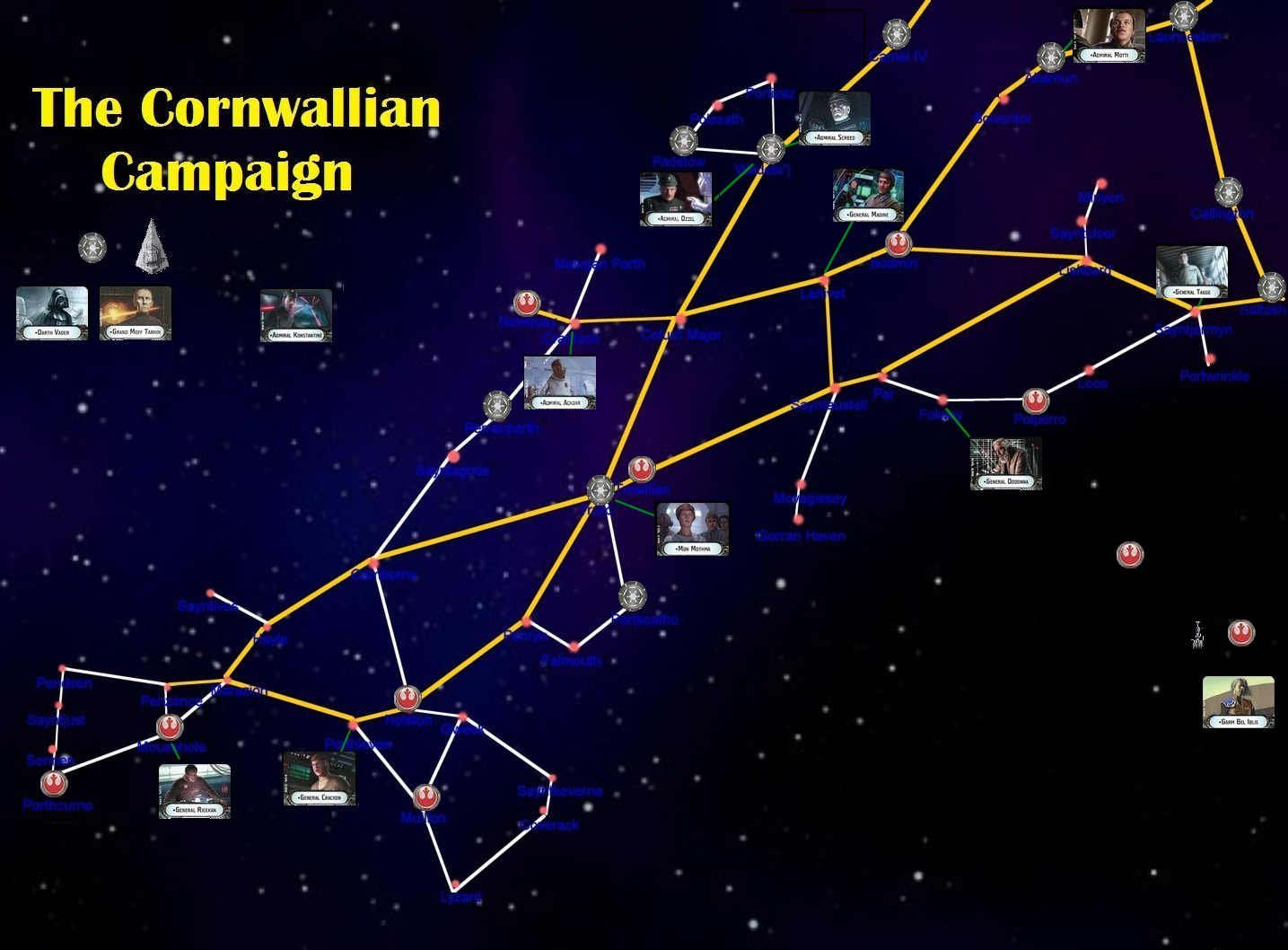
Cornwallia is such a cluster of star systems – rebellions have broken out over a dozen worlds, and the small Imperial Garrisons have been overrun or besieged. Governor Moff Barracu has been trapped with his small fleet in the regional capital system of Truro. Rebel forces are gathering strength throughout the cluster, building ships and recruiting crews.

An Imperial Taskforce has been dispatched to restore order and crush the incipient rebellion…

E1cQIr7.png

Fleets / Forces

A Fleet consists of a Commander with a variety of units (ships and squadrons) assigned to their control. Fleets may perform actions.

Units with no Commander present in a system are called a “force”. A force may make no actions, but will defend itself if attacked.

Only one unique title or character is allowed per fleet / force. In the event that two fleets combine in a system, only one of the unique titles or characters will be retained – the other will revert to standard.

For Example: Admiral Screed has a fleet with Demolisher. Admiral Tarkin also has a Demolisher in his fleet. If the two fleets were to enter the same system, only one ship would remain as Demolisher – the other would revert to an untitled Gladiator, and remain as such for the rest of the game.

Fleets and Forces may NOT have more squadrons than the total number of the Squadron value of the fleet allows (counting Expanded Hangar Bays). If there are more squadrons present than can be accommodated, the excess squadrons are removed.

For Example: A fleet that has three Assault Frigate IIB’s may have up to nine squadrons present. A fleet with a Gozanti Cruiser with Expanded Hangar Bays may have up to three squadrons present.

Commanders

Commanders must be assigned to a ship. No two Commanders can be assigned to the same ship. If there are two Commanders in the same system, they cannot both take the same action.

Only one Commander of each type may be present on the Campaign map at a time. Commanders may be recruited like any other unit or upgrade, including Commanders previously destroyed in battle.

Each Commander may make one action per Campaign Turn.

Actions

​There are four actions available to each Commander per Campaign Turn.

  • Move

Fleets with a commander present may attempt to move to an adjacent, connected system.

  1. Systems connected with a yellow line have well established “Hyper-Routes” – the movement succeeds automatically.
  2. Systems connected with a white line have less established “Hyper-Routes” – the movement succeeds on the roll of a blue-die. Imperial forces may move on the roll of a hit, Rebel forces may move on the roll of a hit or crit.
  3. Fleets may attempt to move to any non-adjacent system by making a “long jump.” A long jump succeeds on the double-hit roll of a red die.

Fleets that enter a system with an opposing force present will fight a battle.

  • Recruit / Build

Commanders may attempt to call local forces to their assistance. For each adjacent Politically Controlled system, roll a blue die. On a hit, gain 25pts of units. On a crit, gain 50 points of units. On an accuracy, no units are gained. Total the results of all die rolls, and add unit(s) to the value or less of the total to the fleet of the commander.

Commanders may not attempt to Recruit in the same system twice in succession.

  • Prepare Defences

Commanders may construct and arm local Space Stations as fixed defences. Up to THREE Armed Space Stations can be constructed in any system. Armed Space Stations have a hull value of 12, Command 1, Squadron 4, and Engineering of 3. They are armed with 4 red and 2 black die, and have an anti-squadron value of 1 blue. Armed Space Stations may fire all of their weaponry at 1 ship target, or divide the dice between as many ships as desired. Armed Space Stations may not fire at Ships and Squadrons in the same turn. All LOS is traced from the centre of the station – the station has a single fire arc of 360 degrees. Armed Space Stations have THREE brace defence tokens. They may not have any upgrades.

  • Assert Political Control

Commanders in a system may attempt to influence the local planets to support their faction. Systems are either Rebel, Imperial, or Neutral. Political Control is useful for Recruiting new vessels, and for bases of supply and retreat.

Roll a blue die – on the result of a hit, the System changes Political ties by one position – Opponent control systems become neutral, neutral systems become controlled by your faction. On the result of a crit, roll another blue die – if it comes up as a crit again, the system moves in the opposite direction – neutral systems become controlled by the opponent. Opponent controlled systems remain the same.

Battle

When two opposing forces are in the same system, battle results.
The force defending the system is the second player, and chooses a mission for each colour type. The force entering the system is the first player, and chooses blue, red, or yellow mission sight unseen.

If both forces entered the system in the same Campaign Turn, the force with the smaller number of points present has the initiative choice to be first or second player.

  • Units that are destroyed in battle are removed from the game – unique titles and characters may be recruited again.
  • Units that are at less than half hull strength or fly off the board are out of the game for one Campaign Turn – if their fleet is attacked again in the following Campaign Turn, these units may not appear in the battle.
  • If a Commanders ship is not available due to damage or flying off the board, the Commander may relocate to another unit if available.

At the conclusion of the battle, the victory points are tallied, and the losing player has a choice:

  • If the battle was lost by 2 or less tournament points (ie, 6/5 or 7/4), the player may elect to remain in the system with all remaining units in order to make an action again the following Campaign Turn. If they do not, the player may elect to retreat.
  • If the player lost by 3 or more tournament points they must retreat. All remaining units are immediately moved to an adjacent system which is either Politically Friendly or Neutral, and where there are no opposing forces present. If there are no such systems available, all the remaining units are considered destroyed.

Setup

The Imperial Forces begin with Political Control and 200 points of units in Truro.

They also have Political Control of Camel IV, Launceston, Callington, and Saltash, with 2000 points of units divided between forces and fleets in these systems as desired.

The remaining systems are randomly divided – for each system, roll a red die. On a Hit, the system is Politically Controlled by the Rebels. On a double hit, it is Politically Controlled by the Imperials.

The Rebels begin with 1000 points of units divided between any Rebel Politically Controlled systems in the remainder of the cluster.

Victory

After twelve Campaign Turns, each system on a yellow Hyper-Route is counted – if one side has Political Control over at least ten systems, and at least five more than the opposing faction, they are considered to have won the game.

If neither side fulfils that condition, the game continues for another six turns, and so on, until one side fulfils the victory conditions.

These are my Campagin thoughts for Armada - it could be played multi-player using Vassal or face to face at a club level.

Thoughts, comments, suggestions, enthusiastic volunteers?

Looks cool! Very clear victory conditions.

The random movement rules are a little worrisome. Maybe you could spend banked points to either ensure a successful jump or allow a reroll of the movement die?

Awesome! Count me as an enthusiastic volunteer!

Good to have an enthusiastic volunteer!

Any other takers?

Preference for Rebel or Imperial?

Any other comments?

Volunteers for a beta test?

I had a similar idea for a campaign when Armada first came out. I wanted to do a Plan/activate system (like in X-Wing and Armada) with the command dials.

Each fleet has a dial they plan with at the start of a round. After planning, each side take turns activating a fleet by revealing and executing the command.

- Nav: Move fleet to an adjacent planet/area

- Eng.: Repair ships

- Squadron: Replenish/build fighters

- Fire: Attack enemy system or attempt control of neutral system

Sadly, didn't too far into the concept but hopefully this gives you an idea or two.

Very, very nice campaing idea. The Cornwall touch is a bit strange... (even when Cornwall is absolutly lovely, just were there in our holiday).

Will it be followed by the Devonshire disaster and Somerset subjugation

I like the dial idea. Thank you.

I've never been to Cornwall myself - but it seemed easier than inventing a whole bunch of names...

I'm wondering what the idea behind the unreliable fleet travel is. Could you elaborate?

I don't recall any time in the movies when an Imperial fleet attempted to travel somewhere and failed - even an out-of-the-way place like Hoth or Endor.

Edited by Democratus

I'd be game to try something like this but am slammed for the next couple of weeks. I like the dials idea as well or some method of issuing commands for all of your fleets for that turn.

I'm wondering what the idea behind the unreliable fleet travel is. Could you elaborate?

I don't recall any time in the movies when an Imperial fleet attempted to travel somewhere and failed - even an out-of-the-way place like Hoth or Endor.

Maybe he based it on actually driving in Cornwall, especially during the summer :)

Edited by Aresxero

I'm wondering what the idea behind the unreliable fleet travel is. Could you elaborate?

I don't recall any time in the movies when an Imperial fleet attempted to travel somewhere and failed - even an out-of-the-way place like Hoth or Endor.

Maybe he based it on actually driving in Cornwall, especially during the summer :)

Never been there. The yellow lines are A roads, the White aren't, I think.

It's meant to give an assymetrical feel - some systems are more boondockish. Maybe it took some time for the imperials to get to Hoth - that but just isn't shown in the movies. How long was Luke upside down in the cave, or kissing his sister in sick bay? We just don't know...

The random movement rules are a little worrisome. Maybe you could spend banked points to either ensure a successful jump or allow a reroll of the movement die?

On reflection I'm starting to agree with this - perhaps I should remove this rule altogether - just make the white lines the less important hyper-routes, so they don't count for victory conditions.

Or perhaps there might be a fleet size limit for travelling on these lines... food for thought, anyway.

Any other thoughts, or volunteers to participate?

How about ruling that logistics are more difficult along minor routes?

For example, ships that are reduced below half hull are out of the game for one campaign turn - two turns if the battle takes place in a system with only white hyperspace lanes.

A Great Idea!

Let me stew on that for a while...

The Cornwallian Campaign

v.1.01

The Emperor Palpatine has dissolved the Imperial Senate, handing direct control to the Regional Governors. This shocking news is followed by the terrifying information that Alderaan has been destroyed. As an act of revenge the Rebel Alliance (striking from hidden base) destroy the Death Star. In response to this provocation, insult, and defeat, many systems have resolved to reject the Imperial Rule and have acted decisively to join the Rebel Alliance.

Cornwallia is such a cluster of star systems – rebellions have broken out over a dozen worlds, and the small Imperial Garrisons have been overrun or besieged. Governor Moff Barracu has been trapped with his small fleet in the regional capital system of Truro. Rebel forces are gathering strength throughout the cluster, building ships and recruiting crews.

An Imperial Taskforce has been dispatched to restore order and crush the incipient rebellion…

UXiGLIz.png

Fleets / Forces

A Fleet consists of a Commander with a variety of units (ships and squadrons) assigned to their control. Fleets may perform actions.

Units with no Commander present in a system are called a “force”. A force may make no actions, but will defend itself if attacked.

Only one unique title or character is allowed per fleet / force. In the event that two fleets combine in a system, only one of the unique titles or characters will be retained – the other will revert to standard.

For Example: Admiral Screed has a fleet with Demolisher. Admiral Tarkin also has a Demolisher in his fleet. If the two fleets were to enter the same system, only one ship would remain as Demolisher – the other would revert to an untitled Gladiator, and remain as such for the rest of the game.

Fleets and Forces may NOT have more squadrons than the total number of the Squadron value of the fleet allows (counting Expanded Hangar Bays). If there are more squadrons present than can be accommodated, the excess squadrons are removed.

For Example: A fleet that has three Assault Frigate IIB’s may have up to nine squadrons present. A fleet with a Gozanti Cruiser with Expanded Hangar Bays may have up to three squadrons present.

Commanders

Commanders must be assigned to a ship. No two Commanders can be assigned to the same ship. If there are two Commanders in the same system, they cannot both take the same action. If there is more than one Commander in a system during a battle, the player may choose which Commander’s effect is in play for the battle.

Only one Commander of each type may be present on the Campaign map at a time. Commanders may be recruited like any other unit or upgrade, including Commanders previously destroyed in battle.

Each Commander may make one action per Campaign Turn.

Actions

· Move

Fleets with a commander present may attempt to move to an adjacent, connected system.

i. Systems connected with a line have well established “Hyper-Routes” – the movement succeeds automatically.

ii. Fleets may attempt to move to any non-adjacent system by making a “long jump.” A long jump succeeds on the double-hit roll of a red die.

Fleets that enter a system with an opposing force present will fight a battle.

· Recruit / Build

Commanders may attempt to call local forces to their assistance. For each adjacent Politically Controlled system (including the one the Commander is in), roll a blue die. On a hit, gain 25pts of units. On a crit, gain 50 points of units. On an accuracy, no units are gained. Total the results of all die rolls, and add unit(s) to the value or less of the total to the fleet of the commander.

Commanders may not attempt to Recruit in the same system twice in succession.

· Prepare Defences

Commanders may construct and arm local Space Stations as fixed defences. Up to THREE Armed Space Stations can be constructed in any system. Armed Space Stations have a hull value of 12, Command 1, Squadron 4, and Engineering of 3. They are armed with 4 red and 2 black die, and have an anti-squadron value of 1 blue. Armed Space Stations may fire all of their weaponry at 1 ship target, or divide the dice between as many ships as desired. Armed Space Stations may not fire at Ships and Squadrons in the same turn. All LOS is traced from the centre of the station – the station has a single fire arc of 360 degrees. Armed Space Stations have THREE brace defence tokens. They may not have any upgrades. Damaged Armed Space Stations automatically repair all hull points between Campaign Turns. Armed Space Stations that are destroyed in battle are removed from the Campaign map.

· Assert Political Control

Commanders in a system may attempt to influence the local planets to support their faction. Systems are either Rebel, Imperial, or Neutral. Political Control is useful for Recruiting new vessels, and for bases of supply and retreat.

Roll a blue die – on the result of a hit, the System changes Political ties by one position – Opponent controlled systems become neutral, neutral systems become controlled by your faction. On the result of a crit, roll another blue die – if it comes up as a crit again, the system moves in the opposite direction – neutral systems become controlled by the opponent. Opponent controlled systems remain the same.

Battle

When two opposing forces are in the same system, battle results.
The force defending the system is the second player, and chooses a mission for each colour type. The force entering the system is the first player, and chooses blue, red, or yellow mission sight unseen.

If both forces entered the system in the same Campaign Turn, the force with the smaller number of points present has the initiative choice to be first or second player.

· Units that are destroyed in battle are removed from the game – unique titles and characters may be recruited again.

· Units that are at less than half hull strength or fly off the board are out of the game for one Campaign Turn – if their fleet is attacked again in the following Campaign Turn, these units may not appear in the battle.

· If the battle occurs in a system on a minor hyper-route (white line) only, then ships lost to damage or flying off the board will be missing for two Campaign Turns.

· If a Commanders ship is not available due to damage or flying off the board, the Commander may relocate to another unit if available.

At the conclusion of the battle, the victory points are tallied, and the losing player has a choice:

· If the battle was lost by 2 or less tournament points (ie, 6/5 or 7/4), the player may elect to remain in the system with all remaining units in order to make an action again the following Campaign Turn. If they do not, the player may elect to retreat.

· If the player lost by 3 or more tournament points they must retreat. All remaining units are immediately moved to an adjacent system which is either Politically Friendly or Neutral, and where there are no opposing forces present. If there are no such systems available, all the remaining units are considered destroyed.

Setup

The Imperial Forces begin with Political Control and 200 points of units in Truro.

They also have Political Control of Camel IV, Launceston, Callington, and Saltash, with 2000 points of units divided between forces and fleets in these systems as desired.

The remaining systems are randomly divided – for each system, roll a red die. On a Hit, the system is Rebel Politically Controlled. On a double hit, it is Imperial Politically Controlled.

The Rebels begin with 1000 points of units divided between any Rebel Politically Controlled systems in the remainder of the cluster.

Victory

After twelve Campaign Turns, each system on a yellow Hyper-Route is counted – if one side has Political Control over at least ten systems, and at least five more than the opposing faction, they are considered to have won the game.

If neither side fulfils that condition, the game continues for another six turns, and so on, until one side fulfils the victory conditions.
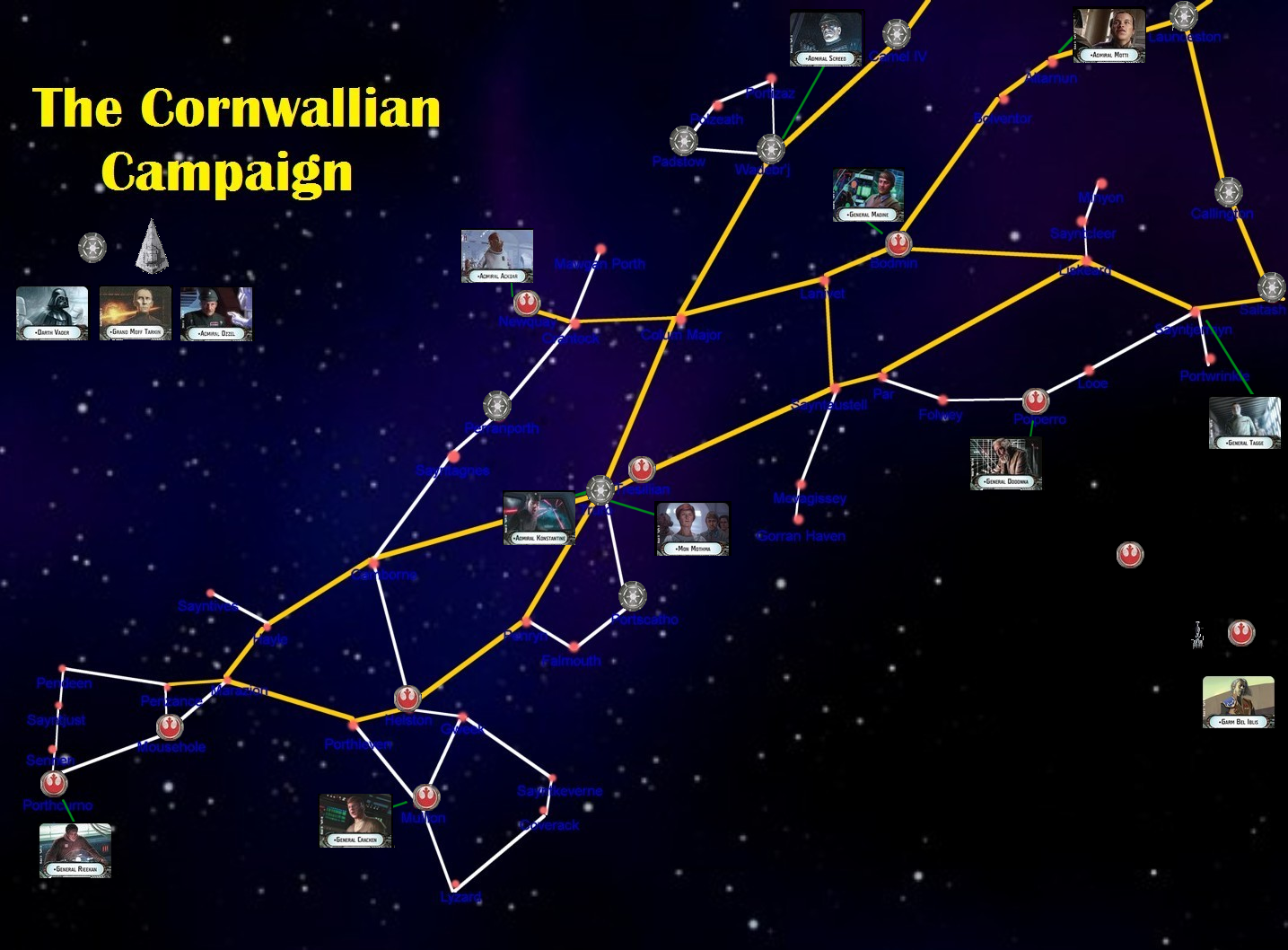
Some changes to some rules, and an example of what the map might look like...

Matt Antilles has agreed to play as the Rebel commander, and I'm running the Imperials - I'm not an Imperial player, so my lists and Admiralship may not reflect well upon his Imperial Majesty.

If there is an Imperial player out there who would like to help (at least to design fleets, maybe to fight them via Vassal) then that would be much appreciated.

This is the map in the gap between turns 1 and 2 - we have a battle pending in Truro, where Mon Mothma is attacking the Imperial Garrison over the Sector's Capital.

LTD%2Bvs%2BMatt%2B02.png

Final version of the rules looks very engaging!

I'm looking forward to seeing how this plays out.

Sadly, my experience with Armada is too low to claim any insight or expertise. So I will lurk and enjoy.

Do systems just all have 3 armed stations, or is there a cost to construct them?

Do systems just all have 3 armed stations, or is there a cost to construct them?

They have to be constructed.

All systems have an unarmed station (normal terrain).

Admiral Konstantine Defeated in Truro!

Mon Mothma Victorious!

Sources close to the Imperial Ministry of Defence have reported that Admiral Konstantine's fleet guarding the Sector Capital of Truro has been defeated. "There were no survivors" one senior aide commented. "Konstantine was outnumbered and outmaneuvered..."

Turn 3 is underway...

LTD%2Bvs%2BMatt%2B03.png

Anything new?

I'm working on my own campaign rules and have stolen much from this. :)

How's it working out?