Has anyone made rules for using a grid or battlemap with EOTE?
Thanks,
Eric
Has anyone made rules for using a grid or battlemap with EOTE?
Thanks,
Eric
There are quite a few threads bumping around on this and other boards regarding using minis and/or a grid with the FFG rules. A lot of people who gamed with D&D or another gridded system want a grid, a lot who come from other "theater of the mind" style games don't, and wargamers seem kind of split (or ambivalent). This system is definitely not a combat simulator - encounters are meant to be fast-paced and fluid, with Boost and Setback dice assigned on the fly as conditions change.
With that in mind, I think a battlemat will help you & your players visualize more complex combat encounters - those with a lot of moving pieces, or those where cover and lanes of fire will be particularly important. For a simple hallway battle with a few stormtroopers, you needn't bother. You'll notice that the range bands for weapons & movement are somewhat vague and arbitrary, with a degree of overlap. This is intentional, but it means that using grid will be frustrating, as the "scale" of each encounter will change. An encounter on an open plain will have large range bands as visibility is very good. The same encounter in a dense fog will have narrow range bands because you can't see worth a ****.
If you have a gridded mat, you can still use it to align your terrain and help you plan things out, but you shouldn't pay too much attention to the grid once the encounter starts. Best of luck!
I switch it up. Sometimes I use maps and minis, sometimes I don't.
When I do use maps and minis, I find that I don't translate squares to a range band and just eye ball it instead. I find this slows things down or otherwise throws my group into a more tactical (3.5/4e) mind which is not the kind of game I like to play when I run Star Wars.
Based on the other threads SFC Snuffy mentioned, my style of play would not work well with some of those groups. There's more than a few posters here who need the "X Squares = Y range band" translation for their table.
Edited by kaosoeUsing miniatures and drawing/placing objects is fine. But, I wouldn't use a mat with an actual grid upon it. Give the system as intended a try before imposing something intended for a different system. They don't mesh well together in my opinion.
I switch it up. Sometimes I use maps and minis, sometimes I don't.
When I do use maps and minis, I find that if I don't translate squares to a range band and just eye ball it instead. I find this slows things down or otherwise throws my group into a more tactical (3.5/4e) mind which is not the kind of game I like to play when I run Star Wars.
Based on the other threads SFC Snuffy mentioned, my style of play would not work well with some of those groups. There's more than a few posters here who need the "X Squares = Y range band" translation for their table.
You nailed it, we will need the "X Squares = Y Range Band" before we even think about playing this game. I was wondering if anyone had done this (along with how far a character can move in a round) and had good success.
I can see not using the tabletop a total cluster. "OK, stormtroopers come at you from the left and the right." "Alright, Han and I run to the ones on the right while Chewie and Poe attack the ones on the left" 3 rounds later "Wait, who is near who? What, where is everyone?"
Not to mention the Blast quality. AOE weapons instantly become awful to use, cause the only people you would ever catch with the blast are enemies of your target, which are you know, your friends!
Our group is not going to deal with that. We need the grid.
Edited by erc1971No, you do not NEED a grid. You WANT a grid, because that is what you are used to. Gaming survived from 1970 to 2000 (when dnd 3.0 came out) without having a strict grid.
Do you need the actual grid, or just a basic visual to keep track of who's where and just ballpark the ranges? I've found the latter to be far more effective, and avoids most problems of having to come up with maps that are super close to scale. At our last session, my group found themselves in a hunting ground, and yes, there was a map to give them an idea of where they were (and, at times, where the other hunting groups and creatures were), but it wasn't to scale at all. In fact, the entire group (with exception of times one or two characters scouted ahead) was just represented by an extra Destiny token.
From personally trying to finagle a translation into grids, it's not defining how many spaces equals what range is the problem, it's incorporating the movement rules. You'll have to figure out a workable system for that.
I had something, but I don't remember and I'm away from my things at the moment.
No, you do not NEED a grid. You WANT a grid, because that is what you are used to. Gaming survived from 1970 to 2000 (when dnd 3.0 came out) without having a strict grid.
You haven't played with my group - yeah, we need a grid  Without a clear layout people will keep asking where people are over and over, say how that guy all of sudden doing "X" is cheap, etc.
Besides, I have been using them since the 80's - the old versions of D&D listed ranges and movement for everything, so we used them since forever. I like the strategic element, and so do my players.
I will probably go with the ranges being base to base, 12, 24, 48, and 96 - since my table is 71" by 59" across, this will cover the entire battlemap. Characters can move 6" per maneuver. These are similar number to what you see in Savage Worlds, so they should work fine.
No, you do not NEED a grid. You WANT a grid, because that is what you are used to. Gaming survived from 1970 to 2000 (when dnd 3.0 came out) without having a strict grid.
You haven't played with my group - yeah, we need a grid
Besides, I have been using them since the 80's - the old versions of D&D listed ranges and movement for everything, so we used them since forever. I like the strategic element, and so do my players.
I will probably go with the ranges being base to base, 12, 24, 48, and 96 - since my table is 71" by 59" across, this will cover the entire battlemap. Characters can move 6" per maneuver. These are similar number to what you see in Savage Worlds, so they should work fine.
Yeah, I find 12 a good number to work with I think, not only does the core rules say short range is "about a dozen meters" but it's easily divisible for different scales (2, 3, 4, and 6). I haven't had the need to use it enough to say whether it actually works or not with the system, but I've had my players question movement and position enough to warrant looking into and considering options. My players might not come out and say "cheap" but they have raised eyebrows at certain things to justify needing to know just where people are, the game seems to have 'issues' with regard to movement in relation to more than one thing (it kinda assumes the players are all moving as one group, which with mine is rarely the case).
You nailed it, we will need the "X Squares = Y Range Band" before we even think about playing this game. I was wondering if anyone had done this (along with how far a character can move in a round) and had good success.
I can see not using the tabletop a total cluster. "OK, stormtroopers come at you from the left and the right." "Alright, Han and I run to the ones on the right while Chewie and Poe attack the ones on the left" 3 rounds later "Wait, who is near who? What, where is everyone?"
Not to mention the Blast quality. AOE weapons instantly become awful to use, cause the only people you would ever catch with the blast are enemies of your target, which are you know, your friends!
Our group is not going to deal with that. We need the grid.
You can try this, but you'll end up with the usual translation errors that others have had. They are usually based around 2 points: 1) The Range bands aren't clearly defined, and in some cases aren't even actual ranges or bands. (Engaged is really more a condition than a distance) and 2) Talents are written to work within the banding system, start tweaking that and you'll end up with issues rippling through to other areas.
It sounds like perhaps part of your problem may be that you just haven't gotten into the rules groove yet and figured out how the bandings really work in play. Your claim that Blast will only hit allies for example isn't really true, as things like minion groups will usually be clustered into engaged range of each other, likewise squads, and there's talents that require certain adversaries to be engaged to other adversaries to work, making blast weapons pretty devastating to them. Likewise things like the Demolitionist tree has talents that specifically let you ignore characters caught in the blast.
I mean there's lots of methods for using maps and other visuals to maintain a relative distance coherence so you don't lose track of who is how far from who, but when you start talking "Short is this many squares, you can only move that many squares per turn" the system is going to start generating artifacts. Have you looked into any of those other options?
No, you do not NEED a grid. You WANT a grid, because that is what you are used to. Gaming survived from 1970 to 2000 (when dnd 3.0 came out) without having a strict grid.
You haven't played with my group - yeah, we need a grid
Besides, I have been using them since the 80's - the old versions of D&D listed ranges and movement for everything, so we used them since forever. I like the strategic element, and so do my players.
I will probably go with the ranges being base to base, 12, 24, 48, and 96 - since my table is 71" by 59" across, this will cover the entire battlemap. Characters can move 6" per maneuver. These are similar number to what you see in Savage Worlds, so they should work fine.
Yeah, I find 12 a good number to work with I think, not only does the core rules say short range is "about a dozen meters" but it's easily divisible for different scales (2, 3, 4, and 6). I haven't had the need to use it enough to say whether it actually works or not with the system, but I've had my players question movement and position enough to warrant looking into and considering options. My players might not come out and say "cheap" but they have raised eyebrows at certain things to justify needing to know just where people are, the game seems to have 'issues' with regard to movement in relation to more than one thing (it kinda assumes the players are all moving as one group, which with mine is rarely the case).
I agree. If an encounter is ran involving the PC's, 50 stormtroopers, 10 rebels, and is supposed to result in the PC's making a fighting retreat cause they are outnumbered - everyone is going to need to know where everyone is. Characters out in the open are going to be swiss cheesed, so making use of cover to limit who can shoot at them, etc is going to be important.
And, let's say Darth Vader shows up. I can guaran-****-tee you every single one of my players is going to want to know exactly where the F he is and where there they are.
No, you do not NEED a grid. You WANT a grid, because that is what you are used to. Gaming survived from 1970 to 2000 (when dnd 3.0 came out) without having a strict grid.
You haven't played with my group - yeah, we need a grid
Besides, I have been using them since the 80's - the old versions of D&D listed ranges and movement for everything, so we used them since forever. I like the strategic element, and so do my players.
I will probably go with the ranges being base to base, 12, 24, 48, and 96 - since my table is 71" by 59" across, this will cover the entire battlemap. Characters can move 6" per maneuver. These are similar number to what you see in Savage Worlds, so they should work fine.
Yeah, I find 12 a good number to work with I think, not only does the core rules say short range is "about a dozen meters" but it's easily divisible for different scales (2, 3, 4, and 6). I haven't had the need to use it enough to say whether it actually works or not with the system, but I've had my players question movement and position enough to warrant looking into and considering options. My players might not come out and say "cheap" but they have raised eyebrows at certain things to justify needing to know just where people are, the game seems to have 'issues' with regard to movement in relation to more than one thing (it kinda assumes the players are all moving as one group, which with mine is rarely the case).
I agree. If an encounter is ran involving the PC's, 50 stormtroopers, 10 rebels, and is supposed to result in the PC's making a fighting retreat cause they are outnumbered - everyone is going to need to know where everyone is. Characters out in the open are going to be swiss cheesed, so making use of cover to limit who can shoot at them, etc is going to be important.
And, let's say Darth Vader shows up. I can guaran-****-tee you every single one of my players is going to want to know exactly where the F he is and where there they are.
Yep, though it's the movement rather than the positions I find to cause the most issue. As I said, the game seems to think the PCs are all going to be moving together, once they split up things can get messy. One maneuver allows you to move from short to medium for instance, but in relation to who? I've had a couple of situations where that has led to 'interesting' movement and discussions.
Yep, though it's the movement rather than the positions I find to cause the most issue. As I said, the game seems to think the PCs are all going to be moving together, once they split up things can get messy. One maneuver allows you to move from short to medium for instance, but in relation to who? I've had a couple of situations where that has led to 'interesting' movement and discussions.Yeah, I find 12 a good number to work with I think, not only does the core rules say short range is "about a dozen meters" but it's easily divisible for different scales (2, 3, 4, and 6). I haven't had the need to use it enough to say whether it actually works or not with the system, but I've had my players question movement and position enough to warrant looking into and considering options. My players might not come out and say "cheap" but they have raised eyebrows at certain things to justify needing to know just where people are, the game seems to have 'issues' with regard to movement in relation to more than one thing (it kinda assumes the players are all moving as one group, which with mine is rarely the case).No, you do not NEED a grid. You WANT a grid, because that is what you are used to. Gaming survived from 1970 to 2000 (when dnd 3.0 came out) without having a strict grid.
You haven't played with my group - yeah, we need a grid
Besides, I have been using them since the 80's - the old versions of D&D listed ranges and movement for everything, so we used them since forever. I like the strategic element, and so do my players.
I will probably go with the ranges being base to base, 12, 24, 48, and 96 - since my table is 71" by 59" across, this will cover the entire battlemap. Characters can move 6" per maneuver. These are similar number to what you see in Savage Worlds, so they should work fine.
I agree. If an encounter is ran involving the PC's, 50 stormtroopers, 10 rebels, and is supposed to result in the PC's making a fighting retreat cause they are outnumbered - everyone is going to need to know where everyone is. Characters out in the open are going to be swiss cheesed, so making use of cover to limit who can shoot at them, etc is going to be important.
And, let's say Darth Vader shows up. I can guaran-****-tee you every single one of my players is going to want to know exactly where the F he is and where there they are.
Malcolm Reynolds: "Define 'interesting.'"
Hoban "Wash" Washburne: "Oh god, oh god, we're all gonna die?"
Yep, though it's the movement rather than the positions I find to cause the most issue. As I said, the game seems to think the PCs are all going to be moving together, once they split up things can get messy. One maneuver allows you to move from short to medium for instance, but in relation to who? I've had a couple of situations where that has led to 'interesting' movement and discussions.
Yeah, I find 12 a good number to work with I think, not only does the core rules say short range is "about a dozen meters" but it's easily divisible for different scales (2, 3, 4, and 6). I haven't had the need to use it enough to say whether it actually works or not with the system, but I've had my players question movement and position enough to warrant looking into and considering options. My players might not come out and say "cheap" but they have raised eyebrows at certain things to justify needing to know just where people are, the game seems to have 'issues' with regard to movement in relation to more than one thing (it kinda assumes the players are all moving as one group, which with mine is rarely the case).
No, you do not NEED a grid. You WANT a grid, because that is what you are used to. Gaming survived from 1970 to 2000 (when dnd 3.0 came out) without having a strict grid.
You haven't played with my group - yeah, we need a grid
Besides, I have been using them since the 80's - the old versions of D&D listed ranges and movement for everything, so we used them since forever. I like the strategic element, and so do my players.
I will probably go with the ranges being base to base, 12, 24, 48, and 96 - since my table is 71" by 59" across, this will cover the entire battlemap. Characters can move 6" per maneuver. These are similar number to what you see in Savage Worlds, so they should work fine.
I agree. If an encounter is ran involving the PC's, 50 stormtroopers, 10 rebels, and is supposed to result in the PC's making a fighting retreat cause they are outnumbered - everyone is going to need to know where everyone is. Characters out in the open are going to be swiss cheesed, so making use of cover to limit who can shoot at them, etc is going to be important.
And, let's say Darth Vader shows up. I can guaran-****-tee you every single one of my players is going to want to know exactly where the F he is and where there they are.
Malcolm Reynolds: "Define 'interesting.'"
Hoban "Wash" Washburne: "Oh god, oh god, we're all gonna die?"
In at least a couple of cases the NPCs did all die. 
IMO, this game is not well-served when you try to force it into a grid system.
And neither the players nor the GM are well-served by taking a game system that was specifically designed to NOT use a grid and try to force it into that situation.
I believe that the general recommendation of most of the people on this board has been to try to play the game as-written, at least for the first few games.
After that, if you still can’t get over certain problems you’re having with the game, then there might be some simple house rules we can help you with, or maybe this just isn’t the right game for you.
I disagree here. I ran Rescue at Glare Peak, and when the players heard Vader was coming, they didn't care where he was (exactly). They just wanted to know how to get away. Which was funny, because that adventure didn't stat out Vader, it just stated that if Vader catches them, he kills them. But my players had no idea that was how it ran. They just assumed that the stats would have them obliterated.
Everyone, please note that using battlemat (with grid) or map with grid is different than using a gridless map about area where combat is happening. Gridless map may offer many good aspects of battlemat, after all all beginner games come with maps. Using grid is not directly compatible with FFG SW. Though, last time we played, I used a battlemat in one encounter to which I didn't have a map. I draw a rought map to battlemat, and we used it as gridless map (i.e. squares were meaningless). Because we mostly used battlemat on Pathfinder, I noticed certain slight change on player mentality, but luckily it was only small. No one ever counted the squares to get a distance.  Personally I really like when there is a map so everyone can see their rough position (with about accuracy of which room they are in).
Personally I say that forget grid and all which position PCs and NPCs precisely to map. You encounter less problems with that way. When you have larger combat or other action where you or players need to know their position, try to embrace FFG SW style and use gridless maps. Or make your house rules, you don't have to listen me. This is not the truth, just my thoughts.
Also you can do something more like this:
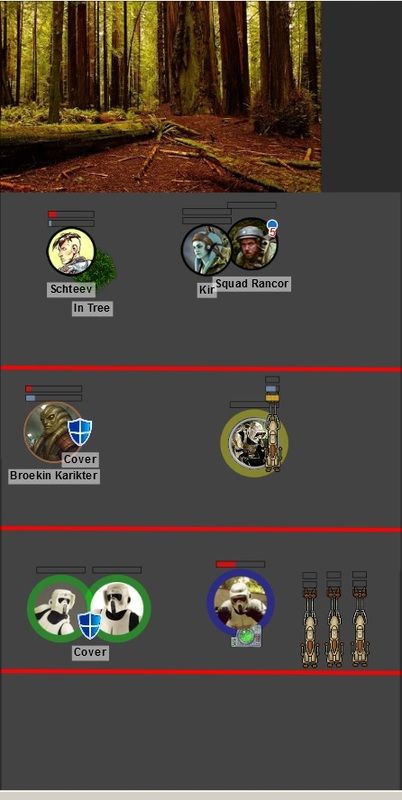
Shows groupings, relative positioning, distance, basic conditions, but doesn't lay down specific grid numbers or hard positioning of environmental features. This technique can be easily applied to a battlemat with minis and tokens to lay down characters, features and conditions, and you can add in extra banding lines or notes as needed.
That's a thing to watch out for. Start using maps with too much detail and you may discourage use of Triumph/Threat/ect. to introduce features, which can really be a thing in this system.
Disclaimer. I'm not trying to convert you, even if this reply may seem a bit like it. I'm just trying to offer some thoughts about subject matter as a player who was in similar situation before I started to GM EotE, and point out some problems.
You nailed it, we will need the "X Squares = Y Range Band" before we even think about playing this game. I was wondering if anyone had done this (along with how far a character can move in a round) and had good success.
This is not actually directly possible, because how much one can move depends on how far he is.
Example: Distance from short to engaged is several meters (one maneuver to move). Medium to engaged is several dozen meters (two maneuver to get to engaged, one to short). Long is further than few dozen meters (four maneuvers to engaged, two to medium). Extreme is maybe few hundred meters (two maneuvers to long, four to medium, five to short, six to engaged). (please, if I calculated or remembered incorrectly correct me, I'm having an migraine attack, and currenty don't trust my brains very much.)
So, there are many possibilities how much Character can move with one maneuver. Ext->L: Maybe even hundreds of meters. L->M: Tens of meters at least, possible even hundred, M->S: Tens of meters, S->Eng few meters. And this is just personal scale. There are also planetary scale and space scale for vehicles. And if my brain still functions correctly same vehicle can move in both planetary scale and space scale (not at same time, but possibly even in same encounter).
Also, if PCs are standing in line where they are at short range of each other, things get complicated. How many short ranges are contained by long range?
So, if you want to have "X Squares = Y Range Band" you will need to change whole range band system, and it affects talents, equipments, vehicles, Force powers and some other things. It's doable, but you could use that time better (e.g. maybe actually playing something). Maybe for example Saga edition SW game, which I think is more traditional. See last paragraph of this post (not signature  ).
).
I can see not using the tabletop a total cluster. "OK, stormtroopers come at you from the left and the right." "Alright, Han and I run to the ones on the right while Chewie and Poe attack the ones on the left" 3 rounds later "Wait, who is near who? What, where is everyone?"
No need for grid. Simple map and tokens can give enough visual cues to remind everyone where they are.
Not to mention the Blast quality. AOE weapons instantly become awful to use, cause the only people you would ever catch with the blast are enemies of your target, which are you know, your friends!
I don't see how you can actually only hit your friends with weapon having blast quality. In traditional grid games, it's much easier. If you are in area of effect, you get hit (trust me, I'm a wizard who loves fireballs. ). In FFG SW attacker chooses targets he hits if he rolls well enough. If he doesn't then he doesn't hit additional characters. If he rolls really poorly, then friendly fire may happen. Not hitting friends is actually very much easier to explain in this system, because exact locations are not there, and system is not very specific about details. "So, you throw the grenade to in middle of storm troopers. half of them fall because of the explosion. Chewie who was apprehended by troopers leaps behind the crate which protects him."
Our group is not going to deal with that. We need the grid.
Only you know your group. I can only offer some fairly n00b thoughts.
Have you considered that maybe FFG SW is not a game for you and your group. It's highly narrative system, where many aspects are not simulated with specificity you probably want. And there is nothing wrong with this. BTW, I though I would and up with same problem when I started GMing Edge of the empire to my group. We have long strategy game history, and our main game has been Pathfinder for maybe five years. I was really surprised how player embraced the more holistic style of Edge of the Empire.
That's a thing to watch out for. Start using maps with too much detail and you may discourage use of Triumph/Threat/ect. to introduce features, which can really be a thing in this system.
Or make it that everything in map is there. In our previous session (EotE beginner game) PC found a wookie bowcaster from Trex's ship, when he got a triump at perception roll while searching the ship, and pointed out the bowcaster in Krayt Fang map. And just to be clear, I don't disagree with. Much of the matter depends on players, some are better at ignoring details in map when thinking about dice result usage, and some get inspired by details.
Everyone, please note that using battlemat (with grid) or map with grid is different than using a gridless map about area where combat is happening.
Absolutely agreed.
When I’ve been a player or a GM in a game, I have sometimes found it really helps to do a rough sketch of the situation. I generally place letters to indicate the different PCs, and numbers to indicate the NPCs or NPC groups. I’ll give the players a general idea of what the room shape is like, any obvious notable features inside the room, but not really anything more — not even to the level of drawing stick figures.
But I’m really bad at drawing, so nothing is to scale, and I don’t make any attempt to keep anything to scale.
By keeping the map as simple and generic as possible, the players are allowed maximum freedom in determining what other things might be in the room, and where they might be.
They can ask if certain things are present, and if it’s simple and small then I’m likely to just go ahead and give it to them.
If it’s not so simple or not so small, then I’m likely to let them flip a Destiny Point and get it. I usually do that by pointing at the pool of Destiny Points and asking “I don’t know — is there?” If they don’t want to flip a DP to get the thing they’re asking about, then that’s their choice.
The key here is to preserve player agency as much as possible. They get to help bring to the narrative of the story whatever elements they might like.
Using a map with a grid on it tends to lock players and GMs alike into a certain mindset that will generally destroy that kind of creativity.
I don't see how you can actually only hit your friends with weapon having blast quality. In traditional grid games, it's much easier. If you are in area of effect, you get hit (trust me, I'm a wizard who loves fireballs.
And I have to correct myself. Of course I remembered that incorrectly. If blast is not activated, only target who was hit is damaged. If it is activated, everyone engaged with original target are damaged. Friend or foe. But still, hitting friends with area effects is not easier than hitting foes. But the Stormtrooper holding Chewie in my example could be harmed with grenade, while other troopers and Chewie would dive for cover. Though, I would allow Chewie to flip a destiny point and dive for cover unharmed even when blast is activated.
When I’ve been a player or a GM in a game, I have sometimes found it really helps to do a rough sketch of the situation. I generally place letters to indicate the different PCs, and numbers to indicate the NPCs or NPC groups. I’ll give the players a general idea of what the room shape is like, any obvious notable features inside the room, but not really anything more — not even to the level of drawing stick figures.
I agree. General idea of situation is most important.
By keeping the map as simple and generic as possible, the players are allowed maximum freedom in determining what other things might be in the room, and where they might be.
Now I understand this point of view. When room is just box in map, for players it's easier to fill it objects. Still, I personally like more detailed maps (EotE beginner box scale is good IMO), because of few advantages for group I play with. 1) it conveys certain aspects of environment better than words (I don't have to say there are sand everywhere when I use Mos Shuuta map). 2) Players I play with (me including) are hit with analysis paralysis if they have nothing to build on, or game goes too much towards freeform for our liking. Maybe good summary is: find out what works for you and your group.
The key here is to preserve player agency as much as possible. They get to help bring to the narrative of the story whatever elements they might like.
Using a map with a grid on it tends to lock players and GMs alike into a certain mindset that will generally destroy that kind of creativity.
Last winter I made one huge mistake as GM, when I was GM'ing SLA Industries. I made a map (very rought, stick figure accuracy, just like I had been using earlier) for social encounter. PCs immediately went for tactical mindset and almost turned the social encounter to combat encounter. Partial reason was the style of game which we had had for few previous sessions, which was fairly tactical almost war game styled gaming. And map had a grid (we were playing in roll20), which was kind of message to PCs that combat is coming. Good side was that characters were veteran operatives just coming home from warzone, so situation kind of described well PTSD situation. But after that I have been much more particular about how I use maps.
Also you can do something more like this:
Shows groupings, relative positioning, distance, basic conditions, but doesn't lay down specific grid numbers or hard positioning of environmental features. This technique can be easily applied to a battlemat with minis and tokens to lay down characters, features and conditions, and you can add in extra banding lines or notes as needed.
That's a thing to watch out for. Start using maps with too much detail and you may discourage use of Triumph/Threat/ect. to introduce features, which can really be a thing in this system.