Star Wars: The American Mythology

By Stone37, in X-Wing

This is an article I wrote connecting American history and ideologies to the Star Wars movies. (I'm a Humanities professor and teach Mythology as one of my courses. I use Star Wars every chance I get in the class room. lol)

Star Wars: The American Mythology Episode I

In the near future, Geek Street Station has asked me to come on to talk about X-wing as well. Along with our Fly Casual (all rights reserved) attitude, what other elements of the game do you think should be discussed to help draw in new players?

Cool.

Maybe you already have heard of them, but there is a large group all about incorporating Star Wars in the Classroom .

If you want to talk about things that might interest new players... I'd say being able to recreate your favorite moments of space combat, or create your own story. The game gives you a lot of freedom.

Edited by RogueLieutenant

This is quite an awesome topic and a fun read! I've always been fascinated on the socio-cultural influence that Star Wars has utilized and has on others. I'm a literature major myself and plan on becoming an instructor, hopefully I'll land a spot in a college that will allow me to teach "Literary Theory in Star Wars" that would parallel the franchise with works of literature throughout the ages.

Cool read, let us know when Episode 2 comes out

This is quite an awesome topic and a fun read! I've always been fascinated on the socio-cultural influence that Star Wars has utilized and has on others. I'm a literature major myself and plan on becoming an instructor, hopefully I'll land a spot in a college that will allow me to teach "Literary Theory in Star Wars" that would parallel the franchise with works of literature throughout the ages.

Thank you for the kind words! The next article will compare the King Arthur mythology to Star Wars. All the characters are there, but Lucas makes a very important change with one of them to make his space opera an American one.

As with all good myths, it mirrors some cultural issues going on at the time.

here is a shortish (26 minutes) analisys by an anarchist philosopher.

There is enough there to make most people squirm uncomfortably.

I would say `enjoy!` but....most people tend to not so much enjoy as ....absorb and consider.

An interesting read for sure.

But I don't get the comparison between light sabers and log cabins. Please explain that one.

As with all good myths, it mirrors some cultural issues going on at the time.

here is a shortish (26 minutes) analisys by an anarchist philosopher.

There is enough there to make most people squirm uncomfortably.

I would say `enjoy!` but....most people tend to not so much enjoy as ....absorb and consider.

(Video)

Wow. You weren't kidding! After about ten minutes I began to believe that this wasn't a parody - the speaker actually believed what he was pitching!

That made me embarrassed for the guy.

I still subscribe to the Luke's Change mythos.

This is an article I wrote connecting American history and ideologies to the Star Wars movies. (I'm a Humanities professor and teach Mythology as one of my courses. I use Star Wars every chance I get in the class room. lol)

Star Wars: The American Mythology Episode I

In the near future, Geek Street Station has asked me to come on to talk about X-wing as well. Along with our Fly Casual (all rights reserved) attitude, what other elements of the game do you think should be discussed to help draw in new players?

My only complaint is that it's too short!

As with all good myths, it mirrors some cultural issues going on at the time.

here is a shortish (26 minutes) analisys by an anarchist philosopher.

There is enough there to make most people squirm uncomfortably.

I would say `enjoy!` but....most people tend to not so much enjoy as ....absorb and consider.

I actually did enjoy quite a bit of it. Toward the end, he made things a little personal and lost some credibility. I didn't agree with everything he said in the video, but he raised some good points. I agree that "Hollywood" doesn't value families the way it should. I also think he's right about Rey and other characters doing a disservice to girls by making it appear that everything should be easy the first time. Thanks for sharing this.

An interesting read for sure.

But I don't get the comparison between light sabers and log cabins. Please explain that one.

Lightsabers are considered weapons of antiquity with the Jedi Order/Sith being its reliquary. Hence, the short-ranged, bladed weapon is believed to be outclassed by projectile weaponry and alternative combat technology, yet, the Jedi and Sith will still use them due to their belief in its practicality and application to their religion and ideals.

As a comparison to the Transcendentalist Movement, writers such as Thoreau and Walden often relinquished their ways of modern dependence and decided to be in tune with their beliefs and roots in nature (much like the ideologies of the Jedi being one with the Force). The way they choose to express this is by living in the woods, enveloped in nature, and living in an outdated, outclassed structure such as a log cabin rather than building a brick or steel structure that would not be in the same aesthetic or appeal in nature, just as the Jedi prefer to use lightsabers for combat rather than blasters.

An interesting read for sure.

But I don't get the comparison between light sabers and log cabins. Please explain that one.

Lightsabers are considered weapons of antiquity with the Jedi Order/Sith being its reliquary. Hence, the short-ranged, bladed weapon is believed to be outclassed by projectile weaponry and alternative combat technology, yet, the Jedi and Sith will still use them due to their belief in its practicality and application to their religion and ideals.

As a comparison to the Transcendentalist Movement, writers such as Thoreau and Walden often relinquished their ways of modern dependence and decided to be in tune with their beliefs and roots in nature (much like the ideologies of the Jedi being one with the Force). The way they choose to express this is by living in the woods, enveloped in nature, and living in an outdated, outclassed structure such as a log cabin rather than building a brick or steel structure that would not be in the same aesthetic or appeal in nature, just as the Jedi prefer to use lightsabers for combat rather than blasters.

I guess I should have been more specific. What I meant was: Are log cabins really to american culture what light sabers are to Star Wars?

Are log cabins even an american thing? They must have been used for thousands of years (literally) before Leif Eriksson set sail to discover the continent.

Sounds awesome. I will definitely be making time to read.

I actually did enjoy quite a bit of it.

I only made it through the first 56 seconds before I had to pause it for a fairly lengthy eye-roll. Then it turned out to be the deal for the second minute, after which I just skimmed for the main ideas.

I agree that "Hollywood" doesn't value families the way it should.

Tolstoy: "Happy families are all alike; every unhappy family is unhappy in its own way."

Or as a radical paraphrase, there's only one story to tell about a happy family, and it's "Look, a happy family! Aaaww." That's because traditionally, narratives are built on conflict, and if you remove the conflict you remove the foundation of the story; happy families don't usually display a lot of conflict, and when they do it's handled with relatively little tension or drama.

I also think he's right about Rey and other characters doing a disservice to girls by making it appear that everything should be easy the first time. Thanks for sharing this.

There is a certain kind of person (usually, but not invariably, a man) who works very hard to find ways to object to narratives with female protagonists without resorting to "yuck, cooties." This guy doesn't manage much of a veneer, IMO.

An interesting read for sure.

But I don't get the comparison between light sabers and log cabins. Please explain that one.

Lightsabers are considered weapons of antiquity with the Jedi Order/Sith being its reliquary. Hence, the short-ranged, bladed weapon is believed to be outclassed by projectile weaponry and alternative combat technology, yet, the Jedi and Sith will still use them due to their belief in its practicality and application to their religion and ideals.

As a comparison to the Transcendentalist Movement, writers such as Thoreau and Walden often relinquished their ways of modern dependence and decided to be in tune with their beliefs and roots in nature (much like the ideologies of the Jedi being one with the Force). The way they choose to express this is by living in the woods, enveloped in nature, and living in an outdated, outclassed structure such as a log cabin rather than building a brick or steel structure that would not be in the same aesthetic or appeal in nature, just as the Jedi prefer to use lightsabers for combat rather than blasters.

I guess I should have been more specific. What I meant was: Are log cabins really to american culture what light sabers are to Star Wars?

Are log cabins even an american thing? They must have been used for thousands of years (literally) before Leif Eriksson set sail to discover the continent.

American in the sense of it being related to Transcendentalism as an American movement, yes. The lightsaber-to-cabin comparison doesn't necessarily mean all cabins ever, but Americans using cabins in similar principle to Jedis using light sabers.

They're samurai from Japanese westerns, guys.

An interesting read for sure.

But I don't get the comparison between light sabers and log cabins. Please explain that one.

The log cabin, as you are thinking of it now, is an invention of the mid 1800s. The first European settlers built their crude homes made from felled trees in the early 1600s. These structures were not built to last, the technique became popular because it was fast and easy. Very few of the structures are still standing.

By the mid 1800s, the industrial age began transforming towns into cities and country jobs into dangerous (and pollution filled) factory jobs in the inner cities. Philosophers, authors, and poets (known as Transcendentalists) began romanticizing about the beauty and simplicity of America in the 1600s. Painters (landscape artists out of the New England areas as well) known as the Hudson River School painted depictions of these simpler times. American architects (a part of the Arts and Crafts movement) like Gustav Stickley designed the modern log cabin. It was built to last and to reconnect humans with Nature. It is a more elegant home from a more civilized age.

Craftsman Farms - Gustav Stickley's Log Cabin Design

The Lightsaber is as out of place in a word full of laser guns as a log cabin is in the Industrial Revolution. There is a saying, "Don't bring a knife to a gun fight." The Jedi did, and it was because they were fighting against the dehumanization that technology often brings with it. The sword is a romantic weapon often used to symbolize chivalry and justice.

lady_justice.jpg

My only complaint is that it's too short!

I'll tell the editor. Maybe he'll give me a few more words to work with for Episode II ;)

They're samurai from Japanese westerns, guys.

This is half true. Hidden Fortress (a movie by Japanese great Akira Kurosawa) is a major influence for Lucas. There is another. That second influence, and how Lucas changed it to tell a VERY AMERICAN story, is the center of my second article. ;)

I really enjoyed the article. Don't have much more to say, other than good job. :)

I really enjoyed the article. Don't have much more to say, other than good job. :)

Thank you. Your signature is brilliant by the way! :D

While I will grant that, along with superheroes, Star Wars has carved out a significant place for itself in the American psyche, I have difficulty with the notion that Star Wars is the American mythology. Gone With the Wind tells us a hell of a lot more about America than Star Wars does, and is much more concerned with preserving and communicating cultural values, for instance. Its influence is with us today in a non-trivial way.

And that's leaving aside the near-religious (sometimes openly religious) reverence with with the Founders are regarded, or the fantastical vision of Westward expansion that only ever existed in the public imagination and lingers on to this day, or...

As with all good myths, it mirrors some cultural issues going on at the time.

here is a shortish (26 minutes) analisys by an anarchist philosopher.

There is enough there to make most people squirm uncomfortably.

I would say `enjoy!` but....most people tend to not so much enjoy as ....absorb and consider.

https://www.youtube.com/watch?v=JwThhlhBZqk

As I listened to this, I had a flash of "Chasing Amy"; anyone can really make a cultural myth bend to any agenda they want it to. Luke is a sociopath, Finn lets us ignore the impact of abuse, and Darth Vader indicates that all black people want to be white deep down.

An interesting read for sure.

But I don't get the comparison between light sabers and log cabins. Please explain that one.

The log cabin, as you are thinking of it now, is an invention of the mid 1800s.

Really? I would guess around 3000 BC.

An interesting read for sure.

But I don't get the comparison between light sabers and log cabins. Please explain that one.

The log cabin, as you are thinking of it now, is an invention of the mid 1800s.

Really? I would guess around 3000 BC.

The ancients worked with stone, brick, and thatch mostly. The Romans invented concrete, the first binder, and nails did not come into use until much later.

Edited by Stone37

An interesting read for sure.

But I don't get the comparison between light sabers and log cabins. Please explain that one.

The log cabin, as you are thinking of it now, is an invention of the mid 1800s.

Really? I would guess around 3000 BC.

A log cabin is more than a wood house. It is a technique that was developed in the early 1600s and updated and modernized in the mid to late 1800s.

The ancients worked with stone, brick, and thatch mostly. The Romans invented concrete, the first binder, and nails did not come into use until much later.

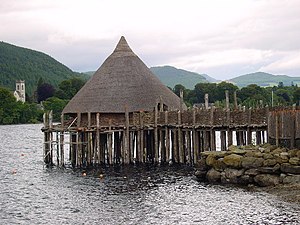
300px-Crannog_-_geograph.org.uk_-_35551. Recreated from archeological evidence. Wooden huts, circa 3000BC. Not, I'll admit, the 'traditional American Log Cabin'. Wood has been a building material for a long time!