XX9/Default/Fire Control Team Discussion

By Drasnighta, in Star Wars: Armada Rules Questions

RRG 2:

Resolve Damage: The attacker can resolve one of its

critical effects. Then the attacker determines the total

damage amount. Then the defending squadron or hull

zone suffers that total damage, one point at a time.

◊ If the attacker or defender is a squadron, the damage

is the sum of all F icons.

◊ If the attacker and defender are ships, the damage is

the sum of all F and E icons.

◊ Each ship has the following standard critical effect:

“E: If the defender is dealt at least one damage card

by this attack, deal the first damage card faceup.”

Just to be clear, I am not set on one position or the other. I don't think there is enough evidence either way in the rules to make a call one way or the other. It does appear that the intent is that they should stack, but for it to unequivocally function that way, either XX9 would need to be errata'd, or an FAQ would need to define the damage referenced on both XX9 and in the default crit effect to not include damage dealt by critical effects.

*inb4 Lyraeus' BUT DODONNA. We can argue about true randomness in card decks somewhere else, but I don't want to sidetrack this, and for the purpose of this discussion it doesn't matter.

I think this argues for the three face-up with both XX-9 and APT and Fire-control.

You may resolve a critical effect. So you "pop" the APT and deal a face-up damage card. Now Fire-control can trigger allowing you to "pop" the XX-9. If your damage vs. shields and token deals damage cards you'll deal up to two of them face-up.

Right.

Under what circumstances would you want to deal 3 face up crit cards? What ship have you not just killed anyway?

:huh:

All the ships with more than 3 hull and those face-up damage cards are the first three damage.

So everything that isn't a flotilla. :)

Edited by Frimmel

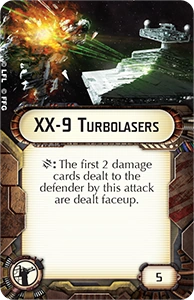
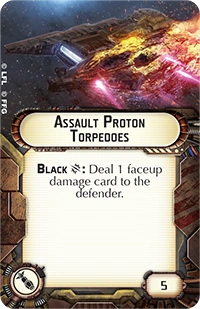
APT/XX9 is tough. XX9-Turbolasers.png Swm12_assault-proton-torpedoes.png

Is the damage from APT (and incidentally, ACM) counted as being dealt "by this attack"? From a certain point of view, they obviously are; from another, they're not affected by defense tokens, so... Maybe not?

I'm leaning towards air/XX9 not stacking absent a clarification, but it's a tough call tbh.

No, ACM and APT are not damage dealt by the attack, otherwise they would be subject to defense tokens.They are critical effects that cause damage as a result using a critical effect.
They're not subject to defense tokens because of the timing, not because they're not "damage dealt by that attack," though. Criticals resolve before damage is totaled, and thus before brace and redirect resolve.
Right, it's a critical effect, not damage from the attack. It's similar to using XX9's and the first crit being structural damage. You don't flip the card dealt by structural damage for the second as that's not damage from the attack, you would flip the next card.
Are you sure about that? It functionally doesn't currently matter which card is flipped when*, so it's never come up.

The damage card can be both damage from the attack and from a crit at the same time. It's like how you can be a Taco Bell manager and a Taco Bell employee at the same time: one is a subset of the other.

The rules as written do not appear to clearly delineate damage dealt by a crit effect from that dealt by an attack. The relevant section:

RRG 2:

Resolve Damage: The attacker can resolve one of its

critical effects. Then the attacker determines the total

damage amount. Then the defending squadron or hull

zone suffers that total damage, one point at a time.

◊ If the attacker or defender is a squadron, the damage

is the sum of all F icons.

◊ If the attacker and defender are ships, the damage is

the sum of all F and E icons.

◊ Each ship has the following standard critical effect:

“E: If the defender is dealt at least one damage card

by this attack, deal the first damage card faceup.”

Just to be clear, I am not set on one position or the other. I don't think there is enough evidence either way in the rules to make a call one way or the other. It does appear that the intent is that they should stack, but for it to unequivocally function that way, either XX9 would need to be errata'd, or an FAQ would need to define the damage referenced on both XX9 and in the default crit effect to not include damage dealt by critical effects.

*inb4 Lyraeus' BUT DODONNA. We can argue about true randomness in card decks somewhere else, but I don't want to sidetrack this, and for the purpose of this discussion it doesn't matter.

I disagree with your example. The attack provides the trigger for the critical effect. It does not provide the effect itself. Damage from the attack is what you calculate after defense tokens are taken into consideration. APT's, ACM's, and the additional card dealt by Structural Damage are, not damage dealt by the attack, the attack may be the trigger for those effects but they are different from, technically speaking, damage dealt by the attack.
attack pool

RRG 4 CRITICAL EFFECTS:

A critical effect, denoted by the “E:” header, can resolve if

there is at least one E icon in the attack pool.

The entirety of this damage resolution process is contained within the Attack step (ref RRG 2 ATTACK), which, again, dies not define damage dealt by the dice in the attack pool as the entire damage dealt by the attack.

At least as far as I can find. I would love to be shown to be wrong about this, because definitive, supported evidence would clear up the whole question right now.

Edited by Ardaedhel

At least as far as I can find. I would love to be shown wrong about this to be wrong about this, because definitive, supported evidence would clear up the whole question right now.

As I mentioned in a different thread - there are some things do require FFG intervention... I believe this is one of them, because we can't find the requisite rules in what we've been given...

Unlike The 'nonsense' about Speed 5, and Speed -1, for example, has its precedence in the Speed Rules (If you don't have it listed, you can't use it... With a specific exception to Speed 0 being made...)

At least as far as I can find. I would love to be shown wrong about this to be wrong about this, because definitive, supported evidence would clear up the whole question right now.

As I mentioned in a different thread - there are some things do require FFG intervention... I believe this is one of them, because we can't find the requisite rules in what we've been given...

Unlike The 'nonsense' about Speed 5, and Speed -1, for example, has its precedence in the Speed Rules (If you don't have it listed, you can't use it... With a specific exception to Speed 0 being made...)

I agree.

As nice as it would be to have this cleared up without an FAQ, I haven't seen definitive evidence one way or the other.

RRG 2:

Resolve Damage: The attacker can resolve one of its
critical effects. Then the attacker determines the total
damage amount. Then the defending squadron or hull
zone suffers that total damage, one point at a time.

The more problematic interaction to me then become XX-9 with the default. I see no conflicts with using two critical effects on different upgrade cards. But XX-9 and the default are going to have the same initial trigger though aren't they? And even if they don't conflict you'll still be needing three damage cards dealt.

RRG 2:

Resolve Damage: The attacker can resolve one of its

critical effects. Then the attacker determines the total

damage amount. Then the defending squadron or hull

zone suffers that total damage, one point at a time.

The more problematic interaction to me then become XX-9 with the default. I see no conflicts with using two critical effects on different upgrade cards. But XX-9 and the default are going to have the same initial trigger though aren't they? And even if they don't conflict you'll still be needing three damage cards dealt.

I think this one, RAW, is pretty clearly not going to stack barring an errata. Which may be forthcoming, given the text in the announcement, but neither would I hang my hat on it on that basis alone.

Ok. Here we go.

RRG 4:

Damage

Ships and squadrons can suffer damage from attacks, obstacles, and other game effects .

Ok here we establish damage can come from things other than attacks.

Critical Effects

A critical effect, denoted by the “E:” header, can resolve if there is at least one E icon in the attack pool. • The attacker can resolve only one critical effect per attack. • The attacker does not spend a die icon to resolve a critical effect unless the effect says otherwise. • Critical effects resolve at the beginning of the “Resolve Damage” step of an attack.

So here is the definition of the critical effect. We've established it can cause damage as part of it's effect and that it resolve at the beginning of the "Resolve Damage" step of the attack.

RRG 2:

Resolve Damage: The attacker can resolve one of its critical effects . Then the attacker determines the total damage amount. Then the defending squadron or hull zone suffers that total damage, one point at a time. ◊ If the attacker or defender is a squadron, the damage is the sum of all (hit) icons. ◊ If the attacker and defender are ships, the damage is the sum of all (hit) and (crit) icons .

Ok so here it clearly states that if damage is the sum of all the crit and hit icons.

From this we can understand that ACM's resolve fully and that any damage that may or may not have been dealt does not have any bearing on the damage from the attack which is defined as the total of the results shown on the dice.

Edited by Silver Crane

Ok. Here we go.

RRG 4:

Damage

Ships and squadrons can suffer damage from attacks, obstacles, and other game effects .

Ok here we establish damage can come from things other than attacks.

Critical Effects

A critical effect, denoted by the “E:” header, can resolve if there is at least one E icon in the attack pool. • The attacker can resolve only one critical effect per attack. • The attacker does not spend a die icon to resolve a critical effect unless the effect says otherwise. • Critical effects resolve at the beginning of the “Resolve Damage” step of an attack.

So here is the definition of the critical effect. We've established it can cause damage as part of it's effect and that it resolve at the beginning of the "Resolve Damage" step of the attack.

RRG 2:

Resolve Damage: The attacker can resolve one of its critical effects . Then the attacker determines the total damage amount. Then the defending squadron or hull zone suffers that total damage, one point at a time. ◊ If the attacker or defender is a squadron, the damage is the sum of all (hit) icons. ◊ If the attacker and defender are ships, the damage is the sum of all (hit) and (crit) icons .

Ok so here it clearly states that if damage is the sum of all the crit and hit icons.

From this we can understand that ACM's resolve fully and that any damage that may or may not have been dealt does not have any bearing on the damage from the attack which is defined as the total of the results shown on the dice.

I agree completely. However, I don't know if that answers the question of XX-9 and the default.

The counterpoint to that is:

Critical effects resolve at the beginning of the “Resolve Damage” step of an attack.

The statement there, being that critical damage is still part of the attack .

Furthermore, ACMs still use the terminology suffers damage ... And since we are part of an attack set of steps, it is damage suffered by that...

We havn't been doing it wrong so far, because you couldn't have a default effect and ACMs at the same time ... F-CT has certainly opened many cans of worms.

I do agree that's its far too ambiguous to make a clear ruling on all the aspects... That's why I created this as a discussion topic :D

The counterpoint to that is:

Critical effects resolve at the beginning of the “Resolve Damage” step of an attack.

The statement there, being that critical damage is still part of the attack .

Furthermore, ACMs still use the terminology suffers damage ... And since we are part of an attack set of steps, it is damage suffered by that...

We havn't been doing it wrong so far, because you couldn't have a default effect and ACMs at the same time ... F-CT has certainly opened many cans of worms.

I do agree that's its far too ambiguous to make a clear ruling on all the aspects... That's why I created this as a discussion topic :D

Sorry, look at the whole rule from RRG 2:

Resolve Damage: The attacker can resolve one of its critical effects . Then the attacker determines the total damage amount. Then the defending squadron or hull zone suffers that total damage, one point at a time. ◊ If the attacker or defender is a squadron, the damage is the sum of all (hit) icons. ◊ If the attacker and defender are ships, the damage is the sum of all (hit) and (crit) icons .

As for XX-9 and the default effect, they both trigger at the same time. You pick whch one triggers first. The both flip the first card face up. The second card is then also face up. They are not additive.

Edited by Silver Crane

So, Damage being suffered isn't Damage then?

The counterpoint to that is:

Critical effects resolve at the beginning of the “Resolve Damage” step of an attack.

The statement there, being that critical damage is still part of the attack .

Furthermore, ACMs still use the terminology suffers damage ... And since we are part of an attack set of steps, it is damage suffered by that...

We havn't been doing it wrong so far, because you couldn't have a default effect and ACMs at the same time ... F-CT has certainly opened many cans of worms.

I do agree that's its far too ambiguous to make a clear ruling on all the aspects... That's why I created this as a discussion topic :D

The only ambiguous situation is XX-9 and the default. These are the only critical effects that refer to the first damage card. And that doesn't seem all the ambiguous really. Because I agree with this:

As for XX-9 and the default effect, they both trigger at the same time. You pick whch one triggers first. The both fli the first card face up. The second card is then also face up. They are not additive.

It's damage clearly it is, just not damage dealt by the attack. Again, RRG 4:

Damage

Ships and squadrons can suffer damage from attacks, obstacles, and other game effects .

RRG 2:

Resolve Damage: The attacker can resolve one of its critical effects . Then the attacker determines the total damage amount. Then the defending squadron or hull zone suffers that total damage, one point at a time. ◊ If the attacker or defender is a squadron, the damage is the sum of all (hit) icons. ◊ If the attacker and defender are ships, the damage is the sum of all (hit) and (crit) icons .

I do like it when people both agree and disagree with me at the same time :D

It's damage clearly it is, just not damage dealt by the attack. Again, RRG 4:

Damage

Ships and squadrons can suffer damage from attacks, obstacles, and other game effects .

RRG 2:

Resolve Damage: The attacker can resolve one of its critical effects . Then the attacker determines the total damage amount. Then the defending squadron or hull zone suffers that total damage, one point at a time. ◊ If the attacker or defender is a squadron, the damage is the sum of all (hit) icons. ◊ If the attacker and defender are ships, the damage is the sum of all (hit) and (crit) icons .

So you are defining that Critical Damage is an Other Game Effect rather than a Due to an Attack effect.

Do you have something to back that definition up?

I ask, because, if the question was asked to me, my answer is "No, I don't." - I can't back it up, one way or another.

I'd define "Other game effect" as things like - Objectives... Minefields, in particular, is a perfect candidate for it, after all... Overlapping is another, as that is separate to obstacles. But that is how I define it, which is clearly different to how you define it... And unfortunately, we can't agree on that part of it...

Ergo, its ambiguous.

And we'll need someone to lay the rules-fu down on us.

Edited by Drasnighta

So, Damage being suffered isn't Damage then?

It isn't a question of damage. It is a question of if a damage card is dealt faceup or not.

And it only becomes a question when dealing more three or more damage cards when resolving the default and XX-9 at the same time.

I don't think it is ambiguous, and I've proved my point with rules the to back it up The damage suffered from the attack is defined as the total of the dice results. A crit result on a die is the trigger for a critical effect. The critical effect can deal damage, but it is not added to the dice results which, is what the rules define as damage dealt by the attack.

I suppose eventually there could be a crit that lets you add icons to the dice pool, which would then be totaled, but that remains to be seen.

Edited by Silver Crane

I am firmly in the three cards camp. Its two seperate effects, taking place one after the other. Default crit effects the first card to go through while under that effect, XX9 effects the first two cards to go through under its effect. I think its pretty clear by their example in the article this is the interpretation they are going to support, so we may as well all get on board now.

Also this conversation got crazy deep into technicality. I don't even get what some of you are arguing at this point. But good on you, you crazy kids.

Edited by Madaghmire

Ok. Here we go.

RRG 4:

Damage

Ships and squadrons can suffer damage from attacks, obstacles, and other game effects .

Ok here we establish damage can come from things other than attacks.

Critical Effects

A critical effect, denoted by the “E:” header, can resolve if there is at least one E icon in the attack pool. • The attacker can resolve only one critical effect per attack. • The attacker does not spend a die icon to resolve a critical effect unless the effect says otherwise. • Critical effects resolve at the beginning of the “Resolve Damage” step of an attack.

So here is the definition of the critical effect. We've established it can cause damage as part of it's effect and that it resolve at the beginning of the "Resolve Damage" step of the attack.

RRG 2:

Resolve Damage: The attacker can resolve one of its critical effects . Then the attacker determines the total damage amount. Then the defending squadron or hull zone suffers that total damage, one point at a time. ◊ If the attacker or defender is a squadron, the damage is the sum of all (hit) icons. ◊ If the attacker and defender are ships, the damage is the sum of all (hit) and (crit) icons .

Ok so here it clearly states that if damage is the sum of all the crit and hit icons.

From this we can understand that ACM's resolve fully and that any damage that may or may not have been dealt does not have any bearing on the damage from the attack which is defined as the total of the results shown on the dice.

Thank you for taking the time to cite sources here. While I still disagree that it is clear-cut, you do make a better argument than I'd been able to find.

I don't think that "other game effects" means that crits necessarily don't count as damage dealt by an attack, nor does the description of how to calculate damage from the attack pool exclude critical damage from the attack, because "critical effects resolve at the beginning of the "Resolve Damage" step of an attack " --that is, the critical effect is part of the attack.

I've just submitted the question for clarification, in hopes that it will be included in the FAQ for Wave 4. Until then, I don't think arguing here is going to do much more good.

Thanks for keeping it civil, I appreciate that.

I still think you are missing the key part, that the damage from the attack is determined by the results on the dice, nothing more.

Edited by Silver Crane

Silver crane.

When would fire control team have an effect?

I am firmly in the three cards camp. Its two seperate effects, taking place one after the other. Default crit effects the first card to go through while under that effect, XX9 effects the first two cards to go through under its effect. I think its pretty clear by their example in the article this is the interpretation they are going to support, so we may as well all get on board now.

Also this conversation got crazy deep into technicality. I don't even get what some of you are arguing at this point. But good on you, you crazy kids.

Two separate effects that both effect the first card dealt by the attack. The first card is the first card in either case.