Sadly the meta's sorta like gravity, it exists whether you believe in it or not
But also like gravity, it can be overcome (just requires a whole lot of ingenuity and effort )
Sadly the meta's sorta like gravity, it exists whether you believe in it or not
But also like gravity, it can be overcome (just requires a whole lot of ingenuity and effort )
Sadly the meta's sorta like gravity, it exists whether you believe in it or not
But also like gravity, it can be overcome (just requires a whole lot of ingenuity and effort )
Good analogy!
Top 8 lists of any major National or Systems Open disagrees with the meta being a myth.
"It's true.. All of it" - Han Solo (TFA)
That's kind of a self-fulfilling prophecy isn't it? The more people believe it's a winning squad, the more people bring it to tournaments. The more it shows up to tournaments, the more it will win. The more it wins, the more people think it's a winning squad.
Sadly the meta's sorta like gravity, it exists whether you believe in it or not
But also like gravity, it can be overcome (just requires a whole lot of ingenuity and effort )
To overcome the meta you need to be aware of the meta and become part of it. If you make any decisions while list building based on your expectations of what you will be playing against you are participating in the meta.
If everyone in your area brings nothing but special snowflake squads to tournaments, that's still a meta.
Edited by WWHSDIt seems to me some people have a knee-jerk reaction to the term Meta, yet quite often have no clue what the term actually means.
Top 8 lists of any major National or Systems Open disagrees with the meta being a myth.
"It's true.. All of it" - Han Solo (TFA)
That's kind of a self-fulfilling prophecy isn't it? The more people believe it's a winning squad, the more people bring it to tournaments. The more it shows up to tournaments, the more it will win. The more it wins, the more people think it's a winning squad.
That's true to an extent, but it's also true that the more people bring it to tournaments the greater the reward is for bucking that trend and playing something designed to beat it. There's an inbuilt tension or check/balance in the competitive scene that the type of progressive logic you're using tends to ignore. The more successful a list gets the more popular it gets, which makes it harder to continue winning with it when more people know what it does and how to beat it.
There's plenty of lists that win a tournament or two but then don't build that breakout momentum, because the power of the list means that the wins are not sustainable or scaleable.
You've also got to factor in that most of the time the big new strong lists are being developed by strong players, so that initial success comes as a result of them being very good with a very good list. Once the list gains traction and starts spreading down the skill curve and through the rest of the field it's odds of winnings are not increased by an exponential amount. To put it most simply, if the best player in the room plays a squad it may have a 10% chance of winning the tournament. If the best player and the worst player both play it the chances of winning don't become 20%, they may not even become 11%.
It seems to me some people have a knee-jerk reaction to the term Meta, yet quite often have no clue what the term actually means.
inconceivable!
Edited by ficklegreendiceIt seems to me some people have a knee-jerk reaction to the term Meta, yet quite often have no clue what the term actually means.
Demonstrably.
You should post video of shoe stew. I'd like to watch
I 'm
S o
M eta
E ven
T his
A cronym
Edited by RakaydosIt's like believing in creationism because you've created your own internal gatekeeper for what would be required to disprove your belief and nobody can meet it. Congrats, your prize is that you get to be a creationist while the the rest of us get on with our lives.
Stay on the leader's points we're, in the end, good ones. My twist on his 'opinion illustration' goes something like this: not believing in the meta through mathmatical proofs is a lot like believing that we and everything around us came into being through some unknown source, random chance and mutation when clearly the math proves that wrong (ref: The Grand Design - Hawking). In the same way, MathWing proves meta not only does exist, but, beyond pilot ability and the weirdness of dice sometimes (beyond averages), accurately tells us which lists will trump others.
There's plenty of lists that win a tournament or two but then don't build that breakout momentum, because the power of the list means that the wins are not sustainable or scaleable.
Or it lacks one of the two main elements that allow a list of multiply out of control: perceived power and ease of use. Take five A-wings: not an easy list to make work.
It seems to me some people have a knee-jerk reaction to the term Meta, yet quite often have no clue what the term actually means.
Because the metagame (an intrinsic part of any game with a building/customisation element) is abbreviated to meta which is also used as a word for the current popular squads. There's some overlap but it's used to mean multiple related things.
The metagame exists, I think everyone who understands the word agrees on that. The actual question is to what extent is the popularity of a squad reflective of its power? Is it copied because it's broken or because people think it's broken?
You've also got to factor in that most of the time the big new strong lists are being developed by strong players, so that initial success comes as a result of them being very good with a very good list. Once the list gains traction and starts spreading down the skill curve and through the rest of the field it's odds of winnings are not increased by an exponential amount.
I think the word you're looking for is linear, not exponential.
If every list in a tournament is a lone Z-95 then Lone Z-95 with 88 point initiative bid will win. If nobody runs Lone Z-95 then it has a zero percent chance to win. The chances of a lone Z-95 winning then vary between 0% and 100% with increasing numbers of Lone Z-95.
If you make the following two assumptions you can model the argument many people are making quite simply.
Let's take Sandwing, a coarse, rough and irritating list that gets everywhere, and enter it into a 32 person tournament that cuts to Top 8.
This tournament has one person running Sandwing. There are 32 people in the tournment, all with an equal chance of victory. This makes Sandwing's chance of winning as 1/32 or just over 3%. Enter a second Sandwing into the tournament and it becomes 2/32 or 1/16 or 6.25%. Enter a third and it becomes 3/32. If half the lists are Sandwing, there's a 50% chance of a Sandwing victory. If all the lists are Sandwing, there's a 100% chance of a Sandwing victory.
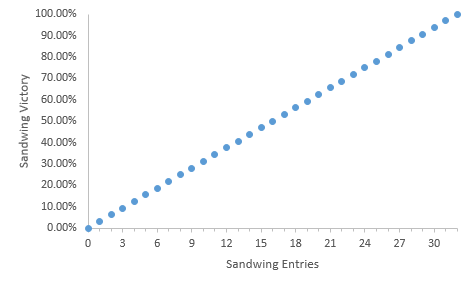
Let's return to the assumptions. Player skill is independent of list composition for a netlist and should average out over a sufficiently large sample. As for list quality, how much of an advantage does a "meta list" (currently PalpAces and U-Boats) increase your chances of winning?
Let's assume Sandwing is crazy overpowered and doubles your chance of winning a tournament with no other Sandwings from 3.13% to 6.25%.
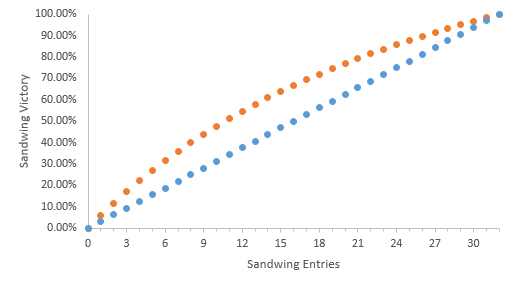
The blue line is the original chance of a Sandwing victory and the orange is when Sandwing's chance to win the tournament is doubled.
Our imbalanced Sandwing again shows a similar picture: the more Sandwings you put into a tournament, the better chance Sandwing will win. This remains true even if Sandwing is crazy OP.
What if Sandwing sucks? Let's halve any one Sandwing's chance to win the tournament.
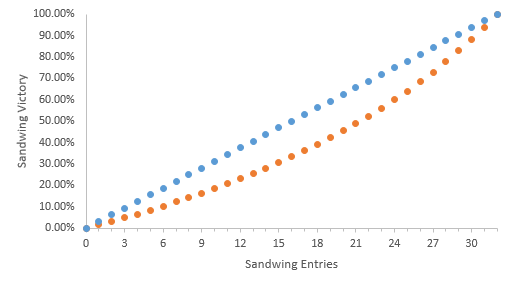
The impact of additional copies of the same list in a tournament on the chance for that list to win is HUGE. If more copies of a list are entered into a tournament, the chances of any one of those winning jumps enormously.
What this means is we can't use tournament winrate to judge quality unless we know all the lists that entered. Otherwise how can we factor out this massive boost?
Edited by Blue FiveExcept that's got no modification whatsoever for player skill so it was a waste of however long you took to write it.
Paul Heaver wins worlds with his list. If somebody else played his list as well the odds of that list winning worlds doesn't double, in fact it barely moves at all.
Except that's got no modification whatsoever for player skill so it was a waste of however long you took to write it.
As I explained, player skill averages out over a sufficiently large sample. It's a factor of the player and not the list itself. Secondly, player skill also hampers attempts to judge the power of a list by its Top 8 appearances, so I fail to see how it serves as a rebuttal.
Add a second XYYZ to Worlds played by a player of significantly lesser skill and the chance of an XYYZ victory likely doesn't double, correct. But that sample is far too small to be statistically significant for most things. You couldn't use it to claim XYYZ was a power list.
But when you're dealing with enough Jumpmaster wins to claim "Jumpmasters OP" player skill has likely averaged out.
My point is that comparing list quality by tournament wins is not a fair test unless you have an even distribution of skills amongst each archetype and the same number of each archetype. Otherwise you introduce huge biases. U-Boats and PalpAces are so ahead on numbers that you can't compare their winrates to other less prevalent lists and draw conclusions about power.
In the same way, MathWing proves meta not only does exist, but, beyond pilot ability and the weirdness of dice sometimes (beyond averages), accurately tells us which lists will trump others.
I think you need to go and look up how MathWing 2.0 actually works.
Edited by Blue Five
Except that's got no modification whatsoever for player skill so it was a waste of however long you took to write it.
As I explained, player skill averages out over a sufficiently large sample. It's a factor of the player and not the list itself.
Add a second XYYZ to Worlds and the chance of an XYYZ victory likely doesn't double, correct. But that sample is far too small to be statistically significant for most things. You couldn't use it to claim XYYZ was a power list.
But when you're dealing with enough Jumpmaster wins to claim "Jumpmasters OP" player skill has likely averaged out.
If we define "skilled players" to be "players that can consistently make the cut at large tournaments" those players aren't bringing arbitrary lists. They are bringing lists that they feel are competitive in the meta that they expect to face. What lists the bottom half of players at a tournament happen to bring ends up being almost irrelevant unless the top players are bringing lists that struggle against them. That's going to skew the results quite a bit.
Even guys like Biophysical and Kinetic Operator that win with more unique lists tweak those lists to deal with what they perceive the meta to be.
If we define "skilled players" to be "players that can consistently make the cut at large tournaments" those players aren't bringing arbitrary lists. They are bringing lists that they feel are competitive in the meta that they expect to face. What lists the bottom half of players at a tournament happen to bring ends up being almost irrelevant unless the top players are bringing lists that struggle against them. That's going to skew the results quite a bit.
Even guys like Biophysical and Kinetic Operator that win with more unique lists tweak those lists to deal with what they perceive the meta to be.
What are you trying to say? I'm not seeing where this debunks the assertion that an imbalance in the number of each list attending a tournament is going to skew the victory chances of that list.
What I'm getting at is numerical imbalance skews tournament results to the point where they're not proof of a list's power. Player skill skewing further supports them being skewed.
Absolutely nothing wrong with following the flock.
Cheers
Baaa
Just do your own thing, don't listen to anyone else but yourself, and above all, HAVE FUN FOR HECK'S SAKE!
Yep
If we define "skilled players" to be "players that can consistently make the cut at large tournaments" those players aren't bringing arbitrary lists. They are bringing lists that they feel are competitive in the meta that they expect to face. What lists the bottom half of players at a tournament happen to bring ends up being almost irrelevant unless the top players are bringing lists that struggle against them. That's going to skew the results quite a bit.
Even guys like Biophysical and Kinetic Operator that win with more unique lists tweak those lists to deal with what they perceive the meta to be.
What are you trying to say? I'm not seeing where this debunks the assertion that an imbalance in the number of each list attending a tournament is going to skew the victory chances of that list.
What I'm getting at is numerical imbalance skews tournament results to the point where they're not proof of a list's power. Player skill skewing further supports them being skewed.
If you have 10 players that bring the same list and only 1 of them normally makes the cut, the 9 other guys that brought the same list that had a 50% day with it didn't make it any more likely that the guy who won with the list was going to win. In fact it may have had the opposite effect since enough players may be bringing squads to deal with what is a common list.
You need some way to control for "likely winners" and then track which lists are prevalent among them. That's where a higher frequency of people bringing the same list would increase the chances of that list winning. It's a simplification but you are still bumping into a situation where if most of the top players are bringing scissors, the guys that brought rocks are going to have an increased chance of winning.
Edited by WWHSDOr it lacks one of the two main elements that allow a list of multiply out of control: perceived power and ease of use. Take five A-wings: not an easy list to make work.
I'm not so sure, having watched three or four regulars at the store all switch over to A-Wings and immediately start placing better than they had been prior to changing their list.
Though I don't doubt there's the perception it's hard to manage.
Ahh, another anti-competitive/anti-mathwing thread. All dressed up in confusion.
A metagame will always exist. Psychology is just as much a factor as game balance.
Edited by Sithborg
What. Does. It. Mean. Then?
The metagame is best thought of as the "game of the game". It will always exist, but it doesn't really mean the same thing that a lot of people think it means. It means those that think about other people's game. So...if you have a friend that ALWAYS plays Soontir Fel when he plays Imperials...and you decide to play a game and he plays Imperials....you plan against Soontir Fel. That's metagame.
Metagame when it comes to tournaments is just thinking about what others are going to bring and what you can bring to stop them. So, if Wave x just comes out and you are expecting people to bring ship y from Wave x....so you bring a way to stop it. Or....you know the best local guy loves to fly Poe Dameron a certain way....and you bring something you know will beat it. That's meta.
I was just listening to the Kessel Run and one of the guys built a list to defeat Imp Aces as that's what he was expecting at a Regionals. Well, he didn't face any all day. That's metagaming. Not effective, but it is metagaming.
So, one can say the "meta" is what you are thinking others are going to bring to a tournament. No matter what the list is, you are expecting them to bring something and plan accordingly. That's metagaming. It doesn't have to be accurate, but that's what it is.
This is exactly what the meta really is. Well said.
It's whatever shows up. Whether the lists that show up are those identified subjectively or otherwise as the best lists, or every single participant colludes to enter scyk swarms, the lists that enter the contest are by definition the meta for that event.
The herd mentality shows up when people see the results of the first event and attempt to emulate the results of those lists that made the cut because many people would rather have a seemingly quantifiable competitive edge using someone else's idea than attempt a run at greatness with their own (not knowing the full make-up of that event or what lists their faced, and more importantly, what lists their didn't face through random draw in the early rounds). Repeat for a tournament season with each new result compounding the data and emulation and you start to see 60/40 Palp-Aces to U-Boat wins in the last events of the season just because of the quantity of each of those lists entered.
You can say U-Boats and Palp-Aces are meta lists, and currently you are correct, but only because those lists are currently being fielded by everybody and their brother
Hypothetically, if hard counters for Palp-Aces defined 50% of the meta at the start of the regional season, such that they outnumbered Palp-Aces, you wouldn't see the proliferation of Palp-Aces later in the season. Those counters would have had great success early as they would have faced so many palp-aces to inflate their win column, then at later tournaments the meta gamers would have been fielding counters to that counter instead of palp-aces.
The meta defines what you can expect to see, but a diverse meta means you may never see any given specific list that you came prepared to face.
God damnit. Got me again Ribann.
arguing about the meta of the meta.
thats so meta.