Dodge and Flame attacks.

By Yui 56, in Rogue Trader Rules Questions

If someone shoots a flamer at you can you try to dodge before you make the agility test or is a flame attack considered something different than a distance attack? I've read the description of the Dodge skill (DH pg 101), the description of the Flame special quality (DH pg 128), the descriptions for flame weapons (DH pg 134) and even the Errata about the Flame special quality (Errata v.3.0 pg 8) and I'm stumped. sad.gif

I was under the assumption that you can try to dodge it before the agility test but I've been told different and now have no idea. Am I missing something?

Ruleswise there's nothing stopping a character from attempting to dodge a flame attack even after he or she has rolled for Agility.

This because the agility test isn't a reaction per se, but rather a condition confered by the weapon that is used to determine if you actually hit everyone with the flamer or not.

What Varnias said.

While normal weapons go BS->Dodge->Damage, flamers go Agility->Dodge->Damage.

Awesome. Thanks. happy.gif

I would put it under the area affect and dodge rules too. Your dodge has to be able to get you out of the area that is flame-washed.

Little Dave said:

I would put it under the area affect and dodge rules too. Your dodge has to be able to get you out of the area that is flame-washed.

Could be tricky, mainly because weapons with an area of effect (mainly blast weapons) has a numeric value of the radius they do affect. Flamers just have a rather abstract "cone" with no specific number to it.

Little Dave said:

I would put it under the area affect and dodge rules too. Your dodge has to be able to get you out of the area that is flame-washed.

That sounds correct by me. If you are being shot at in a corridor with a flamer, you wouldn't be able to dodge, and rightly so.

MILLANDSON said:

Little Dave said:

I would put it under the area affect and dodge rules too. Your dodge has to be able to get you out of the area that is flame-washed.

That sounds correct by me. If you are being shot at in a corridor with a flamer, you wouldn't be able to dodge, and rightly so.

Actually, you might be able to dodge depending on which target is being fired at.

There is this common misconception about flamethrowers that they fire in the same way as depicted in the movies. The thing is that flamethrowers used in movies use volatile gas as the fuel, and that's why you get that "coned spray" effect that we figure would be impossible to dodge if you're in a narrow corridor.

Real (military) flamethrowers however don't fire gas, but ignited liquid fuel on pretty much the same principle as a firehose, in order to cause as much damage as possible. Meaning that the stream of burning fuel is kept more or less consistent in it's "flight path" until the fuel hits it's target or the ground where it will create a blazing inferno which radius depends on how long the shooter is keeping the trigger depressed and hosing the area down. (the more burning fuel "stacked" at the same area, the larger the puddle of burning fuel will be). If the flamethrower actually fired a "coned spraycloud" of droplets instead of a consistent stream, it wouldn't be very effective because the individual droplets would burn out and thus vaporize very fast, meaning that just being grazed by the cone might burn your skin or clothes a little, but won't be very likely to set you on fire or kill you. However if you get hit by a consistent stream of burning fuel (usually napalm because it sticks to pretty much everything and won't come off) then you will suffer serious burns and run a very high risk of catching fire.

To summarize, a cloud of burning droplets might be extremely hard or impossible to dodge in a tight corridor, but I doubt that flamers in 40K actually works like this because it would make the weapon pretty useless. A consistent stream however could be dodged depending on what the shooter is aiming at.

However, if you ask me I think flamers should all be blast weapons rather than using the "cone" approach as they do in most RPG's, but instead of actually firing projectiles that explode they set an area on fire that is as large as the numeric blast value that will burn for several rounds and be impossible to cross

Except that, as the 40k setting has demonstrated, they do use the cone effect. Perhaps it's something unique to promethium, but that's how it has always been demonstrated to work. You are forgetting that "real world physics" often has no place in 40k gui%C3%B1o.gif

MILLANDSON said:

Except that, as the 40k setting has demonstrated, they do use the cone effect. Perhaps it's something unique to promethium, but that's how it has always been demonstrated to work. You are forgetting that "real world physics" often has no place in 40k gui%C3%B1o.gif

Aha, but you forget my dear MILLANDSON, that the Imperial Guard use this particular tank called the "Hellhound" whose Inferno cannon works on the same principle as I've illustrated (you don't use the flame template from the muzzle of the cannon, but rather you place the flame template a set number of inches away from the tank and directed in such a manner where the large end is not closer to the tank than the narrow end).

It stands to reason that if a tank use the "real world" principle for a flame throwing weapon, a portable variant should do the same.

Besides I can sort of figure out why most roleplaying games use the hollywood-esque "cone spraycloud" flamethrower principle rather than the real thing. It's because normally while shooting a film the special effects department aren't allowed to actually fire a real military flamethrower but have to use a special effects gas flamethrower due to fire hazards.

Which means that most game designers only have the "special effects" flamethrowers as a reference point, instead of the real thing.

And speaking as the hobby pyromani... uhm "pyrotechnician", and "fire afficionado" as I am, ANYONE who have seen a military flamethrower in action would consider it to be A LOT cooler than the puny gas launchers used in hollywood movies. Heck, those things could very well be simple hairspray aerosol cans fitted with a lighter.

I **** you not when I say that the real thing looks like the weapon is firing a stream of liquid fire, kinda like it was a stream of magma, and wherever it hits it will set anything ablaze. It's as beautiful as it is destructive.

Sure gas powered pyrotechnics might look cool the first few times, but if you've been to a lot of metal live shows and seen a lot of action flicks, those effects will grow pretty dull. A real flamethrower is by far a lot cooler and will never seem "old".

So if we're gonna go with "rule of cool" here, I say ditch the hollywood inspired flamers with their puny cone gasclouds and use the real stuff as a reference point. demonio.gif

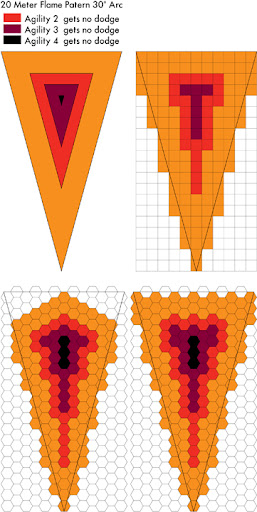
20 in/m flame template

These are four different 20 meter flame templates. They show who gets a dodge option after their agility check that the flamer grants.

By the RAW you only get to dodge IF you are within your Ag in meters from the edge of the flame template, otherwise you only get the agility check.

Flamer units were trained to spray in arcs, back and forth, to cover more area than a thin line. Hence the flame cone template. Flame tanks couldn't wiggle back and fourth so they only shot in narrow lines. I think it's the History channel that has the full color WWII footage. If you can catch some of the South Pacific footage you are likely to see flamers in action, spraying back and forth covering a large cone area with fire.

Varnias Tybalt said:

MILLANDSON said:

Except that, as the 40k setting has demonstrated, they do use the cone effect. Perhaps it's something unique to promethium, but that's how it has always been demonstrated to work. You are forgetting that "real world physics" often has no place in 40k gui%C3%B1o.gif

Aha, but you forget my dear MILLANDSON, that the Imperial Guard use this particular tank called the "Hellhound" whose Inferno cannon works on the same principle as I've illustrated (you don't use the flame template from the muzzle of the cannon, but rather you place the flame template a set number of inches away from the tank and directed in such a manner where the large end is not closer to the tank than the narrow end).

It stands to reason that if a tank use the "real world" principle for a flame throwing weapon, a portable variant should do the same.

Besides I can sort of figure out why most roleplaying games use the hollywood-esque "cone spraycloud" flamethrower principle rather than the real thing. It's because normally while shooting a film the special effects department aren't allowed to actually fire a real military flamethrower but have to use a special effects gas flamethrower due to fire hazards.

Which means that most game designers only have the "special effects" flamethrowers as a reference point, instead of the real thing.

And speaking as the hobby pyromani... uhm "pyrotechnician", and "fire afficionado" as I am, ANYONE who have seen a military flamethrower in action would consider it to be A LOT cooler than the puny gas launchers used in hollywood movies. Heck, those things could very well be simple hairspray aerosol cans fitted with a lighter.

I **** you not when I say that the real thing looks like the weapon is firing a stream of liquid fire, kinda like it was a stream of magma, and wherever it hits it will set anything ablaze. It's as beautiful as it is destructive.

Sure gas powered pyrotechnics might look cool the first few times, but if you've been to a lot of metal live shows and seen a lot of action flicks, those effects will grow pretty dull. A real flamethrower is by far a lot cooler and will never seem "old".

So if we're gonna go with "rule of cool" here, I say ditch the hollywood inspired flamers with their puny cone gasclouds and use the real stuff as a reference point. demonio.gif

Considering the flammers of the Imperium have ad 38 thousand years to improve upon out piddly fire dispensers, it stands to reason that they should be a bit more awesome then what we have to offer today. Granted, mankind has had it's technological ups and downs between the now and the grimdark then, the Impeirium still has, on the whole, shown its self to be more technologically advanced in the arts of making things die in horrible ways. That being the case, why should we look at only what flame throwers are capable of today instead of what those nutters could have made them capable of? After all, a flammer might be spitting out a massive cone of liquid flame and not just combustible gas for the safety of the actors on set. Hell, I think a massive splattering soaking bath of liquid flame beats your single little stream of liquid flame in the cool department any day ;-p