HobbyTalk: Filling model cracks with green stuff

By Norsehound, in Star Wars: Armada

We don't have a hobby board anymore but hopefully the hobbyists are still around. Had a question.

I don't like the cracks spread all over the larger capital ship models. I put up with them, but I'd like to explore a smooth-faced alternative where the surface detailing beneath the greebel level is with paint instead of geometry.

I have a paint pot of green stuff I got for gap sealing an Enterprise model, but it seems the gaps were too big there. Armada ship gaps seem smaller?

So has anyone dared to explore using green stuff to seal all those panel-line cracks on their ships? What did the results look like? Did you have to sand it down after application to get it as smooth as desired, or was it ready to go right after application?

I want to say I saw one poster here doing it but I can't remember where the thread is, or where to look since all the hobby stuff was merged here.
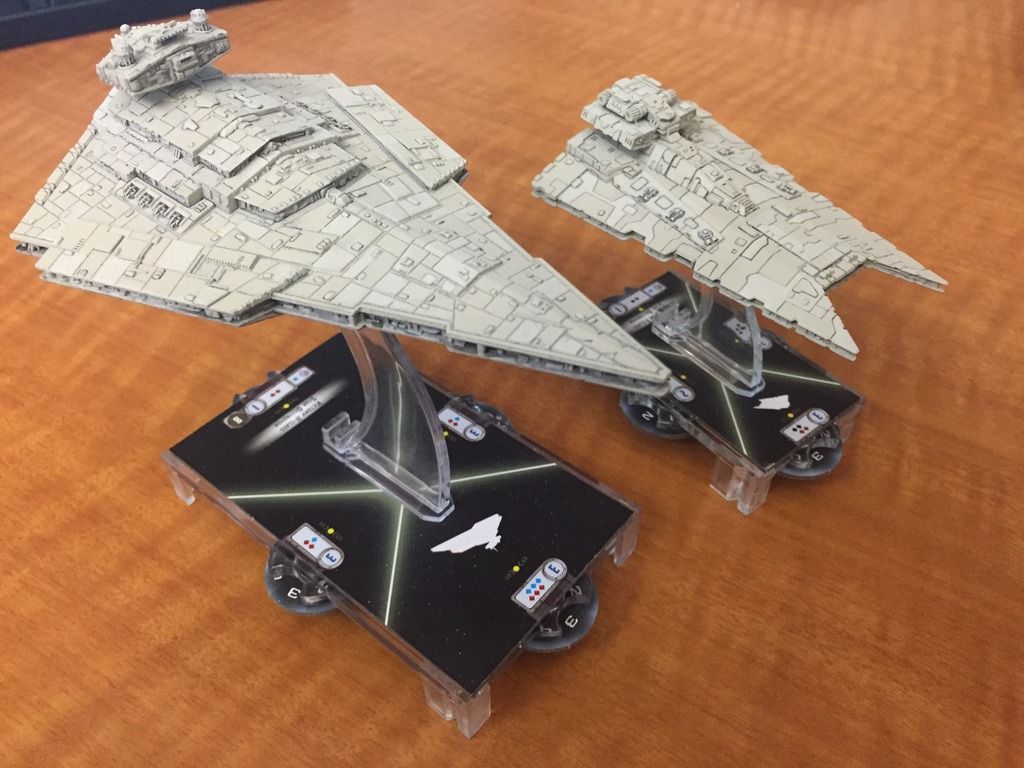
So you're looking at smoothing down, say, the entire surface of a Star Destroyer in order to be smooth, and then paint detail?

If you have a pot of Liquid Green Stuff, painting that into the gap lines would be a good start. Even if you water it down with just a dab of water to help it flow. It WILL sit on the surface of each panel at the same time, so to be smooth, you'd be best getting some fine grit sandpaper and taking that over the surface once you're done. Two applications of thinned liquid green stuff might be needed... Then sand back. It will need to be sanded one way or another, mostly because the green stuff will still be thick enough to either deposit on the surface, or to even leave brush lines where you've applied it... If its so thin that it doesn't do either of those, odds are it hasn't gapfilled because its too thin, too.

Of course, with the way the plastic is, you could just forgo the green stuff, and just go straight to an emery board, followed by some really fine sandpaper.

Either procedure is lengthy, and has little tolerance to "short cuts" as you need the surface smooth when you're done... So take your time with it.

I really dislike the overly large panel lines as well. However, I think it's actually more a problem with color choice: have you considered, for example, just painting/redetailing with a lighter touch? Here are some of my SD's- I'm actually going to give them one more misting of Testor's Camo Grey to wipe out the lines/apply a tad more highlight.

gray_ships_zpsjaciimto.jpg

If you're still set on filling the gaps, I've found using a really thin CA flows pretty nicely into the cracks. Since it's self-levelling, I think it would drastically decrease the gap width. In my case, I found this out on accident after accidentally over-filling some panel lines in my neb-b's when I was just trying to get rid of the part joints.

Liquid green stuff could actually reduce the depth, which you might like. Do the bottom first to learn.

Green stuff doesn't sand well, so if you want smooth, use grey stuff. Let it dry, then do a second application until it's slightly proud. Then, sand it all smooth. Green stuff won't easily be made smooth.

Yeah, my Imperial craft were already given a Star Destroyer white treatment. It looks good on the Determinator I won at Sullust, but I'm wondering if I could have a smoother result for my next ship. Also, any Rebel MC80 I get is also going to be marred by those gridlines where I imagine a very smooth surface to give it a silver finish (It will be the Macon, after the US airship of the same name).

DUR, what is this CA you're talking about?

DUR, what is this CA you're talking about?

Positive guess that CA = Cyanoacrylate, or in laymen's terms, Superglue.

DUR, what is this CA you're talking about?

Positive guess that CA = Cyanoacrylate, or in laymen's terms, Superglue.

Oops, yes, that's more modeler lingo getting slung about :)

It sands "good enough" in my experience. Also, another thing I thought of is try laying on Future Floor Wax really thick on the MC80- I think that might help get the effect you want. It won't fill in the cracks quite as much, but it will definitely help with the sheen.

Just looking at a good image of Home One, you can tell the details are more a product of color variation than of a geometry variance.

Home_One_Endor.jpg

FFG, and our custom modelers, do geometric panel lines to make this simple. Flat colors followed by a wash produce the panel lines. But I wanted to try starting with a flat model and painting (or airbushing with a mask) the details on after the fact, then follow up with some kind of reflective coat.

On that subject of modeling, another thing I wanted to try was using a custom mask when applying gloss. Specular maps for 3D modeling can make some areas of the texture shiny only when the light hits them at an angle, but I haven't seen many models where a gloss coat is irregularly applied to do this effect.

DUR, do you have any brand recommendations? I'm imagining trying to use watered down citadel superglue for what you're describing but that can't be what you mean... can it?

--- Do *NOT* try to add Water to Superglue, or Vice Versa...

Hazarding another guess, He just means a thin superglue - like the cheaper ones you get in dollar stores, perhaps - pouring it and letting it run and dry.

--- Do *NOT* try to add Water to Superglue, or Vice Versa...

Hazarding another guess, He just means a thin superglue - like the cheaper ones you get in dollar stores, perhaps - pouring it and letting it run and dry.

Yeah, water makes CA harden.

Are you in the US? Typically, if you're at a US hobby shop and ask for a thin CA the salesperson might be able to help you. The kind I use is branded by the shop I frequent, so that's no good to you.

And yes, that's what I mean- if your model is very clean and gloss coated (with future!) the glue will run down the seams pretty much on its own. It will be tedious, though, as you'll ahve to wait for one section to dry before moving on to the next.