Tallon Roll and ACMs

By Parravon, in X-Wing Off-Topic

No it's not Advanced Concussion Missiles or something like that. The ACM s I'm referring to are Air Combat Manoeuvres , which is the bread and butter of all fighter pilots. And I'm no stranger to these either, but I've been looking at the Tallon Roll, and trying to figure out how the ship would actually perform this manoeuvre in a genuine 3D environment, but I just can't see it.

It seems to be a massive rudder drift more than anything else. You go into a tight turn, but end up facing the direction you've just come from. The closest thing I can equate it to is a hand brake turn in a car, like setting up for a drift. But at no stage can I see where a "roll" might be in there.

Anyone else got any ideas what this manoeuvre might look like?

( And I'm not asking how to perform this on the table, in case someone is about to explain that )

The only thing I can compare it to visually is when the Vipers in BSG would perform that maneuver - it wasn't a roll in the sense I think you're thinking of, more like a twist on the axis

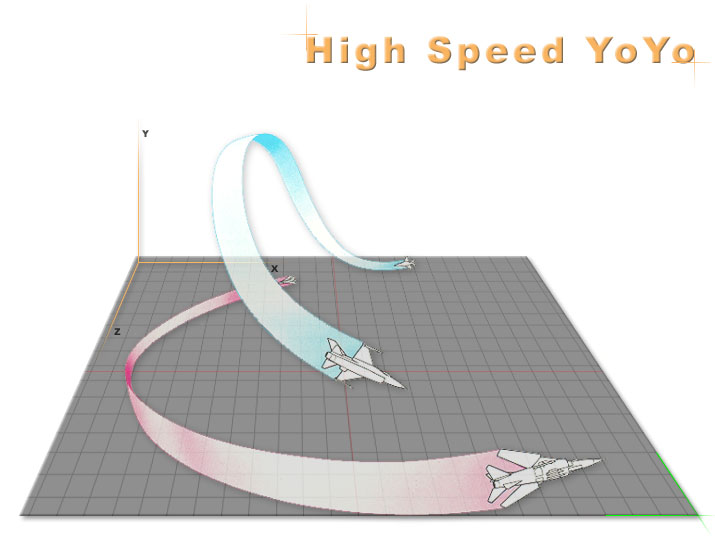
I believe the closest equivalent to the Tallon Roll in the real world is known as the Hi Speed Yo-Yo:

high_speed_yoyo.jpg

When the attacker realizes that he is unable to stay on the inside of the defender's turn, he relaxes his angle of bank a little, then pulls high. As he comes over the top he is inverted, looking down at his opponent through the top of his canopy. His speed falls due to the climb, and this diminishes his radius of turn. The 1g of gravity is utilized by turning in the vertical plane, which reduces the radius of turn still further. The attacker should then be well placed to slide down into a firing position.

The high-speed yoyo is a very difficult maneuver to perform well, and demands perfect timing and precise execution. If it is commenced too early, the defender can counter by pulling up into the attack. If started too late, the attacker is forced to pull up at an excessively steep angle to avoid overshooting. This allows the defender to disengage by diving away. A common fault in executing the high-speed yoyo is not pulling the nose high enough. This can result in the attacker ending directly above the defender. Some pilots find that they obtain better results from a series of small yoyos than one large one. A variant on this maneuver, used to prevent overshooting or to reduce the angle-off, is the rollaway.

http://www.combataircraft.com/en/Tactics/Air-To-Air/High-Speed-Yo-Yo/

Edited by zathras23

No it's not Advanced Concussion Missiles or something like that. The ACM s I'm referring to are Air Combat Manoeuvres , which is the bread and butter of all fighter pilots. And I'm no stranger to these either, but I've been looking at the Tallon Roll, and trying to figure out how the ship would actually perform this manoeuvre in a genuine 3D environment, but I just can't see it.

It seems to be a massive rudder drift more than anything else. You go into a tight turn, but end up facing the direction you've just come from. The closest thing I can equate it to is a hand brake turn in a car, like setting up for a drift. But at no stage can I see where a "roll" might be in there.

Anyone else got any ideas what this manoeuvre might look like?

( And I'm not asking how to perform this on the table, in case someone is about to explain that )

it always just looked like a combat roll to me.

I believe the closest equivalent to the Tallon Roll in the real world is known as the Hi Speed Yo-Yo:

When the attacker realizes that he is unable to stay on the inside of the defender's turn, he relaxes his angle of bank a little, then pulls high. As he comes over the top he is inverted, looking down at his opponent through the top of his canopy. His speed falls due to the climb, and this diminishes his radius of turn. The 1g of gravity is utilized by turning in the vertical plane, which reduces the radius of turn still further. The attacker should then be well placed to slide down into a firing position.

The high-speed yoyo is a very difficult maneuver to perform well, and demands perfect timing and precise execution. If it is commenced too early, the defender can counter by pulling up into the attack. If started too late, the attacker is forced to pull up at an excessively steep angle to avoid overshooting. This allows the defender to disengage by diving away. A common fault in executing the high-speed yoyo is not pulling the nose high enough. This can result in the attacker ending directly above the defender. Some pilots find that they obtain better results from a series of small yoyos than one large one. A variant on this maneuver, used to prevent overshooting or to reduce the angle-off, is the rollaway.

http://www.combataircraft.com/en/Tactics/Air-To-Air/High-Speed-Yo-Yo/

Yeah, that's probably the closest to it. It's a little tricky trying to visualise a 3D manoeuvre on a 2D table. But the pull up, and then back down should bring you in tighter than a just a sharp turn.

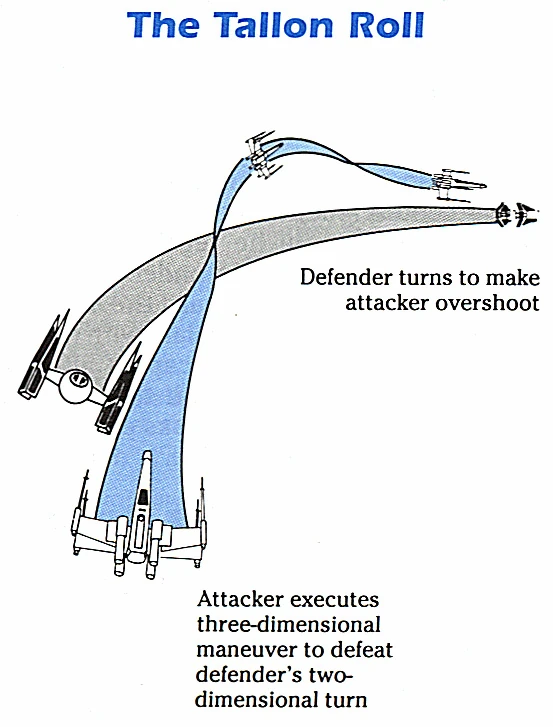
In canon, this is a Tallon Roll:

TallonRoll.jpg

I think the high-speed yo-yo illustrated above is indeed the best real-world equivalent. Of course starfighters wouldn't lose speed due to a climb, but increasing the attacker's path length should still help correct the attacker's position relative to the defender at the end of the defender's turn.

What's called a Tallon Roll in the minis game, though, doesn't look anything like that. As you say, it's more like a drifting turn.

I think it really is more like a drift turn as well. Thinking of as fishtailing your car is what would come closest.

In canon, this is a Tallon Roll: TallonRoll.jpg I think the high-speed yo-yo illustrated above is indeed the best real-world equivalent. Of course starfighters wouldn't lose speed due to a climb, but increasing the attacker's path length should still help correct the attacker's position relatI've to the defender at the end of the defender's turn.

I'm not sure this is correct, but Star Wars physics don't bear thinking about too hard.

The Cobra's just a stall that maintains forward momentum before the aircraft bring its nose back down. And the others in the vid were just banks and half rolls. The Tallon Roll that Vorpal Sword has shown, is just a high speed yo-yo. But that requires gravity to slow you down at the top of the arch, thus bringing you back inside the opponent's turn. Pulling this manouevre in a starfighter in space seems like a waste of time, because without gravity, you'd need to throttle back and pull a tight inverse turn at the top, and why not just pull a tight turn on the horizontal plane instead?

It seems that some Air Combat Manoeuvres just wouldn't work in zero-G. The Cobra would, though.

The only thing I can compare it to visually is when the Vipers in BSG would perform that maneuver - it wasn't a roll in the sense I think you're thinking of, more like a twist on the axis

Nah, that's the K-turn.

See, I've always looked at the k-turn as a half-loop with a half-roll. It's the manoeuvre that the Falcon did at the end of ESB over the cloud when they had to go back to Cloud City.

See, I've always looked at the k-turn as a half-loop with a half-roll. It's the manoeuvre that the Falcon did at the end of ESB over the cloud when they had to go back to Cloud City.

That would be the atmospheric version. :P .

It just makes more sense in space, the BSG and Space Above and Beyond way.

Edited by Dagonet

You've got to remember some aircraft have thrust vectoring nozzles. This allows them to slew (I think that's the proper term) the nose of the ac more than just kicking the rudder over. This would allow them to "skid" around a turn rather than having to fly it. I don't know if any current ac have 3D nozzles but I think the F22 has a 2D one.

FWIW I think the K turn is 1/2 of an Immelman if that 3D maneuver was played out in 2D.

Yeah, I agree with the Immelman to a degree. It's usually a spiralling climb where you pull out at the top facing whatever direction you wanted. As far as I know, I can't think of any aircraft with sideways vectoring jet nozzles, only up and down. Which still makes for incredibly tight banked turns. These days there's more computer control that pilot control. I've heard it said that if you remove the computer, most of the latest generation of combat jets would be unflyable.

That's especially true of the F-117 and I think the X-29. At least I think it's the X-29. That was the F-5 with the forward swept wings. FSW technology has a lot going for it but stability isn't one of them. With FSW the ac suffers from aerelastic diversion, I think that's what it's called. Where one wing tip wants to go down when thd other goes up. Trying to control it manually sets up a vibration that rips the plane apart. The Germans tried it in WWII on a bomber but had to make the wings so thick that it lost most if not all of the advantages of FSW.

In canon, this is a Tallon Roll: TallonRoll.jpg I think the high-speed yo-yo illustrated above is indeed the best real-world equivalent. Of course starfighters wouldn't lose speed due to a climb, but increasing the attacker's path length should still help correct the attacker's position relatI've to the defender at the end of the defender's turn.

I'm not sure this is correct, but Star Wars physics don't bear thinking about too hard.

I dont think its correct ether. They showed in on source that the two ties making thier first attack on the MF in ANH as the Tallon Roll, it it just looks like a combat roll, or in universe a offensive wotan weave.

That's especially true of the F-117 and I think the X-29. At least I think it's the X-29. That was the F-5 with the forward swept wings. FSW technology has a lot going for it but stability isn't one of them. With FSW the ac suffers from aerelastic diversion, I think that's what it's called. Where one wing tip wants to go down when thd other goes up. Trying to control it manually sets up a vibration that rips the plane apart. The Germans tried it in WWII on a bomber but had to make the wings so thick that it lost most if not all of the advantages of FSW.

So far the ruusians have done a bett3r job with that style of aircraft. One thing great about it is that these craft stall differently. They are depicted having alot of control when they stall.

That's especially true of the F-117 and I think the X-29. At least I think it's the X-29. That was the F-5 with the forward swept wings. FSW technology has a lot going for it but stability isn't one of them. With FSW the ac suffers from aerelastic diversion, I think that's what it's called. Where one wing tip wants to go down when thd other goes up. Trying to control it manually sets up a vibration that rips the plane apart. The Germans tried it in WWII on a bomber but had to make the wings so thick that it lost most if not all of the advantages of FSW.

So far the ruusians have done a bett3r job with that style of aircraft. One thing great about it is that these craft stall differently. They are depicted having alot of control when they stall.

If you're referring to the FSW youre right. If I remember correctly the stall begins at the wing root rather than the tip. The control surfaces stay in "clean air" longer.

I don't think the F-35 is going to be what they want it to be. The last time they wanted on ship to do everything the result was the F-111 Aardvark. Not your ideal carrier born ac.

To get this back on topic, I kind of view the Talon Roll as being a combination of a lateral roll and a split-s maneuver. The craft rolls to the side and pulls inverted, then pulling up on the stick they level out and now have thrust in the opposite direction.

A split-S starts with a lateral roll to the inverted and then just half loops down back the way you've come. A K-turn could be equated as the same thing, as you're generally not getting any horizontal shift, only vertical. The reverse of that would be a half loop up followed by a lateral roll from the inverted, effectively resulting in the same thing, and could easily be considered a K-turn as well.

FFG's Tallon Roll uses the turn template so you're making quite a horizontal shift. But then, they've never simulated anything on the vertical plane at all, so the yo-yo still seems the best fit, although not a snug fit to me.

The Russian Cobra manoeuvre seems to equate best to an X-wing "0" stop, as it's pretty much a forward moving stall instead of the traditional climbing stall. I'm not sure how effective this would be in combat though. The video clips I've seen have displayed this at fairly low speed and it seems to take time to set up and recover. You shed most of your speed and throttle back at the same time, only to have to throttle back up and try and regain some speed again just to avoid losing too much altitude. The priority is to shake an attacker, forcing them past you, then hopefully drop onto their six. It's also nothing new as Tom Cruise did it in Top Gun back in '86. It'd be interesting to find out if any Russian pilots have ever used it in a combat situation. But considering they'd deny they were even in combat to start with, I don't think we'd EVER see any combat reports. :D

Something I'm also wondering about is the fact that this has shown up in the TFA core rules, and in the Episode VII previews we've seen so far there seems to be a lot of combat scenes, so is there a reference to a Tallon Roll in the upcoming movie and has FFG used that as a movie tie in? It would make a little sense. We may see a hero doing one of these, or saying he's going to and then defeat one of the bad guys with it, and now X-wing player's can do the same. Just a thought.

Edited by Parravon

A 0 maneuver is just that, slam on the brakes and stop. Very stressful on the ships, that's why it's red.

A 0 maneuver is just that, slam on the brakes and stop. Very stressful on the ships, that's why it's red.

I can see the Russian Cobra as much the same. I imagine the stress on the airframe and pilot would be quite a lot.

Some years back the USMC called in reps from Hawker-Siddley. Seems the Harriers the marines were using were developing stress cracks in the main wing spar. The reps were perplexed because no other users of the jump jet had commented on such failures. The problem was solved when it was discovered that marine pilots were slamming the jet into "reverse" during mock dogfights. So yeah, the zero move maneuver does impart a lot of stress!

Some years back the USMC called in reps from Hawker-Siddley. Seems the Harriers the marines were using were developing stress cracks in the main wing spar. The reps were perplexed because no other users of the jump jet had commented on such failures. The problem was solved when it was discovered that marine pilots were slamming the jet into "reverse" during mock dogfights. So yeah, the zero move maneuver does impart a lot of stress!

Yeah, I remember the USMC fleet getting overhauled for wing strengthening. But I didn't realise it was ACM related. Probably why the AV-8B Harrier II was designed with a much stronger wing. Shifting the our-rigger wheels inboard must have helped as well. If you didn't drop a Harrier I onto the deck dead flat, I imagine it would put a lot of stress on the wing root with the out-rigger hitting first.

I know the RAF and RN Harriers that fought in the Falklands used a similar ACM technique where they'd rotate the exhausts down while flying in order to rapidly push the jet up. They called it "viffing" or Vectoring In Forward Flight. Similar result to the Russian Cobra, but without pitching the nose up. It would put you higher than a tailing opponent, but right on their six.