Heavy still allows you to attack ships. I used that last night when a Y-Wing engaged my B-Wing.
Rest of wave 2 spoiled
That's not what we're talking about at all 
Are you certain?
Where does the "rather than enemy ships" qualifier come into play in that case? It sounds like you're interpreting it as "rather than any other target", which isn't what it says...
Heavy as it is written does not nullify being "engaged" just alters the functionality of what it prevents or mandates.
Edited by ScottieATF
Simply put the Enagement rules stipulate "must attack an engaged squadron..." The Heavy rules interact with that mandate by essentially nullify in it as it is concerned with ships and instead boil down to may attack a ship or an engaged squadron. As Heavy says nothing of non-engaged Squadrons it wouldn't alter thier ability to be attacked while engaged.Are you certain?
Where does the "rather than enemy ships" qualifier come into play in that case? It sounds like you're interpreting it as "rather than any other target", which isn't what it says...
Heavy as it is written does not nullify being "engaged" just alters the functionality of what it prevents or mandates.
Sounds exactly like what you are talking about.
As stated, Heavy modifies the rules of engagement, on top of that being obstructed means you are not engaged so the TIE fighter can attack the A-Wing squadron BUT does not stop the squadron from moving.
Alright, forget I mentioned Heavy, it has nothing to do with my main point - I brought it up to illustrate an extreme example, but it seems to have clouded the discussion so let's focus on the essential:
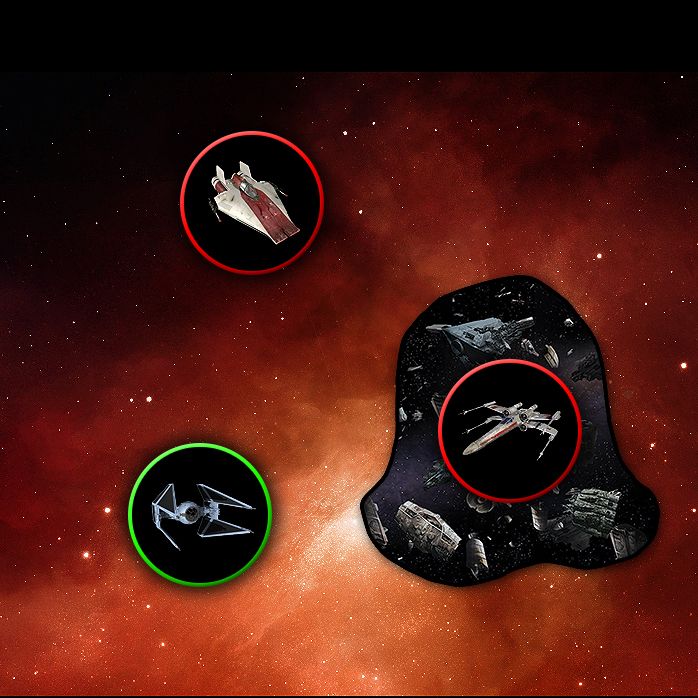
Question 1: Can the TIE Interceptor choose to attack the X-Wing?
Question 2: Can the TIE Interceptor choose not to attack at all?
If the answer to 1 is no (because "It must attack an engaged squadron if possible", ignoring the rest of the phrase), then the answer to 2 must also be no.
Conversely, if the answer to question 2 is yes, then the answer to question 1 must also be yes.
Alright, forget I mentioned Heavy, it has nothing to do with my main point - I brought it up to illustrate an extreme example, but it seems to have clouded the discussion so let's focus on the essential:
Question 1: Can the TIE Interceptor choose to attack the X-Wing?
Question 2: Can the TIE Interceptor choose not to attack at all?
If the answer to 1 is no (because "It must attack an engaged squadron if possible", ignoring the rest of the phrase), then the answer to 2 must also be no.
Conversely, if the answer to question 2 is yes, then the answer to question 1 must also be yes.
Also, not correct.
FAQ Pg 4.
Q: When a squadron activates, is it required to move and/or
attack?
A: No. A squadron can activate and end its activation without
moving and/or attacking.
The TIE Interceptor can not choose to attack the X-Wing because if it chooses to attack it must attack an engaged Squadron since it is engaged. But the TIE Interceptor can always opt to not attack at all.
Sounds exactly like what you are talking about.Simply put the Enagement rules stipulate "must attack an engaged squadron..." The Heavy rules interact with that mandate by essentially nullify in it as it is concerned with ships and instead boil down to may attack a ship or an engaged squadron. As Heavy says nothing of non-engaged Squadrons it wouldn't alter thier ability to be attacked while engaged.Are you certain?
Where does the "rather than enemy ships" qualifier come into play in that case? It sounds like you're interpreting it as "rather than any other target", which isn't what it says...
Heavy as it is written does not nullify being "engaged" just alters the functionality of what it prevents or mandates.
As stated, Heavy modifies the rules of engagement, on top of that being obstructed means you are not engaged so the TIE fighter can attack the A-Wing squadron BUT does not stop the squadron from moving.
Yeah, as he said you aren't on the same page as to what is being disputed.
FAQ Pg 4.
Q: When a squadron activates, is it required to move and/or
attack?
A: No. A squadron can activate and end its activation without
moving and/or attacking.
The TIE Interceptor can not choose to attack the X-Wing because if it chooses to attack it must attack an engaged Squadron since it is engaged. But the TIE Interceptor can always opt to not attack at all.
If it chooses not to attack at all, it does not fulfil your requirement of "it must attack an engaged squadron if possible".
The requirement I read is a different one: "it must attack an engaged squadron if possible rather than a ship".
There's no ship in this case. So either:
A) you parse the whole sentence, in which case the requirement "fizzles" and you're free to attack either target, or
B) you stop reading after "if possible", in which case the attack is mandatory.
Note that the FAQ entry is not an errata. It doesn't change the rulebook or how it should be read. What it does is give a strong indication that reading B is not correct.
Putting it more simply:
"You must choose A over B if you can" does not mean "You must choose A if you can", and it certainly doesn't mean "You must choose A over C if you can". It just means "You can't choose B if you can choose A".
Diablo is correct. In the photo provided the TIE could choose to attack either target. Escort keyword is not in effect due to obstruction, so the X-Wing does not prevent the TIE from shooting the A. The RAW do not prevent an engaged squadron from attacking a non-engaged squadron, so the A does not prvent the TIE from shooting the X.
Diablo is correct. In the photo provided the TIE could choose to attack either target. Escort keyword is not in effect due to obstruction, so the X-Wing does not prevent the TIE from shooting the A. The RAW do not prevent an engaged squadron from attacking a non-engaged squadron, so the A does not prvent the TIE from shooting the X.
But the rules DO prevent a squadron from attacking an unengaged squadron in situations where an engaged squadron is a viable target.
IMO, in the picture, the Interceptor must either attack the A Wing (being the only engaged squadron it could attack) or not attack at all.
Here are the rules:

It clearly says that if the line of sight is obstructed between two squadrons, those squadrons are not engaged. If the T/I and X-Wing were the only two squadrons in play, they could attack each other.
However, because the A-Wing is engaged with the T/I, the following rule still applies: "When a squadron attacks, it must attack an engaged squadron if possible rather than an enemy ship". The catch is that this rule does not modify squadron on squadron attacking, just squadron on ship attacking.
So, the T/I may attack the X-Wing if it chooses, or it may attack the A-Wing if it chooses, or it may choose to not attack at all: this third choice is available because the rule is "When a squadron attacks", not "A squadron must attack". There is no rule saying a squadron must attack, only a rule modifying when a squadron attacks.
When you read the whole reference, it becomes clear. But, I do see how easy it is to misremember one of the operative clauses. They all fit together very carefully, and their wording is very precise.
Edited by DemaratusBut the rules DO prevent a squadron from attacking an unengaged squadron in situations where an engaged squadron is a viable target.
"Must attack an engaged squadron if possible rather than an enemy ship."
As written, this rule merely prohibits an engaged squadron from shooting a ship if it can shoot an engaged squadron instead. It does not prohibit an engaged squadron from shooting anything else.
When a squadron attacks, it must attack an engaged squadron if possible rather than an enemy ship
I missed that last part! Gee, these rules SEEM simple and intuitive, but there's a fair bit of reading to do to get the whole hang of it.
on the instigator and fighter questions, I could see someone arguing that a fighter that has 2 ships one of them instigator in range1 then they must shoot instigator as it's engaging them and not the second ship.... I could see a rule as intended vs rule as written argument starting about that.
The way it's written reads the fighter could attack any ship too me, and until faq otherwise that's how I would explain it to an opponent,
on the instigator and fighter questions, I could see someone arguing that a fighter that has 2 ships one of them instigator in range1 then they must shoot instigator as it's engaging them and not the second ship.... I could see a rule as intended vs rule as written argument starting about that.
The way it's written reads the fighter could attack any ship too me, and until faq otherwise that's how I would explain it to an opponent,
Yes, if we start making presumptions about CGI making an error in the rules, then we have voided all the rules=)
FFG gave an answer (emphasis mine):
In response to your questions:
Rules Question:Dear Armada gurus: I have a question regarding the Engagement rules on p.6, specifically the following bullet point: "When a squadron attacks, it must attack an engaged squadron if possible rather than an enemy ship." It is clear that a squadron can't shoot at a ship if it could attack an engaged squadron instead. However, can the squadron shoot at a squadron that it is NOT engaged with (due to obstruction)? See for example the image here:Can the TIE Interceptor attack the X-wing? In fact, can it choose to not attack at all? Or is the "must attack an engaged squadron if possible" absolute?Excellent question! The rule that you quoted is only intended to protect ships, allowing players to establish fighter screens as long as those squadrons aren’t on the wrong side of the ship or buried in an obstacle. In your example, the TIE interceptor can attack the X-wing. Additionally, since the TIE interceptor is not engaged with the X-wing, the X-wing’s escort keyword cannot protect the A-wing.To your second point, squadrons are never required to perform attacks. When a squadron activates, it canattack or move (or both if activated by a squadron command), but it is not required to do so. For example, a squadron can activate and choose to do nothing in order to avoid being counterattacked.Thanks for playing!James KniffenGame DesignerFantasy Flight Games
Thanks for posting the response. I definitely game some incorrect information due to the constantly shifting variables and intersections from others not sure of what was being talked about. My apologies on that as I have no idea why I answered how I did in hindsight.
Engagement on protects ships, and it only does that if there is an engaged squadron to attack.
No worries, there was definitely room for misunderstandings 
...and we never know if FFG will reverse this ruling too 